
Global Protein Market Overview - Size, Share & Industry Snapshot
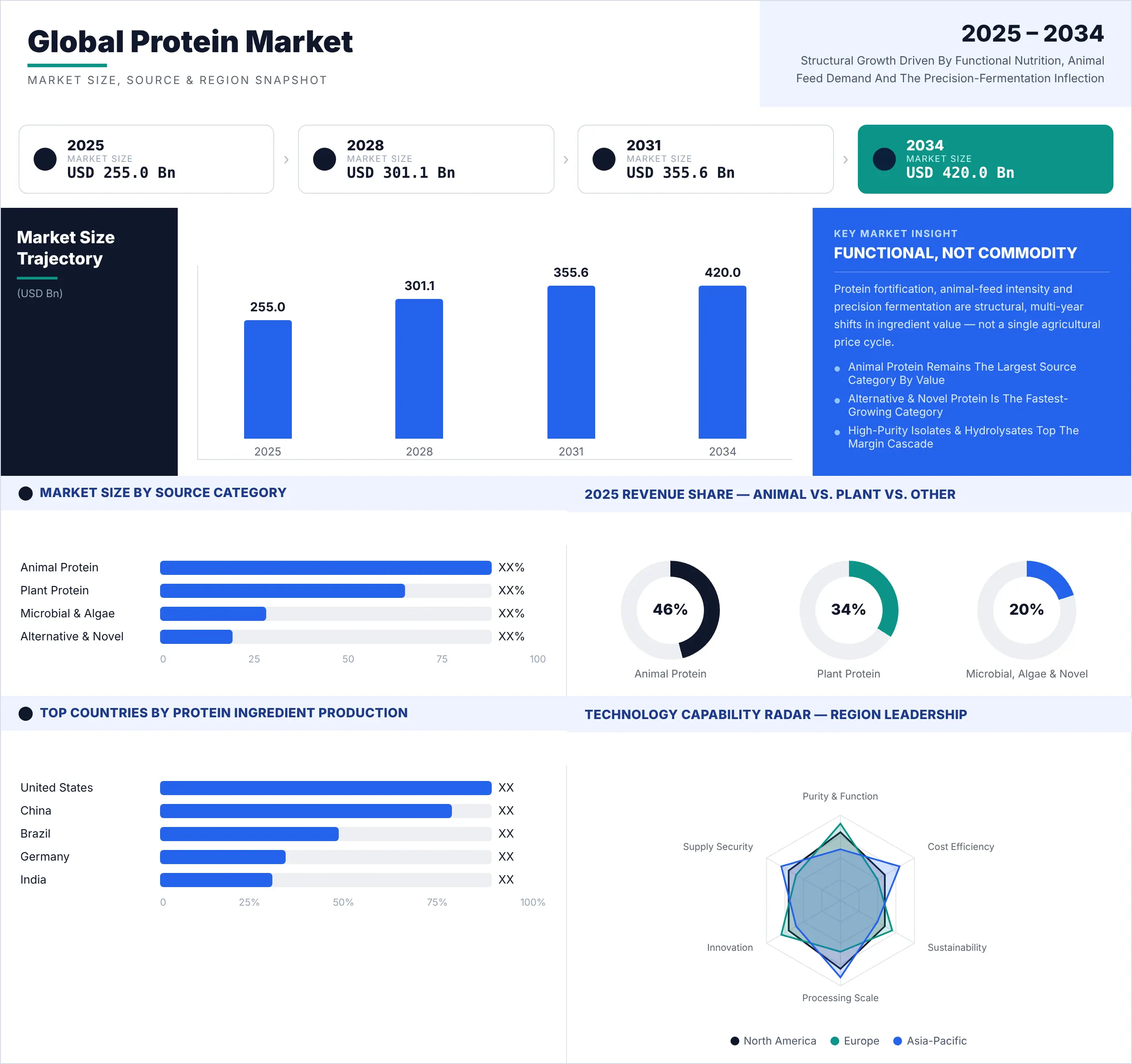
The Global Protein Market was valued at USD 255 Bn in 2025 and is projected to reach USD 420 Bn by 2034, growing at a CAGR of 5.7% during 2026-2034 - an addition of USD 165 Bn in annual market revenue over the forecast window. The market covers animal, plant, microbial, algae and novel proteins, including protein-rich feed materials and specialized protein ingredients used across food and beverages, sports nutrition, animal nutrition, infant nutrition, clinical nutrition, pharmaceuticals, personal care and industrial applications.
The protein industry combines high-volume agricultural protein materials with high-value functional ingredients. Soybean meal, other oilseed meals, dairy proteins, collagen, gelatin, concentrates, isolates and hydrolysates support established commercial demand, while precision fermentation, microbial proteins, insect proteins and advanced protein formulations create new opportunities for ingredient manufacturers. The market also benefits from protein fortification, growing demand for convenient nutrition, dietary diversification and the development of specialized food and feed formulations.
The global supply chain connects agricultural producers, dairy processors, protein extraction facilities, biotechnology companies, ingredient formulators and industrial buyers. Market competition depends on production cost, protein purity, functional performance, raw material security, regional manufacturing capacity and distribution efficiency.
Protein Market Scope & Report Coverage - Inquire Before Buying
| Report Coverage | Details | ||
|---|---|---|---|
| Base Year | 2025 | Forecast Period | 2026-2034 |
| Historical Data | 2020 to 2025 | Market Size in 2025 | USD 255 Bn |
| Forecast Period 2026-2034 CAGR | 5.7% | Market Size in 2034 | USD 420 Bn |
Segments Covered
| Segment | Coverage |
|---|---|
| By Source | Animal Protein (Whey, Casein, Milk Proteins, Egg Protein, Collagen, Gelatin) • Plant Protein (Soy, Pea, Wheat, Rice, Potato, Hemp, Oilseed Meals) • Microbial & Algae Protein (Mycoprotein, Yeast, Bacterial, Algae) • Alternative & Novel Protein (Insect, Precision Fermentation-Derived) |
| By Product Type | Concentrates • Isolates • Hydrolysates • Textured Proteins • Other Protein Ingredients (Meals, Flours, Blends) |
| By Application | Food & Beverages • sports nutrition & Dietary Supplements • Infant Nutrition • Clinical & Medical Nutrition • Animal Feed & Pet Food • Personal Care & Cosmetics • Pharmaceuticals • Other Applications |
| By Form | Dry / Powder (Powders, Meals, Flours, Granules) • Liquid (Solutions, Concentrates, Dispersions) |
| By Distribution Channel | Direct Sales (B2B) • Indirect Sales (Distributors) • Other Channels (Commodity Trading, Digital Procurement) |
| By Region | North America (US, Canada, Mexico) • Europe (Germany, UK, France, Italy, Spain) • Asia-Pacific (China, India, Japan, South Korea, Australia) • South America (Brazil, Argentina) • Middle East & Africa (GCC, South Africa) |
Segment definitions and coverage shown here mirror the complete report's table of contents; all share and value figures are released at the sub-segment level in the full study.
Protein Market Key Highlights & Growth Trends 2026-2034
Most market reports list highlights. This section explains what they mean - for ingredient-manufacturer strategy, for processor positioning, and for investment timing in the global protein industry.
1. From Commodity Proteins to Bioengineered Ingredients - Precision Fermentation's Inflection Point
Precision fermentation enables the production of targeted proteins through biological manufacturing systems rather than agricultural cultivation or animal rearing, and it is moving from pilot-scale demonstration toward early commercial volume across dairy-protein analogues, specialty enzymes and functional peptides. The bottleneck is not the biology - it is fermentation economics and industrial-scale bioreactor capacity, which is why commercial maturity still varies substantially across the different novel-protein technologies tracked in this report.
Companies that qualify into branded or private-label formulations early are establishing a functional-performance and regulatory-approval moat that is difficult for later entrants to replicate, even once production costs fall.
2. The Expanded Market Definition - Protein-Rich Feed Materials Are the Volume Engine
Soybean meal and other oilseed-derived feed materials sit at the core of this market's expanded definition, and they anchor the industry's volume base even as attention gravitates toward higher-value isolates, hydrolysates and novel proteins. This "Other Protein Ingredients" category - bulk meals, flours and blends - is disproportionately important to overall tonnage, which means any protein-market strategy built only around specialty ingredients is pricing against a fraction of the real addressable base.
Agricultural scale and diversified feedstocks give plant-protein producers a structural cost advantage here, even as crop prices and processing characteristics remain the main source of margin volatility.
3. The Purity Premium - Isolates & Hydrolysates Outgrow Commodity Meals
Protein isolates target applications requiring higher protein purity, while hydrolysates support products requiring modified digestibility and functional performance - both command meaningfully higher selling prices than commodity concentrates and meals, but require additional processing and quality control that raises production cost. This creates a persistent market gap between affordable commodity proteins and specialized high-purity ingredients that producers must actively manage rather than assume away.
Producers who improve yield, recover valuable co-products and control energy use are best positioned to capture this purity premium without surrendering commodity-scale cost competitiveness.
4. Animal Feed & Pet Food - The Industrial Backbone Hiding Inside "Protein"
Animal feed and pet food incorporate protein-rich oilseed meals, animal-derived meals, fishmeal, specialized functional proteins and selected alternative proteins, and this application is an important component of the expanded protein industry due to its sheer industrial production scale. It is easy to underweight this segment when a report's narrative is dominated by human-nutrition and novel-protein stories, but it represents one of the largest and steadiest sources of aggregate protein demand in this market.
Livestock, poultry, aquaculture and pet-food protein requirements move on a different, generally less cyclical demand curve than discretionary human-nutrition spending, which gives this application a stabilizing role across the forecast period.
5. Protein Blending, Traceability & Manufacturing Efficiency - The New Competitive Battleground
Protein blends are becoming important because different ingredients offer different amino acid compositions, flavors, textures and functional properties, pushing producers to develop improved concentrates, isolates and hydrolysates tuned to specific industrial applications rather than selling a single undifferentiated ingredient. Manufacturing innovation is concentrated in membrane processing, enzymatic techniques, fermentation efficiency and resource recovery.
At the same time, the industry is placing growing emphasis on supply-chain transparency, ingredient certification and product traceability - increasingly a condition of doing business with large food, feed and pharmaceutical buyers, not just a marketing claim.
Global Protein Industry Overview - Definition, Scope & Market Evolution
The Global Protein Market represents the commercial production, processing, manufacturing, distribution and sale of protein ingredients and protein-rich intermediate materials derived from animal, plant, microbial, algae, insect and advanced biotechnology sources.
The scope includes commodity protein meals, protein flours, concentrates, isolates, hydrolysates, textured proteins, specialty peptides, collagen, gelatin, and commercial protein formulations, as well as protein produced through microbial cultivation and precision fermentation. The report examines their use across the complete industrial ecosystem, from agricultural processing and animal feed to specialty food manufacturing, medical nutrition and pharmaceuticals - with therapeutic biologics classified separately so that whole finished-drug revenues are not incorporated into this market.
The global protein market is the economic expression of a structural shift in how human and animal nutrition is formulated - from undifferentiated agricultural and dairy commodities toward functionally engineered protein ingredients purpose-built for specific nutritional, textural and processing requirements. It spans the full value chain from agricultural producers, dairy processors and protein extraction facilities, through biotechnology companies and ingredient formulators, to the industrial buyers across food, feed, healthcare and personal care that turn these ingredients into finished products.
The industry combines high-volume agricultural protein materials with high-value functional ingredients. That is not a contradiction - it reflects two different competitive games running in parallel: a scale-and-cost game played out in oilseed meals and commodity concentrates, and a functionality-and-purity game played out in isolates, hydrolysates, collagen peptides and novel proteins. Independent industry research, including the Good Food Institute's published work on fermentation-based and plant-based proteins, supports including advanced biotechnology within this market's scope while keeping its revenue classification separate from established ingredient markets.
Three forces are reshaping who captures the next decade of growth. First, protein fortification and convenient-nutrition demand are pulling value upstream from commodity meals toward functional concentrates, isolates and hydrolysates. Second, animal feed, aquaculture and pet-food protein requirements provide a large and comparatively stable volume floor beneath the more visible human-nutrition and novel-protein narratives. Third, precision fermentation and microbial cultivation are opening a genuinely new production route for targeted proteins, though manufacturing economics and industrial-scale capacity remain the binding constraint on how fast that route can scale.
Protein Market Segmentation - By Source, Product Type, Application, Form & Region
Protein Source Assessment Matrix
| Source | Primary Economic Advantage | Main Commercial Exposure | Important Applications |
|---|---|---|---|
| Animal | Established functionality and nutritional performance | Dairy and animal feedstock costs | Food, sports, medical, cosmetics |
| Plant | Agricultural scale and diversified feedstocks | Crop prices and processing characteristics | Feed, food, supplements |
| Microbial & Algae | Controlled cultivation and source diversification | Fermentation yield and processing cost | Food, feed, specialty ingredients |
| Alternative & Novel | New functionality and production routes | Scale-up and regulatory access | Food, feed, biotechnology |
Protein Processing & Product Differentiation
| Product Type | Differentiation |
|---|---|
| Concentrates | Cost-effective functional ingredients with protein enrichment |
| Isolates | Higher-purity ingredients for targeted nutritional applications |
| Hydrolysates | Partially broken-down proteins and peptides with modified functionality |
| Textured Proteins | Protein ingredients processed for fibrous or meat-like texture |
| Other Ingredients | Protein-rich meals, flours, blends and specialized formulations |
Protein Market Regional Analysis - Growth Map by Geography
North America XX% share • XX% CAGR
North America benefits from extensive dairy processing, agricultural production, food manufacturing and sports-nutrition businesses. The United States supports industrial protein production through soybean processing, dairy ingredients, specialty food manufacturing and biotechnology investment; Canada has opportunities in pulse proteins and plant-based ingredient development; Mexico contributes demand through food manufacturing, feed processing and industrial nutrition supply chains.
Europe XX% share • XX% CAGR
Europe has an established network of dairy processors, food manufacturers, specialty-ingredient businesses and research institutions. Germany, the United Kingdom, France, Italy and Spain contribute to protein demand across food, feed, supplements and industrial applications, with manufacturers focused on processing performance, quality certification, traceability and specialized functional ingredients; alternative-protein commercialization here is shaped by product regulation and consumer acceptance.
Asia-Pacific XX% share • XX% CAGR
Asia-Pacific has a substantial protein-consuming manufacturing base supported by industrial food processing, animal feed demand and nutritional product development. China plays a major role in oilseed processing and feed ingredient demand; India offers opportunities in dairy ingredients, nutrition products and plant protein manufacturing; Japan, South Korea and Australia support specialized nutritional formulations, biotechnology research and dairy/agricultural capability.
South America XX% share • XX% CAGR
South America plays an important role in agricultural protein materials, especially soybean meal and other oilseed-derived feed inputs. Brazil and Argentina support global ingredient trade through soybean cultivation, processing and export infrastructure, with value-added protein concentrates and food-grade ingredients creating additional development opportunities on top of the established oilseed-crushing industry.
Middle East & Africa XX% share • XX% CAGR
The Middle East & Africa market includes GCC countries, South Africa and other national markets with demand for food ingredients, animal feed proteins and specialized nutritional formulations. GCC economies offer opportunities in food manufacturing, import distribution and supply-chain diversification, while South Africa supports agricultural processing and animal nutrition; regional opportunities center on local ingredient manufacturing, feed processing and partnerships with international protein suppliers.
Regional Research Dashboard
| Region | Major Protein Value Chains | Main Market Opportunities | Key Market Constraint |
|---|---|---|---|
| North America | Dairy, soy, sports nutrition, biotechnology | Specialty ingredients and fermentation | Manufacturing cost |
| Europe | Dairy, specialty proteins, plant-based ingredients | Premium formulations and functional proteins | Regulatory requirements |
| Asia-Pacific | Food, feed, dairy, nutrition manufacturing | Industrial processing and product expansion | Feedstock dependence |
| South America | Soybean meal, oilseed processing, agricultural protein | Value-added processing and exports | Commodity volatility |
| Middle East & Africa | Protein imports, food and feed processing | Local manufacturing and distribution | Supply infrastructure |
Read together, the regional split makes a specific strategic point: Asia-Pacific's demand is driven as much by industrial feed and dairy manufacturing scale as by direct human-nutrition consumption, while South America's role is overwhelmingly a production-and-export one rather than a consumption one. A go-to-market sequence that treats either region as a single homogeneous demand pool risks misreading where volume, margin and competitive intensity actually sit.
Protein Market Dynamics - Drivers, Restraints & Opportunities
Demand Driver Impact - MMR Analysis
Driver 1 - Protein-Enriched Foods, Supplements & Functional Nutrition: Protein fortification, functional foods and convenient-nutrition products are expanding the baseline addressable demand for concentrates, isolates and hydrolysates across bakery, dairy alternatives, beverages and snacking - the single most durable driver across every human-nutrition application tracked in this report.
Driver 2 - Animal Nutrition, Aquaculture & Pet Food: Livestock, poultry, aquaculture and pet-food protein requirements anchor a large, comparatively stable volume base that moves on a different demand curve than discretionary human-nutrition spending, providing a structural floor beneath the market's more visible novel-protein narrative.
Driver 3 - Processing Innovation & New Protein Technologies: Extraction, filtration, hydrolysis and high-purity manufacturing improvements are expanding what producers can profitably deliver at the premium end, while precision fermentation and microbial cultivation are opening an entirely new, biologically manufactured route to targeted proteins.
Restraints - Protein Market Challenges
Restraint 1: Raw Material Volatility & Product Affordability
Protein production depends on agricultural commodities, dairy availability, processing energy and supply-chain efficiency. Variations in soybean prices, milk production, feedstock availability, freight expenditure and manufacturing costs directly influence producer margins and create a persistent gap between affordable commodity proteins and specialized high-purity ingredients.
Restraint 2: Processing Cost Premium for High-Purity Ingredients
Specialty protein isolates and hydrolysates require additional processing and quality control, which increases selling price relative to commodity meals and concentrates. Producers must improve yield, recover valuable co-products and control energy use to remain competitive at the premium end of the market.
Restraint 3: Feedstock Security, Regulatory Approval & Industrial Scalability
Agricultural proteins are exposed to commodity price movements, climate conditions and trade policy; dairy and animal-derived proteins require dependable raw-material sourcing, traceability and quality assurance; and novel-protein businesses must overcome fermentation economics, industrial-scale production constraints and market-access requirements. Food safety, allergen management and labeling are particularly important for global commercialization.
Opportunities - White Space Roadmap, 2026-2034
Of these four, protein recovery and resource efficiency is the most underpriced relative to its addressable size: agricultural by-products, food-processing residues and emerging microbial feedstocks provide a source of incremental protein volume that does not depend on new agricultural land or herd expansion, while precision fermentation carries the highest long-run payoff precisely because it targets the functional-purity premium identified in Highlight 3 (Section 03). Companies that solve for improved protein functionality, neutral flavor, digestibility and formulation stability are best placed to capture unmet customer requirements across both paths.
Protein Market Key Developments - Latest News & Industry Updates
| Date | Company | Development | Impact |
|---|---|---|---|
| 2024 | Archer Daniels Midland (ADM) | Expanded soy-protein and specialty-ingredient processing capacity | Reinforced ADM's scale position across agricultural and food-grade proteins |
| 2024 | Cargill, Incorporated | Broadened its plant-protein and feed-ingredient production network | Strengthened Cargill's integrated feed-and-food protein value chain |
| 2025 | Perfect Day | Advanced commercial-scale precision-fermentation dairy-protein production | Accelerated capitalization of fermentation-derived dairy-protein technology |
| 2024-25 | Glanbia plc | Expanded whey and specialty nutritional-ingredient manufacturing | Reinforced Glanbia's position in sports-nutrition and dairy-protein ingredients |
| 2025 | Roquette Frères | Scaled pea-protein and plant-based ingredient production | Strengthened European plant-protein supply and ingredient diversification |
| 2024 | GELITA AG | Expanded collagen-peptide manufacturing capacity | Reinforced specialty collagen and gelatin ingredient supply |
| 2024-25 | Innovafeed | Expanded insect-protein production facilities for feed applications | Advanced commercial-scale insect-protein manufacturing for animal nutrition |
| 2025 | Kerry Group plc | Broadened functional-ingredient and nutritional-formulation portfolio | Strengthened Kerry's cross-application protein ingredient offering |
Entries are illustrative, sample developments compiled for this preview report; the complete report tracks 50+ developments per year across capacity expansions, funding, M&A, partnerships and regulatory actions, each independently verified before publication.
Protein Market Production Flow & Top Country Markets
Top Countries by Protein Ingredient Production
Top Protein Meal Exporters - Share of Global Trade
Brazil and Argentina's combined share of global oilseed-meal exports: MMR estimate, figures pending final validation.
South America's role in this market is overwhelmingly a production-and-export one: Brazil and Argentina's soybean cultivation, processing and export infrastructure make the region the structural swing supplier of protein-rich feed meal to the rest of the world, with freight costs, climate conditions, crop prices and international trade regulation setting the competitiveness bar. The United States, China and Germany, by contrast, combine large domestic production with large domestic consumption across food, feed and specialty-ingredient manufacturing - meaning their "production" leadership reflects integrated industrial scale rather than an export orientation.
Protein Market - Top 10 Country Markets
| Country | Production Volume | YoY Change | Key Domestic Players |
|---|---|---|---|
| United States | XX | XX | ADM, Cargill, Ingredion, Darling Ingredients |
| China | XX | XX | Wilmar International, domestic soy processors |
| Brazil | XX | XX | Bunge Global, domestic oilseed crushers |
| Germany | XX | XX | GELITA, specialty dairy and collagen processors |
| India | XX | XX | Dairy cooperatives, emerging plant-protein base |
| Netherlands | XX | XX | Royal FrieslandCampina, Darling/Rousselot |
| Argentina | XX | XX | Oilseed crushing and export infrastructure |
| France | XX | XX | Roquette Frères |
| Ireland | XX | XX | Glanbia plc, Kerry Group |
| New Zealand | XX | XX | Fonterra Co-operative Group |
Production-volume and YoY change figures are placeholders pending the complete report's bottom-up/top-down triangulation. Domestic-player mapping is MMR's own classification, illustrative.
Protein Market Competitive Landscape & Key Players
This preview profiles 16 companies spanning agricultural commodity processing, dairy protein manufacturing, specialty ingredient production and biotechnology; the complete report extends this benchmarking across the full set of 50+ companies tracked. The positioning map below plots these 16 on market scale against technology/functional innovation.
| Strategic Archetype | Revenue Scale | Backlog Quality | Commodity Exposure | 2026-2034 Outlook |
|---|---|---|---|---|
| Scale Leader | Highest | Deep, diversified | High | Margin pressure from raw-material volatility |
| Integrated Group | High | Strong | Medium | Scale advantage across dairy and specialty ingredients |
| Specialty Innovator | Low-Medium | Fast-growing | Low | Best-positioned for purity-premium and novel-protein growth |
| Niche Challenger | Low | Selective | Low | Niche premium, limited scale |
Scale Leaders dominate agricultural and commodity-protein revenue but are the archetype most exposed to raw-material and crop-price volatility. Integrated Groups have structural advantages serving customers who want a single supplier across dairy, specialty and functional ingredients - a genuine moat for large-account bundling, but one that moves slowly against nimbler entrants. Specialty Innovators are the best-positioned archetype for 2026-2034 premium growth precisely because their capability profile (fermentation-first, high-purity, low commodity exposure) aligns with the purity-premium and novel-protein opportunities identified elsewhere in this report. Niche Challengers command the highest per-contract margins in categories where they hold a genuine technology or regulatory edge, but have limited scale to compete for the largest industrial accounts outright.
Companies Profiled in This Report
16 companies spanning agricultural processing, dairy proteins, plant and specialty ingredients, and novel-protein technology, as profiled in this preview report.
| Company | Main Protein Market Relevance | Archetype |
|---|---|---|
| Archer Daniels Midland Company (ADM) | Agricultural proteins, soy processing, food and feed ingredients | Scale Leader |
| Cargill, Incorporated | Agricultural processing, feed and food protein value chains | Scale Leader |
| Bunge Global SA | Oilseed processing and protein-rich meals | Scale Leader |
| Wilmar International | Agricultural processing and feed ingredients | Scale Leader |
| Glanbia plc | Dairy proteins and nutritional ingredients | Integrated Group |
| Arla Foods Ingredients | Whey and specialized dairy proteins | Integrated Group |
| Fonterra Co-operative Group | Dairy protein ingredients | Integrated Group |
| Royal FrieslandCampina | Dairy-based ingredients | Integrated Group |
| Ingredion Incorporated | Plant-based and functional ingredients | Integrated Group |
| Kerry Group plc | Food ingredients and nutritional formulation | Integrated Group |
| Roquette Frères | Plant-based protein ingredients | Specialty Innovator |
| GELITA AG | Gelatin and collagen peptides | Specialty Innovator |
| Darling Ingredients / Rousselot | Collagen, gelatin and animal-derived ingredients | Specialty Innovator |
| Perfect Day | Fermentation-derived dairy protein technology | Specialty Innovator |
| Quorn Foods | Mycoprotein-based food products | Niche Challenger |
| Innovafeed | Insect-derived ingredients | Niche Challenger |
Archetype classification per MMR's Scale Leader / Integrated Group / Specialty Innovator / Niche Challenger framework (above). Full company-level revenue, backlog and capability scoring is available in the complete report.
Protein Technology Innovation Radar & Hype Cycle
The strategic read on this curve matters more than the curve itself. Technologies at the Peak of Inflated Expectations (cultivated protein, AI-driven fermentation optimization) attract the most funding headlines but the longest and least certain path to fielded commercial volume - a buyer or investor anchoring a near-term thesis there is underwriting hype-cycle risk, not technology risk. The Slope of Enlightenment categories (enzymatic hydrolysis, membrane filtration, by-product recovery, texturization) are where near-term, sub-two-year payoff actually concentrates, and where this report's White-Space recommendations (Section 07) are weighted most heavily.
Strategic Posture Map - Where to Invest vs. Monitor
Illustrative strategic-posture classification, MMR analysis; the complete report scores each technology individually against capability gap, manufacturing readiness and cost trajectory.
Protein Market FAQ - Size, Growth, Trends & Key Players
What is the Global Protein Market size in 2025?
The Global Protein Market is valued at USD 255 Billion in 2025 under the selected expanded protein materials and ingredients market definition.
What is the Global Protein Market size forecast for 2034?
The Global Protein Market is forecast to reach USD 420 Billion by 2034, an increase of USD 165 Billion over the 2025 base - see Section 01 and Section 02 for the full basis.
What is the Global Protein Market CAGR?
The market is projected to grow at a CAGR of 5.7% during the forecast period 2026-2034.
What are the major protein sources covered?
Animal proteins, plant proteins, microbial and algae proteins, and alternative and novel proteins - detailed in Section 05, Segment S1.
What products are included in the Protein Market?
Protein concentrates, isolates, hydrolysates, textured proteins, protein-rich meals, flours and other specialty protein ingredients - detailed in Section 05, Segment S2.
Which industries create demand for protein ingredients?
Food and beverages, sports nutrition, dietary supplements, infant nutrition, clinical nutrition, animal feed, pet food, personal care, pharmaceuticals and industrial applications - see Section 03, Highlight 4 for the animal feed and pet food scale point specifically.
What are the most important emerging protein technologies?
Microbial cultivation, biomass fermentation, precision fermentation, enzymatic protein processing and advanced protein recovery - see Section 11's Technology Radar.
How is protein market volume measured?
The market uses metric tons, thousand metric tons, million metric tons, kilograms and protein-equivalent units; liquid ingredients may also be measured in liters, kiloliters and cubic meters.
How reliable are the figures in this sample report?
Market size (USD 255 Bn, 2025), CAGR (5.7%) and the 2034 forecast (USD 420 Bn) are MMR's base-case estimates. Segment-share and country-level figures still marked "XX" are placeholders pending the full bottom-up/top-down triangulation and data validation in the complete report.
Protein Market Analyst Perspective & Strategic Outlook
Call 1: Protein-Rich Feed Materials, Not Alternative Proteins, Remain the Market's Real Volume Engine
Most commentary on this market gravitates toward alternative and novel proteins because they are the more interesting story. We think the more consequential point is the opposite: bulk protein-rich meals and flours feeding animal nutrition and feed applications anchor the overwhelming majority of this market's physical tonnage, and any strategy priced only against the specialty-ingredient layer is underwriting a fraction of the real addressable base.
Call 2: Precision Fermentation Reaches Commercial Cost Parity in Narrow Categories Before 2030
Most roadmaps treat precision fermentation as a 2030s-scale story across the board. We think the crossover to genuine commercial cost parity arrives earlier, but only in narrow, high-value categories - specialty dairy-protein analogues and functional peptides - not across commodity-scale protein production, where fermentation economics remain the binding constraint for materially longer.
Call 3: High-Purity Isolates & Hydrolysates Out-Return Commodity Meal Production Through 2034
Isolates and hydrolysates sit at a higher point on the margin cascade than the commodity meals and concentrates that dominate industry tonnage, and they carry none of the crop-price exposure that compresses commodity-processor margins. A producer qualified into this purity tier captures functional-nutrition demand growth without carrying the agricultural commodity-cycle risk of the base layer beneath it.
Call 4: South America's Soybean Meal Trade Becomes a Structural Swing Factor for Global Feed-Protein Pricing
Brazil and Argentina's combined share of global oilseed-meal exports is already large, and we think it keeps rising as Asia-Pacific's feed and aquaculture protein demand continues to outpace domestic oilseed-processing capacity there. That makes South American crop conditions and export policy a direct, structural input into global feed-protein pricing, not a regional footnote.
Call 5: Dairy-Ingredient Majors Consolidate Around Fermentation Partnerships Rather Than Build In-House
Most market models assume large dairy-protein ingredient makers will build precision-fermentation capability internally to defend share. We think the more capital-efficient path - and the one we expect to dominate - is partnership and licensing arrangements with specialist fermentation companies, since it lets incumbents capture the functional-purity premium identified in Call 3 without carrying the industrial-scale-up risk themselves.