
Dermatology Drugs Market – Industry Structure Evaluation, Demand Drivers Analysis, Regional Growth Analysis and Identification, Competitive Positioning Review & Global Market Size Forecast to 2034
Overview
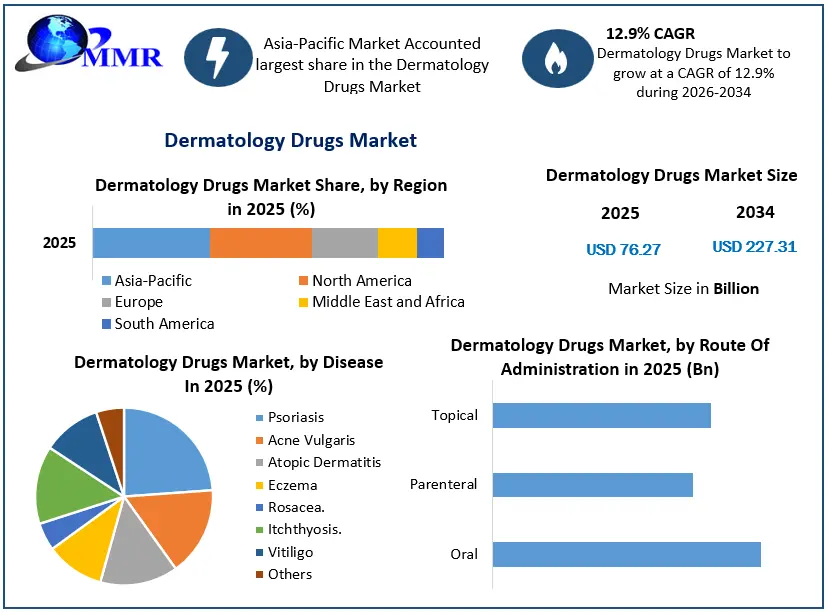
Dermatology Drugs Market size is expected to reach nearly USD 227.31 Bn by 2034 with a CAGR of 12.9% during the forecast period.
The Dermatology Drugs market report is a comprehensive analysis of the industry, market, and key players. The report has covered the market by demand and supply-side by segments. The global Dermatology Drugs market report also provides trends by market segments, technology, and investment with a competitive landscape.
Dermatology Drugs Market Growth Outlook
To know about the Research Methodology :- Request Free Sample Report
Dermatology Drugs Market Overview
The global dermatology drug market was at US$ 53 Bn in 2022 and is expected to reach US$ 86.13 Bn in 2029. Dermatology is defined as a therapy that deals with diseases such as acne vulgaris, fungus, psoriasis, eczema related to the skin. Dermatology drugs are used for the treatment of this disease. Currently, there are various types of drugs available in the market for treatment. The FDA Center for Drug Evaluation and Research is responsible for the study and evaluation of drugs before they are approved for sale and commercial use. A team of CDRE, consisting of a Physician, Pharmacist, and a Statistician who then determines if the drugs are effective and risk-free or not.
A patient may choose to go for either allopathic or homoeopathic treatment depending on his choice, according to reports dermatologists provide more than 7 million medicinal prescriptions than any other specialist. Success in dermatology is measured by the efficiency of the medicine in treating certain skin or other conditions, therefor dermatologist prescribes the most clinically proven medicine for the treatment
Dermatology Drugs Market Dynamics
The growing number of patients suffering from acne, fungus, and dermatitis are driving the market growth of dermatology drugs. As per the reports of the American Association of Dermatologists approximately 50 million people in the US alone are affected by acne. There are many reasons which can cause skin and other related problems such as not cleaning body properly, excessive sweating, eating spicy food, and wearing tight clothes. Due to which the market is noting an increase in the number of drug sales for treatments.
An increase in awareness and among the population about skin and hair infections is proven to be opportunistic for market growth. As the rise in awareness has propelled the sale of OTC medicines has grown, which helps in treating acne and hair fall commonly. Mostly a section of the young population and teens are affected by skin-related issues such as skin irritation, pimples, and excessive sweating due to hormonal changes. With the rise in demand for dermatological drugs which are used on routine and applied topically as anti-inflammatory agent and cleanser are expected to grow market further.
Other factors include an increase in investments in the Research and Development by market key players for the production and clinical trials of new drugs due to the rise in demand for new, effective, and less costly drugs Combined with the increase in skin cancer and disorders are helping in the growth of the drugs market. However several side effects and improper use of dermatological drugs combine with government restrictions and parameters will restraint the market from reaching its potential.
Trends in Dermatology Drugs Market
An increase in the approval of Drugs by various scientific and government authorities has been the most opportunistic way for the growth of the market, Due to a continuous increase in the demand for low and cost-effective drugs despite the high complexity of clinical trials and cost related to its launch of new drugs to generate more revenue in is the trend. Especially in the USA, the Food and Drug Administration has ramped up the process of approval.
Dermatology Drugs Market Segment Analysis
On the basis of Route of Administration the dermatology market is segmented into Acne Psoriasis, Atopic Dermatitis, Eczema, Rosacea, Ichthyoses, Vitiligo and others of which the segment of psoriasis accounted for the most of the drugs market. Psoriasis is a skin disease that causes red, itchy patches commonly on knees, elbows, trunk, and scalp by multiplying skin cells by 10 times and is a chronic disease that has no permanent cure. It is non- transmittable between people but it can affect members of the same family due to common use of things. Because of this dermatology market has noted growth over the years.
The segment of Acne has also witnessed tremendous growth and is expected to hold a major market share in the coming years. As per the reports, it affects 9.4% of the world's population of which adolescents are more prone and is common in North America. It makes skin look bad with red spots on cheeks and forehead, causes pain when touched, takes a long time to heal which can cause emotional breakdown sometimes. Because of this, the sale of dermatologically tested creams, moisturizers, and OTC medicines has increased.
Based on the Route of administration the segment of Parenteral has dominated the market. In the words of the US Food and Drug Administration, it is defined as the way of administrating a drug in a patient's body through injection, infusion, and implantation, or some other way. It is used when certain drugs are less effective when given orally or the need for the drug is immediate for patients. The segment of Topical Delivery has also seen an upsurge in the market due to the easy availability of a variety of dermatologically proven drugs in the market. It is used to cure skin diseases or disorders on the surface or local area.
Based on the distribution channel the segment of hospital pharmacies has accounted for the majority of the market. Due to the preference of patients visit for treatment in hospitals. Hospital pharmacy makes available certain drugs easily which are not available easily. Whereas the segment of retail pharmacy is also on the growth due to increase in demand for cost-effective OTC drugs in the market and is anticipated to gain more market share in the forecast period.
Dermatology Drugs Market Regional Insights:
North America accounted for the majority of market because of more effects of skin disorders and disease in the region. In 2018 market was at US$ 18.10 bn. According to data of statistica.com in the US people belonging to the age group of 18 to 29 paid the highest percentage of the visit to the dermatologist which stands at 16.9% followed by 50-64 years with 15.73% and 30-49 with 12.91%. Moreover, the presence of major market key players combined with the launch of new drugs is driving the market growth. USA, Canada, Mexico are the major contributors in the regions market growth.
The European region stands second in the market due to high investments in research and development by major players for the production of new drugs. An increase in the impact of skin disease among people combined with fewer visits paid by them for the treatment is propelling the market. Skin disorders and diseases are the fourth most common human illness due to which the demand for drugs has grown over time. France, Germany, and Italy are the major contributors to the region's market growth because of more number of young patients. Middle East and Africa region is also showing growth rates due to the shifting of key players in the region and increasing awareness.
Asia-Pacific region is expected to register the highest market growth because of growing knowledge of skin infections and the availability of proper skin treatments in the region. Availability adequate health care facilities has boosted the market growth. The most significant factor behind the growth of the market in this region is the conduction of the Asia-Pacific Dermatology conference in different nations annually. Where nations of Asia-pacific come together and discuss points on progression, collaboration, ideas for improved patient treatment, and development of drugs in the region. India, China, and Japan are the major holders of market share in the region.
The objective of the report is to present a comprehensive analysis of the Global Dermatology Drugs Market to the stakeholders in the industry. The past and current status of the industry with the forecasted market size and trends are presented in the report with the analysis of complicated data in simple language. The report covers all the aspects of the industry with a dedicated study of key players that include market leaders, followers, and new entrants.
PORTER, SVOR, PESTEL analysis with the potential impact of micro-economic factors of the market have been presented in the report. External as well as internal factors that are supposed to affect the business positively or negatively have been analyzed, which will give a clear futuristic view of the industry to the decision-makers.
The report also helps in understanding the Global Dermatology Drugs Market dynamics, structure by analyzing the market segments and project the Global Dermatology Drugs Market size. Clear representation of competitive analysis of key players by product, price, financial position, product portfolio, growth strategies, and regional presence in the Global Dermatology Drugs Market make the report investor’s guide.
Dermatology Drugs Market Recent Industry Developments
| Date | Company | Development | Impact |
|---|---|---|---|
| 23 July 2025 | LEO Pharma A/S | The U.S. FDA approved Anzupgo (delgocitinib cream) as the first topical pan-JAK inhibitor for adults with moderate-to-severe chronic hand eczema (CHE). | This milestone addresses significant unmet needs in hand eczema treatment by expanding non-steroidal topical therapeutic options in clinical dermatology. |
| 18 September 2025 | Incyte Corporation | The U.S. FDA expanded the approval of Opzelura (ruxolitinib) cream 1.5% to include pediatric patients aged 2 to 11 years with mild-to-moderate atopic dermatitis. | The label expansion establishes the drug as the first approved topical JAK inhibitor available for young children suffering from pediatric eczema. |
| 29 September 2025 | Johnson & Johnson | The U.S. FDA approved Tremfya (guselkumab) for pediatric patients aged 6 years and older with moderate-to-severe plaque psoriasis or active psoriatic arthritis. | This authorization represents the first IL-23 inhibitor pediatric approval, substantially widening therapeutic accessibility for young patients with severe dermatological conditions. |
| 30 September 2025 | Novartis AG | The U.S. FDA granted approval for Rhapsido (remibrutinib), an oral Bruton tyrosine kinase inhibitor, for adults with chronic spontaneous urticaria (CSU). | Approval of this targeted drug provides patients with a novel first-in-class oral BTK inhibitor treatment for severe skin hives unresponsive to antihistamines. |
| 06 October 2025 | Arcutis Biotherapeutics, Inc. | The U.S. FDA approved Zoryve (roflumilast) cream 0.05% for pediatric patients aged 2 to 5 years with mild-to-moderate atopic dermatitis. | The decision expands the commercial reach of Arcutis's steroid-free topical PDE4 inhibitor to early childhood eczema management. |
| 09 June 2026 | Eli Lilly and Company | The U.S. FDA approved a single-injection maintenance dosing regimen of EBGLYSS (lebrikizumab-lbkz) every eight weeks for moderate-to-severe atopic dermatitis. | This label update significantly enhances patient convenience and long-term treatment adherence by reducing maintenance injection frequency. |
Dermatology Drugs Market Scope: Inquire before buying
| Dermatology Drugs Market | |||
|---|---|---|---|
| Report Coverage | Details | ||
| Base Year: | 2025 | Forecast Period: | 2026-2034 |
| Historical Data: | 2020 to 2025 | Market Size in 2025: | USD 76.27 Bn. |
| Forecast Period 2026 to 2034 CAGR: | 12.9% | Market Size in 2034: | USD 227.31 Bn. |
| Segments Covered: | by Disease | Psoriasis Acne Vulgaris Atopic Dermatitis Eczema Rosacea. Itchthyosis. Vitiligo Others |
|
| by Route Of Administration | Oral Parenteral Topical |
||
| by Distribution Channel | Hospital Pharmacy Retail Pharmacy Online Pharmacy |
||
Dermatology Drugs Market, by Region
North America (United States, Canada and Mexico)
Europe (UK, France, Germany, Italy, Spain, Sweden, Austria and Rest of Europe)
Asia Pacific (China, South Korea, Japan, India, Australia, Indonesia, Malaysia, Vietnam, Taiwan, Bangladesh, Pakistan and Rest of APAC)
Middle East and Africa (South Africa, GCC, Egypt, Nigeria and Rest of ME&A)
South America (Brazil, Argentina Rest of South America)
Dermatology Drugs Market Key Players
1. AbbVie Inc.
2. Novartis AG
3. Pfizer Inc.
4. Johnson & Johnson
5. Sanofi S.A.
6. Eli Lilly and Company
7. Galderma S.A.
8. GSK plc
9. Almirall, S.A.
10. LEO Pharma A/S
11. Bausch Health Companies Inc.
12. Sun Pharmaceutical Industries Ltd.
13. Bristol Myers Squibb Company
14. Incyte Corporation
15. Arcutis Biotherapeutics, Inc.
16. Regeneron Pharmaceuticals, Inc.
17. Amgen Inc.
18. UBC (Union Chimique Belge)
19. AstraZeneca plc
20. Merck & Co., Inc.
21. Takeda Pharmaceutical Company Limited
22. Glenmark Pharmaceuticals Ltd.
23. Cipla Ltd.
24. Lupin Limited
25. Boehringer Ingelheim International GmbH
26. L'Oréal S.A. (Active Cosmetics Division)
27. Mylan N.V. (Viatris Inc.)
28. Taro Pharmaceutical Industries Ltd.
29. F. Hoffmann-La Roche Ltd
30. Deravant Sciences Inc.
Frequently Asked Questions:
1. Which region has the largest share in Global Dermatology Drugs Market?
Ans: North America region held the highest share in 2025.
2. What is the growth rate of Global Dermatology Drugs Market?
Ans: The Global Dermatology Drugs Market is expected to grow at a CAGR of 12.9% during forecast period 2026-2034.
3. What is scope of the Global Dermatology Drugs Market report?
Ans: The Global Dermatology Drugs Market report helps with the PESTEL, PORTER, COVID-19 Impact analysis, Recommendations for Investors & Leaders, and market estimation of the forecast period.
4. What is the study period of this market?
Ans: The Global Dermatology Drugs Market is studied from 2020 to 2034.