
Global Clinical Nutrition Market Size by Route of Administration, Application, End User, Region and Forecast 2034
Overview
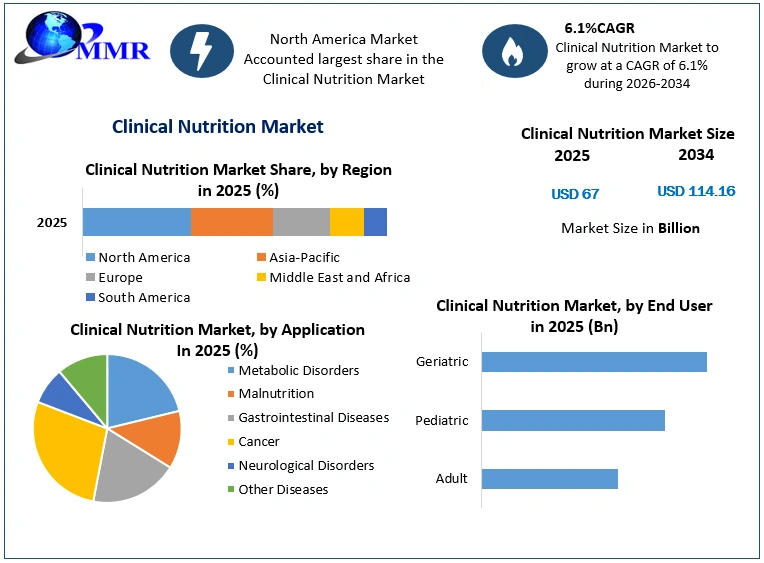
The Global Clinical Nutrition Market Size was valued at USD 59.8 Billion in 2025 and is estimated to grow at a CAGR of 6.94% over the forecast period, reaching USD 109.39 Billion by 2034.
Global Clinical Nutrition Market Overview
Cinical nutrition is area of healthcare that focuses on providing the right nutrients to patients to support their health, recovery, and disease management. It includes nutritional products and dietary solutions such as oral nutritional supplements, enteral nutrition, parenteral nutrition, medical foods, and disease-specific formulas. Clinical nutrition is mainly used when patients are unable to obtain sufficient nutrients from normal food due to illness, surgery, chronic diseases, or other medical conditions.
The Global Clinical Nutrition Market is changing with the rising prevalence of chronic diseases, aging populations, hospital admissions, and growing awareness of disease-related malnutrition. Demand is increasing for personalized nutrition, high-protein formulas, specialized medical nutrition, home-based nutritional care, enteral feeding, and parenteral nutrition. North America is an important market, while Asia Pacific offers strong growth opportunities due to improving healthcare infrastructure and increasing healthcare spending. Major players include Abbott, Nestlé, Danone, Fresenius Kabi, and Baxter.
MMR's research provides detailed analysis of clinical nutrition market size, market share, growth trends, product types, applications, patient groups, regional demand, competitive landscape, key players, drivers, restraints, opportunities, and recent developments. The study helps companies identify opportunities in disease-specific nutrition, pediatric and adult clinical nutrition, home healthcare, personalized nutritional solutions, and specialized enteral and parenteral products, while showing which regions and segments have the strongest future potential.
Clinical Nutrition Market Size, Growth & Share Analysis
To know about the Research Methodology:-Request Free Sample Report
Global Clinical Nutrition Market Key Highlights
| Key Highlight |
Analytical Market Insight |
|---|---|
| Strong Clinical Nutrition Market Growth Through 2034 | The clinical nutrition market is valued at USD 59.8 billion in 2025 and is projected to reach USD 109.39 billion by 2034, registering a CAGR of 6.94% during 2026–2034. Rising demand for medical nutrition products, chronic disease management, and specialized nutritional support creates long-term growth opportunities for manufacturers and investors. |
| North America Leads the Clinical Nutrition Market | North America holds the leading regional position, supported by advanced healthcare infrastructure, established hospital nutrition programs, and widespread use of oral, enteral, and parenteral nutrition products. The region offers opportunities for companies targeting elderly patients, disease-related malnutrition, and specialized medical nutrition services. |
| Oral Nutrition Supports Broad Clinical Nutrition Market Demand |
Oral nutritional supplements represent a major route of administration, supported by convenient consumption, patient acceptance, and applications across hospital and homecare settings. Demand for high-protein beverages, nutrient-dense formulas, and disease-specific nutritional products supports product development and market penetration. |
| Malnutrition and Cancer Nutrition Create High-Value Application Opportunities |
Malnutrition remains a major clinical nutrition application because hospitalized, elderly, and chronically ill patients often require additional nutritional support. Cancer nutrition also presents important opportunities as healthcare providers focus on maintaining nutritional status during treatment and recovery, increasing demand for specialized oral and enteral formulas. |
| Specialized Medical Nutrition Innovation Intensifies Competition |
Leading companies, including Abbott Laboratories, Nestlé Health Science, Danone, Fresenius Kabi, and Baxter International, compete through specialized formulations, hospital nutrition solutions, clinical research, and distribution networks. Personalized nutrition, home-based feeding, pediatric formulas, and advanced parenteral nutrition create opportunities for product differentiation and competitive growth. |
Global Clinical Nutrition Market Dynamics
Rising Demand for Medical Nutrition Products Drives Clinical Nutrition Market Growth
The clinical nutrition market benefits from rising demand for specialized nutritional support among patients with chronic diseases, malnutrition, age-related health conditions, and post-surgical recovery needs. In 2025, hospitals and healthcare facilities increasingly prioritize nutritional screening and personalized dietary support to improve patient recovery and maintain adequate nutrient intake. Clinical nutrition assessments consider indicators such as body mass index, recent weight changes, protein intake, and daily energy requirements. For selected adult patients, nutritional targets may range from 25 to 30 kilocalories per kilogram of body weight per day, depending on clinical condition and professional assessment. Growing demand for oral nutritional supplements, enteral nutrition formulas, parenteral nutrition solutions, and disease-specific medical nutrition products strengthens clinical nutrition market growth and supports greater integration of nutritional care into patient treatment plans.
High Medical Nutrition Product Costs Limit Clinical Nutrition Market Adoption
High product costs, limited reimbursement coverage, and unequal access to specialized healthcare services remain significant restraints on clinical nutrition market growth. Patients requiring long-term nutritional support may face additional expenses for medical nutrition formulas, feeding equipment, clinical monitoring, and professional care, placing pressure on household healthcare budgets. In 2025, affordability remains a concern for patients requiring prolonged enteral or parenteral nutrition, particularly when treatment involves repeated product purchases and home healthcare services. Healthcare facilities must also manage procurement costs, storage requirements, preparation procedures, and staff training when introducing specialized nutrition programs. Differences in insurance coverage and hospital purchasing budgets can limit access to premium nutritional formulations, particularly in cost-sensitive healthcare settings, creating barriers to broader clinical nutrition product adoption.
Personalized Medical Nutrition and Home Healthcare create Clinical Nutrition Market Opportunities
Personalized medical nutrition, home-based nutritional support, and condition-specific dietary formulas create significant opportunities for clinical nutrition market development. Healthcare providers increasingly focus on matching nutritional products to patients' energy requirements, protein needs, digestive tolerance, and disease-related dietary restrictions. For selected adult patients with critical illness, protein requirements may reach 1.2 to 2.0 grams per kilogram of body weight per day, depending on individual clinical circumstances and professional guidance. This creates opportunities for high-protein oral nutritional supplements, specialized enteral formulas, and individualized nutrition plans. Growing preference for home healthcare also encourages demand for convenient ready-to-use formulas, portable feeding equipment, caregiver education, and remote nutritional monitoring. Manufacturers can capture additional clinical nutrition market opportunities by developing pediatric and geriatric formulations, improving product accessibility, and supporting personalized nutritional care throughout recovery.
Clinical Evidence and Product Safety Requirements Shape Clinical Nutrition Market Development
Clinical evidence requirements, product safety standards, nutritional tolerance, and regulatory compliance present important challenges for the clinical nutrition industry. Manufacturers must maintain appropriate nutrient concentrations, ingredient quality, microbiological safety, and product stability throughout the stated shelf life. Parenteral nutrition requires particularly stringent quality controls because intravenous administration bypasses the digestive system and increases the consequences of contamination, dosing errors, and electrolyte imbalances. Enteral nutrition providers must also address feeding intolerance, tube blockages, aspiration risks, and difficulties maintaining adequate nutrient intake among medically complex patients. Consistent with healthcare quality expectations in 2025, providers require reliable product documentation, appropriate patient monitoring, and evidence supporting the suitability of specialized formulas for their intended uses. Differences in patient metabolism, disease severity, and treatment duration further complicate nutritional product selection, increasing the need for clinical evaluation, professional training, and consistent quality management.
Global Clinical Nutrition Market Key Trends
| Market Trend | Description |
|---|---|
| Personalized Clinical Nutrition and Disease-Specific Formulations |
Healthcare providers increasingly use specialized nutritional formulas tailored to the dietary needs of patients with diabetes, kidney disease, cancer, and gastrointestinal disorders. This supports demand for condition-specific medical nutrition products that address individual nutrient requirements. |
| Rising Adoption of Home-Based Clinical Nutrition | Home healthcare is creating demand for oral nutritional supplements, home enteral feeding systems, and caregiver-supported nutrition services. Patients requiring long-term nutritional assistance can receive ongoing support outside hospitals, subject to appropriate clinical supervision. |
| High-Protein Medical Nutrition and Muscle Health Support |
Clinical nutrition manufacturers are focusing on protein-rich formulas for older adults, patients recovering from surgery, and individuals at risk of muscle loss. These products help address increased protein requirements and support recovery when used as part of an appropriate nutritional care plan. |
| Growth in Oral Nutritional Supplements | Ready-to-drink medical nutrition beverages, nutrient-dense powders, and easy-to-consume supplements are gaining attention because they offer convenient nutritional support for patients who cannot meet their dietary requirements through regular meals alone. Product selection depends on clinical needs and suitability. |
| Advanced Enteral and Parenteral Nutrition Solutions |
Healthcare facilities increasingly require specialized feeding formulas, improved delivery equipment, and carefully managed intravenous nutrition solutions for patients who cannot obtain sufficient nutrients through conventional eating. Product safety, accurate nutrient delivery, and feeding tolerance remain important priorities. |
| Digital Nutritional Monitoring and Personalized Patient Care |
Digital health records, remote consultations, and nutrition-tracking tools are helping healthcare professionals monitor dietary intake, treatment adherence, and changes in nutritional status. These approaches support timely adjustments to nutrition plans, particularly for patients receiving long-term care at home. |
Global Clinical Nutrition Market Segment Analysis
Clinical Nutrition Market, by Route of Administration
By Route of Administration, the Clinical Nutrition Market is segmented into Oral, Enteral, and Parenteral. Oral nutrition currently holds the leading position, supported by its non-invasive nature, easier administration, broad use in hospitals and homecare, and higher patient acceptance. Recent market estimates place oral nutrition at around 54% of 2025 market revenue, although reported shares vary by research methodology. Enteral nutrition remains important for patients who cannot consume adequate nutrition orally but have a functioning gastrointestinal tract, particularly in intensive care, neurological conditions, and post-surgical recovery. Parenteral nutrition is used when oral and enteral feeding cannot adequately meet nutritional requirements and remains especially important in critical care and gastrointestinal failure; it is also showing strong current momentum, with recent research identifying parenteral nutrition as the fastest-growing route in the forecast period.
Clinical Nutrition Market, by Application
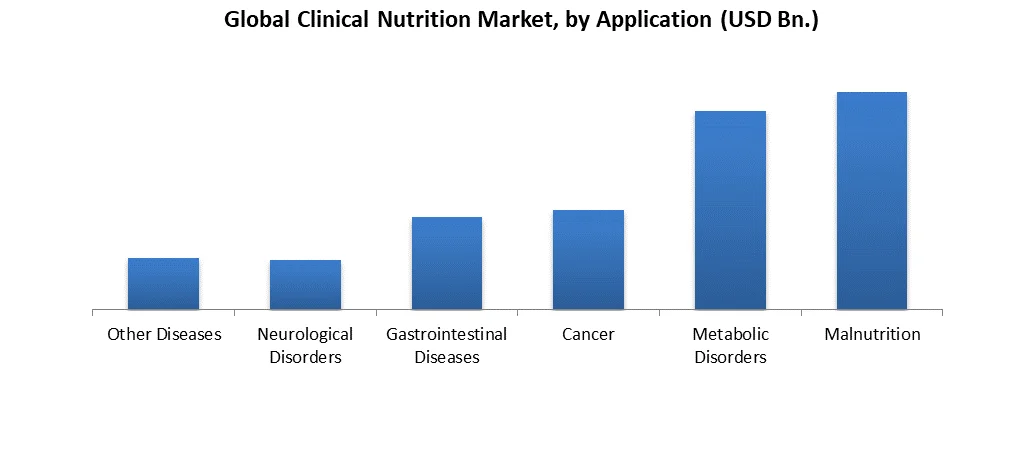
By Application, the Clinical Nutrition Market is segmented into Metabolic Disorders, Malnutrition, Gastrointestinal Diseases, Cancer, Neurological Disorders, and Other Diseases. Malnutrition is currently the leading application, supported by the high incidence of nutrition deficiency among hospitalized, elderly, and chronically ill patients, while cancer nutrition is one of the most active areas of current development as nutritional support is increasingly incorporated into oncology treatment and recovery programs. Metabolic disorders also represent a substantial demand base because patients with diabetes, obesity, and other metabolic conditions increasingly require structured dietary management. Gastrointestinal diseases maintain steady demand because impaired digestion or nutrient absorption can make conventional food intake insufficient, while neurological disorders often require specialized nutrition for patients with swallowing and feeding difficulties. Recent market research supports strong demand from malnutrition and cancer-related applications, although the reported leading segment varies across methodologies.
 Global Clinical Nutrition Regional Analysis
North America is the leading regional market, supported by advanced healthcare infrastructure, established clinical nutrition practices, strong hospital procurement systems, and widespread use of specialized nutritional products. The region has a well-developed base for oral, enteral, and parenteral nutrition across hospitals, long-term care facilities, and homecare settings. A large elderly population and high incidence of chronic and complex diseases further sustain demand for clinical nutrition solutions.
Asia Pacific is the second-largest regional market and the fastest-growing region, driven by improving healthcare access, rising awareness of nutritional therapy, increasing healthcare investment, and a large patient population requiring nutritional support. China, Japan, India, South Korea, and Australia remain important markets, while the increasing availability of specialized nutritional products is supporting wider adoption across hospitals and homecare settings.
Europe holds the third-largest regional position, benefiting from established healthcare systems and greater integration of nutritional care into patient management. Demand is particularly supported by an aging population, chronic disease management, cancer care, elderly nutrition, and the use of oral and enteral nutritional products in hospitals and long-term care facilities.
South America represents an emerging regional market, with demand supported by improvements in healthcare infrastructure and increasing recognition of disease-related malnutrition. Brazil and Argentina are important markets, while greater availability of specialized nutritional products and improved access to healthcare services are creating additional opportunities for clinical nutrition providers.
Middle East and Africa is a developing regional market, where adoption is concentrated around countries with stronger healthcare infrastructure and specialized medical facilities. Demand is being supported by improvements in hospital services, increasing attention to nutritional deficiencies, and greater use of specialized nutritional support for patients with chronic and critical conditions. Differences in healthcare access, product availability, and reimbursement remain important factors influencing adoption.
Global Clinical Nutrition Market Competitive Landscape
The Clinical Nutrition Market has several well-established companies competing through product quality, clinical research, healthcare partnerships, and strong distribution networks. Key companies include Abbott, Nestlé, Danone, Fresenius Kabi, Baxter, B. Braun, Pfizer, Reckitt, Grifols, and Otsuka Holdings. Abbott and Nestlé have strong positions in adult, pediatric, and oral clinical nutrition, while Fresenius Kabi, Baxter, and B. Braun have a strong presence in parenteral and hospital-based nutrition. Danone focuses on specialized medical nutrition, including pediatric and disease-specific products. Competition is increasingly influenced by new product development, specialized nutrition formulas, personalized nutrition, home-based nutrition care, and solutions for cancer, metabolic disorders, gastrointestinal diseases, and elderly patients. Companies are also strengthening their market position through partnerships, acquisitions, clinical research, and wider healthcare distribution networks.
| region | Country | Company | Market relevance and competitive differentiation |
|---|---|---|---|
| North America | United States | Abbott | Strong presence in adult and pediatric clinical nutrition, with products such as Ensure, Glucerna, Nepro, and specialized tube-feeding formulas. Its portfolio addresses nutritional needs associated with diabetes, kidney disease, malnutrition, and recovery. |
| North America | United States | Baxter International | Important competitor in hospital-based parenteral nutrition, offering ready-to-use multi-chamber bags, lipid emulsions, micronutrients, and preparation technologies for patients with complex nutritional needs. |
| Europe | Switzerland | Nestle Health Science | Competes through specialized medical nutrition for adults and children, including tube-feeding formulas, pediatric nutrition, gastrointestinal support, and products for disease-related malnutrition. |
| Europe | France | Danone | Differentiates through its specialized nutrition business, including Nutricia medical nutrition products for disease-related malnutrition, cancer-related nutritional needs, and patients requiring tube feeding. |
| Europe | Germany | Fresenius Kabi | Maintains a strong hospital nutrition position through oral supplements, enteral feeding products, multi-chamber parenteral nutrition bags, and individual nutrient preparations for critically and chronically ill patients. |
| Europe | Germany | B. Braun | Competes through parenteral nutrition systems, multi-chamber bags, automated compounding technologies, and nutrition therapy services designed to support safe preparation and patient-specific nutritional care. |
| Asia Pacific | Japan | Otsuka Pharmaceutical Factory | Offers medical foods and clinical nutrition products for hydration, swallowing difficulties, rehabilitation, and nutritional support, providing a differentiated position in patient-focused nutrition care. |
| Asia Pacific | India | Nestle India | Has a relevant presence in medical and specialized nutrition, including products supporting protein intake, diabetes and obesity management, and nutritional care. Its established local distribution offers an advantage in reaching Indian consumers and healthcare channels. |
Global Clinical Nutrition Market Recent Development
| Month | Company | Recent Development |
| January 2026 | Fresenius Kabi | Fresenius Kabi highlighted its medical nutrition activities as part of its healthcare portfolio and continued its focus on nutrition therapy and patient care solutions. |
| March 2026 | Otsuka Pharmaceutical | Otsuka announced an improved version of Calorie Mate JELLY with updated flavours, balanced nutrition, and a more convenient format. |
| March 2026 | Fresenius Kabi | Fresenius Kabi introduced new plant based nutrition options intended to provide additional choices for patients with or at risk of disease related malnutrition. |
| April 2026 | Danone | Danone reported continued performance from its Specialized Nutrition business, particularly in Asia Pacific, highlighting the importance of specialised nutrition within its portfolio. |
| April 2026 | Otsuka Pharmaceutical | Otsuka continued its nutrition education activities through educational materials and resources supporting nutrition awareness and health education. |
| May 2026 | Otsuka Pharmaceutical | Otsuka continued development of its nutraceutical portfolio and health focused nutrition activities across its markets. |
| June 2026 | Danone | Danone announced the acquisition of MADE Group to strengthen its presence in the healthy nutrition market in Asia Pacific. |
| July 2026 | Danone | Danone reported continued performance from its health focused portfolio, including Specialized Nutrition, as part of its first half business update. |
| July 2026 | Fresenius Kabi | Fresenius Kabi continued strengthening its healthcare portfolio and medical nutrition presence while reporting progress across its business activities. |
Clinical Nutrition Market Scope: Inquire before buying
| Global Clinical Nutrition Market | |||
|---|---|---|---|
| Report Coverage | Details | ||
| Base Year: | 2025 | Forecast Period: | 2026-2034 |
| Historical Data: | 2020 to 2025 | Market Size in 2025: | USD 59.8 Bn. |
| Forecast Period 2026 to 2034 CAGR: | 6.94% | Market Size in 2034: | USD 109.39 Bn. |
| Segments Covered: | by Route of Administration | Oral Parental Enteral |
|
| by Application | Metabolic Disorders Malnutrition Gastrointestinal Diseases Cancer Neurological Disorders Other Diseases |
||
| by End User | Adult Pediatric Geriatric |
||
Clinical Nutrition Market, by Region
North America (United States, Canada and Mexico)
Europe (UK, France, Germany, Italy, Spain, Sweden, Austria and Rest of Europe)
Asia Pacific (China, South Korea, Japan, India, Australia, Indonesia, Malaysia, Vietnam, Taiwan, Bangladesh, Pakistan and Rest of APAC)
South America (Brazil, Argentina Rest of South America)
Middle East & Africa (South Africa, GCC, Egypt, Nigeria and Rest of ME&A)
Clinical Nutrition Key players
1. Abbott Laboratories
2. Nestlé Health Science
3. Danone
4. Fresenius Kabi AG
5. Baxter International Inc.
6. B. Braun Melsungen SE
7. Pfizer Inc.
8. Otsuka Holdings Co., Ltd.
9. Reckitt
10. Mead Johnson Nutrition
11. Meiji Holdings Co., Ltd.
12. Grifols S.A.
13. Perrigo Company plc
14. Ajinomoto Co., Inc.
15. Kate Farms, Inc.
16. AYMES International Ltd.
17. Medifood International Ltd.
18. Hero Nutritionals
19. Kendal Nutricare Limited
20. Lactalis Nutrition Santé
21. Ausnutria Dairy Corporation Ltd.
22. Glanbia plc
23. Hormel Foods Corporation
24. BASF SE
25. Lonza Group Ltd.
26. ICU Medical, Inc.
27. Medline Industries, LP
28. Bayer AG
29. GlaxoSmithKline plc
30. Aculife Healthcare Pvt. Ltd.
31. Amanta Healthcare
32. American Regent, Inc.
33. BML Parenteral Drugs
34. Eurofarma Laboratórios S.A.
35. JW Pharmaceutical Corporation
36. Sichuan Kelun Pharmaceutical Co., Ltd.
37. SternLife GmbH & Co. KG
38. Victus, Inc.
39. Megalabs
40. DaisyFSMP
41. Maifu Nutrition Technology
42. Functional Formularies
43. Nutricia
44. Nestlé S.A.
45. Vivante Health
Global Clinical Nutrition - Frequently Asked Questions:
1. Which region has the largest share in Clinical Nutrition Market?
Ans: North America region held the highest share in 2025.
2. What is the growth rate of Clinical Nutrition Market?
Ans: The Clinical Nutrition Market is growing at a CAGR of 6.94% during the forecasting period 2026-2034.
3. What is scope of the Clinical Nutrition Market report?
Ans: Clinical Nutrition Market report covers recommendations for investors and leaders, and market estimation for the forecast period.
4. Who are the key players in Clinical Nutrition Market?
Ans: The important key players in the Clinical Nutrition Market are Abbott Laboratories, Nestlé Health Science, Danone, Fresenius Kabi, Baxter International, B. Braun, Pfizer, Otsuka Holdings, Reckitt, Meiji Holdings, Grifols, and Ajinomoto.
5. What is the study period of this Market?
Ans: The Clinical Nutrition Market is studied from 2020 to 2034.