
Europe Zero Trust Security Market by Security Type, by Authentication Type, by Deployment Model, by Industry Vertical, by Region and Forecast 2034
Overview
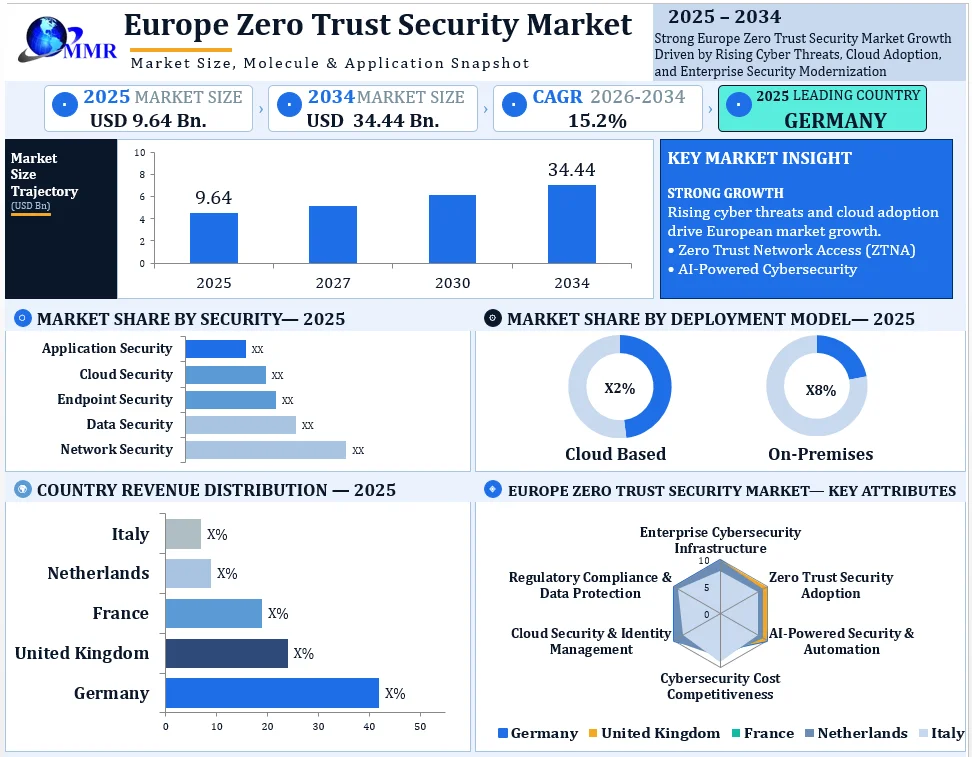
The Europe Zero Trust Security Market was valued at USD 9.64 Billion in 2025 and is projected to reach USD 34.44 Billion by 2034, growing at a CAGR of 15.2% during the forecast period 2026–2034.
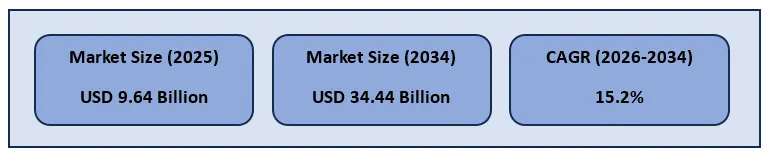
Europe Zero Trust Security Market Overview
The Europe Zero Trust Security Market focuses on advanced cybersecurity solutions that continuously verify user identities, devices, applications, and network access before granting access to enterprise resources. Zero Trust Security operates on the principle of “Never Trust, Always Verify” and integrates Zero Trust Network Access (ZTNA), identity and access management (IAM), multi-factor authentication (MFA), endpoint security, and cloud security solutions. The market plays a critical role in strengthening enterprise cybersecurity, data protection, and secure network access across European industries. Increasing ransomware attacks, phishing threats, cloud computing adoption, and enterprise digital transformation drive Europe Zero Trust Security Market growth. Organizations implement Zero Trust Architecture (ZTA), continuous authentication, least-privilege access, and micro segmentation to protect sensitive business information, remote workforces, and hybrid cloud infrastructure.
The Europe Zero Trust Security Market experiences increasing demand as enterprises transition toward identity-centric security models and cloud-native cybersecurity platforms. AI-powered cybersecurity, Secure Access Service Edge (SASE), passwordless authentication, privileged access management (PAM), and automated threat detection represent key Europe Zero Trust Security Market trends. Major buyers include BFSI, healthcare, government & defense, IT & telecommunications, retail & e-commerce, manufacturing, and energy & utilities. Germany, the United Kingdom, France, the Netherlands, and Italy represent important markets for Zero Trust Security adoption in Europe, supported by expanding digital infrastructure, cloud migration, and cybersecurity compliance requirements. Growing investments in cloud-based Zero Trust Security solutions, managed cybersecurity services, and industrial network protection create opportunities for technology providers. Leading Europe Zero Trust Security Market key players, including Microsoft Corporation, Palo Alto Networks, Cisco Systems, Zscaler, and Fortinet, provide enterprise security solutions such as Microsoft Entra ID, Prisma SASE, Cisco Secure Access, Zscaler Zero Trust Exchange, and FortiSASE.
Maximize Market Research (MMR) examines the Europe Zero Trust Security Market through market dynamics, growth drivers, technology adoption, segmentation, regional analysis, and competitive landscape. The research evaluates the influence of the General Data Protection Regulation (GDPR), NIS2 Directive, and Digital Operational Resilience Act (DORA) on enterprise cybersecurity strategies and regulatory compliance requirements. It also analyzes Zero Trust Security Market opportunities, authentication technologies, cloud-based and on-premises deployment models, network security investments, and industry-specific cybersecurity demand. MMR assesses competitive positioning, product innovation, strategic partnerships, and country-level security adoption across European economies. The analysis provides insights into emerging cybersecurity technologies, enterprise security modernization, market challenges, and strategic growth opportunities within the Europe Zero Trust Security industry.
Europe Zero Trust Security Market Key Highlights
|
CAGR |
Strong Market Expansion Through 2034 The Europe Zero Trust Security
|
|
Cyber Resilience |
European Cybersecurity Regulations GDPR, NIS2, and DORA strengthen
|
|
Cloud Security |
Cloud-Native Zero Trust Security Increasing hybrid cloud adoption
|
|
AI-Innovation |
AI-Powered Cybersecurity and European organizations adopt
|
|
Regional Demand |
Five Major European Economies Germany, the United Kingdom, France,
|
Europe Zero Trust Security Market Growth Outlook
To know about the Research Methodology :- Request Free Sample Report
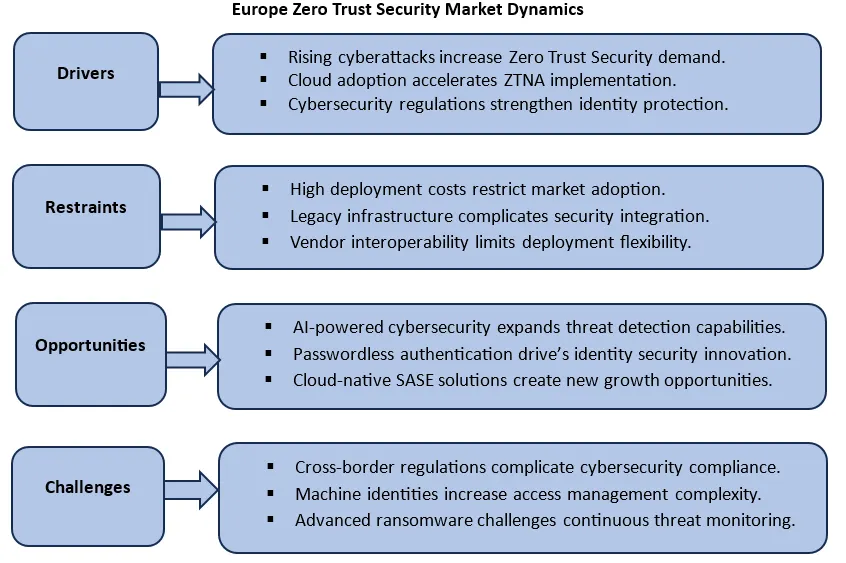
Europe Zero Trust Security Market Dynamics
Growing Demand for Multi-Layered Cybersecurity and Regulatory Compliance Accelerates Zero Trust Security Adoption
The Europe Zero Trust Security Market experiences increasing demand as organizations implement advanced cybersecurity platforms to protect enterprise networks, cloud applications, and sensitive business information. The NIST SP 800-207 Zero Trust Architecture framework defines 7 core security tenets, emphasizing continuous verification, resource-level protection, and dynamic access control. European enterprises integrate Zero Trust Network Access (ZTNA), identity and access management (IAM), multi-factor authentication (MFA), and endpoint security to strengthen network protection. MFA requires 2 or more independent authentication factors, such as passwords, security tokens, and biometric credentials, reducing reliance on single-factor access controls. The European Union's NIS2 framework includes 24-hour early warning and 72-hour incident notification requirements for significant incidents, strengthening demand for security monitoring and incident response services. Financial institutions, healthcare organizations, government agencies, and telecommunications providers prioritize secure application connectivity, least-privilege access, and continuous identity verification. Increasing enterprise digitalization and regulatory compliance requirements support Europe Zero Trust Security Market growth.
Complex Enterprise Integration and Multi-Platform Security Requirements Limit Zero Trust Deployment
The Europe Zero Trust Security Market faces restraints associated with integrating cybersecurity solutions across legacy enterprise applications, hybrid cloud environments, and existing authentication infrastructure. Zero Trust implementation typically involves 5 major security domains: identity, devices, networks, applications, and data, requiring coordinated security policy management and infrastructure modernization. Enterprises must integrate identity providers, endpoint security tools, network gateways, and application access controls while maintaining compatibility with existing systems. Organizations operating across 2 deployment models, cloud-based and on-premises, encounter additional challenges in maintaining consistent security configurations and authentication policies. Migration from traditional VPN-based connectivity to Zero Trust Network Access requires application discovery, device verification, access policy configuration, and continuous monitoring. Large organizations also manage multiple security vendors, authentication protocols, and business-critical applications, increasing technical complexity. These operational requirements restrict rapid adoption of enterprise Zero Trust Security solutions in Europe, particularly among organizations with extensive legacy IT environments.
AI-Powered Identity Security, Cloud-Native Platforms, and Scalable Zero Trust Services Create Growth Opportunities
The Europe Zero Trust Security Market presents growth opportunities through increasing demand for AI-powered identity protection, risk-based authentication, and managed Zero Trust Network Access (ZTNA). Microsoft Entra ID Protection classifies identity threats into 3 risk levels: low, medium, and high, enabling enterprises to configure adaptive access policies based on user behavior and sign-in risk. The platform also supports 2 risk-detection approaches: real-time and offline analysis, improving identity threat assessment. Cloudflare Access provides another example of scalable cybersecurity services, supporting teams of up to 50 users under its free Zero Trust plan and enabling expansion through enterprise subscription models. Organizations increasingly adopt Security Service Edge (SSE), Secure Access Service Edge (SASE), passwordless authentication, and cloud-native security platforms to protect remote workforces and distributed applications. These capabilities create opportunities for cybersecurity providers to develop specialized identity security services, AI-assisted threat monitoring, and flexible enterprise access management solutions across Europe.
Strict Incident Reporting Requirements and Complex Threat Classification Challenge Enterprise Security Operations
The Europe Zero Trust Security Market encounters operational challenges as cybersecurity teams manage regulatory reporting, security incident classification, and continuous access monitoring. Under the EU Cyber Resilience Act, applicable manufacturers must submit an early warning within 24 hours and a full notification within 72 hours after becoming aware of certain actively exploited vulnerabilities or severe security incidents. Final reporting deadlines include 14 days after a corrective measure becomes available for actively exploited vulnerabilities and one month after the 72-hour notification for severe incidents. These requirements increase the importance of accurate vulnerability detection, incident logging, and coordinated response processes. Enterprises operating across European countries integrate Security Information and Event Management (SIEM), Security Orchestration, Automation and Response (SOAR), endpoint detection and response (EDR), and Zero Trust policy management to improve visibility across distributed systems. Managing third-party access, machine identities, cloud applications, and continuously changing user permissions creates additional security challenges. Increasing demand for automated incident classification, centralized monitoring, and unified identity governance shapes the competitive environment for Europe Zero Trust Security solutions.
Europe Zero Trust Security Market Trends
| Key Market Trends |
Impact on Europe Zero Trust Security Market |
|---|---|
| AI-Powered Zero Trust Security & Automation | European enterprises adopt AI-driven threat detection, behavioral analytics, and automated access controls to strengthen cybersecurity and identify suspicious activities. |
| Passwordless Authentication & Identity Security | Increasing adoption of FIDO2 passkeys, biometric authentication, and multi-factor authentication (MFA) strengthens enterprise identity protection and reduces credential-based security risks. |
| Cloud-Native Zero Trust Network Access (ZTNA) | Hybrid and multi-cloud adoption supports demand for Zero Trust Network Access, Secure Access Service Edge (SASE), and secure remote connectivity across European organizations. |
| Regulatory-Driven Zero Trust Security Adoption | NIS2, DORA, and GDPR compliance priorities strengthen demand for continuous access verification, cybersecurity risk management, and enterprise data protection solutions. |
| Zero Trust Security for Industrial & OT Networks | Manufacturing, energy, and critical infrastructure industries implement network micro segmentation, device authentication, and industrial cybersecurity solutions to protect connected operational technology systems. |
Europe Zero Trust Security Market Segment Analysis
Europe Zero Trust Security Market Analysis, by Industry Vertical
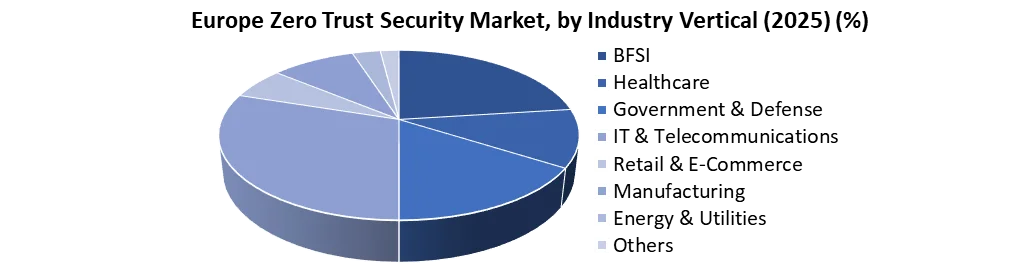
The Europe Zero Trust Security Market by Industry Vertical includes BFSI, Healthcare, Government & Defense, IT & Telecommunications, Retail & E-Commerce, Manufacturing, Energy & Utilities, and Others. The BFSI sector adopts Zero Trust Security solutions to protect digital banking transactions, financial data, and payment systems, while healthcare organizations implement identity and access management (IAM) and endpoint security to safeguard patient records and connected medical devices. Government and defense agencies prioritize Zero Trust Architecture (ZTA) to secure critical infrastructure and confidential information. IT and telecommunications companies deploy Zero Trust Network Access (ZTNA) to protect distributed networks and cloud applications. Retail and e-commerce businesses strengthen customer data protection and transaction security, while manufacturing industries implement network micro segmentation to secure industrial control systems. Energy and utilities providers focus on operational technology security and infrastructure resilience. Increasing demand for multi-factor authentication (MFA), cloud-based Zero Trust Security, and enterprise cybersecurity solutions supports market growth across European industries.
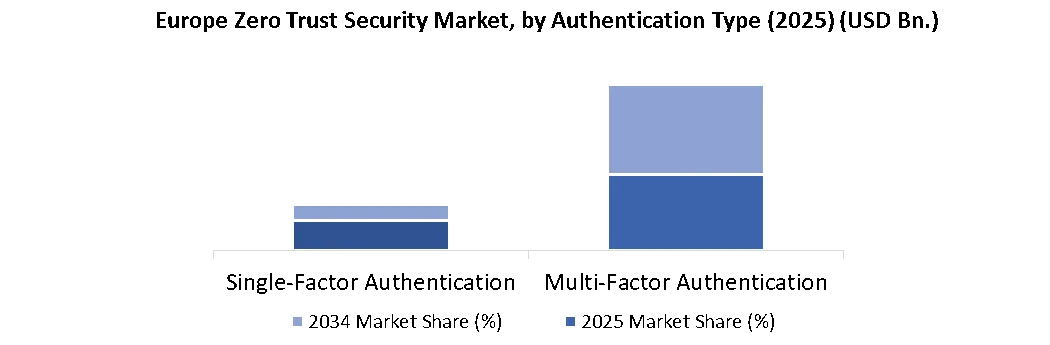
Europe Zero Trust Security Market Analysis, by Authentication Type
The Europe Zero Trust Security Market by Authentication Type includes Single-Factor Authentication (SFA) and Multi-Factor Authentication (MFA). Multi-Factor Authentication gains significant traction as European enterprises strengthens identity protection against phishing attacks, credential theft, and unauthorized access. Increasing adoption of Zero Trust Architecture (ZTA), passwordless authentication, biometric verification, and identity and access management (IAM) supports demand for advanced authentication solutions. Single-Factor Authentication remains relevant in legacy enterprise applications, while MFA strengthens secure access across cloud platforms, remote workforces, and critical business systems. BFSI, healthcare, government & defense, and IT & telecommunications industries prioritize continuous identity verification, phishing-resistant MFA, and cloud-based Zero Trust Security solutions. GDPR, NIS2, and DORA compliance requirements further influence enterprise cybersecurity strategies and support Europe Zero Trust Security Market growth.
Europe Zero Trust Security Market Regional Analysis
Germany represents a significant market within the Europe Zero Trust Security Market, supported by advanced industrial infrastructure, enterprise digital transformation, and increasing cybersecurity requirements. Automotive manufacturers, financial institutions, healthcare providers, and industrial enterprises implement Zero Trust Network Access (ZTNA), identity and access management (IAM), endpoint security, and network micro segmentation to protect critical business applications and sensitive information. The expansion of Industry 4.0, industrial Internet of Things (IIoT), smart manufacturing, and connected production facilities strengthens demand for operational technology (OT) security and Zero Trust Architecture (ZTA). German enterprises integrate continuous identity verification, privileged access management (PAM), and secure remote connectivity to reduce unauthorized network access and strengthen operational resilience. Increasing cloud migration, industrial automation, and cybersecurity governance requirements create opportunities for AI-powered threat detection, cloud-based Zero Trust Security solutions, and enterprise network protection across Germany.
The United Kingdom demonstrates strong demand for Zero Trust Security solutions across banking, financial services, government, healthcare, and IT industries. Financial institutions prioritize multi-factor authentication (MFA), privileged access management (PAM), identity threat detection, and Zero Trust Network Access (ZTNA) to protect digital banking systems, payment platforms, and confidential customer information. Increasing adoption of hybrid cloud infrastructure, remote working, and digital financial services strengthens demand for Secure Access Service Edge (SASE), Security Service Edge (SSE), and cloud-native cybersecurity platforms. British enterprises integrate continuous authentication, endpoint detection and response (EDR), and AI-powered security analytics to monitor suspicious activities and protect distributed workforces. Financial sector operational resilience requirements and increasing enterprise reliance on cloud applications support investment in integrated Zero Trust Architecture and identity-based cybersecurity solutions. The expansion of managed security services creates further opportunities for specialized cybersecurity providers within the UK Zero Trust Security Market.
France represents an important market for enterprise Zero Trust Security, supported by digital infrastructure modernization, cloud computing adoption, and increasing focus on data protection. Government agencies, aerospace companies, telecommunications operators, financial institutions, and healthcare organizations implement Zero Trust Architecture (ZTA), application security, identity governance, and cloud workload protection to secure critical digital infrastructure. The growing importance of data sovereignty and secure enterprise connectivity encourages organizations to adopt Zero Trust Network Access (ZTNA), multi-factor authentication (MFA), and centralized access management platforms. French enterprises integrate AI-powered cybersecurity, behavioral analytics, and continuous threat monitoring to identify unauthorized activities and strengthen enterprise network security. Expanding hybrid cloud environments create demand for Data Security Posture Management (DSPM), privileged access management, and Secure Access Service Edge (SASE). Cybersecurity compliance requirements and enterprise digitalization support opportunities for cloud-native security providers and managed Zero Trust Security services in France.
The Netherlands represents an important market within the Europe Zero Trust Security Market, supported by its advanced digital infrastructure, strong enterprise connectivity, and expanding cloud services ecosystem. Amsterdam serves as a major European digital connectivity hub, creating demand for cloud-based Zero Trust Security solutions, Secure Access Service Edge (SASE), and Security Service Edge (SSE). Financial institutions, logistics companies, telecommunications providers, and technology enterprises implement Zero Trust Network Access (ZTNA), identity and access management (IAM), and cloud workload protection to safeguard distributed enterprise applications. Increasing adoption of multi-cloud environments strengthens demand for centralized security management, continuous authentication, and secure application access. Dutch organizations integrate Data Security Posture Management (DSPM), privileged access management (PAM), and automated security monitoring to strengthen data visibility and identity protection. The growing emphasis on regulatory compliance, secure digital transactions, and enterprise network modernization creates opportunities for managed cybersecurity service providers and advanced Zero Trust Architecture (ZTA) solutions across the Netherlands.
Italy presents increasing opportunities in the Europe Zero Trust Security Market as small and medium-sized enterprises, manufacturing companies, healthcare providers, and financial institutions strengthen their cybersecurity infrastructure. The expansion of industrial automation, digital manufacturing, and enterprise cloud computing supports demand for Zero Trust Network Access (ZTNA), endpoint security, multi-factor authentication (MFA), and secure remote access solutions. Italian manufacturing companies implement network micro segmentation, device authentication, and operational technology (OT) security to protect connected production systems and industrial control networks. Financial institutions prioritize identity verification, transaction security, and privileged access management to safeguard digital banking applications. Increasing adoption of software-as-a-service platforms and hybrid IT environments encourages businesses to integrate cloud-based Zero Trust Security, centralized access management, and AI-powered threat detection. Managed security service providers offer scalable enterprise cybersecurity solutions that support organizations with limited internal security resources. Growing emphasis on data protection, cybersecurity risk management, and digital infrastructure modernization strengthens demand for Zero Trust Security solutions in Italy and supports long-term opportunities within the European cybersecurity industry.
Europe Zero Trust Security Market Recent Developments
| Date | Company | Development Type |
Recent Developments |
Market Impact |
|---|---|---|---|---|
| September 2026 | Cloudflare, Inc. | Strategic Partnership | Cloudflare partners with Deutsche Telekom to expand enterprise cybersecurity and secure network connectivity solutions across Europe. |
Strengthens cloud-based Zero Trust Security, enterprise network protection, and secure digital connectivity across European industries. |
| July 2026 | Zscaler, Inc. | Strategic Agreement & Expansion |
Zscaler collaborates with Schwarz Digits to deliver its Zero Trust Exchange platform through Germany-based STACKIT sovereign cloud infrastructure. |
Supports Zero Trust Network Access (ZTNA), sovereign cloud security, SASE adoption, and enterprise data protection across Europe. |
| July 2026 | Check Point Software Technologies Ltd. | Product Availability & Cloud Expansion | Check Point expands its Cloud Firewall offering to AWS European Sovereign Cloud, strengthening enterprise network, workload, and application security. |
Accelerates cloud security adoption, data sovereignty, regulatory compliance, and Zero Trust Architecture (ZTA) implementation across European enterprises. |
| June 2026 | Palo Alto Networks, Inc. | Product Launch & Strategic Collaboration |
Palo Alto Networks collaborates with Deutsche Telekom to introduce Sovereign Cortex with T Security for European regulated industries. |
Strengthens AI-powered cybersecurity, automated threat detection, sovereign security operations, and enterprise cyber resilience across Europe. |
| March 2026 | Fortinet, Inc. | Product Launch | Fortinet introduces FortiOS 8.0 with enhanced SASE capabilities, AI-powered security controls, and sovereign deployment options for enterprise infrastructure. |
Expands opportunities for Zero Trust Network Access, cloud-native cybersecurity, hybrid network security, and integrated threat protection in the Europe Zero Trust Security Market. |
Europe Zero Trust Security Market Competitive Landscape
Europe Zero Trust Security Market Competitive Landscape
The Europe Zero Trust Security Market competitive landscape reflects increasing competition among cybersecurity companies, cloud security providers, and enterprise identity protection vendors. Leading Europe Zero Trust Security Market key players, including Microsoft Corporation, Palo Alto Networks, Cisco Systems, Zscaler, Fortinet, Check Point Software Technologies, Cloudflare, and CrowdStrike, focus on advanced Zero Trust Architecture (ZTA), product innovation, and strategic partnerships. Microsoft offers Microsoft Entra ID and Defender for identity security and endpoint protection, while Palo Alto Networks provides Prisma SASE for secure enterprise connectivity and cloud security. Zscaler delivers Zero Trust Exchange solutions for secure application access, whereas Cisco offers Cisco Secure Access and Duo Security for network protection and multi-factor authentication (MFA). Fortinet provides FortiSASE and FortiGate solutions for integrated enterprise cybersecurity. Increasing demand for Zero Trust Network Access (ZTNA), Secure Access Service Edge (SASE), AI-powered cybersecurity, passwordless authentication, and cloud-based Zero Trust Security solutions strengthens market competition across Germany, the United Kingdom, France, the Netherlands, and Italy. Maximize Market Research (MMR) examines competitive positioning, product portfolios, technological advancements, regional presence, strategic collaborations, and emerging Europe Zero Trust Security Market growth opportunities through 2034.
Europe Zero Trust Security Market Scope: Inquire before buying
| Europe Zero Trust Security Market | |||
|---|---|---|---|
| Report Coverage | Details | ||
| Base Year: | 2025 | Forecast Period: | 2026-2034 |
| Historical Data: | 2020 to 2025 | Market Size in 2025: | USD 9.64 Bn. |
| Forecast Period 2026 to 2034 CAGR: | 15.2% | Market Size in 2034: | USD 34.44 Bn. |
| Segments Covered: | by Security Type | Network Security Data Security Endpoint Security Cloud Security Application Security |
|
| by Authentication Type | Single-Factor Authentication Multi-Factor Authentication |
||
| by Deployment Model | Cloud-Based On-Premises |
||
| by Industry Vertical | BFSI Healthcare Government & Defense IT & Telecommunications Retail & E-Commerce ManufacturingEnergy & Utilities Others |
||
Europe Zero Trust Security Market, by Country
Germany (Berlin, Munich, Frankfurt, Hamburg, Stuttgart)
United Kingdom (London, Manchester, Birmingham, Edinburgh, Cambridge)
France (Paris, Lyon, Marseille, Toulouse, Bordeaux)
Netherlands (Amsterdam, Rotterdam, The Hague, Utrecht, Eindhoven)
Italy (Milan, Rome, Turin, Bologna, Florence)
Spain (Madrid, Barcelona, Valencia, Seville, Bilbao)
Switzerland (Zurich, Geneva, Basel, Bern, Lausanne)
Sweden (Stockholm, Gothenburg, Malmö, Uppsala, Lund)
Poland (Warsaw, Kraków, Wrocław, Gdańsk, Poznań)
Rest of Europe (Belgium, Denmark, Norway, Finland, Ireland, Austria, Portugal, Czech Republic, Luxembourg, Greece)
Europe Zero Trust Security Market Key Players
1. Microsoft Corporation
2. Palo Alto Networks, Inc.
3. Cisco Systems, Inc.
4. Zscaler, Inc.
5. Fortinet, Inc.
6. Check Point Software Technologies Ltd.
7. Cloudflare, Inc.
8. CrowdStrike Holdings, Inc.
9. Netskope, Inc.
10. Okta, Inc.
11. IBM Corporation
12. Broadcom Inc.
13. Akamai Technologies, Inc.
14. CyberArk Software Ltd.
15. Sophos Limited
16. Trend Micro Incorporated
17. SentinelOne, Inc.
18. Google Cloud
19. Amazon Web Services (AWS)
20. Thales Group
21. Orange Cyberdefense
22. Eviden (Atos Group)
23. Capgemini SE
24. Accenture plc
25. BT Group plc
26. Deutsche Telekom AG (T-Systems)
27. Darktrace Limited
28. WithSecure Corporation
29. ESET, spol. s r.o.
30. Bitdefender
31. secunet Security Networks AG
32. WALLIX Group
33. Yubico AB
34. Nord Security
35. Clavister AB
36. NCC Group plc
37. Kudelski Security
38. Forcepoint LLC
39. F5, Inc.
40. Illumio, Inc.
41. Ping Identity Corporation
42. SailPoint Technologies, Inc.
43. Beyond Trust Corporation
44. Ivanti, Inc.
45. Cato Networks Ltd.
46. Versa Networks, Inc.
47. NetBird GmbH
48. Good Access s.r.o.
49. Enclave Networks Ltd.
50. S21sec
Frequently Asked Questions:
1. What is the Europe Zero Trust Security Market size, CAGR, and forecast for 2034?
The Europe Zero Trust Security Market is valued at USD 9.64 Billion in 2025 and is projected to reach USD 34.44 Billion by 2034, growing at a CAGR of 15.2% from 2026 to 2034, according to Maximize Market Research (MMR).
2. What are the major growth drivers of the Europe Zero Trust Security Market?
Rising cyberattacks; cloud adoption, enterprise digital transformation, and cybersecurity regulations drive demand for Zero Trust Network Access (ZTNA), multi-factor authentication (MFA), and identity security solutions.
3. How is the Europe Zero Trust Security Market segmented?
The market is segmented by Security Type, Authentication Type, Deployment Model, and Industry Vertical, covering network security, cloud security, endpoint protection, MFA, and enterprise cybersecurity applications.
4. Which countries are important in the Europe Zero Trust Security Market?
Germany, the United Kingdom, France, the Netherlands, and Italy represent important markets, supported by expanding cloud infrastructure, enterprise cybersecurity investments, and data protection requirements.
5. Who are the leading key players in the Europe Zero Trust Security Market?
Microsoft Corporation, Palo Alto Networks, Cisco Systems, Zscaler, and Fortinet are prominent providers of Zero Trust Architecture (ZTA), cloud security, identity and access management (IAM), and SASE solutions.
6. What are the emerging trends in the Europe Zero Trust Security Market?
Key Europe Zero Trust Security Market trends include AI-powered cybersecurity, passwordless authentication, cloud-native ZTNA, Secure Access Service Edge (SASE), and industrial Zero Trust Security.
7. What are the major opportunities and challenges in the Europe Zero Trust Security Market?
AI-driven identity security, managed Zero Trust services, and cloud-native cybersecurity platforms create growth opportunities, while legacy IT integration, cybersecurity compliance complexity, and advanced cyber threats present challenges.