
Global Lithium Metal Market Size by Source, Application, End-users, Region and Forecast 2034
Overview
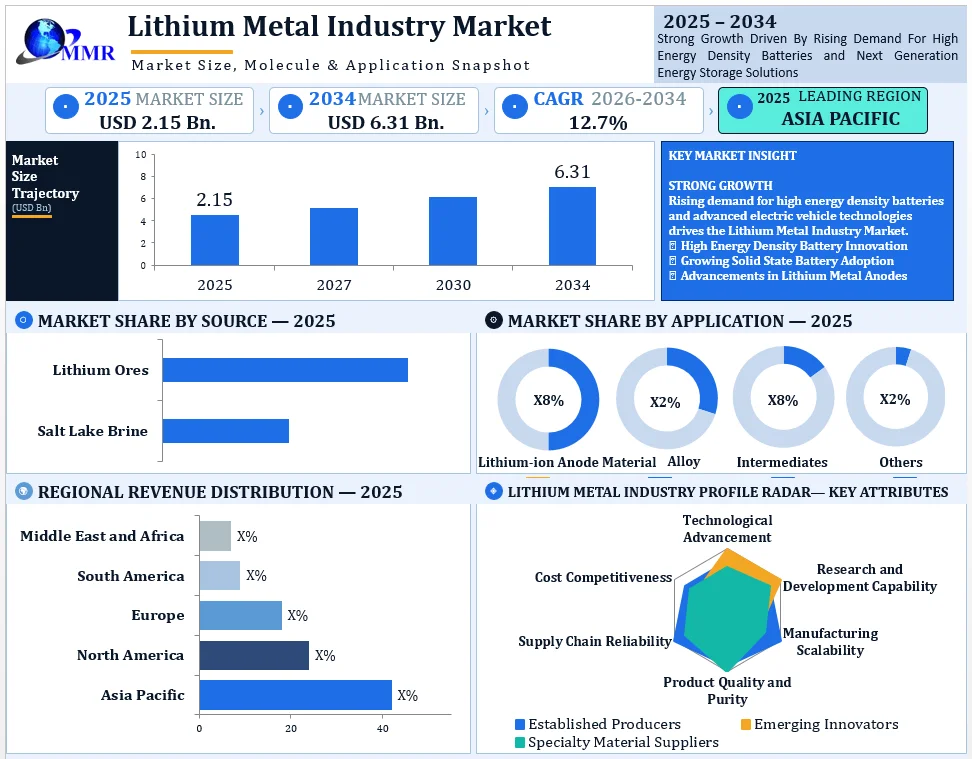
The Lithium Metal Industry size was valued at USD 2.15 Billion in 2025 and the total Lithium Metal revenue is expected to grow at a CAGR of 12.7% from 2026 to 2034, reaching USD 6.31 Billion by 2034.
Lithium Metal Industry Overview:
The Lithium Metal Industry Market comprises the production, refining, processing, and distribution of metallic lithium for advanced battery technologies, specialty chemicals, aerospace systems, and high-performance energy storage applications. Lithium metal is gaining importance because of its high electrochemical potential and lightweight properties, making it a promising material for lithium-metal batteries and next-generation solid-state battery technologies.
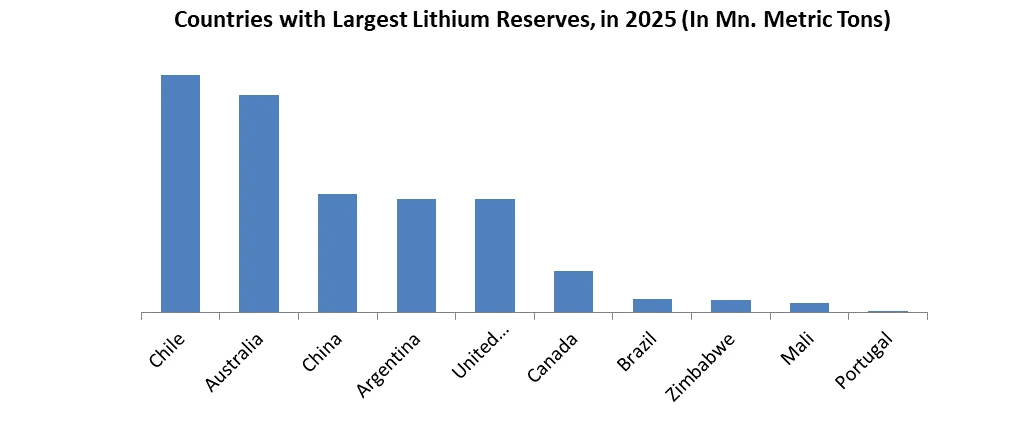
The Lithium Metal Industry Market is expanding as battery manufacturers, electric vehicle developers, energy storage companies, and advanced materials producers explore high-energy-density battery solutions and next-generation anode technologies. Asia Pacific remains a key region due to its established battery manufacturing ecosystem and lithium processing capabilities, while Australia is a leading lithium mining country, according to the U.S. Geological Survey (USGS). Industry participants, including Albemarle Corporation and Ganfeng Lithium Group, operate across the broader lithium supply chain, supporting the availability of lithium-based materials for downstream applications. The USGS and the International Energy Agency provide important data on lithium supply, critical mineral security, and battery supply chains, helping explain the market forces shaping investment and technology development.
The Lithium Metal Industry Market research by Maximize Market Research (MMR) examines market trends, growth drivers, restraints, emerging technologies, competitive landscape, and regional demand to identify commercial opportunities. Key growth opportunities include lithium-metal anode development, solid-state battery commercialization, advanced electric vehicle batteries, strategic material sourcing, and improvements in battery manufacturing processes. The report helps clients assess market positioning, supply-chain developments, investment potential, and future demand opportunities across the lithium metal industry.
Global Lithium Metal Industry Market Size, Growth and Share Analysis
To know about the Research Methodology :- Request Free Sample Report
Global Lithium Metal Industry Market Key Highlights
| Key Highlight |
Insight |
|---|---|
| Strong Market Growth Outlook |
The Lithium Metal Industry Market is valued at USD 2.15 billion in 2025 and is projected to reach USD 6.31 billion by 2034, registering a CAGR of 12.7% during 2026–2034. |
| Asia Pacific Leads the Market | Asia Pacific holds the leading regional position, supported by battery manufacturing capabilities, lithium processing infrastructure, and demand for advanced energy storage technologies. |
| Batteries Remain the Primary End User |
Battery applications are driving market development as manufacturers explore lithium metal anodes for electric vehicles, solid-state batteries, and high-energy-density storage systems. |
| Lithium Ores Strengthen Supply Availability | Lithium ores remain an important source of lithium feedstock, supported by established hard-rock mining and processing operations, while salt lake brine offers an alternative supply route. |
| Advanced Battery Technologies Create Growth Opportunities |
Solid-state battery research, thin lithium metal foils, surface protection technologies, and improvements in electrode stability are creating opportunities for manufacturers to improve battery performance and commercial viability. |
What does the bundle’s collection provide?
1. The collection includes individual reports that offer a comprehensive analysis of the lithium metal industry in specific regions.
2. The Lithium metal bundle report examines the global Lithium Metal Industry. It covers various aspects such as type, products, distribution channel, category, and end-users.
3. Included in the report are insights into growth drivers, upcoming challenges, trends, opportunities, risks, and entry barriers facing the industry.
4. The research methodology involves a detailed analysis of product-type literature, industry releases, annual reports, and other relevant documents from key industry participants.
5. The report emphasizes industry players' focus on technological advancements to establish dominance in the global Lithium Metal Industry. Key players are actively strengthening their market positions.
6. The report aims to provide valuable insights and an in-depth analysis of the Lithium Metal Industry, assisting stakeholders in making informed decisions and gaining a comprehensive understanding of market dynamics.
Unlock a wealth of knowledge about the Lithium Metal Industry with this economical bundle, offering a treasure trove of valuable information and insights. By purchasing this cost-effective package, you gain access to multiple reports at a reduced price than buying them individually. Don't miss out on the opportunity to delve into comprehensive analyses and valuable data on the lithium metal industry with this discounted collection.
The Future of Energy Storage and Transportation in the Lithium Metal Industry report bundle worth US$ 14000 can now be purchased at a reduced price of UD$ 12000
1. North America Lithium Metal Market (Single User $ 2900)
2. Asia Pacific Lithium Metal Market (Single User $ 2900)
3. Europe Lithium Metal Market (Single User $ 2900)
4. Middle East and Africa Lithium Metal Market (Single User $ 2900)
5. South America Lithium Metal Market (Single User $ 2900)
How this report will help you:
1. The report helps you to Gain valuable insights and make informed decisions for your business with this comprehensive report covering the main trends and drivers of the Lithium Metal Industry.
2. The report helps you to expand your market presence and identify growth opportunities in the lithium metal industry using this report.
3. The report helps you to discover potential areas for growth and investment with a detailed analysis of key sectors and major projects provided in this report.
4. Understand the impact of government policies on the Lithium Metal Industry, anticipate policy changes, and align your business strategies accordingly.
5. Plan for the future with historical and forecasted valuations of the Lithium Metal Industry. This will assist with budgeting, resource allocation, and goal-setting for upcoming market developments.
6. Implement effective risk mitigation strategies by identifying potential challenges, market volatility, and regulatory factors highlighted in this report.
Global Lithium Metal Industry Market Dynamics
Rising Demand for High Energy Density Batteries Drive Lithium Metal Industry Market Growth
The growing demand for high energy density batteries is driving the Lithium Metal Industry Market as electric vehicle manufacturers, battery developers, and energy storage companies seek materials that deliver higher energy capacity with reduced weight. Lithium metal offers a theoretical specific capacity of 3,860 milliampere-hours per gram, substantially higher than the 372 milliampere-hours per gram offered by graphite anodes, making it an important material for next-generation battery technologies. Increasing investments in electric mobility, portable electronics, and advanced battery research are encouraging manufacturers to develop lithium metal anodes for solid-state and lithium metal batteries. The growing need for longer driving ranges, faster charging capabilities, and improved battery performance is strengthening demand for high-purity lithium metal and supporting long-term Lithium Metal Industry Market growth.
High Manufacturing Costs and Lithium Metal Handling Risks Restraint Market Adoption
High production costs and the chemical reactivity of lithium metal remain significant restraints on Lithium Metal Industry Market development, particularly for manufacturers targeting large-scale battery production. Lithium metal requires controlled processing, specialized handling, moisture-free storage, and protective packaging to reduce the risk of unwanted chemical reactions. In rechargeable batteries, unstable electrode interfaces and continuous electrolyte consumption can reduce battery efficiency, shorten service life, and increase maintenance and replacement costs. Manufacturers must also invest in advanced purification, precision foil production, and quality control to achieve consistent material performance. These requirements can increase production complexity and create cost disadvantages compared with established graphite-based battery technologies, slowing the commercial adoption of lithium metal in price-sensitive applications.
Solid State Battery Innovation Creates New Opportunities for Lithium Metal Industry Market
Advancements in solid-state batteries, lithium-sulfur batteries, and high-performance energy storage systems are creating promising opportunities for the Lithium Metal Industry Market. Lithium metal has a theoretical specific capacity of approximately 3,860 milliampere-hours per gram, making it an attractive anode material for battery designs targeting higher energy density and reduced weight. Research into ultrathin lithium metal anodes, artificial protective layers, and advanced solid electrolytes is helping address technical barriers associated with conventional lithium metal electrodes. A further opportunity lies in electric aviation, premium electric vehicles, aerospace equipment, and compact electronic devices, where higher energy storage per unit of weight can provide substantial performance benefits. As battery developers work toward cell-level specific energy targets of around 500 watt-hours per kilogram by 2030, improved lithium metal manufacturing processes and commercially viable battery designs could create new demand for high-purity lithium metal and engineered anode materials.
Dendrite Formation and Battery Safety Requirements Challenge Lithium Metal Industry Market Development
Preventing lithium dendrite formation and maintaining stable battery performance throughout repeated charging cycles remain major challenges for the Lithium Metal Industry Market. Uneven lithium deposition can produce needle-like structures that penetrate battery separators, potentially causing internal short circuits and thermal runaway. Repeated charging and discharging can also create unstable surface layers, consume active lithium, and reduce the amount of energy a battery can deliver over its service life. These technical limitations require manufacturers to improve electrolyte formulations, separator protection, electrode surface coatings, and battery management systems without significantly increasing production costs or reducing energy density. In addition, scaling laboratory-tested materials into high-volume manufacturing requires consistent foil thickness, reliable material purity, and reproducible performance across production batches. Overcoming these challenges will be essential for improving battery safety, extending cycle life, and achieving commercially competitive lithium metal battery technologies.
Global Lithium Metal Industry Market Key Trends
| Market Trend | Description |
|---|---|
| Growing Adoption of Lithium Metal Anodes | Battery manufacturers are increasingly investigating lithium metal anodes to achieve higher energy density and reduce battery weight. With a theoretical specific capacity of 3,860 milliampere-hours per gram, lithium metal remains a promising material for advanced electric vehicle batteries and high-performance electronic devices. |
| Commercial Development of Solid State Batteries |
Battery developers are working to integrate lithium metal anodes with solid electrolytes to improve energy storage potential and address safety concerns associated with conventional liquid electrolytes. Progress in electrolyte compatibility, electrode stability, and manufacturing methods is influencing the commercial development of next-generation batteries. |
| Increasing Focus on Thin Lithium Metal Foils | Manufacturers are developing thinner lithium metal foils to reduce inactive material, improve cell-level energy density, and support compact battery designs. Greater control over foil thickness, surface quality, and material purity is becoming an important consideration for battery manufacturers seeking consistent electrode performance. |
| Advancements in Lithium Metal Surface Protection |
Research into artificial protective coatings, engineered electrode surfaces, and improved electrolyte formulations is gaining attention as manufacturers seek to reduce dendrite formation and unwanted chemical reactions. These developments aim to improve charging stability, extend battery cycle life, and increase the reliability of lithium metal battery systems. |
| Rising Demand for High Purity Lithium Metal | Battery producers and advanced material manufacturers are placing greater emphasis on lithium metal purity, consistent composition, and controlled processing conditions. Reliable material specifications are essential for reducing impurities, maintaining stable electrode interfaces, and meeting the performance requirements of advanced batteries and specialized industrial applications. |
| Greater Emphasis on Supply Chain Security and Processing Efficiency |
Lithium supply chain diversification and improvements in refining and processing efficiency are becoming important industry priorities. The International Energy Agency reported that lithium demand increased by around 25% annually on average over the previous two years, highlighting the need for dependable material supplies, although lithium metal production also depends on specialized downstream processing capabilities. |
Global Lithium Metal Industry Market Segment Analysis
By Source, Lithium ores are currently the leading source for lithium production, supported by established hard-rock mining operations, particularly in Australia and China, and their ability to supply lithium-bearing minerals such as spodumene for further processing. Salt lake brine remains an important source, especially in Chile, Argentina, and China, where lithium-rich brines are processed through evaporation or direct lithium extraction technologies. Lithium ores are trending in terms of production because hard-rock operations can support established supply chains and respond to demand through mining and processing capacity, while salt lake brine projects remain attractive for resource diversification and potentially competitive extraction costs. Continued improvements in lithium recovery, processing efficiency, and resource development are shaping competition between these two sources.
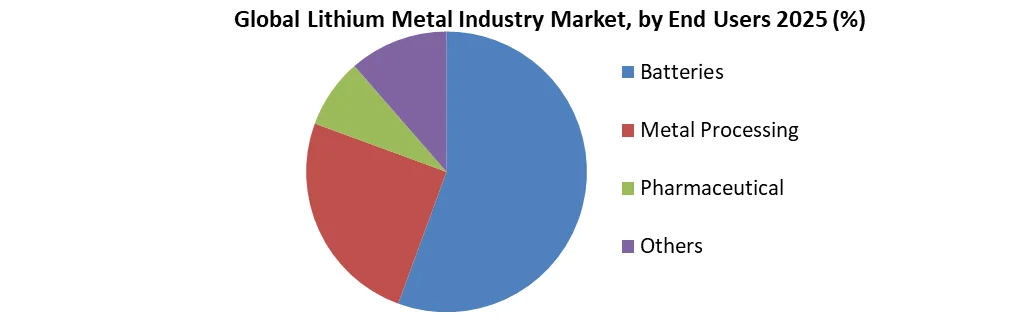
By end Users, The batteries segment is currently the leading and most prominent end user in the Lithium Metal Industry Market, driven by growing interest in high-energy-density batteries, solid-state battery development, and advanced energy storage technologies. Lithium metal is attracting battery manufacturers because of its high theoretical specific capacity and potential to improve energy storage performance in next-generation electric vehicles and portable electronic devices. Metal processing remains an important industrial application, where lithium metal is used in specialized metallurgical processes and material production. The pharmaceutical segment serves more specialized requirements, while other end users include research, chemical synthesis, and niche industrial applications. Continued investment in advanced battery research and efforts to improve lithium metal battery safety and cycle life are expected to reinforce the batteries segment's leading position.
Global Lithium Metal Industry Market Regional Analysis
Asia Pacific is the leading region in Lithium Metal Industry Market, supported by its established battery manufacturing ecosystem, advanced material processing capabilities, and strong demand for electric vehicles and consumer electronics. China, Japan, and South Korea remain important contributors through battery innovation, lithium metal processing, and investment in next-generation battery technologies.
North America is advancing in the Lithium Metal Industry Market through investments in domestic battery manufacturing, advanced energy storage research, and next-generation electric vehicle technologies. The United States is a key contributor, with growing interest in lithium metal anodes and solid-state batteries to strengthen local battery supply chains.
Europe is developing its Lithium Metal Industry Market through battery innovation, electric vehicle manufacturing, and efforts to establish more resilient material supply chains. Germany and France contribute through automotive engineering and battery research, while regional manufacturers are exploring advanced anode materials to improve battery performance and energy efficiency.
South America plays an important supporting role in the Lithium Metal Industry Market through its lithium resource base and upstream extraction activities. Chile and Argentina are key contributors to lithium brine production, supplying raw materials for downstream conversion and supporting the wider battery materials supply chain.
Middle East and Africa represent an emerging region for the Lithium Metal Industry Market, with opportunities linked to mineral resource development, industrial diversification, and investment in battery-related supply chains. African lithium-producing countries are attracting interest in extraction and local processing, while Middle Eastern economies are exploring battery materials and energy storage as part of broader industrial development.
Global Lithium Metal Industry Competitive Landscape
The Lithium Metal Industry Market is characterized by competition among established lithium producers, specialty chemical manufacturers, and emerging battery technology developers. Key companies such as Albemarle Corporation, Ganfeng Lithium Group, Tianqi Lithium Corporation, Livent Corporation, China Lithium Products, and Chengxin Lithium Group compete through lithium metal production capabilities, material purity, processing efficiency, supply chain integration, and product quality. Market participants are increasingly focusing on high-purity lithium metal, thin lithium metal anodes, and advanced battery materials to meet the evolving requirements of electric vehicle batteries, solid-state battery systems, and high-performance energy storage applications. Companies with reliable raw material access, specialized manufacturing expertise, and strong research and development capabilities are well positioned to strengthen their competitive presence. Strategic collaborations with battery manufacturers, improvements in lithium metal processing technologies, and investments in next-generation battery development are expected to shape the competitive landscape and create new growth opportunities in the Lithium Metal Industry Market.
| Region | Country | Company | Market Relevance and Competitive Advantage |
|---|---|---|---|
| Asia Pacific | China | Ganfeng Lithium Group | A major lithium metal producer with integrated capabilities spanning lithium resource development, metal refining, lithium foil, and battery manufacturing. Its value-chain integration supports demand from advanced battery manufacturers. |
| Asia Pacific |
China | Chengxin Lithium Group |
Manufactures lithium metal and lithium compounds, with production capabilities supporting specialty chemical applications and the development of advanced battery materials. |
| Asia Pacific | China | Tianqi Lithium | An established lithium resource and processing company with hard-rock supply chain exposure. Its strategic relevance lies in providing upstream lithium feedstock and processed materials for downstream battery applications. |
| North America |
United States |
Albemarle Corporation |
Supplies lithium metal products, including foils and ultra-thin foils, alongside other specialty lithium materials. Its established processing expertise supports industrial applications and next-generation battery development. |
| North America | United States | Livent, now part of Rio Tinto | Has an established background in lithium metal and specialty lithium products. Its relevance includes supplying advanced battery materials and supporting lithium metal anode development through its legacy operations. |
| Europe | Germany | Chemetall, part of BASF |
Has a specialty materials and lithium processing background relevant to industrial lithium applications. Its market position is associated with technical expertise in lithium metal products and specialized material handling. |
| South America | Chile | Sociedad Química y Minera de Chile | A significant lithium resource and brine-based producer. Its principal competitive relevance is upstream lithium supply, which supports the broader lithium processing and battery materials value chain rather than establishing it as a leading lithium metal manufacturer. |
| Middle East and Africa |
Zimbabwe | Sinomine Resource Group |
Its lithium mining and processing activities in Zimbabwe contribute to the upstream supply of lithium-bearing materials. Its relevance to the lithium metal industry is primarily through feedstock availability for downstream conversion. |
Global Lithium Metal Industry Recent Development
| Month and Year | Company | Recent Development |
|---|---|---|
| February 2026 | Century Lithium | Century Lithium reported an updated feasibility study for its Angel Island lithium project in Nevada, outlining project economics and operating cost estimates relevant to future domestic lithium supply. |
| June 2026 | Tianqi Lithium |
Tianqi Lithium reported that its Chongqing project, designed for annual production of 1,000 tonnes of lithium metal and supporting raw materials, entered trial production on 15 June as the company worked toward completing safety and licensing requirements. |
| July 2026 | Century Lithium | Century Lithium announced that lithium carbonate from its Angel Island project had been converted into lithium metal by Alpha-En and incorporated into cylindrical battery cells manufactured by EaglePicher Technologies, with initial testing showing improved power performance against control cells. |
| August 2026 |
Ganfeng Lithium Group |
Ganfeng Lithium Group reported that Phase One of its Qinghai lithium metal project, with planned capacity of 1,000 tonnes annually, had reached trial production, with commissioning expected during the third quarter of 2026. |
| September 2026 | Century Lithium | Century Lithium announced progress on plans for a chlor-alkali plant at its Angel Island project, advancing integrated processing infrastructure intended to support the project's development and reagent supply strategy |
Lithium Metal Industry Scope: Inquire before buying
| Lithium Metal Industry | |||
|---|---|---|---|
| Report Coverage | Details | ||
| Base Year: | 2025 | Forecast Period: | 2026-2034 |
| Historical Data: | 2020 to 2025 | Market Size in 2025: | USD 2.15 Bn. |
| Forecast Period 2026 to 2034 CAGR: | 12.7% | Market Size in 2034: | USD 6.31 Bn. |
| Segments Covered: | by Source | Salt Lake Brine Lithium Ores |
|
| by Application | Lithium-ion Anode Material Alloy Intermediates Others |
||
| by End-users | Batteries Metal Processing Pharmaceutical Others |
||
Lithium Metal Industry Key Players:
1. Albemarle Corporation
2. Alpha-En Corporation
3. Altura Mining Limited
4. American Elements
5. China Energy Lithium Co., Ltd.
6. China Lithium Products Technology Co., Ltd.
7. CNNC Jianzhong Nuclear Fuel Co., Ltd.
8. European Lithium Limited
9. European Metals Holdings Limited
10. Galaxy Resources Limited
11. Ganfeng Lithium Group Co., Ltd.
12. JSC Chemical Metallurgical Plant
13. Li-Metal Corp.
14. Lithium Americas Corp.
15. Livent Corporation
16. Manosanthi Group of Company
17. Otto Chemie Pvt. Ltd.
18. Oxford Lab Fine Chem LLP
19. Pilbara Minerals Limited
20. Pure Lithium Corporation
21. Shandong Ruifu Lithium Industry Co., Ltd.
22. Shanghai China Lithium Industrial Co., Ltd.
23. Shenzhen Chengxin Lithium Group Co., Ltd.
24. Sion Power Corporation
25. Spectrum Chemical
26. SQM
27. The Honjo Chemical Corporation
28. Tianqi Lithium Corporation
29. TRU Group Inc.
30. Zimbabwe Lithium Company
31. Thermo Fisher Scientific Inc.
32. Merck KGaA
33. Nanoshel LLC
34. UACJ Foil Corporation
35. Mitsubishi Chemical Group Corporation
36. Umicore
37. POSCO Holdings Inc.
38. LG Chem Ltd.
39. Samsung SDI Co., Ltd.
40. Panasonic Holdings Corporation
41. QuantumScape Corporation
42. Solid Power, Inc.
43. Goodfellow Cambridge Limited
44. MTI Corporation
45. TOB New Energy Technology Co., Ltd.
Global Lithium Metal Industry Market – Frequently Asked Questions
1. Which region has the largest share in the Lithium Metal Industry Market?
Ans: Asia Pacific held the leading position in the Lithium Metal Industry Market in 2025.
2. What is the growth rate of the Lithium Metal Industry Market?
Ans: The Lithium Metal Industry Market is projected to grow at a CAGR of 12.7% during the forecast period from 2026 to 2034.
3. What is the scope of the Lithium Metal Industry Market report?
Ans: The report covers market dynamics, regional analysis, competitive landscape, key growth opportunities, PESTEL analysis, PORTER analysis, and market forecasts.
4. Who are the key players in the Lithium Metal Industry Market?
Ans: Key players include Albemarle Corporation, Ganfeng Lithium Group, Tianqi Lithium, American Elements, Chengxin Lithium Group, Li-Metal Corp., and Livent Corporation.
5. What is the study period of the Lithium Metal Industry Market?
Ans: The Lithium Metal Industry Market is studied from 2020 to 2034.