
Robotic Grippers Market– Industry Structure Evaluation, Demand Drivers Analysis, Regional Growth Analysis and Identification, Competitive Positioning Review & Global Market Size Forecast to 2032
Overview
Global Robotic Grippers Market Size to Reach USD 3.69 Billion by 2032 from USD 1.8 Billion in 2025 at a CAGR of 10.8%, Driven by Smart Manufacturing, Cobots, AI-Enabled Grippers, and Industrial Automation
Robotic Grippers Market Overview
Industrial automation is moving beyond fixed robotic systems toward intelligent, flexible, and application-specific handling technologies, making robotic grippers one of the fastest-evolving components within modern manufacturing automation. As industries adopt collaborative robots, smart factories, and AI-enabled production lines, demand for robotic grippers is expanding from simple pick-and-place operations to precision handling, adaptive gripping, machine vision integration, and complex material manipulation.
The global Robotic Grippers Market was valued at USD 1.8 Billion in 2025 and is projected to reach USD 3.69 Billion by 2032, growing at a CAGR of 10.8% during the forecast period (2026–2032). Market growth is driven by increasing deployment of industrial robots, collaborative robots (cobots), warehouse automation, e-commerce logistics, and Industry 4.0-enabled manufacturing systems across automotive, electronics, food & beverage, pharmaceuticals, and logistics industries.
Robotic grippers have evolved from conventional end-of-arm accessories into intelligent handling systems that enable precise gripping, positioning, sorting, assembly, packaging, inspection, and material transfer across automated production environments. Advances in electric actuation, force sensing, adaptive gripping, soft robotics, and machine vision have expanded their role across both industrial robots and collaborative robots.
The market is increasingly shaped by the transition toward flexible manufacturing, shorter production cycles, high product variety, and frequent changeovers. As manufacturers digitize production under Industry 4.0 initiatives, robotic grippers are becoming critical for improving production flexibility, reducing manual intervention, and enabling application-specific automation across automotive, electronics, pharmaceuticals, logistics, food processing, and warehouse operations.
Robotic Grippers Market Size and Forecast
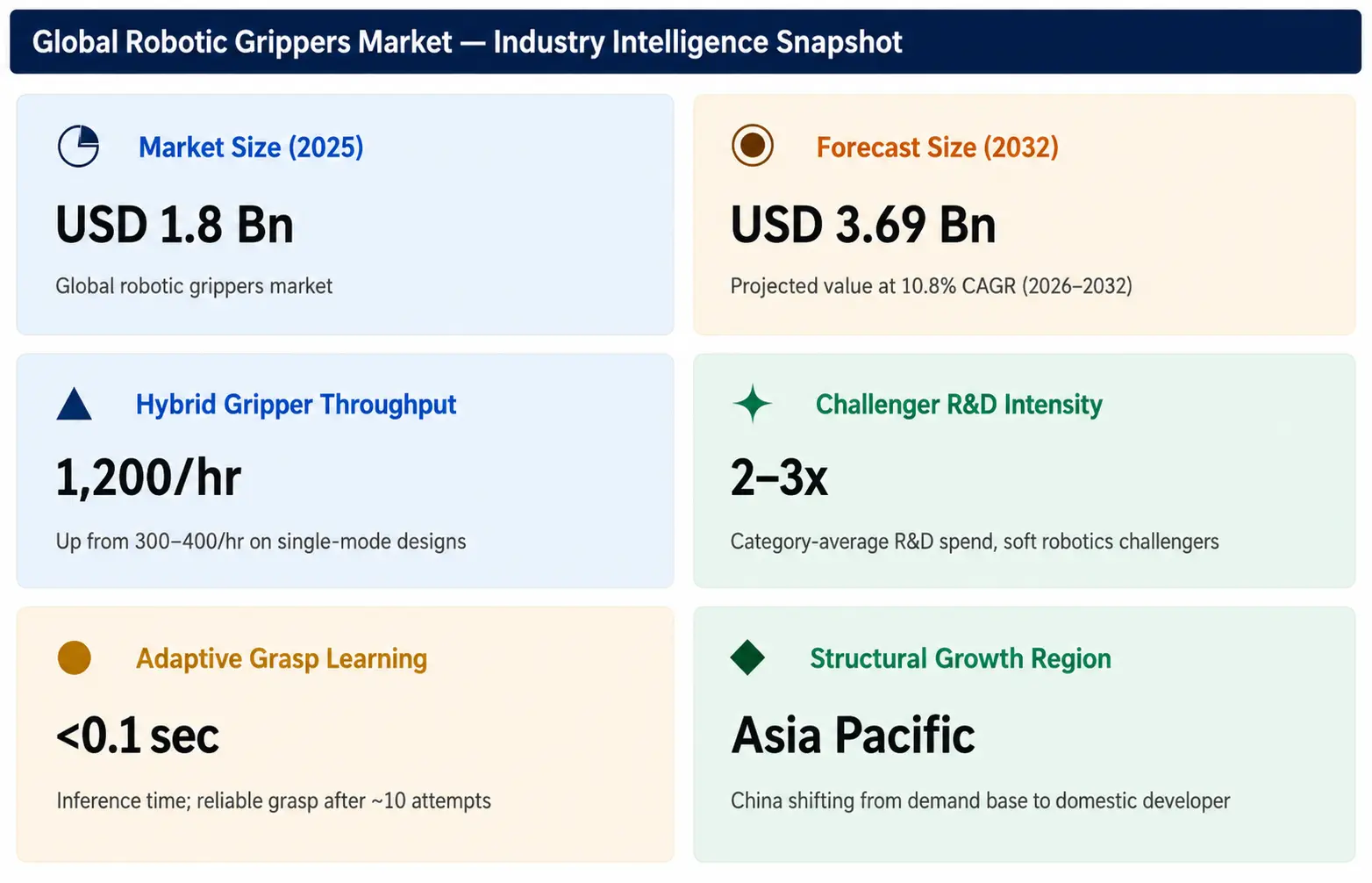
To know about the Research Methodology :- Request Free Sample Report
Robotic Grippers Market Trends: Intelligent Automation, Adaptive Gripping, and Supply Chain Transformation
The Robotic Grippers Market is entering a new growth phase as manufacturers prioritize intelligent automation, flexible production systems, and application-specific gripping technologies. Increasing SKU complexity, shorter manufacturing cycles, and demand for rapid production changeovers are accelerating adoption of adaptive, modular, and sensor-enabled grippers across industrial automation environments. Technology competition is expanding beyond pneumatic and vacuum grippers toward electric, magnetic, soft robotic, adaptive, sensorized, and AI-enabled gripping solutions that improve handling precision, object recognition, force control, and integration with machine vision systems.
Supply-chain conditions are also influencing the Global Robotic Grippers Market, particularly for precision actuators, force sensors, electronics, specialty elastomers, and controllers. Component cost fluctuations and procurement risks are encouraging greater focus on supplier diversification, localization, standardization, and production scalability.
Technology competition is intensifying as mechanical, pneumatic, and vacuum grippers compete with electric, adaptive, magnetic, soft robotic, sensorized, and AI-enabled solutions. These technologies are expanding automation opportunities across automotive, electronics, food & beverage, pharmaceuticals, logistics, and warehousing, particularly for delicate, irregular, and variable products. At the same time, customers increasingly value ease of integration, faster changeovers, sensing, software, and lifecycle support, shifting competition beyond hardware performance toward application-specific and intelligent gripping solutions.

Robotic Grippers Market Value Chain and Value Capture Analysis
The Robotic Grippers Market operates through a multi-layer value chain that includes precision component suppliers, gripper manufacturers, robot OEMs, automation system integrators, distributors, software providers, and aftermarket service partners. Value creation is increasingly shifting from conventional hardware manufacturing toward intelligent gripping technologies, application engineering, software integration, predictive maintenance, and lifecycle support services.
The Global Robotic Grippers Market spans a multi-stage value chain encompassing precision components, sensing and actuation technologies, gripper design and manufacturing, system integration, deployment, and aftermarket services. Value capture varies across these stages, with differentiation increasingly driven by engineering capabilities, application-specific customization, intelligent gripping, integration expertise, and lifecycle support. As robotic automation becomes more flexible and application-focused, higher-value opportunities are emerging beyond conventional gripper hardware.
• Component suppliers capture high-volume value, with margins influenced by specialization, precision, and component differentiation
• Gripper manufacturers and system integrators capture significant technical value-add through engineering, customization, intelligent functionality, and integration capabilities
• Aftermarket and lifecycle services represent an expanding recurring-revenue and higher-margin value pool through maintenance, replacement parts, upgrades, and optimization.
Installed Robot Base: Long-Term Aftermarket Revenue Driver
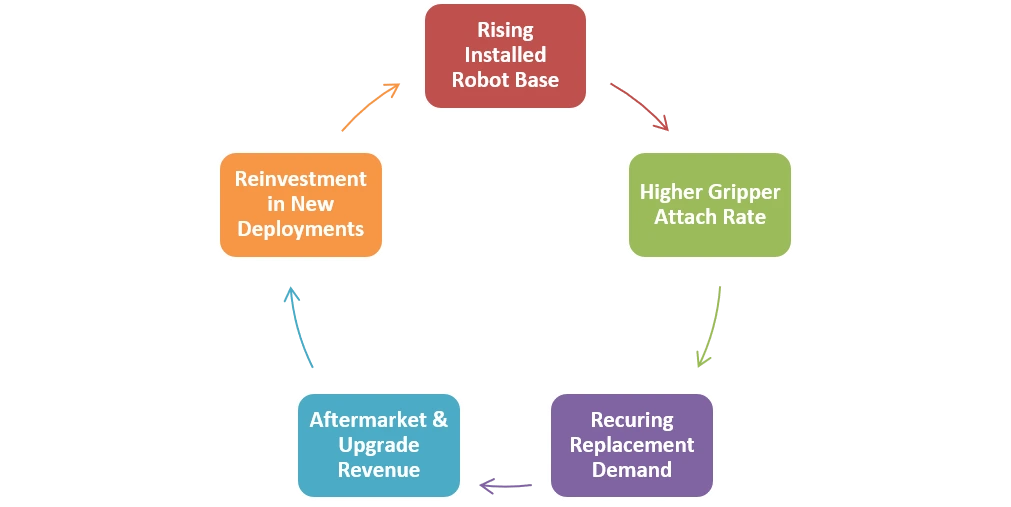
Every new industrial robot installation expands the addressable installed base for robotic grippers, creating recurring demand through replacement grippers, additional end-of-arm tooling, retrofit projects, maintenance, and software-enabled upgrades. Since gripper replacement cycles are generally shorter than robot arm lifecycles, the installed robot base creates a recurring revenue stream for OEMs, gripper manufacturers, and service providers..
• Gripper replacement and upgrade cycles are generally shorter than robot arm lifecycles, creating recurring demand opportunities
• A growing installed robot base creates a structurally recurring revenue pool for gripper manufacturers through replacements, additional tooling, upgrades, and application expansion
• Flywheel strength depends on installed-base penetration, service network coverage, OEM and integrator partnerships, and customer retention
Installed Robot Base- Recurring Gripper Demand Flywheel
Higher Gripper Intensity Per Robot: Increasing Revenue Opportunity
As production lines become more flexible and product portfolios expand, manufacturers increasingly deploy multiple grippers or interchangeable end-of-arm tooling on a single robot. Industries with high SKU diversity, rapid changeovers, and delicate component handling require a greater number of grippers per robot, increasing tooling intensity and expanding recurring aftermarket opportunities.
• Electronics and high-mix assembly typically exhibit higher gripper intensity due to frequent product changeovers, smaller components, and diverse handling requirements
• Metal fabrication and standardized F&B applications generally exhibit lower intensity where production runs and tooling configurations are more standardized
• Rising gripper intensity increases tooling demand, replacement potential, and aftermarket revenue per installed robot.
Gripper Intensity per Robot in 2025

Robotic Grippers Market Supply Chain Dependency and Localization and Component Resilience
The robotic gripper supply chain remains highly dependent on precision actuators, force sensors, controllers, semiconductors, specialty elastomers, magnets, and electronic components sourced through a concentrated supplier ecosystem. Supply chain resilience is becoming a competitive differentiator as manufacturers adopt multi-sourcing strategies, regional production hubs, standardized component architectures, and localized procurement to reduce geopolitical and logistics risks.
• Precision actuators and force sensors represent key supply-chain dependency points due to specialized manufacturing and limited qualified suppliers
• Asia-Pacific remains a critical sourcing hub, particularly for electronics, actuators, sensors, and precision components used in robotic gripper systems
• Germany, South Korea, and the U.S. are strengthening their roles in precision automation technologies, supporting greater supplier diversification and regionalization
Supply-chain resilience is increasingly becoming a competitive factor, with leading gripper manufacturers prioritizing multi-sourcing, supplier qualification, localization, and component standardization.
Supply-Chain Dependency Map 2025

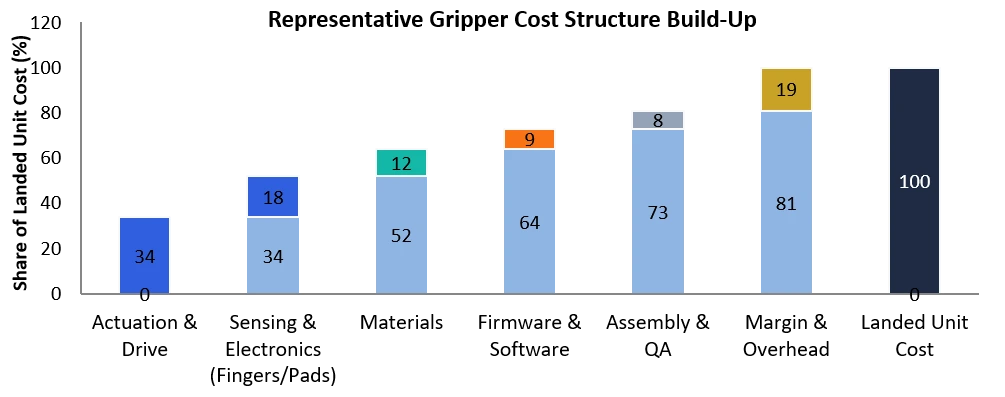
Gripper Economics: From Component Costs to Value Capture
Robotic gripper economics extend beyond component manufacturing, as manufacturers determine landed costs through actuation and drive systems, sensing and electronics, materials, firmware and software, assembly, quality assurance, and associated overheads. As manufacturers integrate more electric, sensor-enabled, adaptive, and software-enabled technologies into grippers, the cost structure is gradually shifting toward higher-value technology layers. This shift enables manufacturers to improve value capture through component optimization, intelligent functionality, application-specific engineering, and differentiated performance while maintaining cost competitiveness across diverse automation applications.
Representative Gripper Landed-Cost Build-Up by Component Category 2025
Robotic Grippers Market Competitive Landscape and Innovation Analysis
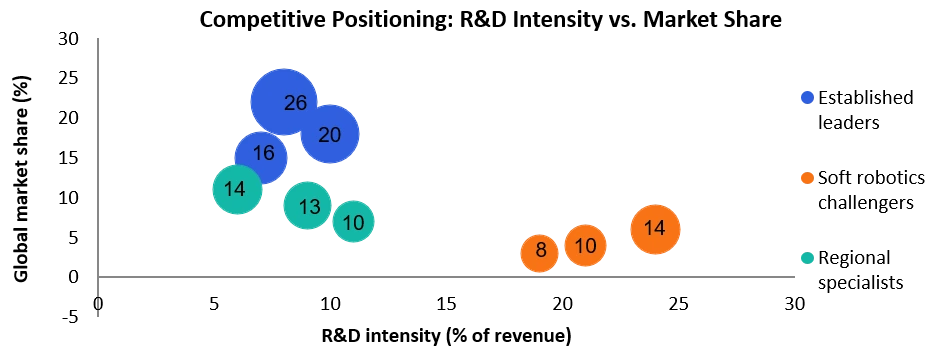
Competitive differentiation is increasingly determined by intelligent software integration, modular product architecture, precision engineering, cobot compatibility, lifecycle services, and scalable manufacturing capabilities rather than hardware performance alone.
Research and development, patent activity, and product innovation have become important competitive differentiators. While leading companies continue to expand their portfolios through acquisitions and strategic partnerships, newer technology providers are focusing on adaptive and intelligent gripping solutions for high-growth industries such as electronics, logistics, healthcare, and food processing. As automation requirements continue to evolve, companies that combine technological innovation with scalable manufacturing capabilities are expected to strengthen their competitive position in the global robotic gripper market.
Robotic Grippers Market Regional Outlook and Growth Opportunities
The robotic gripper market is witnessing varied growth patterns across regions, driven by differences in manufacturing maturity, automation investments, labour availability, and industrial policies. North America continues to benefit from reshoring initiatives and increasing demand for advanced factory automation, while Europe emphasizes precision manufacturing, sustainability, and collaborative automation across key industries.
Asia Pacific remains the largest and fastest-growing Robotic Grippers Market, supported by its leadership in industrial robotics manufacturing, electronics production, automotive automation, semiconductor manufacturing, and precision engineering. China, Japan, South Korea, and India continue to expand investments in smart manufacturing and industrial automation, strengthening regional demand for robotic grippers. North America is driven by warehouse automation, reshoring initiatives, collaborative robots, aerospace automation, and advanced manufacturing investments, while Europe continues to emphasize precision manufacturing, machine safety, sustainability, and Industry 4.0-enabled production systems.
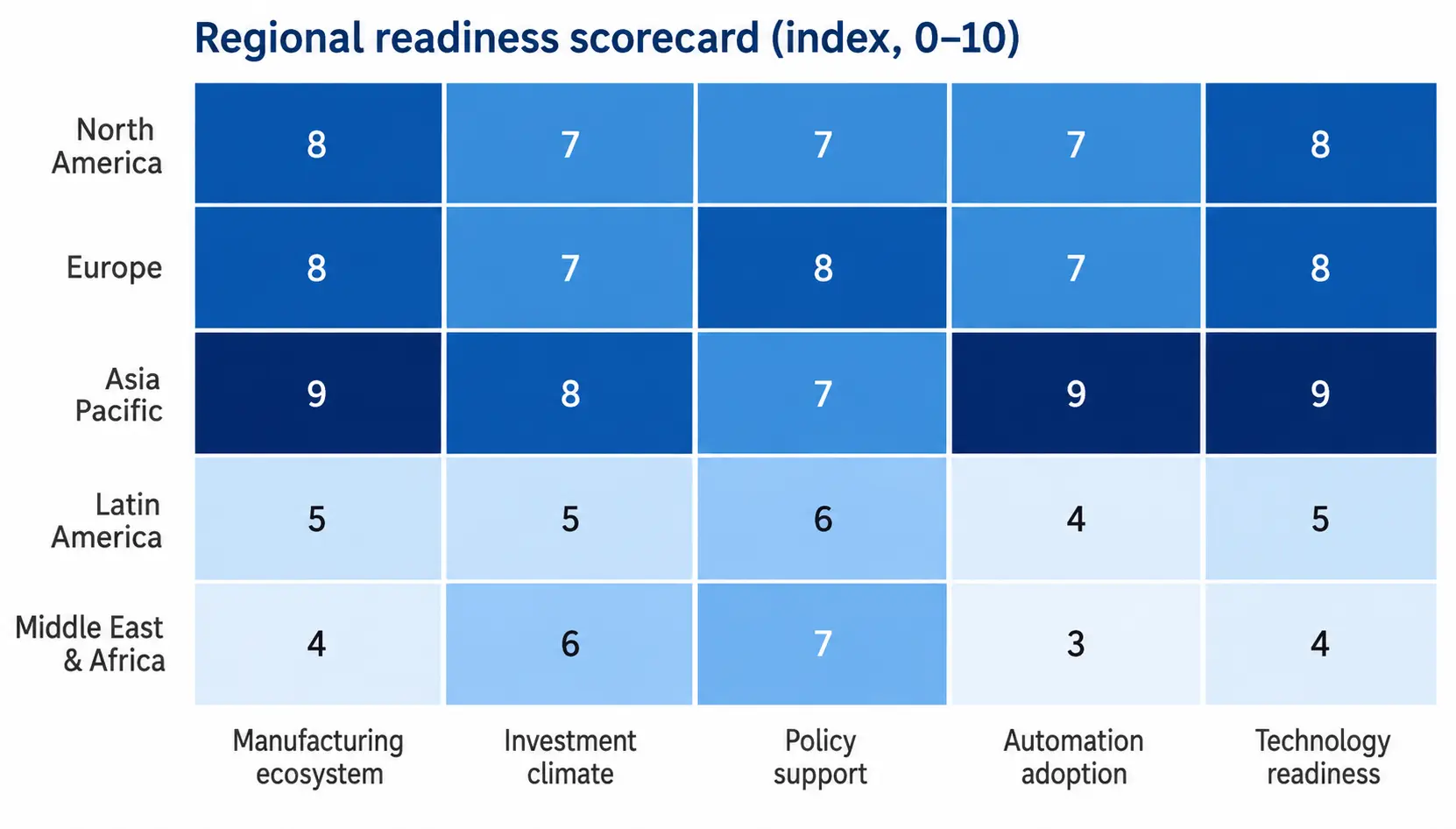
South America and the Middle East & Africa are gradually increasing the adoption of robotic grippers through investments in industrial modernization, logistics automation, and government-supported manufacturing initiatives. Although these regions currently account for a smaller market share, continued infrastructure development and expanding automation projects are expected to create new growth opportunities during the forecast period.
Robotic Grippers Market Investment Trends and Strategic Opportunities
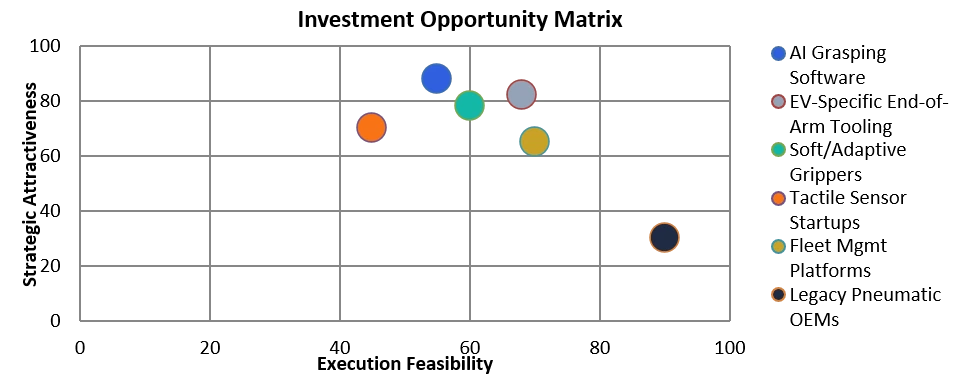
Investment activity in the Robotic Grippers Market is increasingly concentrated around electric grippers, adaptive gripping systems, AI-enabled gripping intelligence, machine vision integration, tactile sensing, and soft robotic technologies. Strategic acquisitions, partnerships with robot OEMs, and investments in scalable manufacturing facilities are accelerating commercialization across logistics automation, electronics assembly, pharmaceuticals, warehouse robotics, and collaborative automation applications.
The robotic gripper market is attracting increasing investment as automation technologies continue to evolve across manufacturing, logistics, healthcare, and warehouse operations. Investment activity is expanding across both established mechanical gripping technologies and next-generation solutions such as soft robotics, artificial intelligence, machine vision, and tactile sensing. Growing demand for flexible automation is encouraging investors to support companies developing intelligent and application-specific gripping systems.
The market is also witnessing an increase in strategic acquisitions and partnerships as leading automation companies strengthen their technology portfolios and expand their product offerings. Rather than relying solely on in-house development, several industry participants are acquiring specialized gripping technologies to accelerate innovation and address evolving customer requirements. As the market continues to mature, companies that combine proven mechanical performance with intelligent sensing, software integration, and scalable manufacturing capabilities are expected to attract greater investment and create long-term growth opportunities.
Robotic Grippers Market Scope: Inquire before buying
| Robotic Grippers Market | |||
|---|---|---|---|
| Report Coverage | Details | ||
| Base Year: | 2025 | Forecast Period: | 2026-2032 |
| Historical Data: | 2020 to 2025 | Market Size in 2025: | USD 1.8 Bn. |
| Forecast Period 2026 to 2032 CAGR: | 10.8% | Market Size in 2032: | USD 3.69 Bn. |
| Segments Covered: | by Type | Pneumatic Grippers Electric Grippers Servo-Electric Grippers Two-Finger Grippers Three-Finger Grippers Vacuum Grippers Magnetic Grippers Hydraulic Grippers Soft Robotic Grippers Adhesive & Hybrid Grippers |
|
| by Design | Two-Finger Grippers Three-Finger Grippers Flexible-Finger Grippers Angular Grippers Parallel Grippers |
||
| by Application | Pick-and-Place Operations Assembly & Component Handling Packaging & Palletizing Machine Tending Bin Picking & Sorting Quality Inspection & Vision-Assisted Handling Material Transfer & Logistics Automation Others |
||
| by Robot Type | Industrial Robots Collaborative Robots (Cobots) Mobile Robots SCARA Robots Articulated Robots Delta Robots Other Robots |
||
| by End-Use Industry | Automotive Manufacturing Electronics & Semiconductor Manufacturing Food & Beverage Processing Pharmaceuticals & Healthcare E-commerce, Warehousing & Logistics Consumer Goods & Packaging Aerospace & Defense Metal & Machinery Manufacturing Others |
||
1. Industrial Mechanical & Pneumatic Robotic Gripper Manufacturers
These companies manufacture parallel grippers, angular grippers, pneumatic grippers, and mechanical end-of-arm tooling for industrial automation.
Europe
1. SCHUNK SE & Co. KG – Germany
2. Zimmer Group – Germany
3. Festo SE & Co. KG – Germany
4. Weiss Robotics GmbH & Co. KG – Germany
5. FIPA GmbH – Germany
Asia Pacific
1. SMC Corporation – Japan
2. IAI Corporation – Japan
3. DH-Robotics Technology Co., Ltd. – China
North America
1. DESTACO – United States
2. Applied Robotics, Inc. – United States
3. SAS Automation – United States
4. EMI Corp. – United States
2. Collaborative Robot (Cobot) & Adaptive Robotic Gripper Manufacturers
These companies specialize in intelligent, flexible, and adaptive grippers designed for collaborative robots and flexible automation.
North America
1. Robotiq Inc. – Canada
2. Soft Robotics Inc. – United States
3. Grabit Inc. – United States
Europe
1. OnRobot A/S – Denmark
2. Effecto Group – Italy
3. SoftGripping (Wegard GmbH) – Germany
Asia Pacific
1. DH-Robotics Technology Co., Ltd. – China
3. Vacuum, Suction & Material Handling Gripper Manufacturers
These companies provide vacuum-based robotic gripping solutions for packaging, electronics, logistics, and material handling applications.
Europe
1. Piab AB – Sweden
2. FIPA GmbH – Germany
North America
1. ATI Industrial Automation, Inc. – United States
2. SAS Automation – United States
Asia Pacific
1. SMC Corporation – Japan
4. Robotic Automation & Integrated End-of-Arm Tooling Providers
These companies provide complete robotic systems, EOAT technologies, and automation solutions incorporating robotic grippers.
Europe
1. ABB Ltd. – Switzerland
2. KUKA AG – Germany
3. SCHUNK SE & Co. KG – Germany
North America
1. ATI Industrial Automation, Inc. – United States
2. Bastian Solutions, Inc. – United States
3. DESTACO – United States
Asia Pacific
1. SMC Corporation – Japan
5. Customized Robotic Gripper & Automation Component Manufacturers
These companies develop customized gripping systems and specialized end-effectors for unique industrial applications.
North America
1. Dorner Mfg. Corp. – United States
2. EMI Corp. – United States
3. Applied Robotics, Inc. – United States
Europe
1. Zimmer Group – Germany
2. Weiss Robotics GmbH & Co. KG – Germany
3. Effecto Group – Italy
Key Questions Answered
• What is the future of AI-enabled and adaptive robotic grippers across high-mix manufacturing environments?
• How are global players differentiating their portfolios amid the shift toward electric, sensor-integrated, and flexible grippers?
• Which countries offer the strongest growth potential for robotic gripper adoption through 2032?
• Who is gaining competitive advantage through cobot-compatible, plug-and-play and application-specific gripping solutions?
Why This Report?
This report provides strategic insights into the global Robotic Grippers Market across industrial automation, collaborative robotics, warehouse automation, and intelligent end-of-arm tooling applications. It evaluates market size, technology evolution, investment opportunities, competitive positioning, and regional growth trends across key manufacturing industries.
This 300+ page analysis unpacks
• Competitive Battlefield: Established automation companies, emerging technology providers, R&D, patent activity, acquisitions, partnerships and product innovation
• Value Chain Intelligence: Component suppliers, gripper manufacturers, system integrators, deployment, aftermarket services and value-capture opportunities
• Technology & Segment Intelligence: Mechanical, pneumatic, vacuum, electric, magnetic, adaptive, soft robotic, sensorized and AI-enabled gripping solutions
• Regional & Strategic Outlook: Asia Pacific, North America, Europe, Latin America and Middle East & Africa, including manufacturing ecosystems, automation investments, supply-chain localization and emerging opportunities
Access the full report now: Request Free Sample Report
Frequently Asked Questions
1] What is the projected market size and growth rate for the Global Robotic Grippers Market through 2032?
Ans. The Robotic Grippers Market was valued at USD 1.8 Billion in 2025 and is projected to reach USD 3.69 Billion by 2032, growing at a CAGR of 10.8% during the forecast period (2026–2032).
2] Which region leads the Global Robotic Grippers Market?
Ans. Asia Pacific remains the largest and fastest-growing regional market, supported by its strong manufacturing base and increasing industrial robotics adoption across China, Japan, South Korea and Southeast Asia.
3. What is driving the growth of the Robotic Grippers Market?
Answer: Growth is driven by increasing deployment of industrial robots, collaborative robots (cobots), warehouse automation, AI-enabled gripping systems, machine vision integration, and Industry 4.0-enabled manufacturing across automotive, electronics, logistics, food processing, pharmaceuticals, and semiconductor industries.
4] How is higher gripper intensity per robot influencing market opportunities?
Ans. Increasing product variety, SKUs and changeovers are raising gripper requirements per robot, particularly in electronics and high-mix assembly, supporting higher tooling and aftermarket revenue.
5] How are supply-chain challenges affecting the market?
Ans. Dependence on precision actuators, force sensors, electronics, and specialized materials is encouraging multi-sourcing, localization, supplier diversification, and component standardization.
6] How is technology competition changing the robotic gripper market?
Ans. Competition is shifting from conventional pneumatic and mechanical grippers toward electric, adaptive, magnetic, soft-robotic, sensorized, and AI-enabled solutions, with greater emphasis on flexibility and integration.
7] Where are the major investment opportunities in the market?
Ans. Key opportunities include AI, machine vision, tactile sensing, soft robotics, intelligent gripping, software integration, and application-specific solutions, supported by strategic partnerships and acquisitions.