
Data Center Battery / BESS Market by System Type, Battery, Data Center, Application, Storage Capacity and Region – Global Industry Analysis and Forecast to 2034
Overview
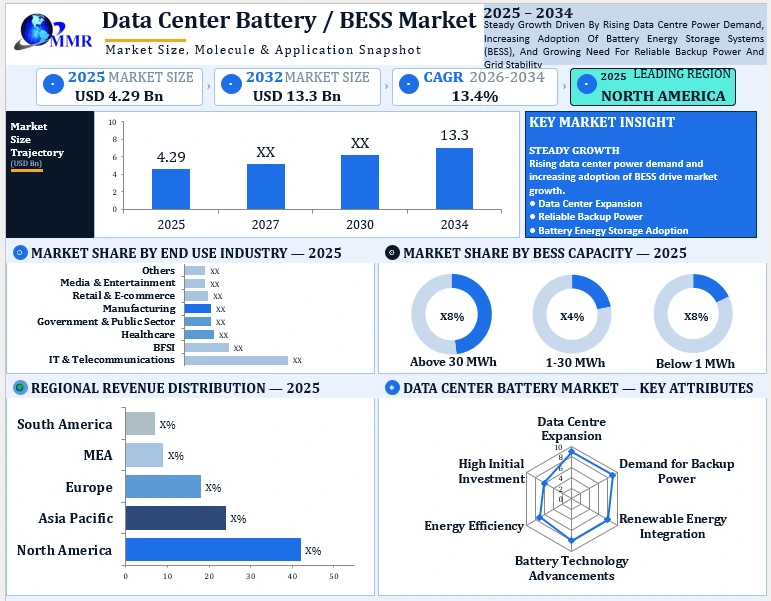
Data Center BESS Market was valued at USD 4.29 Billion in 2025 and is projected to reach USD 13.3 Billion by 2034 at 13.4% CAGR, driven by AI data centers, lithium-ion UPS and energy storage.
Global Data Center BESS Market Overview
The Data Center Battery Energy Storage System (BESS) Market comprises advanced energy storage technologies designed to provide uninterrupted power supply, emergency backup, peak load management, grid stabilization and renewable energy integration across mission-critical data centers. These systems include Uninterruptible Power Supply (UPS) batteries, lithium-ion batteries, lead-acid batteries, lithium iron phosphate (LFP), nickel-zinc batteries, battery management systems (BMS) and power conversion systems (PCS). Conventional UPS batteries typically provide 5–15 minutes of backup power, while BESS installations can support 1–4 hours or longer, depending on system configuration. Increasing adoption of advanced battery technologies is improving power reliability, operational efficiency and energy resilience across AI-driven and hyperscale data centers.
The Global Data Center Battery / BESS Market is expanding due to rising investments in artificial intelligence, hyperscale data centers, cloud computing and high-performance computing infrastructure. According to the International Energy Agency (IEA), global data center electricity consumption increased by 17% to approximately 485 TWh in 2025 and is projected to reach 950 TWh by 2030. Additionally, global data center battery storage installations could reach 20–25 GW by 2030. North America represents a major market, supported by extensive digital infrastructure and increasing electricity requirements. Companies such as Vertiv, Schneider Electric, CATL, Tesla and EnerSys are advancing lithium-ion UPS systems, intelligent energy storage solutions and grid-interactive battery technologies to support growing data center power requirements.
The Maximize Market Research (MMR) report provides a detailed analysis of the Global Data Center Battery / BESS Market, covering historical trends from 2021–2025 and forecasts for 2026–2034. The study examines market dynamics, battery technology adoption, UPS modernization, AI-driven infrastructure expansion, renewable energy integration and emerging BESS applications. It includes segmentation by system type, battery chemistry, data center type, application, storage capacity and end-use industry, along with regional insights across five major regions. The report also evaluates competitive strategies, technological advancements, regulatory frameworks, investment opportunities and 50 key industry participants, enabling stakeholders to identify emerging growth opportunities and make informed business decisions.
Global Data Center BESS Market Growth Outlook
To know about the Research Methodology :- Request Free Sample Report
Global Data Center BESS Market Dynamics
Data Center BESS Market Drivers
Rapid Expansion of AI and Hyperscale Data Centers Is Accelerating Demand for Advanced Battery Storage Infrastructure
The rapid growth of artificial intelligence, hyperscale data centers, cloud computing and high-performance computing is significantly driving the Global Data Center Battery / BESS Market. According to the International Energy Agency (IEA), global data center electricity consumption reached approximately 485 TWh in 2025 and is projected to increase to 950 TWh by 2030, representing nearly 3% of global electricity demand. Additionally, AI server power density increased approximately 11-fold between 2020 and 2025, creating greater demand for high-performance Uninterruptible Power Supply (UPS) systems, lithium-ion batteries and intelligent battery management systems. The increasing deployment of GPU-intensive servers and AI infrastructure is encouraging data center operators to invest in modular battery storage, fast-response backup power and energy-efficient electrical systems. Growing demand for continuous power availability, reduced downtime and scalable energy infrastructure is expected to support market expansion throughout 2026–2034.
Increasing Grid Reliability Requirements and Renewable Energy Integration Are Strengthening Data Center BESS Adoption
Rising electricity demand, grid connection delays and renewable energy integration are encouraging data center operators to adopt advanced Battery Energy Storage Systems (BESS). Global battery storage capacity additions reached approximately 108 GW in 2025, increasing by 40% compared with 2024, highlighting the growing adoption of flexible energy storage technologies across the wider power sector. Battery-based UPS capacity additions, primarily associated with data centers, also increased by 30% to approximately 45 GW in 2025. These developments are strengthening demand for lithium iron phosphate (LFP) batteries, behind-the-meter energy storage, hybrid microgrids and intelligent power management systems. Data center operators are increasingly exploring BESS solutions for peak shaving, load shifting, emergency backup and renewable energy optimization. The growing emphasis on energy resilience and uninterrupted data center operations is expected to accelerate the deployment of grid-interactive battery systems.
Data Center BESS Market Restraints
High Installation Costs and Stringent Battery Safety Requirements Are Limiting Large-Scale BESS Deployment
High initial investment, complex system integration and stringent battery safety requirements remain major restraints in the Data Center Battery / BESS Market. Advanced lithium-ion battery storage installations require power conversion systems, battery management software, cooling equipment, electrical protection and fire safety infrastructure, increasing total project costs. For example, a 10 MW battery system designed for 15 minutes of discharge requires approximately 2.5 MWh of usable energy, whereas a 4-hour configuration requires approximately 40 MWh, excluding additional design margins and system losses. The substantial difference in battery capacity increases infrastructure requirements and installation complexity. Additionally, compliance with the 2026 edition of NFPA 855 and UL 9540A testing requirements places greater emphasis on thermal runaway assessment and fire protection. Battery degradation, replacement expenses and compatibility with existing UPS infrastructure can further restrict adoption, particularly among small and medium-sized enterprise data centers.
Data Center BESS Market Opportunities
Growing Investments in Grid-Interactive Data Centers and Hybrid UPS–BESS Systems Are Creating New Growth Opportunities
Increasing investments in renewable-powered data centers, behind-the-meter energy storage and smart grid infrastructure are creating opportunities for the Global Data Center Battery / BESS Market. The IEA projects that approximately 20–25 GW of battery storage capacity could be installed in data centers globally by 2030, reflecting growing demand for flexible and reliable power infrastructure. The expanding adoption of hybrid UPS–BESS configurations is enabling operators to explore peak demand management, renewable energy integration, demand response and electricity cost optimization while maintaining protected emergency reserves. Lithium iron phosphate technology accounted for approximately 90% of new global battery storage deployments in 2025 across the wider stationary storage sector, demonstrating its commercial maturity for energy storage applications. Advancements in modular battery systems, AI-enabled energy management, microgrid technology and virtual power plant integration are expected to create additional opportunities for battery manufacturers, UPS providers and energy storage integrators during the forecast period.
Data Center BESS Market Challenges
Battery Supply Chain Concentration and Rising AI Power Requirements Are Increasing Data Center Energy Storage Integration Risks
Battery supply chain dependence, changing data center power requirements and complex electrical integration represent significant challenges for the Global Data Center Battery / BESS Market. China accounted for approximately 60% of global battery storage capacity additions in 2025, highlighting geographic concentration within the broader energy storage industry. Growing reliance on lithium-ion battery cells, specialized power electronics and critical materials can expose manufacturers to procurement delays, material price fluctuations and supply chain disruptions. Additionally, the June 2026 U.S. data center electricity assessment estimated consumption could range from 521 TWh to 843 TWh by 2030, reflecting uncertainty in AI infrastructure deployment and operating requirements. Such variations complicate long-term battery sizing, UPS modernization and energy storage investment planning. Integrating lithium-ion, sodium-ion and nickel-zinc batteries with existing electrical infrastructure also requires careful evaluation of charging systems, thermal management, operating life and emergency power reserves. These challenges are increasing the importance of advanced monitoring technologies, reliable battery management systems and standardized energy storage integration.
Global Data Center Battery / BESS Market Segment Analysis
By System Type: UPS Continues to Support Core Power Protection Demand, While BESS Emerges as a High-Growth Segment
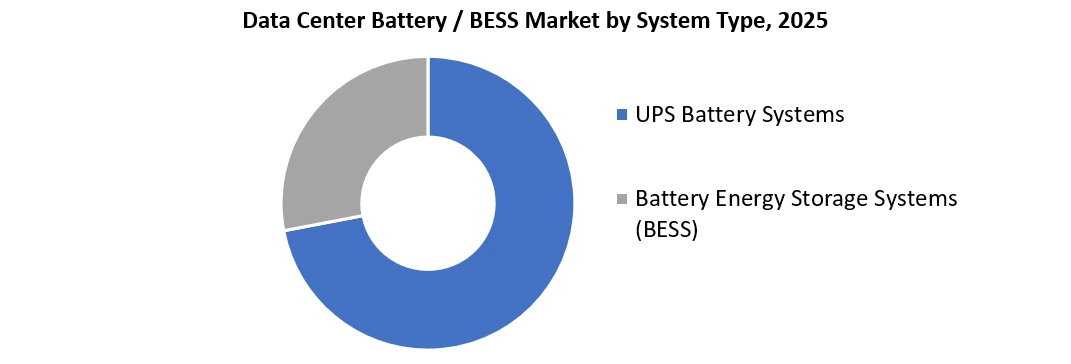
Based on system type, the Global Data Center Battery / BESS Market is segmented into Uninterruptible Power Supply (UPS) Battery Systems and Battery Energy Storage Systems (BESS).
The UPS battery systems segment maintains an important position because uninterrupted power protection remains a fundamental requirement across hyperscale, colocation, enterprise and edge data centers. UPS batteries provide immediate power during electrical disturbances and bridge the transition to alternative generation or controlled shutdown. Lead-acid technologies retain an established position in conventional installations, while lithium-ion and nickel-zinc systems are increasingly evaluated for improved footprint efficiency, lifecycle characteristics and high-power performance.
The BESS segment is expected to experience faster growth during 2026–2034, supported by rising interest in energy resilience, peak shaving, grid support and renewable electricity integration. Larger hyperscale campuses are particularly relevant because their electrical demand can justify dedicated energy storage and microgrid infrastructure.
By Battery Chemistry: Lithium-Ion Battery Technology Gains Momentum as Lead-Acid Maintains a Large Installed Base
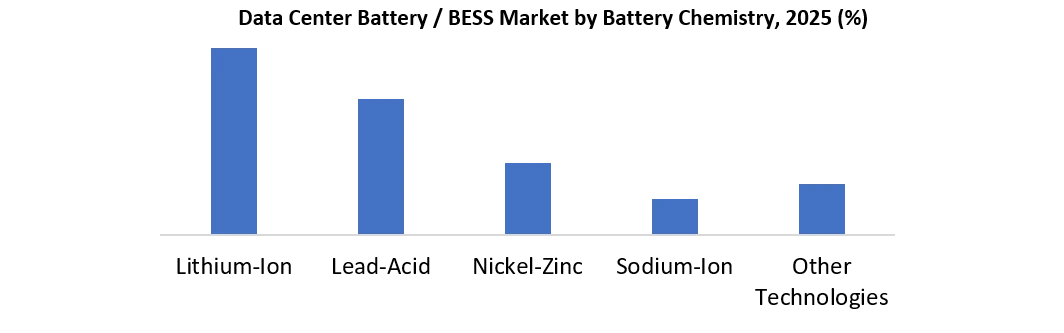
Based on battery chemistry, the market includes Lead-Acid Batteries, Lithium-Ion Batteries, Nickel-Zinc Batteries, Sodium-Ion Batteries, Nickel-Cadmium Batteries and Other Emerging Battery Technologies.
Lead-acid batteries remain widely used in UPS applications due to established installation practices, relatively low initial acquisition costs and mature replacement and recycling channels. However, their weight, footprint, maintenance requirements and lifecycle characteristics can make alternative technologies attractive for some modern facilities.
Lithium-ion batteries are positioned for strong adoption in new data center projects and modernization programs. LFP is particularly relevant for many BESS applications because of its cycle-life characteristics, thermal behavior and commercial maturity. Lithium-ion solutions can offer compact installations, faster recharge capability and improved monitoring, subject to system design and operating conditions.
Nickel-zinc batteries represent a specialized alternative for short-duration, high-power UPS requirements, while sodium-ion technologies are emerging as potential options for stationary storage applications. Their future market penetration will depend on field validation, manufacturing scale, lifetime economics, certification and procurement acceptance.
Global Data Center Battery / BESS Market Regional Insights
North America: Extensive Hyperscale Infrastructure and Power Availability Constraints Support Market Leadership
North America represents a major market for data center battery and BESS solutions, supported by large hyperscale campuses, cloud infrastructure investments and expanding artificial intelligence computing facilities.
The United States remains the primary regional demand center, with significant activity in Virginia, Texas, Ohio, Illinois, Arizona and other developing data center locations. Increasing electricity requirements and lengthy grid interconnection processes are encouraging operators to consider enhanced UPS infrastructure, behind-the-meter BESS and integrated power generation arrangements.
Technology suppliers are developing grid-interactive storage platforms that allow data centers to participate in energy flexibility programs while preserving critical backup requirements. Canada also presents opportunities in cloud infrastructure, modular data centers and renewable-powered digital facilities.
Europe: Energy Efficiency Requirements and Grid Constraints Accelerate Advanced Battery Integration
Europe is expected to experience steady demand for advanced data center battery systems as operators prioritize energy efficiency, grid compliance, decarbonization and reliable digital infrastructure.
Germany, the United Kingdom, France, Ireland and the Netherlands are important markets, supported by established colocation clusters and growing requirements for cloud and artificial intelligence computing capacity.
Power availability constraints in certain European data center hubs are increasing interest in grid-interactive storage, renewable integration and energy-efficient power systems. European manufacturers also contribute expertise in UPS equipment, industrial battery systems, power conversion technologies and battery safety engineering.
The region offers opportunities for distributed BESS deployment, advanced electrical infrastructure upgrades and long-term service contracts covering battery performance and maintenance.
Asia Pacific: Rapid Digital Infrastructure Development and Battery Manufacturing Scale Drive Growth
Asia Pacific is expected to demonstrate strong growth potential during the forecast period, supported by hyperscale investments, expanding cloud infrastructure and substantial regional battery manufacturing capacity.
China remains an important production center for lithium-ion cells, LFP batteries, integrated energy storage systems and related power electronics. Japan and South Korea contribute established battery technology portfolios, advanced manufacturing capabilities and high-reliability industrial energy systems.
India is emerging as a significant opportunity as cloud services, AI infrastructure, digital public services and colocation facilities expand. Investments in renewable energy integration and improvements in electrical infrastructure are likely to strengthen demand for UPS modernization and site-level BESS.
Singapore, Malaysia, Indonesia and Australia also represent important data center investment markets, although specific battery deployment rates will depend on local energy regulations, construction pipelines and project-level economics.
Middle East and Africa: Sovereign AI Investments and Renewable Energy Expansion Create Emerging Storage Opportunities
The Middle East and Africa market is developing as governments and private investors increase investment in digital infrastructure, sovereign cloud computing and renewable energy projects.
The United Arab Emirates and Saudi Arabia are strategically important due to large-scale energy investments and growing interest in high-capacity data center infrastructure.
Battery energy storage can support renewable generation integration, electricity network flexibility and selected data center power applications. However, utility-scale BESS projects and data center-dedicated BESS projects must be evaluated separately when estimating addressable market revenue.
South Africa and other African markets present opportunities for resilient backup power systems where power reliability and distributed electricity generation remain important investment considerations.
South America: Data Center Modernization and Local Battery Manufacturing Support Market Development
South America offers emerging opportunities for data center battery and BESS suppliers, particularly in Brazil, Chile and Argentina.
Brazil is the leading regional focus for this study because of its data center ecosystem, local energy storage manufacturing capabilities and expanding demand for digital services.
Growing interest in renewable electricity, distributed generation and advanced industrial energy management could support increased adoption of modern battery systems.
However, project economics, procurement conditions, electricity tariffs and the availability of qualified installation and maintenance services will influence adoption across the region.
Global Data Center BESS Market Competitive Landscape
Global Battery Manufacturers and Power Infrastructure Providers Compete Through Technology, System Integration and Lifecycle Economics
The Global Data Center Battery / BESS Market features competition among established battery manufacturers, UPS suppliers, BESS integrators, energy management software developers and specialist power protection technology companies.
The competitive environment is influenced by battery chemistry, safety performance, lifecycle cost, power density, installation footprint, charging capability, system modularity and integration with mission-critical electrical infrastructure.
Companies such as CATL, BYD, LG Energy Solution, Samsung SDI, Panasonic Energy, EnerSys and GS Yuasa participate through battery manufacturing and energy storage technologies. Vertiv, Schneider Electric, Eaton, ABB and other power infrastructure companies support the market through UPS platforms, electrical integration, monitoring and related systems.
Suppliers focused on advanced chemistry and specialized applications are also influencing competitive differentiation. Nickel-zinc solutions, sodium-ion technologies and alternative long-duration storage systems are attracting increased attention as operators seek alternatives tailored to different discharge profiles.
Competitive strategies increasingly involve strategic partnerships, manufacturing localization, integrated energy storage platforms and expanded service portfolios.
The industry is also moving toward closer coordination between battery manufacturers, power conversion suppliers, microgrid specialists and data center developers. This creates opportunities for companies offering interoperable systems and end-to-end lifecycle support.
Future competitive positioning is expected to depend on demonstrated safety, installed-system reliability, measurable operating economics and the ability to support high-density computing environments.
Competitive research priorities for MMR: Company financial performance, data-center-specific storage revenues, verified installed capacity, battery technology portfolios, international project references, manufacturing capability, procurement partnerships, patents, technology certifications and market share estimates.
Global Data Center BESS Market Recent Developments – 2026
| Date | Company | Recent Developments |
| September 28, 2026 | ZincFive | Announced the expansion of its nickel-zinc battery technology into in-rack Battery Backup Units (BBU) and AI Dynamic Power Modules (DPM). The new solutions target high-density AI data centers, 48V rack-level architectures and rapid power fluctuations associated with GPU-intensive computing. |
| September 9, 2026 | ZincFive | Launched a next-generation Battery Management System (BMS) specifically designed for nickel-zinc battery technology. The system integrates with BC Series UPS Battery Cabinets to improve battery monitoring, operational visibility and power reliability across AI data center infrastructure. |
| September 2, 2026 | Vertiv | Announced an agreement to acquire UtilityInnovation Group, strengthening its portfolio of microgrid controls, behind-the-meter power infrastructure and integrated energy storage solutions. The proposed acquisition supports advanced power architecture development for AI-driven hyperscale data centers. |
| August 24, 2026 | Vertiv | Introduced a 1.8 MW PowerUPS 9000 model for large-scale data centers across Asia Pacific. The system incorporates Battery Shield technology, intelligent power management and advanced controls to manage rapid AI workload fluctuations and improve battery backup availability. |
| August 24, 2026 | GE Vernova | Introduced a medium-voltage uninterruptible power supply (MV-UPS) solution designed for AI data centers and energy-intensive industrial facilities. The technology supports coordinated power protection and improved management of electrical load fluctuations across large computing installations. |
| July 8, 2026 | ESS Tech | Introduced Bridge, a modular sodium-ion Battery Energy Storage System designed for AI-powered data centers, commercial facilities and critical infrastructure. The platform expands the availability of non-lithium battery solutions for stationary energy storage applications. |
| June 22, 2026 | CATL | Unveiled its TENER Sodium Energy Storage System, featuring modular configurations exceeding 30 MWh and flexible discharge durations of 1–8 hours. The launch strengthens the commercialization of sodium-ion battery technology for large-scale energy storage applications. |
| May 19, 2026 | Enbridge and Meta | Announced the Cowboy solar-plus-storage project in Wyoming, combining 365 MW of solar generation with a proposed 200 MW / 1,600 MWh BESS. The project is designed to support grid reliability and renewable electricity supply associated with Meta's data center operations. |
Resilience-Protected Energy Storage Architecture
Dual-Purpose Battery Infrastructure Could Create a New Competitive Advantage in AI Data Centers
An emerging opportunity in the Data Center Battery / BESS Market is the development of Resilience-Protected Energy Storage Architecture, an analytical framework that separates mandatory emergency backup capacity from commercially dispatchable battery capacity.
Under this proposed approach, data center operators establish a protected energy reserve dedicated to critical computing loads. A separate portion of storage capacity, subject to operating limits, may then be used for peak shaving, renewable integration or grid-support activities.
This framework could improve the economic utilization of large energy storage installations without requiring operators to expose their critical UPS reserve to discretionary electricity market dispatch.
The concept introduces a potential performance indicator called Reserve-Protected Dispatchable Energy (RPDE):
RPDE (MWh) = Usable Stored Energy − Mandatory Critical-Load Reserve − Additional Contingency Reserve
The result is floored at zero and would be adjusted for discharge limits, efficiency, state of health, temperature, duration requirements and electrical-system constraints.
The methodology is proposed as an original analytical framework for this research, not as an existing industry standard or verified commercial product.
Potential applications include evaluating storage investment scenarios, comparing UPS–BESS architectures, assessing grid-service eligibility and estimating the economic value of flexible energy reserves.
Through 2034, manufacturers that can demonstrate secure reserve management, reliable controls and transparent storage economics may achieve competitive differentiation in high-availability data center installations.
Global Data Center BESS Market Scope: Inquire before buying
| Report Coverage | Details |
| Market Name | Global Data Center Battery / BESS Market |
| Market Size in 2025 | USD 4.29 Billion |
| Market Size in 2026 | USD 4.82 Billion |
| Forecast Market Size in 2034 | USD 13.3 Billion |
| CAGR (2026–2034) | 13.4% |
| Base Year | 2025 |
| Historical Data | 2020–2025 |
| Forecast Period | 2026–2034 |
| Study Period | 2020–2034 |
| Report Coverage | Market Size, Industry Forecast, Market Dynamics, Segment Analysis, Regional Insights, Competitive Landscape, Recent Developments, Technology Trends and Growth Opportunities |
| By System Type | UPS Battery Systems; Battery Energy Storage Systems (BESS) |
| By Battery Chemistry | Lead-Acid; Lithium-Ion (LFP, NMC and Other Li-Ion); Nickel-Zinc; Nickel-Cadmium; Sodium-Ion; Flow Batteries; Others |
| By Data Center Type | Hyperscale & Cloud; Colocation; Enterprise; Edge Data Centers |
| By Application | Short-Duration UPS Backup; Extended Backup Power; Peak Shaving & Load Shifting; Renewable Energy Integration; Demand Response & Grid Services; Microgrid Support |
| By UPS Battery Capacity | Below 100 kWh; 100–500 kWh; Above 500 kWh–1 MWh; Above 1 MWh |
| By BESS Capacity | Below 1 MWh; 1–30 MWh; Above 30 MWh |
| By End-User Industry | IT & Telecommunications; BFSI; Healthcare; Government & Public Sector; Manufacturing; Retail & E-commerce; Media & Entertainment; Others |
| By Region | North America; Europe; Asia Pacific; Middle East & Africa; South America |
Regional coverage
North America: United States, Canada, Mexico.
Europe: Germany, United Kingdom, France, Italy, Spain, Netherlands, Ireland, Switzerland, Sweden, Poland and Rest of Europe.
Asia Pacific: China, India, Japan, South Korea, Australia, Taiwan, Singapore, Malaysia, Indonesia, Thailand, Vietnam and Rest of Asia Pacific.
Middle East & Africa: Saudi Arabia, United Arab Emirates, Qatar, Oman, South Africa, Egypt and Rest of Middle East & Africa.
South America: Brazil, Argentina, Chile, Colombia and Rest of South America.
Global Data Center BESS Market Key Players by Region
North America
1. Tesla, Inc. – United States
2. Vertiv Holdings Co. – United States
3. EnerSys – United States
4. East Penn Manufacturing Company – United States
5. C&D Technologies, Inc. – United States
6. ZincFive, Inc. – United States
7. Fluence Energy, Inc. – United States
8. ESS Tech, Inc. – United States
9. Stryten Energy LLC – United States
10. Power-Sonic Corporation – United States
11. Ultralife Corporation – United States
12. Generac Power Systems, Inc. – United States
13. Canadian Solar / e-STORAGE – Canada
14. Electrovaya Inc. – Canada
Europe
15. Schneider Electric SE – France
16. Saft Groupe S.A. – France
17. Legrand SA – France
18. Socomec Group – France
19. Exide Technologies – France
20. ABB Ltd. – Switzerland
21. Hitachi Energy Ltd. – Switzerland
22. Leclanché SA – Switzerland
23. HOPPECKE Batteries – Germany
24. TESVOLT AG – Germany
25. Alfen N.V. – Netherlands
26. Eaton Corporation plc – Ireland
27. Wärtsilä Corporation – Finland
28. FIAMM Energy Technology S.p.A. – Italy
Asia Pacific
29. Contemporary Amperex Technology Co., Limited (CATL) – China
30. BYD Company Limited – China
31. EVE Energy Co., Ltd. – China
32. Sungrow Power Supply Co., Ltd. – China
33. Huawei Digital Power Technologies – China
34. Zhejiang Narada Power Source Co., Ltd. – China
35. Xiamen Hithium Energy Storage Technology Co., Ltd. – China
36. Gotion High-tech Co., Ltd. – China
37. LG Energy Solution Ltd. – South Korea
38. Samsung SDI Co., Ltd. – South Korea
39. Panasonic Energy Co., Ltd. – Japan
40. GS Yuasa Corporation – Japan
41. Toshiba Corporation – Japan
42. Delta Electronics, Inc. – Taiwan
43. Exide Industries Limited – India
44. Amara Raja Energy & Mobility Limited – India
45. HBL Engineering Limited – India
Middle East & Africa
46. Masdar (Abu Dhabi Future Energy Company) – United Arab Emirates
47. ACWA Power – Saudi Arabia
48. Enercap – United Arab Emirates
South America
49. WEG S.A. – Brazil
50. Acumuladores Moura S.A. (Grupo Moura) – Brazil
Global Data Center BESS Market – Frequently Asked Questions
1. What is the expected size of the Global Data Center BESS Market by 2034?
The Global Data Center Battery / BESS Market is projected to reach USD 13.3 Billion by 2034, compared with USD 4.29 Billion in 2025, based on a published industry estimate for the combined UPS-battery and BESS market. The forecast represents a CAGR of 13.4% from 2026 to 2034.
2. What are the major growth drivers of the Data Center BESS Market?
Major growth drivers include expanding hyperscale and AI data centers, increasing demand for uninterrupted electricity supply, rising energy resilience requirements, lithium-ion UPS modernization, renewable energy integration and growing interest in behind-the-meter BESS. Grid constraints and the development of advanced battery management systems are also influencing purchasing decisions.
3. Which battery technology is expected to play an important role in the Data Center BESS Market?
Lithium-ion batteries, particularly LFP systems for many BESS applications, are expected to gain adoption because of their lifecycle performance, compact installation potential and growing manufacturing scale. Lead-acid batteries continue to serve established UPS installations, while nickel-zinc and sodium-ion technologies offer additional opportunities in selected applications.
4. Which region is expected to dominate the Global Data Center BESS Market?
North America is expected to remain a major regional market, supported by hyperscale AI infrastructure, extensive cloud data center capacity and advanced power management investments. Asia Pacific is expected to offer substantial growth potential due to expanding digital infrastructure and a strong battery manufacturing ecosystem.
5. Who are the major companies operating in the Global Data Center BESS Market?
Important market participants include CATL, BYD, LG Energy Solution, Samsung SDI, Panasonic Energy, EnerSys, GS Yuasa, Tesla, Vertiv, Schneider Electric, Eaton, ABB, Fluence, Saft, ZincFive and other specialized battery and energy storage solution providers. Their competitive positions vary according to battery chemistry, system type, regional presence and data center application.