
Samsung and LG Are Racing to Kill the Screen as We Know It — and the $592 Billion 3D Display Market Is Exploding Because of It
Samsung and LG Are Racing to Kill the Screen as We Know It — and the $592 Billion 3D Display Market Is Exploding Because of It
For years, 3D technology failed for one simple reason: People hated the glasses. Now that problem may finally be gone. And if Samsung and LG are right, the next decade of computing may move beyond “flat screens” entirely.
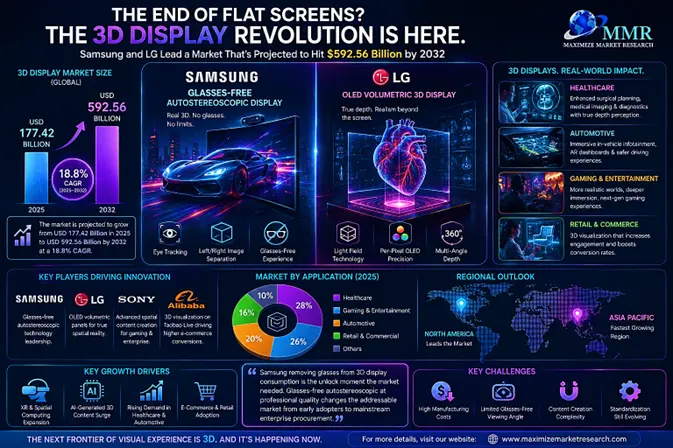
The Global 3D Display Market, valued at USD 177.42 billion in 2025, is projected to surge toward USD 592.56 billion by 2032, expanding at a staggering 18.8% CAGR as spatial computing, XR ecosystems, and immersive visualization move into the mainstream.
This time, the industry believes 3D is not entertainment hype. It is the next interface war.
Samsung Thinks Removing the Glasses Changes Everything
Previous generations of 3D TVs failed because consumers were forced to wear accessories that interrupted normal viewing behavior.
Samsung’s latest autostereoscopic display systems aim to eliminate that friction entirely.
Using integrated eye-tracking systems, the displays dynamically separate left-eye and right-eye imagery in real time, allowing viewers to experience depth without wearable devices.
That sounds technical. But commercially, it changes the entire addressable market.
Because now:
- hospitals can deploy 3D diagnostics
- retailers can install immersive signage
- automakers can build spatial dashboards
- enterprises can visualize complex engineering models
without requiring users to wear specialized hardware.
MMR Insight: Glasses-free visualization may become the “smartphone moment” for 3D displays — removing the biggest behavioral barrier that previously blocked mass adoption.
LG Is Betting on a Much Bigger Vision: True Spatial Reality
While Samsung focuses on glasses-free consumer practicality, LG Electronics is pushing toward volumetric OLED systems capable of generating depth-accurate imagery visible from multiple viewing angles simultaneously.
This is not traditional stereo 3D.
It is much closer to holographic spatial representation.
And the implications are massive for:
- Surgical imaging
- Industrial design
- Defense simulation
- CAD engineering
- Digital twins
because professionals can interact with depth-sensitive visuals more naturally and collaboratively.
MMR Insight: The market is shifting from “3D entertainment displays” toward full spatial-computing infrastructure capable of changing how humans interact with digital information itself.
Alibaba Quietly Revealed Why Investors Suddenly Care
One of the industry’s biggest hidden breakthroughs did not happen in gaming.
It happened in e-commerce. Alibaba Group deployed 3D visualization tools inside Taobao Live for furniture and fashion categories.
And something critical happened: conversion rates improved.
That matters enormously. Because once immersive visualization directly impacts purchasing behavior, 3D displays stop being experimental technology — and become measurable revenue infrastructure.
Gaming, Healthcare, and Cars Are Becoming the Industry’s Growth Engines
The biggest adoption wave is now coming from sectors where immersion directly improves outcomes.
Healthcare:
- surgical planning
- medical imaging
- anatomy visualization
Gaming:
- spatial environments
- XR experiences
- immersive rendering
Automotive:
- AR dashboards
- depth-aware navigation
- driver visualization systems
MMR Insight: The strongest growth is happening where spatial visualization improves decision-making speed, accuracy, or monetization — not merely entertainment value.
The Real Industry Battle Is Happening Behind the Screens
North America currently leads market revenue. But Asia-Pacific is rapidly becoming the production and innovation engine behind the 3D ecosystem. Samsung, LG, Sony, and Chinese display manufacturers are aggressively scaling:
- OLED capacity
- XR ecosystems
- spatial rendering tools
- volumetric content platforms
because the companies controlling display standards today may eventually control the next generation of human-computer interaction.
Why the 3D Display Market Is Suddenly Growing So Aggressively
The projected rise toward USD 592.56 billion is being fueled by multiple megatrends colliding at once:
- spatial computing
- XR adoption
- AI-generated content
- immersive commerce
- automotive digitization
- medical visualization
- gaming expansion
And unlike the failed 3D TV cycle,
this demand is increasingly enterprise-driven.
That changes the economics completely.
The Real Story Nobody Is Saying Loudly Enough
The future of computing may no longer happen on flat screens.
It may happen in layered, spatial, depth-aware environments where digital objects behave more like physical reality itself.
And the companies building those interfaces today —
Samsung, LG, Sony, Alibaba —
are not just competing over displays.
They are competing to define how humans visually interact with the digital world for the next decade.
Related MMR Research
🔵 Display Material Market
🔵 Narrow Pixel Pitch LED Display Market