
Texas Instruments Just Made a $7.5 Billion Bet That Cars Will Soon Behave Like Smartphones
The race to control wireless vehicles, AI-powered factories, and software-defined machines is triggering a massive restructuring inside the $211.6B Embedded System Market
Global | February 2026: Texas Instruments has agreed to acquire Silicon Labs for $7.5 billion in cash, in what is now the largest embedded systems deal of 2026.
But this is not just another semiconductor acquisition.
It is a direct bet that the next generation of cars, factories, and industrial machines will no longer function as isolated hardware systems —
they will behave more like constantly connected, software-updatable computing platforms.
And that shift is rapidly transforming the global Embedded System Market, projected to reach USD 211.6 billion by 2036, growing at a 6.5% CAGR.
Your Next Car Is Quietly Turning Into a Software Platform
The auto industry is undergoing a transformation most consumers still do not fully understand.
Traditional cars relied on dozens of isolated electronic control units.
The next generation of vehicles will operate differently:
- centralized computing
- over-the-air updates
- wireless communication
- real-time AI inference
- software-controlled features
In simple terms: Cars are evolving from mechanical products into continuously connected computing ecosystems.
That shift is exploding demand across the Global Embedded System Market, projected to reach USD 211.6 billion by 2036, growing at a 6.5% CAGR.
And the race to control that infrastructure has officially begun.
Why Texas Instruments Paid a Massive Premium
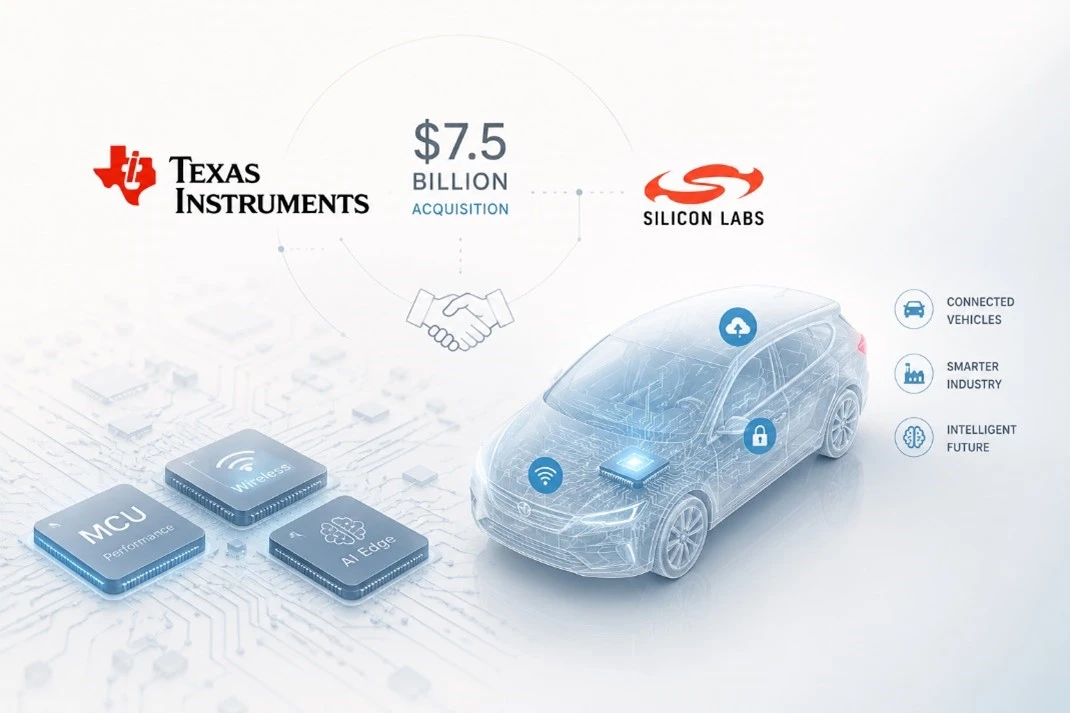
Texas Instruments agreed to pay $231 per share in cash, representing a massive premium for Silicon Labs and instantly sending Silicon Labs stock soaring nearly 49%.
But this deal is not really about today’s chips.
It is about controlling:
- Bluetooth ecosystems
- Wi-Fi communication
- industrial IoT infrastructure
- automotive wireless architecture
- edge AI connectivity
Because the next generation of machines will not simply process commands — they will communicate continuously.
MMR Insight: The embedded industry is shifting from: isolated processors to fully connected AI-enabled edge ecosystems.
And whoever owns connectivity may ultimately control the future software layer of industrial infrastructure itself.
NXP Is Quietly Building the “Brain” of Future Vehicles
While TI focused on wireless infrastructure, NXP Semiconductors moved aggressively into software-defined vehicles (SDVs).
Its:
- $307 million Kinara acquisition
- $625 million TTTech Auto deal
signal something much bigger happening beneath the surface.
Automakers want to eliminate fragmented vehicle electronics and consolidate functions into centralized AI-managed compute platforms.
That changes everything.
Because once cars become software-managed:
- features become subscriptions
- upgrades become downloadable
- diagnostics become predictive
- AI becomes continuous
MMR Insight: The automotive sector is moving from: hardware-driven engineering to software-defined mobility infrastructure and the embedded chip becomes the control center of the entire experience.
This Is No Longer a Semiconductor Race. It’s an Intelligence Race.
Factories, robots, power grids, and smart infrastructure now require:
- real-time AI processing
- ultra-low latency
- local decision-making
- cloud-independent operation
That demand is driving explosive growth in:
- edge AI chips
- neural processors
- energy-efficient microcontrollers
- 3nm automotive compute systems
In early 2026:
- NXP Semiconductors expanded its MCX A MCU portfolio
- Renesas Electronics launched its 3nm Gen 5 R-Car X5H automotive platform
This is no longer about making chips faster.
It is about making machines intelligent.
Asia Quietly Controls the Real Battlefield
While American firms dominate headlines, Asia-Pacific controls much of the physical infrastructure powering the embedded economy.
China, Taiwan, South Korea, and India now anchor:
- semiconductor fabrication
- packaging
- industrial electronics manufacturing
- automotive chip ecosystems
Meanwhile, Samsung Electronics’s massive advanced packaging investments show how strategic semiconductor infrastructure has become.
MMR Insight: The Embedded System Market is evolving into a geopolitical technology battlefield where manufacturing capacity may become just as important as software innovation.
Why This Market Is Suddenly Becoming One of Tech’s Biggest Power Centers
The projected rise toward USD 211.6 billion is being fueled by multiple megatrends colliding simultaneously:
- AI expansion
- autonomous mobility
- industrial IoT
- edge computing
- smart manufacturing
- connected infrastructure
Unlike consumer tech cycles, this demand is deeply structural.
Because once factories, vehicles, and infrastructure become intelligent,
they cannot revert back to “dumb systems.”
The Real Story Nobody Is Saying Loudly Enough
The embedded system market is no longer selling semiconductor components.
It is selling:
- machine intelligence
- industrial connectivity
- autonomous decision-making
- software ecosystems
- AI infrastructure
And the companies controlling those layers may ultimately control the digital nervous system of the global economy.
That is why Texas Instruments spent $7.5 billion now. Because in the next decade, the most valuable technology companies may not be the ones building apps —they may be the ones building the invisible intelligence underneath everything.