
First-Ever Male BV Treatment Launch Could Reshape a $5.13B Market and End a Recurrence Crisis That Has Frustrated Doctors for Decades
Wisp’s March 2025 launch and new ACOG guidance are redefining how bacterial vaginosis is treated, prescribed, and commercially scaled
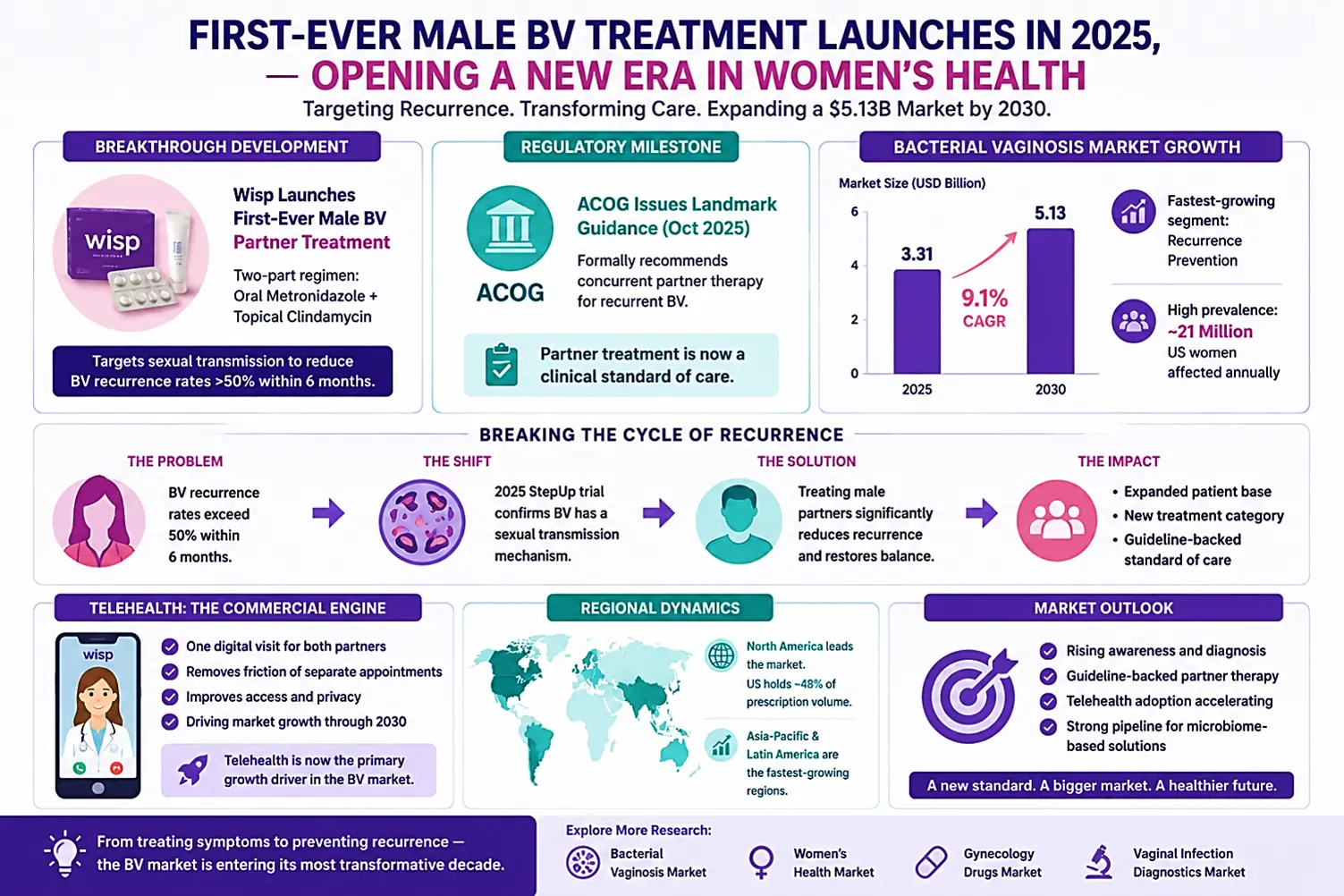
Global | 2025: Wisp has launched the first-ever male partner treatment for bacterial vaginosis (BV), introducing a new therapeutic approach that directly targets one of the biggest unresolved problems in women’s health: recurrence.
The launch comes as the global Bacterial Vaginosis Market, valued at USD 3.31 billion in 2025, is projected to reach USD 5.13 billion by 2030, expanding at a 9.1% CAGR. What is accelerating the market is not just rising diagnosis rates, but a growing shift toward recurrence prevention and partner-directed therapy.
For decades, BV treatment focused almost exclusively on women, despite recurrence rates exceeding 50% within six months. That model is now being challenged.
In March 2025, Wisp introduced a two-part male BV partner regimen combining oral metronidazole with topical clindamycin. The treatment followed findings from the 2025 StepUp clinical trial, which demonstrated that treating male partners significantly reduced recurrence rates in women.
The implications extend far beyond a single product launch.
MMR Insight: The BV market is shifting from a single-patient treatment model → dual-partner management ecosystem, fundamentally expanding the treatment pathway and commercial opportunity.
Market impact: Each diagnosis now has the potential to generate two simultaneous prescriptions, increasing treatment volume and recurring revenue potential across the market.
ACOG Guidance Turns a Niche Therapy Into a Clinical Standard
In October 2025, the American College of Obstetricians and Gynecologists (ACOG) formally recommended concurrent partner therapy for recurrent BV cases, marking one of the most significant guideline changes in the category in years.
This regulatory endorsement is expected to accelerate physician adoption and reduce hesitation around partner-directed treatment strategies.
MMR Insight: Clinical guideline support transforms partner therapy from an experimental approach into a structured standard-of-care segment, creating a scalable commercial category that barely existed a year ago.
Market impact: Demand is expected to shift rapidly toward recurrence-prevention therapies, making this the fastest-growing segment within the Bacterial Vaginosis Market.
Telehealth Emerges as the Commercial Engine of the Market
The rise of telehealth is playing a critical role in scaling this new treatment model.
Traditionally, treating both partners required separate consultations, prescriptions, and follow-ups — creating logistical friction that limited adoption. Digital health platforms remove much of that complexity by enabling simultaneous treatment coordination through a single remote encounter.
MMR Insight: Telehealth is becoming more than a distribution channel — it is evolving into the primary infrastructure layer enabling scalable BV recurrence management.
Market impact:
Digital-first care models are expected to accelerate diagnosis, prescription fulfillment, and repeat treatment engagement, particularly among younger patient populations.
Market Expansion Broadens Beyond North America
North America currently dominates the market, with the US accounting for nearly 48% of prescription volume. However, Asia-Pacific and Latin America are emerging as the fastest-growing regions as awareness, diagnostics access, and women’s healthcare infrastructure improve.
This expansion is expected to bring millions of previously untreated or undertreated patients into the formal treatment ecosystem.
MMR Insight: Improved healthcare access combined with telehealth scalability could significantly increase global treatment penetration, particularly in underserved urban populations.
A Scientific Shift Is Rewriting the Market Narrative
Perhaps the most important change is conceptual.
For years, BV was largely treated as a localized imbalance. The latest evidence increasingly supports a sexual transmission mechanism, fundamentally changing how recurrence is understood and managed.
MMR Insight:
The market is transitioning from a symptom-treatment approach → transmission-management model, creating opportunities for new diagnostics, combination therapies, and microbiome-focused interventions.
Outlook: A New Category Is Emerging Inside Women’s Health
As recurrence prevention becomes central to treatment strategies, the market is expected to see:
- Increased partner-directed therapies
- Expansion of telehealth-driven prescriptions
- Greater investment in microbiome and recurrence-prevention research
- Higher long-term treatment engagement rates
MMR Insight: Future leadership in the BV market will depend on the ability to combine clinical validation, digital accessibility, and recurrence prevention outcomes into scalable care models.
Final Takeaway
The bacterial vaginosis market is no longer defined only by treatment —
it is increasingly being defined by the ability to prevent recurrence altogether.
And with partner-directed therapy now entering mainstream clinical practice,
the industry may be approaching its most significant structural shift in decades.