
The EV Revolution Created a Fire Crisis — and a $34.95 Billion Safety Market Is Exploding Because of It
As lithium-ion batteries ignite a new generation of industrial fire risks, Honeywell, Teledyne, and Siemens are racing to control the next multi-billion-dollar infrastructure battle
Global | 2025: The world’s shift toward electric vehicles, AI-powered data centers, and hydrogen infrastructure is quietly creating one of the most dangerous industrial problems of the decade: fires that conventional suppression systems were never designed to handle.
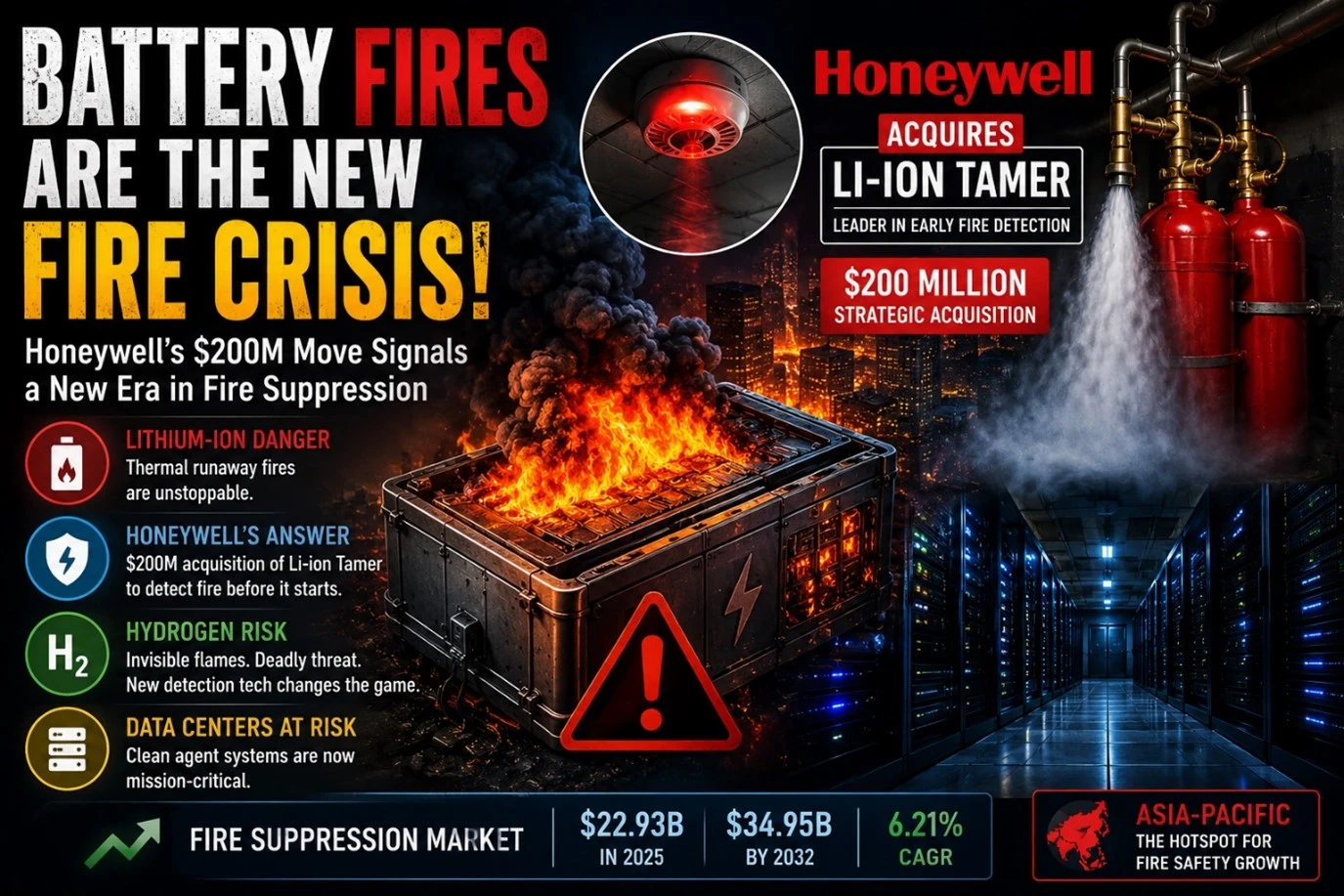
And that problem is rapidly turning the Global Fire Suppression Market, valued at USD 22.93 billion in 2025, into a projected USD 34.95 billion industry by 2032, growing at a 6.21% CAGR.
The warning signs are already visible.
Lithium-ion battery fires linked to EV infrastructure, grid-scale storage systems, and data centers are increasing globally. Unlike conventional fires, these events trigger “thermal runaway” — a chemical chain reaction capable of generating its own oxygen and reigniting repeatedly even after suppression attempts.
Traditional sprinkler systems suddenly look outdated.
That is why Honeywell’s July 2025 acquisition of Li-ion Tamer may become one of the most important industrial safety deals of the decade.
Because the industry is no longer asking:
“How do we extinguish battery fires?”
It is now asking:
“How do we detect them before they even begin?”
The Fire Suppression Industry Just Entered Its Smartphone Moment
For decades, the Fire Suppression Market evolved slowly around familiar risks:
- buildings
- factories
- oil & gas facilities
But lithium-ion batteries changed the chemistry of fire itself.
A thermal runaway event can spread cell-by-cell at extreme temperatures, releasing toxic gases before flames even appear. That makes early gas detection more valuable than traditional suppression response.
MMR Insight: The market is shifting from a reaction-based suppression industry → predictive hazard detection economy.
Market impact: Thermal runaway detection is emerging as an entirely new high-margin category inside the Fire Suppression Market.
And investors are noticing.
Honeywell’s Acquisition Isn’t About Fire Sensors — It’s About Owning the Next Safety Standard
Honeywell’s acquisition of Li-ion Tamer was not simply a technology purchase.
It was a strategic bet on where industrial safety spending is heading next.
The global Fire Suppression Market, valued at USD 22.93 billion in 2025, is projected to reach USD 34.95 billion by 2032, driven primarily by:
- EV charging infrastructure
- grid-scale battery systems
- hyperscale data centers
- hydrogen energy facilities
MMR Insight:
Battery infrastructure is becoming the single biggest catalyst reshaping fire safety procurement worldwide.
Market impact: Companies providing application-specific battery suppression systems are expected to command premium pricing and long-term infrastructure contracts.
The Hydrogen Economy Has an Invisible Fire Problem
As if battery fires were not enough, the hydrogen economy is introducing an entirely different safety challenge.
Hydrogen flames are nearly invisible to the naked eye and difficult for conventional sensors to detect — creating the risk of silent ignition events in industrial environments.
That’s why Teledyne Technologies launched the Spyglass Xtend system in February 2025, capable of detecting both hydrocarbon and hydrogen flames using triple-infrared technology.
This is not incremental innovation.
It is category creation.
MMR Insight: Hydrogen infrastructure is forcing the Fire Suppression Market to evolve beyond conventional flame detection into advanced sensor intelligence systems.
Data Centers Are Quietly Becoming One of the Industry’s Biggest Revenue Engines
The AI boom is also fueling suppression demand.
As hyperscale data centers expand globally, operators are investing heavily in clean-agent systems capable of protecting high-density computing infrastructure without water damage.
In June 2025, Johnson Controls launched the Hygood IGS-300 clean-agent platform specifically targeting next-generation data center facilities.
At the same time, Siemens integrated advanced water mist technologies into its fire safety portfolio following its Danfoss Fire Safety integration.
MMR Insight: The data center industry is transforming fire suppression from a compliance requirement into mission-critical uptime infrastructure.
Market impact: Suppression technologies optimized for AI infrastructure are expected to become one of the fastest-growing premium segments through 2032.
Asia Is Becoming the Industry’s Largest Battlefield
Asia-Pacific already represents nearly USD 17.7 billion in fire protection spending in 2025.
China and India are aggressively tightening industrial safety mandates while simultaneously scaling:
- EV manufacturing
- battery storage
- smart infrastructure
- urban construction
This combination is creating explosive demand for specialized suppression technologies.
MMR Insight: Asia-Pacific is no longer just a manufacturing hub — it is rapidly becoming the world’s largest commercialization market for next-generation fire safety systems.
The Real Story: Fire Safety Is Becoming an Infrastructure Technology Market
The Fire Suppression Market is no longer simply about extinguishers and sprinklers.
It is becoming deeply integrated with:
- energy transition infrastructure
- AI-driven facilities
- battery ecosystems
- smart industrial automation
And that changes the economics entirely.
MMR Insight: Future market leadership will depend less on traditional suppression hardware and more on:
- predictive sensing
- chemical intelligence
- automated response systems
- application-specific engineering
Final Takeaway
The EV revolution created a problem the old fire safety industry was never built to handle.
Now the companies solving thermal runaway, hydrogen ignition, and AI infrastructure risk are not just selling protection systems — they are building the next layer of critical industrial infrastructure.
And as battery-powered economies expand globally,
the Fire Suppression Market may become one of the biggest hidden beneficiaries of the energy transition.