
Microsoft’s Carbon Credit Deal Just Changed the Economics of the Biochar Market — and Triggered a New Carbon Gold Rush
A Canadian forest waste project is turning carbon removal into a high-margin financial asset, pushing the Biochar Market toward a $2.04B transformation
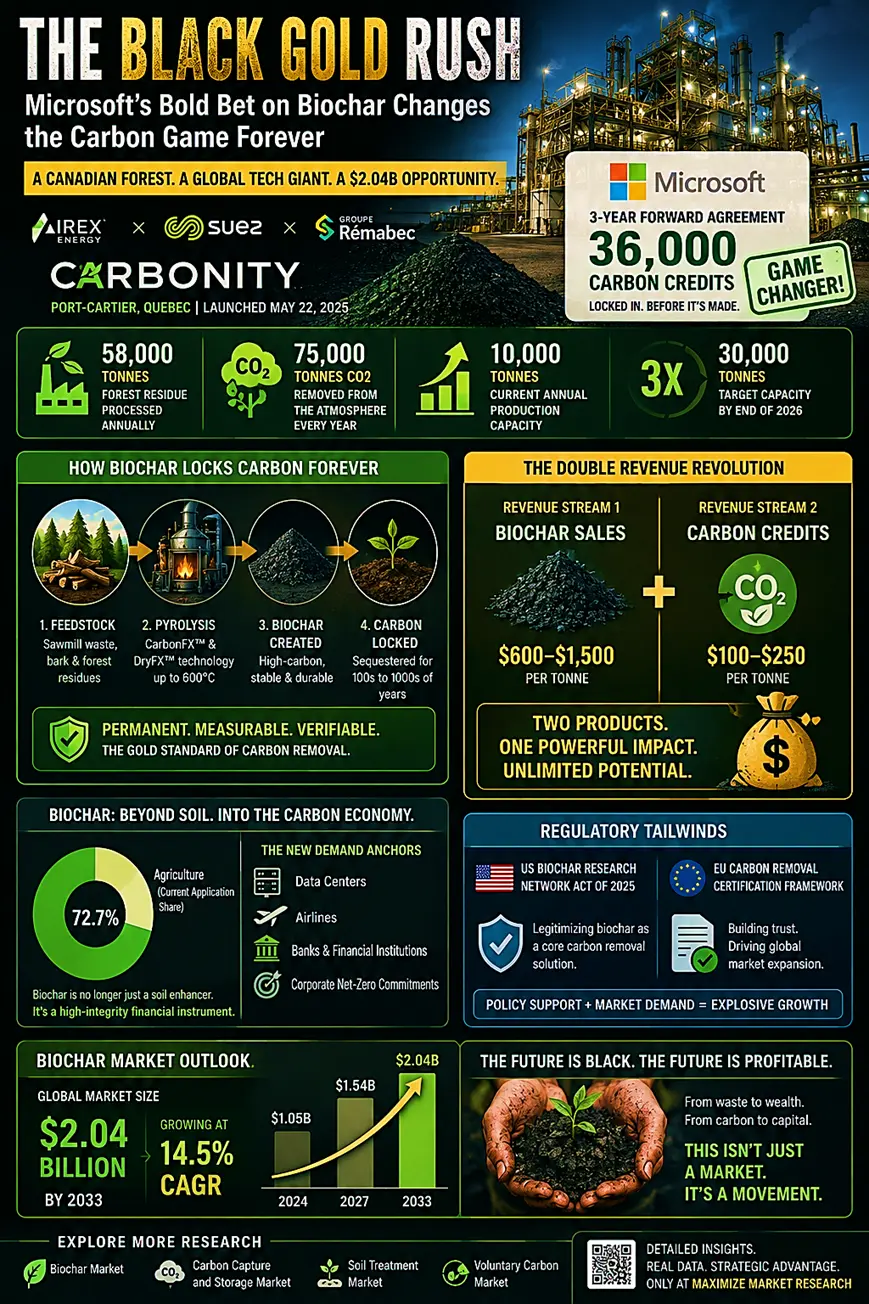
Canada | May 2025: Microsoft has signed a major forward carbon credit agreement tied to the launch of Carbonity, North America’s largest industrial-scale biochar facility, in what could become one of the defining moments for the global Biochar Market.
The facility, launched in Port-Cartier, Quebec through a partnership between Airex Energy, SUEZ, and Groupe Rémabec, processes 58,000 tonnes of forest residue annually and is designed to remove up to 75,000 tonnes of CO₂ from the atmosphere every year.
But the real shockwave across the market came from one detail:
👉 Microsoft agreed to buy 36,000 carbon credits before the facility even reached full production.
That single transaction may have fundamentally changed how the global biochar industry is financed, valued, and scaled.
The Biochar Market Is No Longer Selling Soil — It’s Selling Carbon
The Global Biochar Market, valued to reach USD 2.04 billion by 2033 at a 14.5% CAGR, has historically been positioned around agriculture and soil enhancement. That business model is now being rapidly rewritten.
For years, biochar producers relied primarily on agricultural demand, where biochar improved soil fertility and water retention. Agriculture still accounts for nearly 72.7% of application share, but the center of gravity is shifting.
MMR Insight: The market is transitioning from a materials business → carbon finance ecosystem, where the core product is no longer soil performance, but permanent carbon removal.
👉 Market impact: Biochar is increasingly being valued not only as a physical commodity, but as a monetizable carbon asset.
⚡ Microsoft May Have Validated the Industry’s Entire Business Model
Carbon markets have struggled for years with credibility concerns around permanence and verification. Biochar changes that equation because carbon can remain locked away for centuries.
That permanence is exactly why large corporations are moving aggressively.
MMR Insight: When a company like Microsoft commits to forward-purchasing carbon credits before production maturity, it effectively validates biochar as an institutional-grade carbon removal category.
👉 Market impact: This dramatically improves financing confidence across the sector, making it easier for future projects to attract capital, secure offtake agreements, and scale globally.
💰 The “Double-Revenue” Model Is Reshaping Profitability
One of the biggest reasons investors are paying attention is the emergence of a new revenue structure.
Biochar producers can now monetize:
- Physical biochar sales at approximately USD 600–1,500 per tonne
- Carbon credits valued between USD 100–250 per tonne
MMR Insight: This creates a rare “dual monetization” model where producers generate revenue from both the physical product and the carbon removed during production.
👉 Market impact: Profitability potential in the Biochar Market is increasing significantly compared to traditional low-margin agricultural input markets.
🌍 Regulation Is Accelerating the Market Faster Than Forecasts
The industry is also benefiting from major regulatory momentum.
The US Biochar Research Network Act of 2025 and the EU Carbon Removal Certification Framework are helping formalize biochar as a recognized carbon removal methodology.
For the market, this changes everything.
MMR Insight: Regulatory recognition transforms biochar from an experimental sustainability solution into a compliance-aligned carbon infrastructure category.
👉 Market impact: Institutional participation is expected to accelerate as policy frameworks reduce uncertainty around verification and long-term carbon accounting.
🧠 The Demand Base Is Expanding Beyond Agriculture
The next growth phase is increasingly being driven by industries under pressure to meet net-zero commitments, including:
- Data centers
- Airlines
- Financial institutions
- Industrial manufacturers
These sectors are emerging as the new “demand anchors” for biochar-linked carbon removal.
MMR Insight: The Biochar Market is evolving from an agricultural niche into a strategic decarbonization market integrated with corporate climate finance.
🚨 Scaling Race Begins as Global Capacity Expands
Carbonity currently operates at roughly 10,000 tonnes of annual production capacity, but plans are already underway to scale toward 30,000 tonnes by the end of 2026.
Meanwhile, Airex Energy and SUEZ are targeting global production capacity of 350,000 tonnes by 2035.
MMR Insight: The industry is entering a scale-up phase similar to the early renewable energy market, where capacity expansion, credit validation, and institutional demand reinforce each other simultaneously.
🔍 Outlook: The Carbon Economy Is Being Repriced
As carbon removal markets mature, biochar is increasingly positioned as one of the few scalable and permanent removal solutions available today.
MMR Insight:
Future market leadership will depend on the ability to combine:
- Verified carbon permanence
- Scalable feedstock access
- Industrial-scale pyrolysis technology
- Long-term credit agreements
into integrated carbon removal platforms.
💣 Final Takeaway
The Biochar Market is no longer just about turning waste into soil enhancement —
it is increasingly about turning carbon removal into a financial asset class.
And after Microsoft’s early commitment,
the industry may have crossed a critical threshold:
👉 from experimental climate solution
to institutional-grade carbon economy infrastructure.x