
The Tiny Component Inside Your EV and Smartphone Just Became a Multi-Billion Dollar Battleground
Murata, TDK, and Samsung are fighting over a component smaller than a grain of sand — because modern AI devices and EVs cannot function without it.
Most consumers will never hear the term “MLCC.” Yet this microscopic component quietly powers:
- electric vehicles
- smartphones
- AI servers
- 5G towers
- smartwatches
- industrial robots
And now, as global electronics become smarter, smaller, and more power-hungry, the race to dominate the MLCC industry is accelerating into one of the most important hidden wars inside the semiconductor ecosystem.
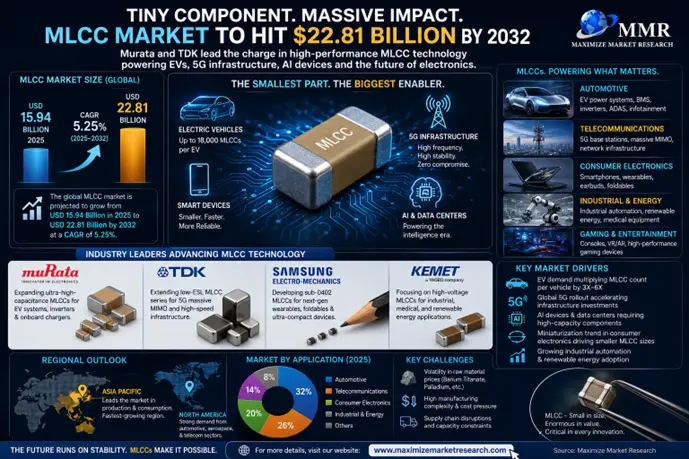
The Global Multilayer Ceramic Capacitor (MLCC) Market, valued at USD 15.94 billion in 2025, is projected to reach USD 22.81 billion by 2032, growing at a 5.25% CAGR.
What’s driving the surge?
- EVs now require up to 18,000 MLCCs per vehicle
- 5G infrastructure needs ultra-high-frequency stability
- AI devices demand smaller, faster, heat-resistant components
And suddenly, the world’s smallest electronic parts are becoming some of the most strategically valuable.
Why EVs Are Quietly Exploding MLCC Demand
The rise of electric vehicles is fundamentally changing component architecture.
Unlike conventional vehicles, EVs require massive amounts of power regulation and signal stability across:
- battery management systems
- onboard chargers
- inverters
- ADAS systems
- infotainment platforms
That means dramatically higher MLCC counts per vehicle. This is why Murata Manufacturing aggressively expanded automotive-grade MLCC production in 2025.
Because in the EV era: the smallest components suddenly determine the reliability of the entire vehicle.
MMR Insight: The EV transition is multiplying passive component demand faster than most semiconductor forecasts anticipated, turning MLCC supply stability into a strategic procurement priority for automakers.
5G Infrastructure Is Creating a New Technical Arms Race
At the same time, TDK Corporation expanded low-ESL MLCC lines optimized for 5G massive MIMO infrastructure. The challenge is brutal:
- higher frequencies
- smaller hardware
- lower heat tolerance
- tighter signal integrity
And MLCCs sit directly at the center of that engineering problem.
That’s why the industry is no longer competing only on volume.
It is competing on:
- miniaturization
- heat resistance
- voltage stability
- ultra-high capacitance
MMR Insight: As 5G and AI infrastructure scale globally, MLCC manufacturers are evolving from component suppliers into core enablers of next-generation compute architecture.
Samsung’s Tiny MLCCs Reveal Where Consumer Electronics Are Heading
Samsung Electro-Mechanics pushed sub-0402 MLCC development in 2025 targeting:
- foldable smartphones
- wireless earbuds
- wearables
- ultra-compact devices
That sounds minor.
But it reveals a major shift:
👉 future devices are increasingly constrained by component size, not software capability.
The smaller electronics become,
the more strategically important MLCC innovation becomes.
MMR Insight: MLCC manufacturers are no longer passive suppliers — they are increasingly shaping the physical limits of future consumer electronics design itself.
Asia Quietly Controls the Entire Industry
Japan, South Korea, China, and Taiwan dominate both MLCC production and supply chains globally.
That concentration creates enormous geopolitical importance because these components now sit inside nearly every advanced technology ecosystem.
Meanwhile, supply-chain disruptions during 2021–2022 exposed how vulnerable electronics manufacturers become when MLCC lead times spike globally.
That is why Murata and TDK expanded manufacturing capacity in:
- Japan
- Malaysia
- Southeast Asia
to strengthen resilience.
Why the MLCC Market Is Becoming More Strategic Than Ever
The rise toward USD 22.81 billion is being fueled by multiple megatrends colliding simultaneously:
- EV expansion
- AI devices
- 5G rollout
- industrial automation
- IoT growth
- wearable technology
And unlike flashy semiconductor categories,
MLCC demand is deeply embedded across nearly every hardware ecosystem.
That makes the market unusually resilient.
The Real Story Nobody Notices
The future of AI, EVs, and smart infrastructure may ultimately depend on components most people never even see.
Because without MLCCs:
- batteries destabilize
- chips overheat
- networks fail
- devices shrink slower
- AI hardware struggles
And that is why companies like Murata, TDK, and Samsung are fighting so aggressively over something smaller than a grain of sand.
Related MMR Research
🔵 Ceramic Capacitor Market
🔵 Discrete Capacitor Market
🔵 Automotive Electronics Market