
Global Thermal Power Plant Market Size, Share, Trends, Growth, Forecast, Industry Analysis by Fuel Type, Technology, Capacity, Application, and Region, 2025–2034
Overview
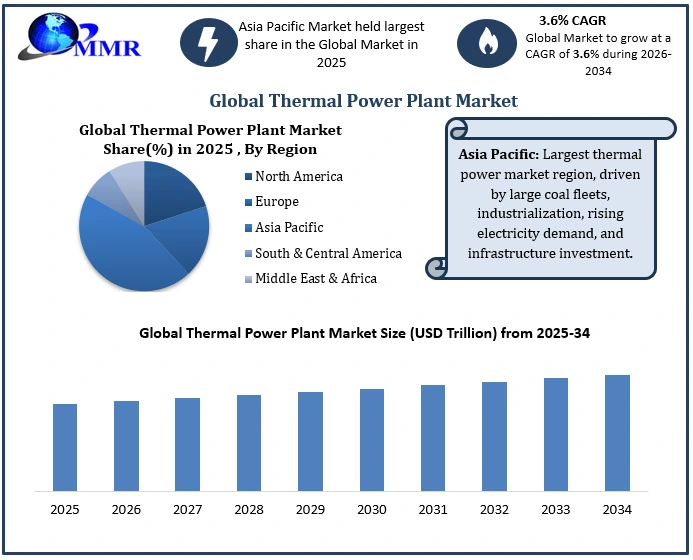
The Global Thermal Power Plant Market was valued at USD 1.57 trillion in 2025 and is estimated to reach USD 2.13 trillion by 2034. The thermal power plant market is expected to grow at a CAGR of 3.6% during 2026–2034.
This report provides a comprehensive view of the global thermal power plant market, combining market sizing, segmentation, regional analysis, competitive landscape, key players, market dynamics, trends, and recent developments. From an analyst perspective, it helps clients identify high-growth opportunities, competitive shifts, regional investment hotspots, technology priorities, and changing customer requirements. The analysis supports strategic decisions related to market entry, expansion, partnerships, technology investments, and positioning by showing where thermal power demand is strengthening and how leading players are adapting.
Global Thermal Power Plant Market Overview
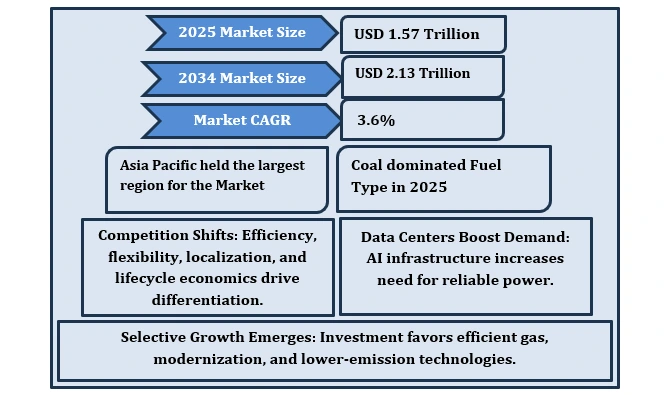
The thermal power plant market is expected to evolve toward more efficient, flexible, and lower-emission generation rather than experience a uniform decline. Growing electricity demand from data centers, industrial activity, and emerging economies is supporting investment in gas-fired generation, combined-cycle plants, modernization, and flexible thermal capacity. At the same time, renewable integration and tighter emissions requirements are accelerating demand for advanced turbines, digital monitoring, alternative fuels, carbon-reduction technologies, and lifecycle services. This report helps clients anticipate these shifts and identify the technologies, regions, and competitive strategies most likely to shape the market's next phase.
Global Thermal Power Plant Market Defination
The thermal power plant market refers to the global development, construction, modernization, and operation of power-generation facilities that convert thermal energy into electricity, primarily using coal, natural gas, oil, biomass, and other combustible fuels. These plants use technologies such as steam turbines, gas turbines, and combined-cycle systems to provide electricity for residential, commercial, industrial, and grid-scale applications. Despite the accelerating transition toward renewable generation, thermal power plants remain a critical component of global electricity systems because of their ability to provide dispatchable, scalable, and grid-balancing power.
The investment in electricity generation capacity, plant modernization, efficiency improvements, and flexible generation technologies. The underlying demand shows that thermal generation is strategically important, as global electricity demand increased by around 3% in 2025, adding around 800 TWh. Thermal generation faces an increasingly competitive low-carbon power mix. In 2025, coal supplied 34% of global electricity, while natural gas accounted for 21%, making them the two largest individual sources of electricity generation. However, the market is entering a structural transition rather than a simple expansion cycle.
Global coal-fired generation declined 0.5% in 2025, while gas-fired generation increased around 0.5%, highlighting a gradual shift within thermal generation itself. The renewable capacity additions reached a record 692 GW in 2025, representing 85.6% of total capacity additions, intensifying pressure on conventional power technologies to become more efficient and flexible.
The next phase of the thermal power plant market is therefore shaped less by simply adding capacity and more by modernizing existing assets, improving efficiency, increasing operational flexibility, and integrating thermal generation into increasingly renewable-dominated power systems.
Global Thermal Power Plant Market Size Forecast
To know about the Research Methodology :- Request Free Sample Report
Global Thermal Power Plant Market Dynamics
Rising Global Electricity Demand Drives Thermal Generation
Growing electricity consumption across industrial, commercial, residential, and digital infrastructure applications continues to support demand for reliable power-generation capacity. Global electricity demand increased by 3% in 2025, adding nearly 800 TWh, while the IEA forecasts demand growth of 3.6% in 2026 and 3.8% in 2027. Industrial expansion, rising appliance ownership, electric vehicles, cooling demand, heat pumps, and data centers are major contributors. Thermal power plants remain valuable where grids require dispatchable generation and reliable capacity, particularly in fast-growing emerging economies and regions experiencing electricity-supply constraints.
Increasing Data Center and AI Infrastructure Increases Demand for Dispatchable Power
The rapid expansion of AI and data-center infrastructure creates a new source of electricity demand. Global data-center electricity consumption is projected to more than double from around 460 TWh in 2024 to 945 TWh by 2030. Natural gas is expected to play an important role alongside renewables in meeting this incremental demand because of its dispatchability and comparatively flexible operation. Growth in AI infrastructure strengthens the business case for gas-fired and combined-cycle power plants, particularly where grid connections and renewable-plus-storage capacity cannot scale quickly enough.
Rapid Renewable Capacity Expansion Reduces Dependence on Conventional Generation
The accelerating deployment of renewable energy increasingly competes with new thermal generation projects. The global renewable capacity increased by 692 GW in 2025, with renewables accounting for 85.6% of total capacity additions. New thermal projects face greater competition from solar, wind, storage, and hybrid systems, particularly in markets where renewable generation is increasingly cost-competitive.
Plant Modernization Creates Opportunities for High-Efficiency Technologies
The transition toward cleaner electricity does not eliminate the existing thermal fleet; instead, it creates opportunities to modernize plants through supercritical and ultra-supercritical technologies, combined-cycle systems, digital monitoring, advanced turbines, emissions-control equipment, and efficiency upgrades. The efficiency of coal plants has a direct impact on their emissions intensity; the IEA notes that a 43%-efficient bituminous-coal plant produces substantially lower CO₂ emissions per MWh than a less-efficient plant. Modernization shifts a portion of market value from greenfield construction toward retrofits, life-extension projects, efficiency improvements, and digital plant optimization.
Flexible Thermal Generation Supports Renewable-Dominated Grids
As variable solar and wind generation expands, power systems require resources that can respond when renewable output fluctuates. The IEA highlights the increasing importance of system flexibility as renewable penetration rises. Natural-gas-fired and other flexible thermal plants can therefore complement renewable generation during periods of low wind or solar output. Thermal power increasingly evolves from continuous baseload generation toward a flexible balancing role, creating opportunities for fast-ramping gas turbines, combined-cycle systems, and digitally optimized plants.
Decarbonization Pressure Accelerates the Shift Away from Coal
Thermal power remains exposed to stringent emissions policies because coal-fired generation has a substantially higher emissions intensity than more efficient gas generation. In 2025, coal remained the largest individual source of global electricity at 34%, but coal-fired generation declined by 0.5%, while the share of renewables increased to 34%. Developers and operators face increasing pressure to reduce emissions through efficiency upgrades, carbon capture, fuel switching, co-firing, and retirement of inefficient units, making decarbonization one of the defining challenges for the market through 2034.
Global Thermal Power Plant Market Trends
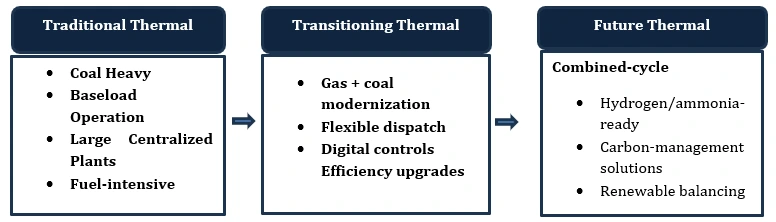
• Thermal Plants Shift Toward Flexible Generation - Thermal power plants increasingly operate as flexible grid assets rather than only baseload generators. Operators are upgrading controls, improving ramp rates, lowering minimum operating loads, and shortening start-up times to respond more effectively to fluctuations in renewable generation. The IEA identifies thermal plants as an important existing source of system flexibility.
• Hydrogen- and Ammonia-Ready Plants Gain Momentum - Thermal generation is increasingly incorporating low-carbon fuels into plant design. Utilities and turbine manufacturers are developing hydrogen- and ammonia-capable systems that can reduce dependence on conventional fossil fuels while retaining dispatchable generation capabilities. The IEA reports successful demonstrations of high hydrogen co-firing and increasing development of H₂-ready gas turbines. For Example: In Japan, KEPCO has operated a unit at its Himeji Daini gas-fired plant with 30% hydrogen co-firing since April 2025, demonstrating the transition toward hydrogen-compatible thermal generation.
• Digital Intelligence Moves into Plant Operations - Thermal power plants increasingly integrate AI, predictive maintenance, advanced sensors, digital monitoring, and automated controls to improve equipment reliability and optimize plant performance. The U.S. Department of Energy highlights AI-based predictive maintenance and digital monitoring as technologies that can improve thermal plant efficiency and reliability.
• Cleaner Thermal Technologies Gain Priority - The market increasingly shifts toward supercritical and ultra-supercritical generation, biomass co-firing, emissions-control systems, and carbon capture as operators seek to extend thermal assets while reducing their environmental footprint. India's Ministry of Power, for example, is promoting supercritical and ultra-supercritical units and has introduced policies supporting biomass co-firing in coal plants. For example, India had commissioned 70,190 MW of supercritical and 7,680 MW of ultra-supercritical capacity by October 2025, while NTPC was operating a pilot carbon-capture project at its Vindhyachal Thermal Power Station.
Thermal Power Transition Map — “From Baseload to Flexibility”
Global Thermal Power Plant Market Segment Analysis
By Fuel Type
Coal dominated the global Thermal Power Plant Market in 2025, supported by its extensive installed generation base and continued importance in major electricity markets, particularly across Asia. Coal-fired power remains deeply integrated into electricity systems in China, India, and Southeast Asia, where it supports industrial activity, grid reliability, and growing electricity demand. The established coal-generation ecosystem, including fuel supply infrastructure, transportation networks, power plants, and technical capabilities, further strengthens its position. Natural gas is projected to witness stronger growth during 2026–2034. It is supported by its flexibility, lower emissions intensity relative to coal, and increasing role in balancing variable renewable generation. Rising electricity demand from data centers, industrial facilities, and other power-intensive applications further creates opportunities for gas-fired generation. The IEA projects gas-fired generation to grow faster than coal-fired generation through 2030.
The fuel mix is gradually shifting from coal-led thermal generation toward a more diversified structure in which natural gas gains strategic importance as grids prioritize flexibility and efficiency.

By Turbine Type
Steam turbine technology dominates the global thermal power plant market in 2025, with the extensive installed base of coal-fired and other conventional steam-cycle power plants. Steam turbines benefit from mature technology, established manufacturing and maintenance infrastructure, and their suitability for large-scale electricity generation. Their relevance is also supported by modernization, refurbishment, and life-extension activities across existing thermal fleets. Combined-cycle technology is expected to witness stronger growth during 2026–2034, supported by higher efficiency, fuel utilization, operational flexibility, and the expanding role of natural-gas-fired generation. Combined-cycle plants integrate gas and steam turbines, allowing waste heat from the gas turbine to generate additional electricity and improving overall plant efficiency. Growing requirements for flexible generation alongside renewable power further strengthen the technology's outlook.
The turbine landscape is transitioning from a predominantly steam-based installed fleet toward more efficient and flexible combined-cycle configurations, particularly for new gas-fired capacity.

Global Thermal Power Plant Market Regional Analysis
Asia Pacific — Largest Demand and Supply Base
Asia Pacific leads the thermal power plant market, with demand concentrated in China, India, Indonesia, Vietnam, Japan, and South Korea. The region accounted for 52% of global electricity generation in 2025, producing approximately 16,132 TWh, demonstrating the scale of its electricity system. China consumed 9,794 billion kWh of electricity in 2025, while coal accounted for 62% of its total energy consumption. Asia Pacific's advantage lies in its ability to combine large electricity demand + domestic fuel availability + established thermal infrastructure. Consequently, thermal power remains important for meeting incremental electricity requirements even as renewables expand rapidly.
North America — Gas-Fired and Reliability-Led Demand
North America remains a major thermal power market, led by the United States. Its demand structure differs considerably from Asia Pacific. The region has extensive natural-gas resources, mature electricity infrastructure, and a growing requirement for reliable power from data centers, manufacturing, and electrification. The United States generated 4,429 billion kWh of utility-scale electricity in 2025, with around 58% coming from fossil fuels. This provides a substantial installed base for thermal generation.
The region's strongest advantage is its domestic natural-gas production and pipeline infrastructure. The United States is also expanding LNG exports rapidly. The IEA expects around 300 bcm/year of new global LNG export capacity by 2030, with the United States and Qatar accounting for around 70% of this expansion. This gives the U.S. an important supply-side advantage: thermal generation can increasingly rely on domestically produced gas rather than imported fuel. Meanwhile, rising electricity requirements from AI and data centers are reinforcing the need for firm generation.
North America's thermal opportunity increasingly shifts away from large-scale coal expansion toward natural-gas combined-cycle plants, flexible gas turbines, modernization, and reliability-oriented generation capacity.
Europe — Replacement and Flexible Generation Demand
Europe represents a mature thermal power market, characterised by declining coal dependence, strong renewable penetration, and increasing emphasis on flexible generation rather than conventional baseload expansion. The European Union generated 47.2% of its electricity from renewable sources in 2025, while fossil fuels accounted for 29.6%. Coal's position has weakened considerably: hard coal represented only 3.7% and lignite 5.5% of EU gross electricity production in 2025, bringing the combined coal share to a record-low 9.2%. Gas-fired generation becomes increasingly valuable when wind and hydropower output is insufficient. In the first half of 2025, European gas consumption increased by 6.5% year on year, primarily because lower wind and hydropower generation increased the need for gas-fired electricity.
Europe shifts from a capacity-expansion market toward a flexibility-and-modernization market, with thermal plants increasingly operating as balancing assets alongside renewable generation.
South America — Hydropower-Dominated but Gas-Supported
South America has a comparatively smaller thermal power opportunity, primarily because hydropower provides a major share of electricity in countries such as Brazil, Colombia, and Paraguay. Brazil's electricity system is particularly hydro-intensive; the EIA reports that hydropower accounted for approximately 54.8% of Brazil's electricity generation in its referenced data. Brazil also has substantial domestic hydropower resources, with approximately 99.8 GW of installed hydro capacity in the same dataset. However, dependence on hydropower creates a requirement for thermal backup during periods of drought and reduced water availability. The Lower hydropower availability in Brazil supported a strong increase in gas-based power generation in 2025. Therefore, natural gas provides an important complementary role, particularly where thermal plants are required to compensate for hydrological variability.
South America's thermal market is less driven by continuous baseload expansion and more by energy-security requirements, hydrological risk management, flexible gas generation, and backup capacity.
Middle East & Africa — Rapid Demand Growth and Fuel Availability
Middle East & Africa present two distinct but complementary thermal-power opportunities. The Middle East benefits from abundant oil and natural-gas resources, while Africa combines substantial coal and gas resources with significant unmet electricity demand. In MENA, natural gas and oil supplied more than 90% of electricity generation in 2024, with natural gas alone accounting for 70%. The region also supplied more than 30% of global oil and nearly 20% of global natural gas in 2024, creating an exceptional domestic fuel advantage. Demand is also structurally strong. MENA electricity consumption is projected to increase by 50% between 2024 and 2035, with cooling and desalination expected to account for around 40% of the additional electricity demand. Saudi Arabia, the UAE, Qatar, Iran, Algeria, and Egypt are particularly important markets.
Africa presents a different requirement: electricity supply is insufficient relative to growing demand. Electricity demand across Africa increased by 3.4% in 2024, and the IEA expects demand growth to average approximately 5% annually during 2025–2027. South Africa, Egypt, and Algeria together account for more than half of Africa's electricity consumption. South Africa additionally possesses substantial domestic coal resources and remains heavily dependent on coal-fired generation, creating continued demand for thermal generation while the country gradually adds renewable capacity.
MENA is positioned around gas-fired expansion and oil-to-gas switching, while Africa offers a longer-term thermal opportunity based on electricity-access gaps, industrialization, domestic coal/gas resources, and grid reliability requirements.
Global Thermal Power Plant Market Recent Developments
| Date | Company / Market | Recent Development | Strategic Impact |
| Aug. 2026 | Siemens Energy | Plans to divest most of its Transformation of Industry division and focus on gas turbines and electrical grids. | Strengthens gas power positioning as a growth area driven by data centers, AI, and grid demand. |
| Jul. 2026 | GE Vernova | Gas-power backlog and slot reservations reached 116 GW, with output targeted at 30 GW annually by 2030. | Highlights strong gas-turbine demand and the growing importance of manufacturing capacity and delivery slots. |
| Aug. 2026 | GE Vernova Hitachi / Blue Energy | Advanced a 2.5 GW gas-plus-nuclear project in Texas, targeting a final investment decision in 2027. | Promotes hybrid firm-power solutions for large electricity loads such as AI and advanced manufacturing. |
| Feb. 2026 | Siemens Energy | Committed USD 1 billion to expand U.S. gas-turbine and grid-equipment manufacturing. | Strengthens localized supply capacity and supports U.S. gas-generation growth. |
| 2026 | U.S. Thermal Power Market | U.S. coal- and gas-power investment is projected at around USD 50 billion, surpassing China's investment. | Reinforces the U.S. as a major thermal investment hub, driven by data-center and AI power demand. |
Global Thermal Power Plant Market Competitive Analysis
Global Players Strengthen Their Position Through Gas Power and Installed Bases
The global thermal power plant market exhibits strong competition among a relatively concentrated group of global technology providers, regional equipment manufacturers, utilities, and EPC contractors. Competition increasingly depends on reliability, efficiency, project execution, and lifecycle economics rather than equipment price alone.
Global suppliers such as GE Vernova, Siemens Energy, Mitsubishi Heavy Industries, and Doosan Enerbility compete through gas and steam turbines, plant engineering, modernization, digital services, and long-term maintenance. Chinese manufacturers such as Harbin Electric, Dongfang Electric, and Shanghai Electric benefit from large domestic project pipelines, localized manufacturing, and cost advantages, while major utilities and power producers such as China Energy Investment, NTPC, JERA, RWE, EDF, and Adani Power strengthen their positions through operating scale, fuel access, financing capabilities, and project-development expertise.
The competitive center of gravity is increasingly shifting toward natural-gas generation, particularly large-frame gas turbines and combined-cycle systems. GE Vernova illustrates this shift, with its gas-power backlog and slot reservations reaching 83 GW at the end of 2025, supported by an installed base of more than 7,000 gas turbines. This installed base creates a significant aftermarket advantage through maintenance, spare parts, upgrades, digital monitoring, and long-term service agreements. Siemens Energy is also placing greater emphasis on gas turbines and grid infrastructure, supported by rising electricity requirements from data centers, AI infrastructure, and broader power-system investment.
New Positioning and Differentiation Strategies
| Player / Group | New Positioning | Key Differentiator |
| GE Vernova | Gas power + grid + lifecycle services | Installed base, equipment availability, services ecosystem |
| Siemens Energy | Gas turbines + grid infrastructure | Flexible generation and power-system integration |
| Mitsubishi Heavy Industries | High-efficiency and lower-carbon generation | Advanced turbines and alternative-fuel pathways |
| Chinese manufacturers | Cost-efficient large-scale thermal systems | Localization, scale, and domestic supply chains |
| Indian power companies | Reliable domestic generation + modernization | Operating scale, fuel access, and local expertise |
| Global equipment leaders | Thermal assets supporting renewable integration | Efficiency, flexibility, digitalization, lifecycle economics |
Regional Manufacturers Compete Through Scale, Localization, and Cost
Competition changes significantly across China and India, where domestic manufacturers and utilities benefit from large project pipelines and localized supply chains. China remains particularly important, with coal-power investment at more than USD 54 billion in 2025. This supports demand for boilers, steam turbines, generators, EPC services, and associated equipment, strengthening the positions of Harbin Electric, Dongfang Electric, and Shanghai Electric. Their advantage is based less on premium technology alone and more on cost efficiency, localized engineering, shorter supply chains, and large-scale project execution.
India demonstrates a similar localization dynamic. Its large coal-based generation fleet and rising electricity demand support domestic thermal generation, equipment manufacturing, and modernization. Companies such as NTPC benefit from extensive operating experience, project-development capabilities, and domestic infrastructure access. Consequently, international suppliers increasingly need local manufacturing, partnerships, financing support, EPC capabilities, and lifecycle services to compete effectively in these markets.
Investment Reinforces Competition Rather Than Signaling a Simple Decline
Thermal power investment is becoming more selective rather than disappearing. Continued investment in coal generation in markets such as China reflects the importance of energy security and reliability, while rapid investment in renewables and grids is simultaneously reshaping the role of thermal generation. This creates a competitive opportunity for suppliers that position thermal assets as complementary to renewable power.
Cost Structure Shifts Competitive Advantage Toward Lifecycle Economics
Thermal power projects involve substantial expenditure on generation equipment, EPC and construction, fuel infrastructure, cooling systems, emissions controls, grid connections, financing, and long-term operations and maintenance. Fuel and efficiency therefore remain critical to plant economics. For equipment manufacturers, however, competitive advantage increasingly extends beyond the initial equipment sale. Spare parts, modernization, performance upgrades, digital monitoring, and long-term maintenance generate recurring revenues throughout a plant's operating life. As a result, large installed bases become strategic assets that strengthen customer retention and create long-term aftermarket opportunities.
Thermal Power Plant Market Competitive Landscape
Leading players are repositioning thermal power around speed, flexibility, efficiency, and lower-carbon operation. Gas turbines and combined-cycle plants are increasingly positioned as flexible generation solutions capable of supporting systems with growing renewable penetration. At the same time, manufacturers are developing hydrogen-capable turbines, carbon-capture solutions, advanced controls, and digital monitoring to extend the relevance of thermal assets under tightening emissions requirements. Overall, competition is shifting from conventional capacity supply toward high-efficiency generation, flexible capacity, modernization, and lifecycle services.
Thermal Power Plant Market Scope: Inquire before buying
| Thermal Power Plant Market | |||
|---|---|---|---|
| Report Coverage | Details | ||
| Base Year: | 2025 | Forecast Period: | 2026-2034 |
| Historical Data: | 2020 to 2025 | Market Size in 2025: | USD 1.57 Tn. |
| Forecast Period 2026 to 2034 CAGR: | 3.6% | Market Size in 2034: | USD 2.13 Tn. |
| Segments Covered: | by Fuel Type | Coal Natural Gas Oil Others |
|
| by Capacity | Up to 400 MW 400–800 MW More than 800 MW |
||
| by Turbine Type | Simple Cycle Combined Cycle |
||
| by Installation Type | New Installation Retrofit / Modernization |
||
| by Application | Utility-Scale Power Generation Industrial / Captive Power Commercial Others |
||
Global Thermal Power Plant Market, by Region
North America (United States, Canada, and Mexico)
Europe (UK, France, Germany, Italy, Spain, Sweden, Austria, and the Rest of Europe)
Asia Pacific (China, South Korea, Japan, India, Australia, Indonesia, Malaysia, Vietnam, Taiwan, Bangladesh, Pakistan, and the Rest of APAC)
Middle East and Africa (South Africa, GCC, Egypt, Nigeria, and the Rest of ME&A)
South America (Brazil, Argentina, Rest of South America)
Global Thermal Power Plant Key Players by Region
North America
1. GE Vernova
2. Westinghouse Electric Company
3. Bechtel
4. Fluor Corporation
5. Babcock & Wilcox
6. ConocoPhillips
7. Duke Energy
8. Dominion Energy
9. Southern Company
10. NRG Energy
Europe
11. Siemens Energy
12. Mitsubishi Power Europe
13. Ansaldo Energia
14. MAN Energy Solutions
15. Wärtsilä
16. Rolls-Royce Power Systems
17. RWE
18. Uniper
19. EDF
20. Engie
Asia Pacific — China
21. Harbin Electric Corporation
22. Dongfang Electric Corporation
23. Shanghai Electric
24. China Energy Investment Corporation
25. China Huaneng Group
26. China Huadian Corporation
27. Datang International Power Generation
28. China Power Investment Corporation
Asia Pacific — Japan & South Korea
29. Mitsubishi Heavy Industries
30. Toshiba Energy Systems & Solutions
31. IHI Corporation
32. Kawasaki Heavy Industries
33. Doosan Enerbility
34. HD Hyundai Heavy Industries
35. Samsung C&T
36. Korea Electric Power Corporation (KEPCO)
Asia Pacific — India
37. NTPC Limited
38. Bharat Heavy Electricals Limited
39. Adani Power
40. Tata Power
41. JSW Energy
42. Reliance Power
43. NLC India
44. Damodar Valley Corporation
Middle East
45. ACWA Power
46. TAQA
47. Masdar
48. Saudi Electricity Company
49. Emirates Water and Electricity Company
50. Elsewedy Electric
51. Orascom Construction
52. Kharafi National
South America
53. Eletrobras
54. ENGIE Brasil Energia
55. CFE
56. AES Corporation
57. Enel
58. Petrobras
59. Colbún
60. Cerro Dominador
Africa
61. Eskom
62. Sasol
63. ACWA Power
64. Elsewedy Electric
65. Orascom Construction
66. Sonelgaz
67. TAQA Morocco
Global Thermal Power Plant Market Frequently Asked Questions
1. What is the global thermal power plant market?
The thermal power plant market covers the development, construction, operation, modernization, and maintenance of power plants that generate electricity using heat from coal, natural gas, oil, nuclear, biomass, or other thermal energy sources.
2. What is driving the growth of the thermal power plant market?
Rising electricity demand, energy security requirements, industrialization, data-center expansion, and the need for reliable and flexible power generation are supporting thermal power plant investments.
3. Which fuel type dominates the thermal power plant market?
Coal remains a major thermal power generation source globally, particularly across Asia, while natural gas is gaining importance because of its flexibility, efficiency, and ability to complement intermittent renewable generation.
4. Which region dominates the global thermal power plant market?
Asia Pacific represents the leading thermal power market, supported by large electricity demand, extensive coal-fired generation fleets, industrialization, and continued investment in power infrastructure, particularly in China and India.
5. Who are the key players in the thermal power plant market?
Major players include GE Vernova, Siemens Energy, Mitsubishi Heavy Industries, Doosan Enerbility, Harbin Electric, Dongfang Electric, Shanghai Electric, NTPC, BHEL, and other regional power-generation and engineering companies.
6. What trends are shaping the thermal power plant market?
Key trends include the expansion of high-efficiency gas turbines, combined-cycle power generation, plant modernization, digital monitoring, flexible thermal generation, alternative fuels such as hydrogen, and integration with renewable energy systems.
7. How is natural gas changing the thermal power plant market?
Natural gas is strengthening its role as a flexible generation source that can respond quickly to changing electricity demand and support power systems with increasing shares of variable renewable energy.
8. What is the future outlook for the thermal power plant market?
The market is expected to become increasingly selective, with investment shifting toward high-efficiency gas generation, flexible capacity, modernization, emissions-reduction technologies, and lifecycle services rather than conventional thermal capacity alone.