
Netherlands Cocoa Butter Market Size by Product Type, Nature, Grade, Application and End User
Overview
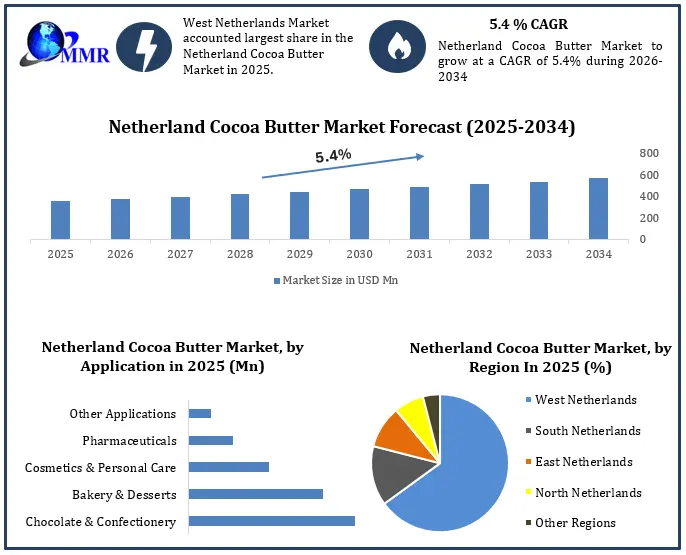
The Netherland Cocoa Butter Market was valued at USD 359.5 Million in 2025 and is projected to reach USD 577.12 Million by 2034, registering a CAGR of 5.4 % during the forecast period (2026–2034).
| Parameter | Value |
| Market Size (Base Year 2025) | USD 359.5 Million |
| Forecast Market Size (2034) | USD 577.12 Million |
| CAGR (2026–2034) | 5.4% |
| Base Year | 2025 |
| Forecast Period | 2026–2034 |
| Historical Period | 2020–2025 |
Netherlands Cocoa Butter Market Definition
The Netherlands Cocoa Butter Market comprises the production, processing, import, export, distribution, and consumption of cocoa butter, a cocoa-derived fat obtained from cocoa beans. It includes cocoa butter supplied in various forms and grades for use as a functional ingredient across chocolate and confectionery, bakery, cosmetics, personal care, and pharmaceutical applications. The market is characterized by an established cocoa-processing and trading ecosystem, supported by the Netherlands’ strong import, storage, processing, and logistics infrastructure. Cocoa butter is utilized by manufacturers based on its melting properties, texture, stability, purity, and formulation performance, serving both domestic demand and international supply chains.
Netherlands Cocoa Butter Market Overview
The Netherlands Cocoa Butter Market is evolving along with the country’s strong position within the European cocoa value chain, with market development influenced by changing cocoa prices, raw material availability, sustainability expectations, traceability requirements, and sourcing practices. The Netherlands benefits from an established cocoa ecosystem centered around major processing and logistics hubs, particularly the Port of Amsterdam and the Zaanstreek region, which support efficient movement of cocoa and semi-finished products across European markets. These structural advantages create significant market potential for sustainable, certified, traceable, and specialty cocoa butter, while growing processing capabilities in cocoa-producing countries are reshaping competitive dynamics and creating new market gaps and opportunities for value-added products and differentiated supply solutions.
The Netherlands Cocoa Butter Market report provides a detailed assessment of market size, forecast, market development, growth potential, competitive landscape, market changes, emerging trends, opportunities, and market gaps. The analysis examines demand across key end-use industries, evolving purchasing and sourcing patterns, competitive developments, and factors influencing future market expansion. Key participants such as Cargill contribute to the country’s cocoa industry through established processing and ingredient operations; for example, Cargill’s Dutch cocoa operations support the supply of cocoa-derived ingredients to downstream manufacturers. The report further identifies commercial opportunities arising from sustainability-led sourcing, product specialization, supply-chain efficiency, and increasing demand for cocoa butter across food and non-food applications.
Netherland Cocoa Butter Market Growth and Forecast Analysis
To know about the Research Methodology :- Request Free Sample Report
Netherlands Cocoa Butter Historical Market Size (2020–2025)
| Year | Market Size | Growth Rate (YoY) |
| 2020 | USD 278.3 Mn | 3.8% |
| 2021 | USD 290 Mn | 4.2% |
| 2022 | USD 310.6 Mn | 7.1% |
| 2023 | USD 321.8 Mn | 3.6% |
| 2024 | USD 341.1 Mn | 5.9% |
| 2025 | USD 359.5 Mn | 5.4% |
Netherlands Cocoa Butter Market Size Forecast (2026–2034)
| Year | Market Size | Growth Rate (YoY) |
| 2026 | USD 379 Mn | 5.4% |
| 2027 | USD 399.7 Mn | 5.4% |
| 2028 | USD 421.4 Mn | 5.4% |
| 2029 | USD 444.3 Mn | 5.4% |
| 2030 | USD 468.5 Mn | 5.4% |
| 2031 | USD 493.9 Mn | 5.4% |
| 2032 | USD 520.8 Mn | 5.4% |
| 2033 | USD 540.3Mn | 5.4% |
| 2034 | USD 577.12Mn | 5.4% |
Netherlands Cocoa Butter Market Key Highlights
• Market Growth: The market is expected to grow from USD 359.5 Mn in 2025 to USD 577.12 Mn by 2034, at a 5.4% CAGR.
• Leading Application: Chocolate and confectionery products account for the largest share of demand.
• Regional Hub: West Netherlands, especially Amsterdam and Zaanstreek, is the leading regional market.
• Key Driver: Strong cocoa processing and chocolate manufacturing support market growth.
• Emerging Opportunity: Demand is increasing for organic, traceable, sustainable, and specialty cocoa butter.
• Major Players: Major companies include ofi, Cargill, Barry Callebaut, ECOM/Dutch Cocoa, ADM, and Theobroma.
• Market Potential: Strong processing infrastructure and European distribution networks support future market expansion.
Netherlands Cocoa Butter Market Consumer Insights & Demand Analysis
| Consumer Dimension | Key Insights | Market Implication |
| Processing Hub Identity | Netherlands' market is defined by its role as a world-class grinding and re-processing centre rather than end-consumption | Structural demand tied to global cocoa trade flows through Amsterdam; relatively insensitive to local consumer trends |
| Sustainability Leadership | Dutch companies are global leaders in sustainable cocoa sourcing; over 70% of cocoa processed domestically is certified under Fairtrade, UTZ, or Rainforest Alliance | Premium sustainability-certified cocoa butter commands price premiums; Dutch processors positioned as ethical supply chain anchors |
| Industrial Cosmetics Demand | Growing Dutch cosmetics industry, particularly in natural and organic personal care, driving domestic cocoa butter end-use | Domestic cosmetics application expanding alongside the Netherlands' position as a European beauty innovation hub |
| EUDR Compliance Hub | Netherlands positioned as the EU's most compliant cocoa processing jurisdiction given early adoption of traceability systems | Competitive advantage in serving EU buyers requiring EUDR-compliant cocoa butter certification |
Netherlands Cocoa Butter Market Dynamics
Netherlands Cocoa Butter Market Drivers
• Strong cocoa-processing ecosystem: The Netherlands has an established cocoa-processing base, with key activities concentrated around Amsterdam and the Zaanstreek region. This well-established industry supports the production, storage, distribution, and export of cocoa butter to European food manufacturers.
• High demand for cocoa butter in semi-finished products: Cocoa butter is an important semi-finished cocoa ingredient for chocolate, confectionery, bakery, and other food formulations. Dutch imports of cocoa butter from producing countries reached about 87,031 tonnes in 2025, demonstrating industrial demand.
• Export-oriented trade structure: The Netherlands exported cocoa products worth €12.4 billion in 2025, with around three-quarters of Dutch cocoa-product exports comprising semi-finished products. This positions the country as a major processing and distribution center, supporting the continued demand for cocoa butter.
• Established distribution network: The Netherlands acts as a distribution channel between cocoa-producing countries and the large European manufacturing markets. Its logistics infrastructure and proximity to Germany, Belgium, France, and other large chocolate-producing markets supports the flow of cocoa butter and food ingredients.
Netherlands Cocoa Butter Market Restraints
• Import dependency: A majority of Dutch cocoa butter producers are dependent on cocoa beans and cocoa products as their primary material inputs. This makes them vulnerable to fluctuations in international markets and cocoa-supply conditions.
• Price volatility of raw-materials: Cocoa prices have seen substantial increases, primarily due to supply disruptions and poor harvests in major producing countries. Higher bean prices can raise cocoa butter production costs, impacting profit margins.
• Compliance cost burden: Companies are required to meet high standards of sustainability, traceability, and responsible sourcing. This can increase the overall administrative, verification, documentation, and supply-chain management burden, particularly for smaller suppliers.
• Flexibility constraints for conventional sourcing: The high requirements for documented origin and responsible sourcing can reduce the number of suppliers that are immediately able to meet buyer specifications, possibly limiting flexibility in cocoa sourcing during a period of supply shortage.
Netherlands Cocoa Butter Market Opportunities
• Premium and traceable cocoa butter: The market has potential for differentiated cocoa butter products that are supported by origin transparency, certification, and sustainability credentials, and a consistent level of quality. Buyers are considering factors beyond price and volume when selecting cocoa butter suppliers.
• Value-added application expansion: Beyond traditional chocolate production, there are opportunities in premium confectionery, bakery, cosmetics, personal care, and pharmaceutical formulations. The functional characteristics of cocoa butter provide value for manufacturers looking to utilize natural and recognizable formulation ingredients.
• Supply diversification prospects: The Dutch cocoa-sourcing landscape is becoming more diverse, with countries such as Cameroon, Nigeria, Ecuador, and Guinea gaining significance. This presents an opportunity for cocoa butter producers and traders to develop and build relationships with multiple suppliers.
• Differentiation potential: Companies can address the market gap between conventional cocoa butter and higher-value traceable or certified products by developing differentiated grades and sourcing programs. This can enable them to strengthen their position in the market and secure long-term contracts.
Netherlands Cocoa Butter Market Challenges
• Risk of supply disruptions from cocoa-producing regions: Weather variations, plant diseases, and poor harvests can impact cocoa availability and subsequently influence cocoa butter production volumes and costs. Since a significant part of the Dutch cocoa market consists of direct imports from producing countries, these factors have a direct bearing on domestic supply.
• Increasing supply-chain traceability requirements: Companies have to enhance their origin tracking, documentation, and supplier verification mechanisms across complex international cocoa chains. Maintaining reliable and consistent information from farm level through processing and distribution can be a challenge.
• Exposure to international market fluctuations: As a major international cocoa trading and processing center, the Netherlands is highly exposed to variations in global cocoa prices, availability, and trade flows.
• Competitive pressures in a mature processing environment: The established Dutch cocoa-processing industry leads to intense competition among processors, traders, and ingredient suppliers. New entrants and those entering the forecast period need to find ways to differentiate themselves, either through product quality, sourcing practices, and supply reliability, or by offering value-added services and specifications beyond the basics.
Netherlands Cocoa Butter Market Segment Analysis
Netherlands Cocoa Butter Market, by Application
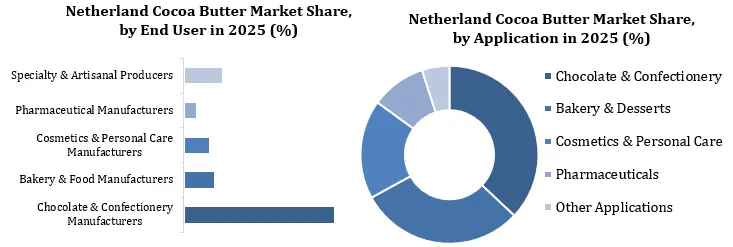
The Chocolate and Confectionery segment represents the core application area, supported by the Netherlands' extensive cocoa-processing and chocolate manufacturing ecosystem. Cocoa butter provides the required melting behavior, texture, gloss, and mouthfeel in chocolate formulations. Bakery and Desserts generate demand through fillings, coatings, biscuits, pastries, and premium desserts. Cosmetics and Personal Care use cocoa butter for its emollient and skin-conditioning properties, while Pharmaceuticals represent a specialized application requiring consistent formulation characteristics. Other applications contribute niche demand through specialty food, nutritional, and formulation uses. Increasing product diversification provides additional opportunities for cocoa butter suppliers beyond traditional chocolate applications.
Netherlands Cocoa Butter Market, by End User
Industrial Manufacturers constitute the largest demand base for cocoa butter, which is consumed in large quantities to produce chocolate, confectionery, bakery, and processed-food products. Meanwhile, Artisanal and Specialty Producers generate demand for premium, organic, origin-specific, and differentiated cocoa butter products. Cosmetics and Personal Care Manufacturers utilize cocoa butter as an ingredient in cosmetics and body-care products, whereas Pharmaceutical Manufacturers represent a specialty end-user segment that specifies products with controlled quality and consistent product specifications. Cocoa butter downstream manufacturers are increasingly focusing on customization, which creates opportunities for suppliers that provide reliable volumes, customized specifications, and traceability.
Netherlands Cocoa Butter Market Regional Analysis
| Region | Market Share | Key Demand Drivers & Trends |
| West Netherlands | 65% | Demand is driven by a strong cocoa-processing infrastructure, port access, and concentration of chocolate and confectionery manufacturers. |
| South Netherlands | 14% | Demand is supported by food processing, confectionery production, and proximity to Belgium and Germany. |
| East Netherlands | 10% | Food manufacturing and ingredient distribution supports steady cocoa butter consumption. |
| North Netherlands | 7% | Demand is driven by smaller food-processing and specialty ingredient applications. |
| Other Regions | 4% | Niche demand comes from food, cosmetics, personal care, and specialty formulations. |
Netherlands Cocoa Butter Market Competitive Landscape
Key Players & Benchmarking
| Company | Product | Market Position |
| ofi (Olam Food Ingredients) | Cocoa Butter, Deodorized Cocoa Butter, Specialty Cocoa Ingredients | Major cocoa processor and cocoa butter supplier |
| Cargill | Pure Cocoa Butter, Full-Flavor Cocoa Butter, Partly Deodorized Cocoa Butter, White Cocoa Butter | Leading integrated cocoa ingredient supplier |
| Barry Callebaut | Cocoa Butter, Deodorized Cocoa Butter, Cocoa Ingredients | Major chocolate and cocoa ingredient supplier |
| ECOM Agroindustrial | Cocoa Butter, Cocoa Liquor, Cocoa Powder | Established cocoa-processing and ingredient supplier |
| ADM | Cocoa Butter, Cocoa Liquor, Cocoa Powder | Major international cocoa processor |
| Theobroma | Cocoa Butter, Cocoa Liquor, Cocoa Powder | Specialized cocoa ingredient processor |
| Petra Foods | Cocoa Butter, Cocoa Liquor, Cocoa Powder | International cocoa ingredient supplier |
| Blommer Chocolate Company | Cocoa Butter and Cocoa Ingredients | Cocoa and chocolate ingredient supplier |
| Natra | Cocoa Butter, Cocoa Liquor, Cocoa Powder, Chocolate Ingredients | European cocoa and chocolate ingredient supplier |
| Euromar | Cocoa Butter, Cocoa Liquor, Cocoa Powder | Specialty cocoa ingredient supplier |
Netherlands Cocoa Butter Market Technology & Innovation Trends
| Innovation Area | Current Trend | Market Impact |
| Cocoa Compass Initiative | Dutch government-industry traceability programme linking cocoa butter to specific origin farms via digital passports | Positions Netherlands as global benchmark for sustainable, traceable cocoa butter processing |
| Precision Fractionation | Advanced cocoa butter fractionation technology producing high-specification StOSt and POP fractions for luxury chocolate applications | High-value specialty cocoa butter fractions commanding 30–50% price premium over standard grades |
| Blockchain Trade Finance | Blockchain-based smart contracts automating cocoa butter trade finance and quality verification for intra-EU transactions | Reduces transaction costs; increases transparency in Amsterdam's cocoa trading ecosystem |
| Carbon-Neutral Processing | Dutch processors piloting renewable energy-powered cocoa butter refining aligned with EU Green Deal targets | Competitive differentiation as EU carbon border adjustment mechanisms tighten |
| EUDR Digital Verification Platform | Netherlands developing EU-first digital EUDR compliance verification system for cocoa butter certification | Establishes Netherlands as standard-setter; attracts global processor investment |
Netherlands Cocoa Butter Market Scope: Inquire before buying
| Netherlands Cocoa Butter Market | |||
|---|---|---|---|
| Report Coverage | Details | ||
| Base Year: | 2025 | Forecast Period: | 2026-2032 |
| Historical Data: | 2020 to 2025 | Market Size in 2025: | USD 359.5 Mn. |
| Forecast Period 2026 to 2032 CAGR: | 5.4% | Market Size in 2032: | USD 577.12 Mn. |
| Segments Covered: | by Product Type | Natural Cocoa Butter Deodorized Cocoa Butter Semi-Deodorized Cocoa Butter |
|
| by Nature | Conventional Cocoa Butter Organic Cocoa Butter |
||
| by Grade | Food Grade Cosmetic Grade Pharmaceutical Grade |
||
| by Application | Chocolate & Confectionery Bakery & Desserts Cosmetics & Personal Care Pharmaceuticals Other Applications |
||
| by End User | Chocolate & Confectionery Manufacturers Bakery & Food Manufacturers Cosmetics & Personal Care Manufacturers Pharmaceutical Manufacturers Specialty & Artisanal Producers |
||
Frequently Asked Questions (FAQs)
Q1. What is the current size of the Netherlands Cocoa Butter Market?
The Netherlands Cocoa Butter Market size reached USD 359.5 Million in 2025, growing at a CAGR of 5.4% during the forecast period (2026–2034), and is expected to reach USD 577.12 Million by 2034.
2. What are the key factors driving the Netherlands Cocoa Butter Market?
Drivers for the Netherlands Cocoa Butter Market are the country’s strong cocoa-processing and chocolate manufacturing industry, its major role as a European cocoa trading and processing hub, and rising demand for certified, traceable, sustainable, and specialty cocoa ingredients. The Netherlands has the second-largest cocoa-grinding industry globally and is a major importer and processor of cocoa butter and other semi-finished cocoa products.
3. Which application segment holds the largest share of the Netherlands Cocoa Butter Market?
The largest application segment of the Netherlands Cocoa Butter Market is Chocolate & Confectionery. This is primarily driven by the country’s extensive cocoa-processing and chocolate manufacturing ecosystem. Cocoa butter is widely used in chocolate and confectionery formulations to provide desirable melting behavior, texture, gloss, snap, and mouthfeel. Dutch cocoa imports also primarily serve chocolate production, making this the leading downstream application.
4. Which region dominates the Netherlands Cocoa Butter Market?
A region that dominates the Netherlands Cocoa Butter Market is West Netherlands, particularly Amsterdam and the Zaanstreek. The region benefits from the Port of Amsterdam, extensive cocoa storage and processing infrastructure, major cocoa-processing companies, and strong connections with European chocolate manufacturers. The Amsterdam–Zaan region is one of the world's leading cocoa-processing clusters.
5. Who are the major players operating in the Netherlands Cocoa Butter Market?
Companies profiled in the Netherlands Cocoa Butter Market include ofi, Cargill, Barry Callebaut, ECOM / Dutch Cocoa, ADM, Theobroma, Petra Foods / Delfi, Blommer Chocolate Company, Natra, and Euromar. Major cocoa processors and ingredient suppliers have operations or supply activities connected with the Netherlands’ established cocoa-processing and trading ecosystem.