
Global Cocoa Butter Market Size by Type, Grade, Application, Distribution Channel and End-User
Overview
The Global Cocoa Butter Market was valued at USD 10.01 billion in 2025 and is projected to reach USD 15 billion by 2032, registering a CAGR of 4.1% during the forecast period (2026–2032). The market is primarily driven by the expanding premium chocolate industry, increasing demand for natural and plant-based cosmetic ingredients, and growing consumption of cocoa-derived products across food, pharmaceutical, and personal care applications. Cocoa butter accounts for a significant share of cocoa bean processing output and remains an indispensable ingredient in premium chocolate manufacturing due to its smooth texture, glossy appearance, and superior melting characteristics.
The food and beverage industry represents the largest consumer of cocoa butter, accounting for more than 70% of global demand, with chocolate and confectionery applications dominating overall consumption. Premium and artisanal chocolate categories continue to outperform conventional products as consumers increasingly seek high-quality ingredients, clean-label formulations, and ethically sourced cocoa. Leading chocolate manufacturers, including Mars, Mondelez International, Nestlé, Ferrero, Lindt & Sprüngli, and The Hershey Company, continue to expand premium product portfolios, directly supporting demand for high-quality cocoa butter.
Beyond confectionery, cocoa butter is witnessing robust adoption in cosmetics and personal care products. Its rich fatty acid composition, natural antioxidants, and excellent emollient properties make it a preferred ingredient in moisturizers, body lotions, lip balms, soaps, anti-aging creams, and hair care formulations. The rising consumer preference for natural, organic, and chemical-free skincare products has encouraged global beauty companies such as L'Oréal, Beiersdorf (NIVEA), Unilever, and The Estée Lauder Companies to incorporate cocoa butter into premium skincare and wellness product lines.
On the supply side, Côte d'Ivoire and Ghana together produce nearly two-thirds of the world's cocoa supply, making West Africa the backbone of the global cocoa butter value chain. However, climate variability, crop diseases, aging plantations, and supply shortages have contributed to significant cocoa bean price volatility in recent years, creating cost pressures for cocoa processors and chocolate manufacturers. During 2024, global cocoa futures reached record highs as adverse weather and lower harvests tightened global supply.
The industry is increasingly emphasizing sustainable sourcing and traceability to ensure long-term supply security. Major processors such as Barry Callebaut, Cargill, Olam Food Ingredients (ofi), and ECOM continue to invest in farmer training, agroforestry, forest conservation, and digital traceability programs. For example, the Cocoa & Forests Initiative, supported by the governments of Côte d'Ivoire and Ghana alongside leading chocolate companies representing approximately 85% of global cocoa usage, focuses on reducing deforestation, improving farmer livelihoods, and promoting sustainable cocoa production.
Regionally, Europe dominates the global cocoa butter market due to its well-established chocolate manufacturing industry, high per capita chocolate consumption, and concentration of major cocoa processors. North America remains a significant market driven by premium confectionery demand and expanding natural cosmetics applications. Meanwhile, Asia-Pacific is projected to witness the fastest growth through 2032, supported by rising disposable incomes, rapid urbanization, expanding middle-class populations, increasing chocolate consumption, and growing investments in food processing and personal care industries across China, India, Indonesia, Japan, and South Korea.
Looking ahead, technological advancements in cocoa processing, sustainable sourcing initiatives, and increasing consumer demand for premium, ethically produced chocolate products are expected to create long-term growth opportunities. Although fluctuations in cocoa bean prices and climate-related production risks remain key challenges, strategic investments in resilient supply chains, certified cocoa sourcing, and value-added cocoa ingredients are expected to support the steady expansion of the global cocoa butter market throughout the forecast period.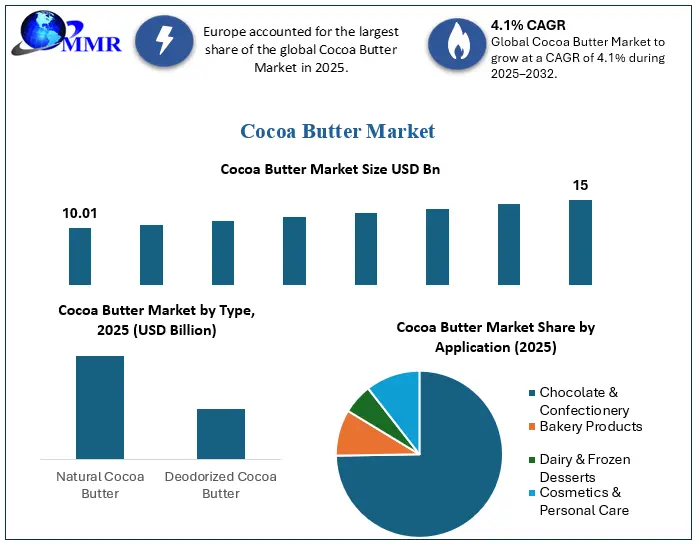
To know about the Research Methodology :- Request Free Sample Report
Cocoa Butter Market Dynamics (2025–2032)
Rising Demand for Premium Chocolate and Confectionery Products
The increasing global demand for premium, artisanal, and dark chocolate products is the primary driver of the cocoa butter market. Consumers are increasingly willing to pay higher prices for chocolates made with high cocoa content, natural ingredients, and sustainably sourced cocoa butter. Premiumization trends, coupled with rising disposable incomes and evolving consumer preferences, have encouraged manufacturers to expand their premium product portfolios. In addition, the rapid growth of the bakery, confectionery, and gourmet food industries in emerging economies has further strengthened cocoa butter consumption. Seasonal demand during festive occasions and increasing popularity of specialty chocolates continue to support steady market expansion.
Expanding Applications in Cosmetics and Personal Care
Cocoa butter is gaining significant traction in the cosmetics and personal care industry due to its excellent moisturizing properties, natural antioxidants, and skin-conditioning benefits. It is extensively used in body lotions, creams, lip balms, soaps, massage products, stretch-mark creams, and hair care formulations. The growing consumer preference for plant-based, organic, and clean-label beauty products has increased the incorporation of cocoa butter into premium skincare products. Rising awareness regarding natural ingredients and sustainable cosmetic formulations is expected to further boost demand throughout the forecast period.
Volatility in Cocoa Bean Prices and Supply Chain Risks
The cocoa butter market remains highly dependent on cocoa bean production, making it vulnerable to fluctuations in raw material prices. Cocoa cultivation is concentrated in West African countries such as Côte d'Ivoire and Ghana, where adverse weather conditions, crop diseases, labor shortages, and geopolitical uncertainties can significantly disrupt supply. Climate change has also intensified production risks, resulting in sharp price increases for cocoa beans. These fluctuations increase production costs for cocoa processors and chocolate manufacturers, thereby affecting profit margins and limiting market growth.
Growing Demand for Sustainable and Certified Cocoa Products
Increasing consumer awareness regarding ethical sourcing, environmental sustainability, and fair-trade practices is creating substantial opportunities for cocoa butter producers. Food manufacturers and cosmetic companies are increasingly sourcing cocoa butter certified by organizations such as Fairtrade, Rainforest Alliance, and UTZ Certified to meet sustainability commitments and consumer expectations. Investments in traceability systems, regenerative agriculture, and farmer support programs are expected to improve supply chain transparency while creating new growth avenues for certified cocoa butter products, particularly in Europe and North America.
Climate Change and Declining Cocoa Productivity
Climate change remains one of the most significant long-term challenges for the cocoa butter market. Rising temperatures, irregular rainfall patterns, prolonged droughts, and increasing incidence of pests and diseases are reducing cocoa yields in major producing countries. Aging cocoa plantations and limited adoption of modern farming practices further constrain production capacity. As global demand for cocoa-based products continues to rise, maintaining a stable supply of high-quality cocoa beans while ensuring sustainable farming practices will remain a critical challenge for industry participants throughout the forecast period.
Global Cocoa Butter Market Trends
The Global Cocoa Butter Market is being shaped by strong premiumization, sustainability initiatives, and expanding applications beyond confectionery. More than 70% of cocoa butter consumption is attributed to the chocolate and confectionery industry, where demand for premium, dark, and single-origin chocolates continues to rise. The cosmetics and personal care sector is also emerging as a key growth avenue, with cocoa butter increasingly used in moisturizers, lip balms, body lotions, and anti-aging products due to its natural emollient properties. Sustainability remains a defining industry trend, as major manufacturers such as Barry Callebaut, Cargill, Olam Food Ingredients (ofi), Mars, Nestlé, and Mondelēz International expand investments in certified and traceable cocoa sourcing.
Meanwhile, Côte d'Ivoire and Ghana collectively account for nearly 60% of global cocoa production, making supply vulnerable to climate-related disruptions. The implementation of the European Union Deforestation Regulation (EUDR) is accelerating adoption of digital traceability systems and responsible sourcing practices, while rising chocolate consumption across Asia-Pacific, particularly in China and India, continues to create long-term growth opportunities for cocoa butter producers.
Cocoa Butter Market Regional Insights
Europe dominates the global cocoa butter market, accounting for approximately 35–40% of total market revenue in 2025, driven by its well-established chocolate manufacturing industry and the presence of leading cocoa processors in countries such as Germany, Belgium, Switzerland, and the Netherlands. The region benefits from high per capita chocolate consumption and increasing demand for premium and sustainably sourced cocoa products.
North America holds the second-largest market share, supported by strong demand for premium confectionery, bakery products, and natural personal care formulations, with the United States leading regional consumption. Asia-Pacific is expected to register the fastest CAGR during the forecast period, fueled by rising disposable incomes, urbanization, expanding middle-class populations, and growing chocolate consumption in China, India, Japan, and Southeast Asia. Meanwhile, South America benefits from cocoa cultivation in countries such as Brazil and Ecuador, supporting regional processing activities and exports. The Middle East & Africa is witnessing steady growth due to increasing demand for premium chocolate products and investments in cocoa value chains, while West African countries, particularly Côte d'Ivoire and Ghana, remain critical suppliers, collectively producing nearly 60% of the world's cocoa beans, ensuring the stability of the global cocoa butter supply chain.
Cocoa Butter Market Scope: Inquire before buying
| Cocoa Butter Market | |||
|---|---|---|---|
| Report Coverage | Details | ||
| Base Year: | 2025 | Forecast Period: | 2026-2032 |
| Historical Data: | 2020 to 2025 | Market Size in 2025: | USD 10.01 Bn. |
| Forecast Period 2026 to 2032 CAGR: | 4.1% | Market Size in 2032: | USD 15 Bn. |
| Segments Covered: | by Type | Natural Cocoa Butter Deodorized Cocoa Butter |
|
| by Grade | Food Grade Pharmaceutical Grade Cosmetic Grade |
||
| by Application | Chocolate & Confectionery Bakery Products Dairy & Frozen Desserts Cosmetics & Personal Care Pharmaceuticals Others |
||
| by Distribution Channel | Direct Sales (B2B) Distributors & Wholesalers Online Retail Specialty Stores Others |
||
| by End User | Food & Beverage Cosmetics & Personal Care Pharmaceuticals Nutraceuticals Others |
||
North America (United States, Canada, and Mexico)
Europe (UK, France, Germany, Italy, Spain, Sweden, Austria, and the Rest of Europe)
Asia Pacific (China, South Korea, Japan, India, Australia, ASEAN, Indonesia, Philippines, Malaysia, Vietnam, Thailand, ASEAN, Rest of Asia Pacific)
Middle East & Africa (South Africa, GCC, Nigeria, Rest of ME&A)
South America (Brazil, Argentina, Rest of South America)
Cocoa Butter Market Key Players
| Company Name | Headquarters | Core Competencies |
| Barry Callebaut AG | Zurich, Switzerland | Global cocoa processing, premium cocoa butter, chocolate manufacturing |
| Cargill, Incorporated | Minnesota, USA | Cocoa processing, sustainable sourcing, ingredient solutions |
| Olam Food Ingredients (ofi) | Singapore | Cocoa ingredient processing, cocoa butter, traceable supply chain |
| Fuji Oil Holdings Inc. | Osaka, Japan | Cocoa butter, specialty fats, chocolate ingredients |
| Guan Chong Berhad (GCB) | Johor, Malaysia | Cocoa grinding, cocoa butter, cocoa liquor, cocoa powder |
| JB Foods Limited | Singapore | Cocoa ingredient manufacturing, cocoa butter processing |
| ECOM Agroindustrial Corp. Ltd. | Pully, Switzerland | Cocoa sourcing, processing, sustainable supply chain |
| Blommer Chocolate Company | Illinois, USA | Cocoa processing, industrial chocolate, cocoa butter |
| Natra S.A. | Madrid, Spain | Chocolate manufacturing, cocoa ingredients, private-label solutions |
| Cemoi Group | Perpignan, France | Cocoa processing, premium chocolate, cocoa butter production |
| BT Cocoa | Johor, Malaysia | Cocoa grinding, cocoa butter, cocoa ingredient exports |
| Plot Enterprise Ghana Ltd. | Tema, Ghana | Cocoa bean processing, cocoa butter, cocoa liquor |
| Indcresa S.A. | Barcelona, Spain | Cocoa derivatives, cocoa butter, food ingredients |
| Touton S.A. | Bordeaux, France | Cocoa sourcing, processing, sustainable cocoa supply |
| Dutch Cocoa B.V. | Amsterdam, Netherlands | Cocoa processing, natural and deodorized cocoa butter |
| Altinmarka Group | Istanbul, Türkiye | Chocolate ingredients, cocoa processing, cocoa butter |
| The Hershey Company | Pennsylvania, USA | Chocolate manufacturing, cocoa ingredient utilization |
| Mars, Incorporated | Virginia, USA | Premium confectionery, sustainable cocoa sourcing |
| Mondelēz International, Inc. | Illinois, USA | Chocolate brands, cocoa ingredient procurement |
| Nestlé S.A. | Vevey, Switzerland | Chocolate products, responsible cocoa sourcing |
| Ferrero Group | Alba, Italy | Premium confectionery, cocoa ingredient integration |
| Lindt & Sprüngli AG | Kilchberg, Switzerland | Premium chocolate manufacturing, high-quality cocoa butter usage |
| Puratos Group | Groot-Bijgaarden, Belgium | Bakery, patisserie and chocolate ingredient solutions |
| Cémoi Côte d'Ivoire | Abidjan, Côte d'Ivoire | Cocoa bean processing, cocoa butter production |
| ECOM Cocoa | Amsterdam, Netherlands | Cocoa trading, cocoa processing, sustainability programs |
| United Cocoa Processor Inc. | Delaware, USA | Cocoa liquor, cocoa butter, cocoa powder manufacturing |
| Chocolaterie de l'Opéra | Paris, France | Premium couverture chocolate, cocoa ingredient expertise |
| Theobroma Industrial Company Ltd. | Tema, Ghana | Cocoa processing, cocoa butter exports |
| Cameroon Development Corporation (CDC) | Buea, Cameroon | Cocoa cultivation, cocoa bean supply, upstream integration |
| Cocoa Processing Company Limited (CPC) | Tema, Ghana | Cocoa butter, cocoa liquor, cocoa powder production |
Frequently Asked Questions
Q1. What is the current size of the global Cocoa Butter Market?
The global Cocoa Butter Market was valued at USD 10.01 billion in 2025 and is projected to reach USD 15.00 billion by 2032, growing at a CAGR of approximately 5.9% during the forecast period.
Q2. What are the key factors driving the growth of the Cocoa Butter Market?
The market is primarily driven by increasing demand for premium chocolate and confectionery products, rising use of cocoa butter in cosmetics and personal care formulations, growing consumer preference for natural ingredients, and expanding sustainable cocoa sourcing initiatives.
Q3. Which application segment holds the largest share of the Cocoa Butter Market?
The Chocolate & Confectionery segment accounts for the largest market share, as cocoa butter is an essential ingredient in premium chocolate manufacturing due to its superior texture, flavor, and melting characteristics.
Q4. Which region dominates the global Cocoa Butter Market?
Europe holds the largest share of the global Cocoa Butter Market, supported by its established chocolate manufacturing industry, high per capita chocolate consumption, and the presence of leading cocoa processors.
Q5. Who are the major players operating in the Cocoa Butter Market?
Key companies operating in the market include Barry Callebaut AG, Cargill Incorporated, Olam Food Ingredients (ofi), Blommer Chocolate Company, ECOM Agroindustrial Corp., JB Foods Limited, Natra S.A., Guan Chong Berhad (GCB), Fuji Oil Holdings Inc., Cemoi Group, and BT Cocoa.