
Castor Oil and Derivatives Market Size by Product, Application, Region – Segment-Level Market Assessment, Growth Opportunity Analysis, Competitive Mapping & Forecast to 2032
Overview
The Castor Oil and Derivatives Market size was valued at USD 1.49 Billion in 2025 and the total Castor Oil and Derivatives revenue is expected to grow at a CAGR of 5.8% from 2026 to 2032, reaching nearly USD 2.21 Billion.
Castor Oil and Derivatives Market Overview
Castor oil is extracted from castor seeds and is used either in its crude form or in the refined hydrogenated form. Generally, 65% of it is processed (about 28% is refined, 12% is hydrogenated, 20% is dehydrated, and the balance 5% is processed to manufacture other derivatives. Castor oil derivatives have a wide range of industrial applications. They are used in the production of lubricants, paints, coatings, cosmetics, pharmaceuticals, plastics, and more.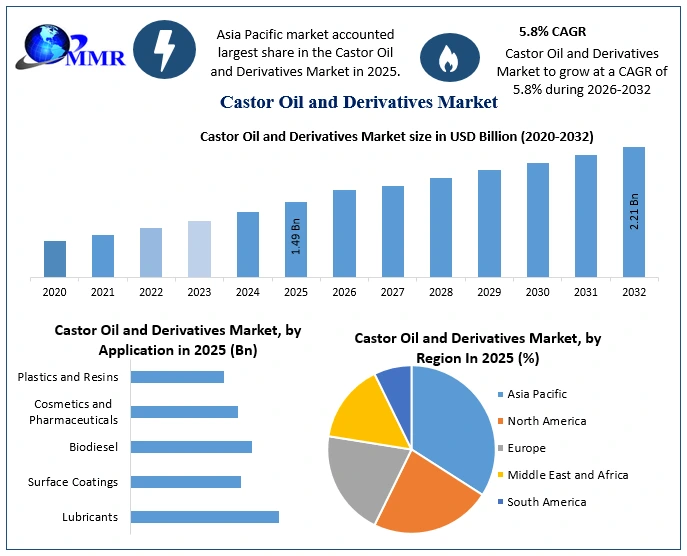 To know about the Research Methodology:-Request Free Sample Report
Castor Oil and Derivatives are not limited to a specific geographical region. The market has a global presence, with consumers across different continents showing interest in these supplements. This Castor Oil and Derivatives Market Report offers a specific and detailed market overview with statistical as well as pre-sized trendy data. This Castor Oil and Derivatives Market report showcases the Castor Oil and Derivatives market situation with Dynamics, Market Segment, Regional Analysis, and Top Competitor's Market Position.
Castor Oil and Derivatives Market Dynamics
Upsurge in Demand for Bio-based Goods Driving Castor Oil and Derivatives Market
Growing concerns over the environmental effects of fuel-based products have driven the demand for more sustainable, renewable alternatives in the Castor Oil and Derivatives Market. Governments across the world are executing numerous strategies to encourage the use of bio-based products. Developments in expertise have reduced the cost of producing bio-based products, making them more competitive with fuel-based substitutes. These factors are expected to spur the castor oil and derivatives market growth in the next few years. Utmost end-users are focused on implementing sustainable and bio-based products as a replacement for traditional energy sources. Oil from castor seeds is high in triglycerides, particularly ricinolein. These oils can be transformed into various products, as well as a potential substitute for petrochemicals.
Numerous governments are supportive of the development and approval of bio cosmetics, which is expected to fuel the castor oil and derivatives market progress in the next few years. In March , BASF SE became the first chemical company to be certified according to the Sustainable Castor Caring for Environmental & Social Standards. With this, BASF commenced the supply of its first sustainable castor ingredients to the personal care sector. Numerous sectors, including the pharmaceutical, chemical, cosmetic, and agricultural industries, use castor oil and its derivatives. For example, the personal care and cosmetics sector uses castor oil in skincare and haircare products, which supports the expansion of the market. The demand for castor oil has also been fueled by its industrial uses in manufacturing and other sectors. Bio-based materials are becoming more and more popular as environmentally friendly and sustainable products become more and more important. Derivatives of castor oil are thought to be renewable resources that can be used in a variety of applications in place of items derived from petrochemicals. In markets looking for more environmentally friendly options, this trend has raised demand for castor oil and its derivatives.
Limited Cultivation and Yield Challenges with Price Volatility and Market Fluctuations Restraining the Castor Oil and Derivative Market
The castor bean plant, which has certain snags in cultivation, yields castor oil. It can be susceptible to pests illnesses and requirements in a certain agroclimatic environment. Castor oil crop from the seeds is also comparatively low when associated with other oil-bearing crops, which may affect the price and availability of the product as a whole. Price fluctuations in the castor oil market may result from multiple aspects, concluding drastic changes in the dynamics of global commerce, changes in supply and demand, and geopolitical concerns in potential manufacturing regions. Such cost fluctuations have the potential to impede market development since it can impact the productivity of manufacturers as well as end consumers.
Castor Oil and Derivatives Market Segment Analysis
The sebacic Acid Compressors Segment dominates the Market Due to its Augmented Inclusion in the Production of Resins and Polyamides
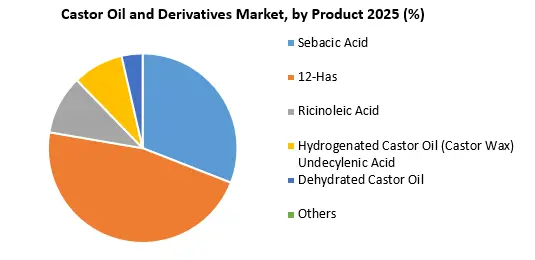
Based on product, the Castor Oil and Derivatives market is segmented into sebacic acid, 12-HAS, ricinoleic acid, hydrogenated castor oil (castor wax), undecylenic acid, dehydrated castor oil, and others. The sebacic acid segment dominates the market and is expected to sustain its dominance over the estimated period. The enlarged inclusion of sebacic acid in the production of resins and polyamides is thought to be the cause of the larger share in the castor oil and derivatives market. It is expected that the gaining robust demand for sebacic acid in the fusion of plastics, biopolymers, and aromatic goods will upscale the castor oil and derivatives market for the product and castor oil production in the Asia Pacific region, particularly in China. The uppermost rate is expected for ricinoleic acid during the estimated timeframe. The development is anticipated due to increasing demand for numerous end-use applications, including finishing textiles, coating inks, and manufacturing soap. Soaps are prepared when ricinoleic acid reacts with bases like ammonia, caustic, and ethanolamines. The substance is applied in cutting oils, metalworking compounds, and emulsifiers.
Plastics and Resins Category to Dominate Market Owing to Rising Use of Biodegradable Plastics
Based on application, the Castor Oil and Derivatives market is segmented into lubricants, surface coatings, biodiesel, cosmetics and pharmaceuticals, plastics and resins and others. The plastics and resins segment holds the largest market and is expected to keep its dominance over the estimated period. The volatile increase in the applications of biodegradable plastics is accredited to their usage. Related to crude oil, the product is far more mostly applied as a raw manufactured part for the production of plastics. The textile business is also exploited as an exchange for recovered plastics. The prominent characteristics of castor oil-based resins, such as castor oil-modified epoxy and polyamide resin, include performance at high temperatures, toughness, flexibility, rigidity, chemical resistance, strong adhesive, and formulation flexibility. Castor oil has become an active component in epoxy and polyamide resin compositions. The paints and coatings segment uses its modified resins extensively in the castor oil and derivatives market.
Castor Oil and Derivatives Market Recent Developments:
| Date | Company | Development | Impact |
|---|---|---|---|
| 18 February 2026 | Jayant Agro-Organics Limited | The company, alongside global consortium partners Arkema and BASF, announced the Year 9 milestones for the Pragati Sustainable Castor Program, certifying over 10,000 farmers in India. | The initiative successfully achieved a 32% surge in crop yields above state benchmarks and a 30% reduction in on-farm water consumption via advanced irrigation techniques. |
| 01 January 2026 | NK Proteins Limited | The company declared a major expansion of its solvent extraction capacity and integrated an advanced oil refining line at its Mehsana processing facility. | The infrastructural upgrade boosts the company's total refined castor oil output capacity to over 50,000 metric tons (MT) per annum to meet export needs. |
| 01 September 2025 | The Better Being Co. | Its brand Heritage Store introduced four new plant-based formulations into its premium Castor Oil Collection, featuring rosemary, tea tree, ginger, and cayenne blends. | The product launch strengthens the brand's footprint in the clean-beauty retail segment, addressing growing consumer demand for sustainably sourced hair wellness solutions. |
| 24 July 2025 | Arkema | The company launched the Castor Farmer Education Fund (CFEF) in collaboration with Temasek Trust's TT Foundation Advisors and Solidaridad to finance local cultivation communities. | The fund establishes a transparent ecosystem aiming to educate and train 100,000 to 150,000 farmers by 2030 in regenerative agricultural practices for bio-based material supply chains. |
Castor Oil and Derivatives Market Regional Analysis
Over the estimated period, it is expected that the Asia Pacific market will showcase the largest revenue share in the castor oil and derivatives market. The rise in manufacturing and utilization of goods is linked to the increase in demand. As castor seeds are extensively available in India, it is one of the leading manufacturers and utilizers of castor oil and derivative goods. Castor seed production is expected to be around 1653 kilotons from July to June . India also exports significantly to China, Japan, and other regions yearly. The statistics estimate that India's Castor oil exports will increase from 600.76 kilotons in to 709.88 kilotons in . India's great production of castor oil and its derivatives is that castor seeds grow well in rain, high temperatures, and low humidity, making them appropriate for growing in various locations of India.
The European castor oil and derivatives market is anticipated to experience stable revenue growth throughout the estimated period. Augmented usage and favorable government laws surrounding bio-based chemicals will fuel market development shortly. The European Commission launched a "Green Deal" in to achieve carbon neutrality by 2050. This agreement is supported by regulatory reforms and green technologies across Europe's chemical industries. As a result, both European manufacturers and consumers are adjusting their preferences toward bio-based chemicals. Thus, such government measures are expected to drive demand for these oil derivatives in Europe presently in the castor oil and derivatives market. Furthermore, for its domestic needs, Europe mostly imports from nations such as India, Brazil, Malaysia, Mexico, and China. France, the Netherlands, Germany, Belgium, Italy, and the United Kingdom were the top importing countries.
Latin America has demonstrated notable potential for growth in the castor oil and derivatives market in recent times. Brazil and Argentina, for example, have been increasing their capacity for castor production and processing. Castor oil and its derivatives meet the growing demand for natural and sustainable products, and these countries profit from favorable agro-climatic conditions. The castor oil and derivatives industry has seen investments throughout Latin America, which has caused the region to become one of the fastest-growing in terms of both production and consumption.
Scope of the Global Castor Oil and Derivatives Market: Inquire before buying
| Global Castor Oil and Derivatives Market | |||
|---|---|---|---|
| Report Coverage | Details | ||
| Base Year: | 2025 | Forecast Period: | 2026-2032 |
| Historical Data: | 2020 to 2025 | Market Size in 2025: | USD 1.49 Bn. |
| Forecast Period 2026 to 2032 CAGR: | 5.8% | Market Size in 2032: | USD 2.21 Bn. |
| Segments Covered: | by Product | Sebacic Acid 12-Has Ricinoleic Acid Hydrogenated Castor Oil (Castor Wax) Undecylenic Acid Dehydrated Castor Oil Others |
|
| by Application | Lubricants Surface Coatings Biodiesel Cosmetics and Pharmaceuticals Plastics and Resins Others |
||
Global Castor Oil and Derivatives Market, by Region
North America (United States, Canada and Mexico)
Europe (UK, France, Germany, Italy, Spain, Sweden, Austria and Rest of Europe)
Asia Pacific (China, South Korea, Japan, India, Australia, Indonesia, Malaysia, Vietnam, Taiwan, Bangladesh, Pakistan and Rest of APAC)
Middle East and Africa (South Africa, GCC, Egypt, Nigeria and Rest of ME&A)
South America (Brazil, Argentina Rest of South America)
Leading Castor Oil and Derivatives Key Players Includes
1. Jayant Agro Organics Ltd – (India)
2. NK Industries Limited – (India)
3. ITOH Oil Chemicals Co. Ltd. – (Japan)
4. Gokul Overseas – (India)
5. Adani Wilmar Limited – (India)
6. Bom Brazil Castor – (Brazil)
7. Thai Castor Oil Industries Co. Ltd. – (Thailand)
8. Kanak Castor Products Pvt. Ltd. – (India)
9. Liaoyang Huaxing Chemical Co., Ltd. – (China)
10. Taj Agro International – (India)
11. Xingtai Lantian Fine Chemical Co., Ltd. – (China)
12. RPK Agrotech Exports Private Limited – (India)
13. Adya Oils & Chemicals Ltd – (India)
14. Hokoku Corporation – (Japan)
15. Ambuja Solvex Pvt. Ltd. – (India)
16. Jayant Agro-Organics (Europe) B.V. – (Netherlands)
17. Thai Castor Oil Industries Co., Ltd. – (Thailand)
18. RPK Agrotech Exports Private Limited – (India)
19. Liaoyang Huaxing Chemical Co., Ltd. – (China)
20. Kanak Castor Products Pvt. Ltd. – (India)
Frequently Asked Questions in the Castor Oil and Derivatives Market:
1. What was the Global Castor Oil and Derivatives Market size in 2025?
Ans: The Global Castor Oil and Derivatives Market size was USD 1.49 Billion in 2025.
2. Who are the key vendors in the Global Castor Oil & Derivatives Market?
Ans: 'Jayant Agro Organics Ltd - India', 'NK Industries Limited - India', 'ITOH Oil Chemicals Co. Ltd. - Japan', 'Gokul Overseas - India', 'Adani Wilmar Limited - India', 'Bom Brazil Castor - Brazil', 'Thai Castor Oil Industries Co. Ltd. - Thailand', 'Kanak Castor Products Pvt. Ltd. - India', 'Liaoyang Huaxing Chemical Co., Ltd. - China', 'Taj Agro International - India'.
3. What is the key driver of Global Castor Oil & Derivatives Market?
Ans: Numerous sectors, including the pharmaceutical, chemical, cosmetic, and agricultural industries, use castor oil and its derivatives. For example, the personal care and cosmetics sector uses castor oil in skincare and haircare products, which supports the expansion of the market. The demand for castor oil has also been fueled by its industrial uses in the manufacturing and other sectors..
4. Who are the key players in the Global Castor Oil and Derivatives market?
Ans: The important key players in the Global market are – CKD Corporation (Japan), Emerson Electric Corporation (USA), Kendrion (Germany), GF Piping (Switzerland), IMI Precision Engineering (Birmingham), Danfoss Industries Ltd. (Denmark), Curtiss Wright Corporation (USA)
5. What is the key market trend for Global Castor Oil & Derivatives Market?
Ans: Growing Demand for Sustainable and Natural Products: The growing inclination of consumers towards natural and ecological products was a noteworthy trend. The potential applications of castor oil and its derivatives in the pharmaceutical, personal care, and cosmetics industries have led to a rise in their appeal. Since castor oil derivatives are frequently regarded as environmentally benign substitutes for synthetic chemicals, the demand for them was driven by the need for organic and natural materials in various industries.