
Membrane Filtration Market Size by Type, Module Design, Membrane Material, Application and Region – Segment-Level Market Assessment, Growth Opportunity Analysis, Competitive Mapping & Forecast to 2032
Overview
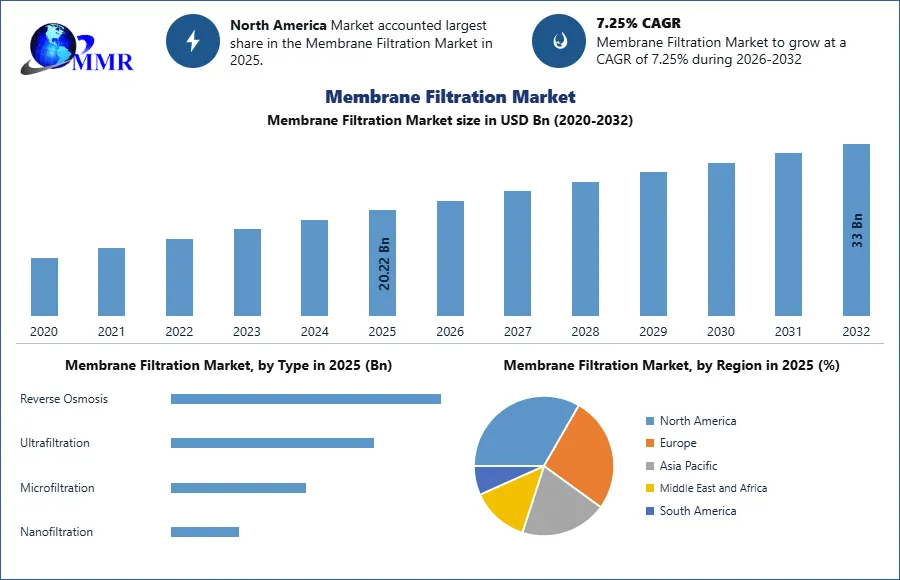
The Membrane Filtration Market was valued at USD 20.22 Bn in 2025, and total global Membrane Filtration Market revenue is expected to grow at a CAGR of 7.25% & reaching nearly USD 33 Bn from 2025-2032
Membrane Filtration Market Overview
Membrane filtration is an advanced separation technology such as reverse osmosis (RO), ultrafiltration (UF), microfiltration (MF) and nanofiltration (NF) used to purify, concentrate, or fractionate fluids across industrial and municipal sectors. Globally, the market is undergoing a robust transformation, driven by growing demand for high purity products, stricter environmental norms and advancements in membrane design and materials. This report by MMR presents a strategic industry outlook into market that is vital for operational efficiency, regulatory compliance and sustainable production, mainly across water & wastewater treatment, food & beverage, dairy and pharmaceutical industries.
 To know about the Research Methodology:- Request Free Sample Report
As regulatory authorities and consumers emphasize product quality and water sustainability, membrane filtration systems are being rapidly adopted for their precision, efficiency and minimal chemical usage. The market is seeing accelerated investments in polymeric and ceramic membranes, zero liquid discharge systems and energy efficient modules. With membrane filtration emerging as a critical enabler for premium product manufacturing and clean water generation, manufacturers are racing to enhance productivity, reduce fouling and scale mobile or compact systems. Our analysis covers evolving end-user preferences, technology upgrades, and regional initiatives shaping market demand.
Asia Pacific dominated the global market, backed by large scale infrastructure development, population driven water demand and industrial expansion in countries like China, India and Japan. North America is closely driven by R&D activity and high compliance in pharmaceuticals and biotech. Major players such as DuPont, Asahi Kasei, Veolia, Toray, Kovalus and GEA are leading innovation by capacity expansion, product launches, and sustainability focused technologies. We provide deep insights into company profiles, technology benchmarking, pricing dynamics and M&A activity to support strategic decision making for stakeholders across this high growth, mission critical sector.
Membrane Filtration Market Dynamics
Increasing Demand for Premium Products to Drive the Membrane Filtration Market Growth
As consumers increasingly seek high-quality and pure end products, manufacturers are made to implement advanced filtration processes to meet these evolving expectations. Membrane filtration, with its ability to separate and purify fluids based on size or molecular weight, plays an important role in ensuring the production of premium goods. In sectors such as food and beverage, pharmaceuticals, and biotechnology, where product quality is paramount, membrane filtration is adopted to remove impurities, contaminants, and unwanted particles, thereby enhancing the overall quality and purity of the final output. Whether it is achieving superior taste in beverages, ensuring the efficacy of pharmaceutical formulations, or meeting stringent quality standards in biotech processes, membrane filtration emerges as an important technology to satisfy the increasing demands of consumers for premium products.
Availability of Alternatives to Hamper the Membrane Filtration Market
Membrane filtration growth is limited by the availability of other technologies such as UV disinfection, chemical treatments, and advanced oxidation processes. Often, these alternatives are more cost-effective as well as environmentally friendly, and cater to particular filtration requirements. Consider for example, the UV disinfection, which is an effective way of killing microorganisms but without depriving the water of useful minerals, thus a suitable method for selective water purification. As per Water Defense, other methods, such as activated carbon filters, distillation and sediment filters, have the added benefit of producing less wastewater and lower maintenance costs and can also remove specific contaminants such as fluoride, arsenic, and large particles. These alternatives are versatile and user-friendly solutions that are appealing to cost-conscious and eco-aware consumers. These technologies will likely limit the adoption of membrane filtration systems, such as reverse osmosis, as demand for sustainable and tailored water purification increases, in segments where such alternatives are capable of meeting the need.
Membrane Filtration Market Segment Analysis
In 2025, Reverse Osmosis dominates the membrane filtration market due to its extensive use in desalination and high-purity water applications across industrial and municipal sectors. Ultrafiltration follows closely, driven by its efficiency in removing bacteria and macromolecules, particularly in wastewater treatment and food processing. Microfiltration is widely adopted for pre-treatment processes and in dairy and beverage industries, while Nanofiltration is gaining traction for selective separation processes, especially in water softening and chemical processing.
Based on Module Design, Spiral Wound systems hold the largest market share in 2025 due to their compact design, cost-effectiveness, and widespread use in water treatment and desalination plants. Hollow Fiber modules are also highly demanded, particularly in ultrafiltration applications, owing to their high surface area and efficiency. Tubular Systems are preferred in applications involving high solid content due to their durability and ease of cleaning, while Plate & Frame modules are used in specialized industrial applications where flexibility and ease of maintenance are required.
Based on Membrane Material, Polymeric membranes dominate the market in 2025 due to their affordability, flexibility, and wide applicability across industries such as water treatment and food processing. Ceramic membranes, although higher in cost, are witnessing increasing demand in harsh operating environments due to their superior thermal, chemical, and mechanical stability. Industries requiring long membrane life and resistance to extreme conditions are increasingly adopting ceramic variants.
| Membrane Filtration Market | |||
|---|---|---|---|
| Report Coverage | Details | ||
| Base Year: | 2025 | Forecast Period: | 2026-2032 |
| Historical Data: | 2020 to 2025 | Market Size in 2025: | 20.22 USD Bn |
| Forecast Period 2026-2032 CAGR: | 7.25% | Market Size in 2032: | 33 USD Bn |
| Segments Covered: | by Type | Reverse Osmosis Ultrafiltration Microfiltration Nanofiltration |
|
| by Module Design | Spiral Wound Tubular Systems Plate & Frame Hollow Fiber |
||
| by Membrane Material | Polymeric Ceramic |
||
| by Application | Water & Wastewater Food & Beverages Pharmaceutical & Biotechnology Chemical & Petrochemical Power Generation Oil & Gas Others |
||
Membrane Filtration Market Regional Analysis
Based on Region, North America leads the global membrane filtration market in 2025 due to advanced water treatment infrastructure, stringent environmental regulations, and strong adoption of innovative filtration technologies. Europe follows closely, driven by sustainability initiatives and regulatory compliance related to wastewater management. Asia Pacific is the fastest-growing region, fueled by rapid industrialization, urbanization, and increasing investments in water treatment facilities, particularly in countries like China and India. Meanwhile, regions such as Latin America and the Middle East & Africa are witnessing steady growth, supported by rising desalination projects and improving industrial infrastructure.
Membrane Filtration Market Competitive Landscape
Global Membrane filtration market is highly competitive and innovation driven, with strong regional dynamics and strategic plays by multinational corporations. The market is currently dominated by Asia Pacific region, accounting for largest share by rapid industrialization, growing urban populations, and rising investments in clean water and wastewater treatment. China, India, Japan, and South Korea are at forefront of adoption, backed by supportive policies and expanding applications in the food & beverage, dairy and pharmaceutical sectors.
Leading companies, DuPont Water Solutions (U.S.), Asahi Kasei (Japan), Veolia Water Technologies (France), Toray Industries (Japan), GEA Group (Germany) and Kovalus Separation Solutions (U.S.) are shaping the market by their continuous product development and membrane technology enhancements. These players are focusing on high efficiency RO, UF, MF and NF solutions tailored to industry specific needs, such as zero liquid discharge systems, energy saving modules and compact mobile filtration units. The market also features key regional players like Litree Purifying Technology (China), SUEZ (France) and Pentair (U.S.) each strengthening their global presence by local manufacturing, turnkey projects and acquisitions. The competitive intensity is further fuelled by increasing mergers and acquisitions, joint ventures and global R&D initiatives.
We provide in-depth competitor profiling of 30 companies, market share analysis, technology benchmarking, and strategic growth mapping. This includes insights into product pipelines, patent landscapes, pricing intelligence, and regional expansion strategies to support informed decision making for clients operating or entering the membrane filtration space.
Membrane Filtration Market Key Trends
| Trends | Description |
| Rising Demand for Sustainable Filtration | Industries are increasingly adopting energy-efficient and low-waste membrane systems to meet ESG goals and stricter environmental regulations. |
| Growth in Food & Beverage Applications | Expanding use of UF, MF, and RO membranes in dairy processing, beverage clarification, and juice concentration is boosting market growth. |
| Advancements in Membrane Technology | Development of next-gen polymeric and ceramic membranes with improved durability, selectivity, and anti-fouling properties is enhancing performance and reducing maintenance costs. |
Membrane Filtration Market Recent Development
• 20th June 2025, Kovalus Separation Solutions (U.S) officially opened a new Technology Centre in Aachen, Germany, enhancing R&D capabilities in advanced membrane systems.
• 16th December 2024, DuPont (U.S) received the Global Sustainability Leadership Award from the International Desalination and Reuse Association for implementing UN SDG 6 initiatives, including deploying ultrafiltration systems in Tanzania and supporting China’s largest nanofiltration plant in Jiaxing.
• 13th November 2024, DuPont (U.S) launched Minerva, a generative AI chatbot providing on-demand technical support for water purification technologies.
• October 2024, Asahi Kasai (Japan) introduced Planova FG1, a next-gen virus removal filter offering up to 7× higher flux for biopharma applications.
• 18th May 2024, Veolia Water Technologies Solutions (France) announced a bold 50% revenue growth target in the US by 2027, under its GreenUp 24 27 plan, with major investments in ultrafiltration and RO systems targeting industrial reshoring.
• 3rd April 2024, Veolia Water Technologies Solutions (France) launched a PFAS-detection campaign in France covering two-thirds of its national network, implementing membrane based PFAS treatment solutions.
Membrane Filtration Market Scope: Inquire before buying
Membrane Filtration Market, by Region
North America (United States, Canada, and Mexico)
Europe (UK, France, Germany, Italy, Spain, Sweden, Austria, and the Rest of Europe)
Asia Pacific (China, South Korea, Japan, India, Australia, ASEAN, Indonesia, Philippines, Malaysia, Vietnam, Thailand, ASEAN, Rest of Asia Pacific)
Middle East & Africa (South Africa, GCC, Nigeria, Rest of ME&A)
South America (Brazil, Argentina, Rest of South America)
Membrane Filtration Market, Key Players
North America
1. DuPont Water Solutions (U.S.)
2. Kovalus Separation Solutions (U.S.)
3. Evoqua Water Technologies (U.S.)
4. Pall Corporation (U.S.)
5. 3M Company (U.S.)
6. Pentair plc (U.S.)
7. Donaldson Company (U.S.)
8. SPX Flow Inc. (U.S.)
9. Applied Membranes Inc. (U.S.)
Europe
10. Alfa Laval AB (Sweden)
11. GEA Group AG (Germany)
12. MANN+HUMMEL (Germany)
13. Porvair Filtration Group (UK)
14. SUEZ Water Technologies & Solutions (France)
15. ProMinent GmbH (Germany)
16. Imemflo Filtration Pvt Ltd (Germany)
17. Aquarion AG (Switzerland)
18. Envirochemie GmbH (Germany)
19. Sefar Holding AG (Switzerland)
20. Veolia Water Technologies & Solutions (France)
Asia Pacific
21. Asahi Kasei Corporation (Japan)
22. Nitto Denko (Hydranautics) (Japan)
23. Toray Industries, Inc. (Japan)
24. Mitsubishi Chemical Group (Japan)
25. CITIC Envirotech (China)
26. Litree Purifying Technology Co Ltd (China)
27. Origin Water (China)
28. Tianjin MOTIMO (China)