
Tetrakis (Hydroxymethyl) Phosphonium Sulfate Market by Function, by Application, by Iron Ion Content and Regional Insights 2034
Overview
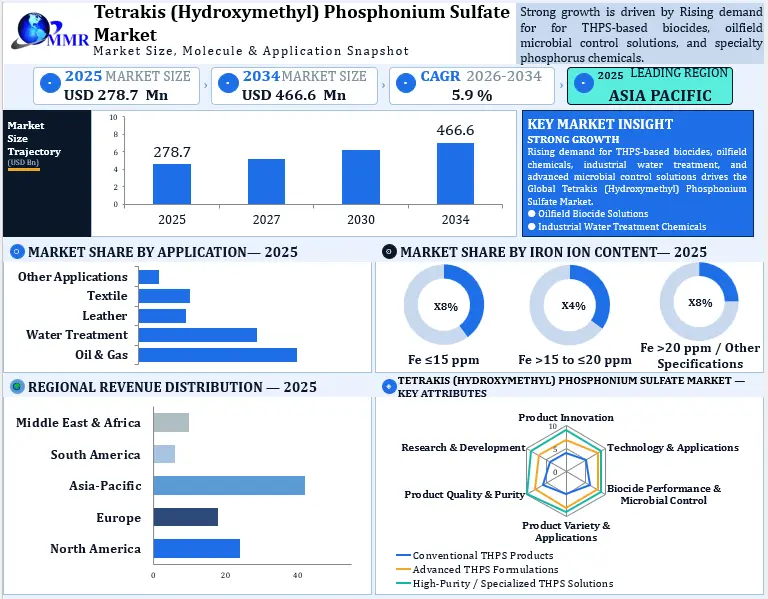
The Global Tetrakis (Hydroxymethyl) Phosphonium Sulfate Market size was valued at USD 278.7 Million in 2025 and the total Tetrakis (Hydroxymethyl) Phosphonium Sulfate revenue is expected to grow at a CAGR of 5.9 % from 2026 to 2034, reaching USD 466.6 Million by 2034.
The global Tetrakis (Hydroxymethyl) Phosphonium Sulfate Market report is a comprehensive analysis of the industry, market, and key players. The report has covered the market by demand and supply-side by segments. The global Tetrakis (Hydroxymethyl) Phosphonium Sulfate Market report also provides trends by market segments, technology, and investment with a competitive landscape.
Tetrakis (Hydroxymethyl) Phosphonium Sulfate Market Overview:
Global Tetrakis (Hydroxymethyl) Phosphonium Sulfate is an organophosphorus compound with a chemical formula [P(CH2OH)4]Cl. Tris (hydroxymethyl)phosphine is derived from Tetrakis (Hydroxymethyl) Phosphonium Sulfate and is an intermediate in the preparation of water-soluble ligand 1,3,5-triaza-7-phosphaadamantane (PTA). This conversion is accomplished by treating hexamethylenetetramine with formaldehyde and tris(hydroxymethyl) phosphine.
The Global Tetrakis (Hydroxymethyl) Phosphonium Sulfate Market refers to the worldwide industry involved in manufacturing, supplying, distributing, and utilizing THPS-based chemicals across oil and gas, industrial water treatment, textile processing, leather tanning, pulp and paper manufacturing, and other industrial applications. THPS functions primarily as a broad-spectrum biocide, antimicrobial chemical, iron sulfide scavenger, and flame-retardant treatment agent, depending on the formulation and end-use requirements. Its commercial demand depends on industrial microbial control, water system maintenance, oilfield operations, textile treatment, leather processing, and industrial chemical preservation.
The market grows through increasing demand for industrial biocides, oilfield chemicals, wastewater treatment chemicals, microbial contamination control, and high-performance textile chemicals. Oil and gas operators use THPS to manage sulfate-reducing bacteria, control microbial growth, and help reduce the risks associated with microbiologically influenced corrosion and hydrogen sulfide formation. Industrial water treatment applications use THPS to control microbial contamination and biofouling, while textile and leather manufacturers apply THPS-based formulations in specialized finishing and processing operations.
Tetrakis (Hydroxymethyl) Phosphonium Sulfate Market Growth and Share Analysis
To know about the Research Methodology :- Request Free Sample Report
Global Tetrakis (Hydroxymethyl) Phosphonium Sulfate Market Highlights
1. Strong Market Growth: Rising demand for THPS biocides, specialty phosphorus chemicals, and industrial antimicrobial solutions drives global market growth.
2. Oil & Gas Demand: Increasing use of THPS for sulfate-reducing bacteria control, iron sulfide management, and oilfield microbial treatment supports market expansion.
3. Asia-Pacific Expansion: China and India strengthen THPS demand through chemical manufacturing, industrial water treatment, textile processing, and leather production.
4. Water Treatment Opportunities: Growing demand for industrial water treatment biocides, wastewater management, and biofouling prevention creates new opportunities for THPS suppliers.
5. Innovation and Regulatory Compliance: Product purity, optimized biocide formulations, environmental regulations, and reliable supply chains shape THPS market competition.
Tetrakis (Hydroxymethyl) Phosphonium Sulfate Market Dynamics:
Market Drivers
• Increasing Demand for Oilfield Biocides and Oil & Gas Chemicals: Expanding oil and gas production increases demand for THPS-based biocides to control sulfate-reducing bacteria, manage reservoir souring, reduce iron sulfide deposition, and protect oilfield infrastructure against microbiologically influenced corrosion.
• Rising Industrial Water Treatment Requirements: Growing demand for industrial water treatment chemicals, cooling tower biocides, wastewater treatment solutions, and microbial contamination control supports THPS adoption in industrial processing systems. THPS helps control biofouling and microbial growth in suitable water treatment applications.
• Growing Demand from Leather and Textile Processing: Leather tanning, textile finishing, and specialized industrial chemical applications support demand for THPS-based formulations. Expanding manufacturing activity, particularly across Asia-Pacific, strengthens opportunities for industrial biocides and specialty phosphorus chemicals.
Market Restraints
• Stringent Environmental Regulations: Environmental risk assessments, wastewater discharge requirements, and restrictions on biocidal substances increase compliance costs for THPS manufacturers and end users. Concerns regarding aquatic toxicity and phosphorus-containing wastewater can restrict adoption in environmentally sensitive applications.
• Volatile Raw Material and Production Costs: Fluctuations in elemental phosphorus, energy, formaldehyde, transportation, and chemical processing costs affect THPS production economics. Higher manufacturing expenses can increase industrial biocide prices and place pressure on profit margins.
Market Opportunities
• Expansion of Advanced Industrial Water Treatment: Increasing investments in cooling water management, industrial wastewater treatment, and microbial control systems create opportunities for THPS suppliers to develop application-specific biocide formulations. Demand for effective biofouling prevention supports adoption in industrial facilities and oilfield water injection systems.
• Emerging Opportunities in Asia-Pacific Markets: Industrialization, expanding oil and gas operations, and growth in leather processing and textile manufacturing create opportunities for THPS manufacturers across China, India, and Southeast Asia. Regional chemical production capabilities and growing industrial treatment requirements support market expansion.
• Development of Optimized Biocide Formulations: Manufacturers can strengthen their market position through improved THPS formulations, optimized dosing systems, application-specific chemical blends, and better compatibility with industrial water treatment processes. These developments support efficient microbial control and more predictable chemical consumption.
Market Challenges
• Supply Chain Concentration and Raw Material Availability: Dependence on specialized organophosphorus chemical production and phosphine-handling infrastructure creates supply continuity risks. Limited production flexibility can expose THPS buyers to delivery delays, supply disruptions, and price fluctuations.
• Regulatory Approval and Compliance Complexity: Differences in biocide registration, active-substance supplier requirements, environmental risk assessments, and product authorization procedures across countries complicate market entry. In April 2026, the European Chemicals Agency's decision to include an additional THPS supplier in the EU Article 95 list becomes the subject of legal proceedings, highlighting the commercial importance of supplier eligibility and regulatory compliance.
Global Tetrakis (Hydroxymethyl) Phosphonium Sulfate Market Trends
• Growing Adoption of Targeted Microbial Control: Oilfield operators and industrial water treatment providers increasingly focus on application-specific biocide programs to control sulfate-reducing bacteria, reduce biofouling, and maintain process reliability. THPS remains relevant where its efficacy, chemical compatibility, and operating conditions meet treatment requirements.
• Increasing Focus on THPS Pricing and Supply Resilience: Procurement teams monitor raw material costs, import availability, freight charges, and supplier diversification to manage THPS purchasing risks.
• Greater Emphasis on Regulatory Transparency and Responsible Chemical Use: Manufacturers increasingly prioritize documented product performance, regulatory compliance, environmental risk assessment, safe handling, and appropriate disposal practices. These priorities influence THPS product development, industrial procurement decisions, and long-term supplier relationships.
Global Tetrakis (Hydroxymethyl) Phosphonium Sulfate Market Segment Analysis:
By Function: The Global THPS Market by Function covers biocide, iron sulfide scavenger, flame retardant, tanning agent, and other specialized chemical functions. Biocide applications support microbial control in oilfield operations and industrial water treatment systems, while iron sulfide scavengers address iron sulfide deposits in selected oil and gas processes. Flame-retardant applications relate to specialized chemical treatments, and tanning-agent applications support leather processing. The relative demand for each function depends on formulation, concentration, end-use requirements, and the technical suitability of THPS-based products.
Biocide represents the principal functional segment in this proposed market model because THPS is used to control sulfate-reducing bacteria and other microorganisms in industrial systems. Iron sulfide scavenger applications support selected oilfield operations by helping manage iron sulfide deposits, while flame retardant and tanning agent applications serve more specialized markets. The Others category includes additional industrial uses that do not fall into the four named functions. These categories must be treated as mutually exclusive according to the primary commercial function of the product to avoid double counting.
By Application: The Global THPS Market by Application includes Oil & Gas, Water Treatment, Leather, Textile, and Other Applications. These categories reflect the end-use industries that purchase THPS-based products for microbial control, industrial chemical treatment, and specialized manufacturing processes.
Oil & Gas represents a major application for THPS because oilfield operators use THPS-based biocides to control sulfate-reducing bacteria, reduce microbial contamination, and manage biofouling in production and water injection systems. Water Treatment covers industrial cooling water, process water, and other suitable water systems requiring microbial control. Leather applications include specialized tanning and processing treatments, while Textile applications include flame-retardant finishing of cotton and cellulose-blend fabrics. Other applications include papermaking, paints, coatings, emulsions, agriculture, and aquaculture where the formulation and application are appropriate. These end-use categories provide a useful basis for estimating THPS revenue by customer industry without counting the same revenue twice.
By Iron Ion Content: The Global THPS Market by Iron Ion Content classifies products according to their iron concentration specifications, which influence suitability for particular industrial processes and customer quality requirements. The 2026 LP Information market report identifies Fe ≤20 ppm and Fe ≤15 ppm as product categories.
However, these two specifications overlap because products containing 15 ppm iron or less also meet the ≤20 ppm specification. For market estimation, the categories therefore need to be redefined into mutually exclusive ranges.
THPS with iron content of 15 ppm or less serves customers requiring tighter iron impurity control in specialized industrial applications. THPS with iron content above 15 ppm and up to 20 ppm covers products meeting the ≤20 ppm specification but not the stricter ≤15 ppm specification. THPS with iron content above 20 ppm or other specifications covers products outside those two defined ranges, provided they meet the relevant customer and application requirements. Actual demand depends on supplier specifications, customer purchasing criteria, and product quality documentation.
Global Tetrakis (Hydroxymethyl) Phosphonium Sulfate Market Regional Insights:
| Region | Key Countries | Key Market Drivers |
| North America | United States, Canada, Mexico | Oilfield biocides, oil and gas production, industrial water treatment, microbial control |
| Europe | Germany, France, UK, Italy | Specialty chemicals, industrial biocides, textile finishing, leather processing, environmental compliance |
| Asia-Pacific | China, India, Japan, South Korea | THPS manufacturing, oilfield chemicals, industrial water treatment, textile and leather industries |
| South America | Brazil, Argentina, Colombia | Oilfield operations, industrial water treatment, leather processing, pulp and paper manufacturing |
| Middle East & Africa | Saudi Arabia, UAE, Qatar, South Africa | Oil and gas production, oilfield microbial control, desalination, industrial water treatment |
North America represents a major market for Tetrakis (Hydroxymethyl) Phosphonium Sulfate, industrial biocides, oilfield treatment chemicals, and industrial water treatment solutions. The United States drives regional demand through oil and gas exploration, produced-water management, drilling operations, and industrial cooling water treatment. Canada contributes through oilfield services and energy production, while Mexico supports demand through petroleum operations and industrial manufacturing. The region benefits from established chemical distribution networks, specialist oilfield service providers, and demand for microbial control, sulfate-reducing bacteria management, biofouling prevention, and iron sulfide control. North America is identified as a leading region in several published THPS market estimates.
Europe maintains demand for THPS-based biocides, industrial water treatment chemicals, specialty phosphorus chemicals, and antimicrobial treatment solutions across oil and gas operations, industrial processing, leather production, and textile finishing. Germany, France, the United Kingdom, Italy, and other European markets support demand through specialty chemical manufacturing, industrial water management, and established chemical distribution channels. Demand for application-specific biocide formulations and reliable industrial treatment performance supports market participation, although stringent chemical requirements increase the importance of product registration and responsible chemical handling.
Asia-Pacific represents a major growth and manufacturing center for the Global THPS Market, supported by expanding industrial production, phosphorus-based chemical manufacturing, oilfield operations, and industrial water treatment requirements. China contributes through chemical manufacturing, oil and gas activities, textile processing, and leather production, while India supports regional demand through industrial wastewater treatment, specialty chemicals, and expanding manufacturing infrastructure. Japan, South Korea, and Southeast Asian economies contribute through industrial processing and chemical supply chains. Rising demand for THPS biocides, oilfield microbial control chemicals, flame-retardant textile treatments, leather processing chemicals, and industrial water treatment solutions supports regional expansion.
South America represents an emerging market for THPS oilfield chemicals, industrial biocides, water treatment chemicals, and specialty industrial chemicals. Brazil supports regional demand through oil and gas production, pulp and paper manufacturing, leather processing, and industrial water management. Argentina and other South American markets contribute through energy production, manufacturing, and industrial chemical procurement. Demand for THPS-based microbial control solutions depends on oilfield development, water injection requirements, industrial wastewater treatment, and access to reliable chemical supply channels. Import dependence, currency fluctuations, logistics costs, and variable industrial investment influence regional purchasing patterns.
The Middle East & Africa market benefits from demand for THPS-based oilfield biocides, oil production chemicals, industrial water treatment solutions, and microbial control agents. Saudi Arabia, the United Arab Emirates, and Qatar support demand through oil and gas production, oilfield water management, and industrial infrastructure. South Africa and other African markets contribute through industrial processing, mining-related water management, and chemical distribution. Regional market development depends on oilfield project activity, industrial investment, import availability, regulatory requirements, and access to specialist chemical suppliers.
The objective of the report is to present a comprehensive analysis of the global Tetrakis (Hydroxymethyl) Phosphonium Sulfate Market to the stakeholders in the industry. The past and current status of the industry with the forecasted market size and trends are presented in the report with the analysis of complicated data in simple language. The report covers all the aspects of the industry with a dedicated study of key players that include market leaders, followers, and new entrants.
PORTER, SVOR, PESTEL analysis with the potential impact of micro-economic factors of the market have been presented in the report. External as well as internal factors that are supposed to affect the business positively or negatively have been analyzed, which will give a clear futuristic view of the industry to the decision-makers.
The report also helps in understanding the global Tetrakis (Hydroxymethyl) Phosphonium Sulfate Market dynamics, structure by analyzing the market segments and project the global Tetrakis (Hydroxymethyl) Phosphonium Sulfate Market size. Clear representation of competitive analysis of key players by Grade, price, financial position, Grade portfolio, growth strategies, and regional presence in the global Tetrakis (Hydroxymethyl) Phosphonium Sulfate Market make the report investor’s guide.
Global Tetrakis (Hydroxymethyl) Phosphonium Sulfate Market Trade and Import Dependency:
The global THPS supply chain connects phosphorus-based chemical manufacturers, THPS producers, international traders, industrial chemical distributors, and end users in oil and gas, water treatment, textiles, and leather processing. China is an important production and export hub, while regional import dependence varies according to domestic manufacturing capacity, product specifications, and supplier access.
| Region | Major sourcing channels | Import dependency assessment | Key trade considerations |
| North America | China, domestic and international chemical suppliers | Imports supplement regional supply | Freight, oilfield demand, supplier qualification |
| Europe | China, France, other European chemical suppliers | Imports are important in several national markets | Biocide compliance, Article 95 eligibility, transport costs |
| Asia-Pacific | Chinese manufacturers and regional chemical suppliers | Varies by country; China is a major supply hub | Production capacity, export pricing, regional distribution |
| South America | China and international chemical distributors | Import reliance is significant in many markets | Ocean freight, exchange rates, customs charges |
| Middle East & Africa | Asian and international suppliers | Import reliance varies by country | Oilfield procurement, shipping costs, distributor availability |
Global Tetrakis (Hydroxymethyl) Phosphonium Sulfate Market Competitive Landscape:
| Competitive category | Representative companies | Key competitive strengths | Main target markets |
| Established specialty chemical companies | Solvay, Arkema, DuPont | Technical expertise, established customer networks, product development capabilities | Industrial chemicals, specialty applications |
| Chinese THPS and phosphorus chemical manufacturers | Hubei Xingfa Chemicals Group, Changshu New-Tech Chemicals, Hubei Lianxing Chemical, Jiangxi Fuerxin | Manufacturing scale, phosphorus chemical supply chains, export capabilities | Global THPS supply, industrial biocides |
| Industrial water treatment chemical companies | Shandong Taihe Technologies, Henan Qingshuiyuan Technology, Acuro Organics | Water treatment formulations, industrial customer access, chemical treatment expertise | Cooling water, wastewater, industrial processing |
| Oilfield chemical suppliers | Finoric, Compass Chemical International, IRO Oil Drilling Chemical | Oilfield treatment solutions, application-specific formulations, supply relationships | Oil and gas production, microbial control, iron sulfide management |
| Specialty chemical distributors and exporters | Univar Solutions, Connect Chemicals, The Chemical Company, ChinaChemNet | Distribution networks, sourcing, logistics, regional customer access | Industrial chemical procurement and regional supply |
| Indian specialty chemical suppliers | Prasol Chemicals, Newzeal Chem India, Hyma Synthesis | Local sourcing, customer support, regional distribution | Industrial chemicals, water treatment, manufacturing |
| Regional THPS exporters | Sawa International, Shanghai Rich Group, Wuhan Dachu Hexing Technology | Export availability, product sourcing, international supply | Global industrial and chemical markets |
Key factors shaping competitive intensity:
| Competitive factor | Market implications |
| Product quality and purity | Iron content, active concentration, consistency, and customer specifications influence supplier selection. |
| Pricing and cost efficiency | Feedstock costs, production efficiency, freight, and distributor margins affect competitiveness. |
| Production and supply capacity | Reliable production volumes and delivery schedules strengthen supplier relationships. |
| Regulatory compliance | Biocide requirements, documentation, and supplier eligibility influence market access. |
| Application expertise | Knowledge of oilfield microbial control, industrial water treatment, and specialized chemical applications differentiates suppliers. |
| Geographic reach | Export capabilities and regional distribution networks support access to international customers. |
Global Tetrakis (Hydroxymethyl) Phosphonium Sulfate Market Recent Development:
| Exact date | Recent development | Market impact |
| 13 April 2026 | The European Chemicals Agency (ECHA) decides to include Vink Chemicals GmbH & Co. KG as an authorized supplier of THPS for biocidal product types 6, 11, and 12 under Article 95 of the EU Biocidal Products Regulation. | Increases the importance of supplier eligibility, regulatory compliance, and competition in the European THPS biocide market. |
| 26 June 2026 | ChemAnalyst reports that US THPS prices remain stable in mid-June after increasing 3.78% month-on-month in May 2026. | Reflects steady demand from oilfield chemicals and water treatment, alongside freight costs and import supply conditions. |
| 7 July 2026 | LP Information publishes its Global Tetrakis(hydroxymethyl)phosphonium Sulfate (THPS) Market Growth 2026–2032 report. | Provides an updated market outlook and reinforces the relevance of THPS in water treatment, oilfields, and papermaking. |
| 7 October 2026 | Oil and Natural Gas Corporation (ONGC) publishes a tender for the supply of Tetrakis Hydroxymethyl Phosphonium Sulphate (THPS) for its requirements in Amreli, Gujarat. | Demonstrates ongoing industrial procurement interest in THPS in India, particularly for oil and gas operations. |
Global Tetrakis (Hydroxymethyl) Phosphonium Sulfate Market Scope:Inquire before buying
| Tetrakis (Hydroxymethyl) Phosphonium Sulfate Market | |||
|---|---|---|---|
| Report Coverage | Details | ||
| Base Year: | 2025 | Forecast Period: | 2026-2034 |
| Historical Data: | 2020 to 2025 | Market Size in 2025: | 278.7 USD Million |
| Forecast Period 2026-2034 CAGR: | 5.9 % | Market Size in 2034: | 466.6 USD Million |
| Segments Covered: | by Function | Biocide Iron Sulfide Scavenger Flame Retardant Tanning Agent Other Functions |
|
| by Application | Oil & Gas Water Treatment Leather Textile Other Applications |
||
| by Iron Ion Content | Fe ≤15 ppm Fe >15 to ≤20 ppm Fe >20 ppm / Other Specifications |
||
Global Tetrakis (Hydroxymethyl) Phosphonium Sulfate Market, by Region
North America (United States, Canada, and Mexico)
Europe (UK, France, Germany, Italy, Spain, Sweden, Austria, and the Rest of Europe)
Asia Pacific (China, South Korea, Japan, India, Australia, ASEAN, Indonesia, Philippines, Malaysia, Vietnam, Thailand, ASEAN, Rest of Asia Pacific)
Middle East & Africa (South Africa, GCC, Nigeria, Rest of ME&A)
South America (Brazil, Argentina, Rest of South America)
Global Tetrakis (Hydroxymethyl) Phosphonium Sulfate Market Key Player
1. Arkema S.A.
2. DowDuPont / DuPont de Nemours, Inc.
3. Solvay S.A.
4. Sigma-Aldrich
5. Hubei Xingfa Chemicals Group Co., Ltd.
6. Hubei Lianxing Chemical Co., Ltd.
7. Prasol Chemicals Pvt. Ltd.
8. ChinaChemNet Corporation
9. Jiangsu Danai Chemical Co., Ltd.
10. Finoric LLC
11. Changshu New-Tech Chemicals Co., Ltd.
12. Jiangxi Fuerxin Medicine Chemical Co., Ltd.
13. Jiangsu Kangxiang Industrial Group Co., Ltd.
14. Compass Chemical International LLC
15. Shandong Taihe Technologies Co., Ltd.
16. Sichuan Chenghong Phosph-Chemical Co., Ltd.
17. IRO Oil Drilling Chemical Co., Ltd.
18. Jiangxi Xinxin Chemical Co., Ltd.
19. SMC Global
20. Hefei TNJ Chemical Industry Co., Ltd.
21. Shandong Minglang Chemical Co., Ltd.
22. Hangzhou Bayee Chemical Co., Ltd.
23. Hyma Synthesis Pvt. Ltd.
24. LANXESS AG
25. Clariant AG
26. Italmatch Chemicals S.p.A.
27. Acuro Organics Limited
28. The Chemical Company
29. Univar Solutions LLC
30. IRO Group Inc.
31. Zhejiang Xinhua Chemical Co., Ltd.
32. Bond Water Technologies
33. IRO Water Treatment
34. Hubei Jinghong Chemical Co., Ltd.
35. Shanghai Sunwise Chemical Co., Ltd.
36. Sinochem Nanjing Corporation
37. Changzhou Koye Chemical Co., Ltd.
38. Haihang Industry Co., Ltd.
39. Mudanjiang Fengda Chemicals Import & Export Corp.
40. Zhangjiagang Free Trade Zone Megawide Chemical Technology Co., Ltd.
Frequently Asked Questions:
1. Which region has the largest share in Global Tetrakis (Hydroxymethyl) Phosphonium Sulfate Market?
Ans: Asia Pacific region hold the highest share in 2025.
2. What is the growth rate of Global Tetrakis (Hydroxymethyl) Phosphonium Sulfate Market?
Ans: The Global Tetrakis (Hydroxymethyl) Phosphonium Sulfate Market is growing at a CAGR of 5.9% during forecasting period 2026-2034.
3. What is scope of the Global Tetrakis (Hydroxymethyl) Phosphonium Sulfate Market report?
Ans: Global Tetrakis (Hydroxymethyl) Phosphonium Sulfate Market report helps with the PESTEL, PORTER, COVID-19 Impact analysis, Recommendations for Investors & Leaders, and market estimation of the forecast period.
4. Who are the key players in Global Tetrakis (Hydroxymethyl) Phosphonium Sulfate Market?
Ans: The important key players in the Global Tetrakis (Hydroxymethyl) Phosphonium Sulfate Market are – Arkema S.A. (France), DowDuPont (US), Solvay (Belgium), Sigma-Aldrich (Merck KGaA) (Germany), Hubei Xingfa Chemicals Group Co., Ltd (China), Hubei Lianxing Chemical Co., Ltd, Prasol Chemicals Pvt. Ltd, ChinaChemNet Corporation, Jiangsu Dan AI Chemical Co., Ltd, Lianxing Chemical Co., Ltd., and Finoric LLC
5. What is the study period of this Market?
Ans: The Global Tetrakis (Hydroxymethyl) Phosphonium Sulfate Market is studied from 2020 to 2034.