
Non-Woven Fabrics Market – Industry Structure Evaluation, Demand Drivers Analysis, Regional Growth Analysis and Identification, Competitive Positioning Review & Global Market Size Forecast to 2034
Overview
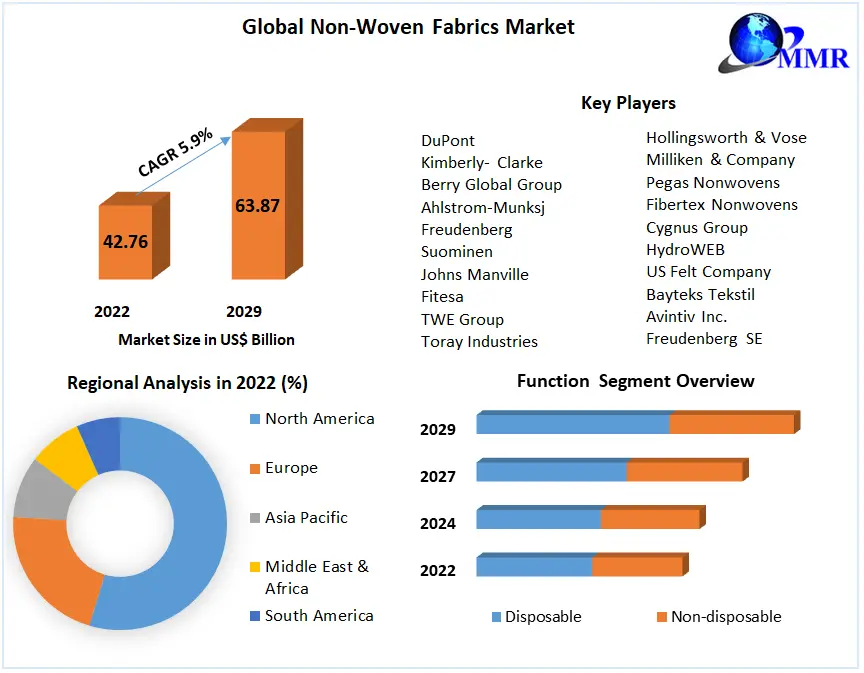
Non-Woven Fabrics Market was valued at USD 50.78 Billion in 2025, and it is expected to reach USD 85.07 Billion by 2034, exhibiting a CAGR of 5.9 % during the forecast period (2026-2034).
Nonwoven fabric is a fabric-like material composed of staple (short) and long (continuous long) fibres bound together via chemical, mechanical, heat, or solvent treatment. The phrase is used in the textile industry to describe textiles that are neither woven or knitted, such as felt. Some non-woven textiles are not strong enough until densified or strengthened with a backing. Non-wovens have recently emerged as a viable alternative to polyurethane foam.
Nonwoven textiles are sheet or web structures that are mechanically, thermally, or chemically bound together by entangling fibre or filaments (and perforating films). Given the correct treatment and facilities, certain nonwoven textiles may be recycled after use. As a result, some perceive non-woven fabrics to be more environmentally friendly in some applications, particularly in areas and businesses where throwaway or single-use items are vital, such as hospitals, schools, nursing homes, and luxury hotels.
The textiles opportunity in IoT: The materials that power IoT devices centre around silicon. As a result, peripheral materials such as heavy metals and plastics are employed to create the electronics we use today, ranging from automobiles to Bluetooth-enabled home appliances. Semiconductive device manufacturers have reaped the benefits of big data, whereas the textile sector has largely been left out of the IoT revolution.
However, materials innovation has recently plateaued, and while chip shortages and supply chain concerns remain, a new player is required to sustain the IoT revolution. In many respects, today's wearable technology is backwards in that it uses hard chips to assess the flexibility of the human body. Consumers will benefit from a more comfortable form factor, while manufacturers will get greater insights into their customers by gathering more behavioural data through fabric-based sensors enabled by sewing technology.
Non-Woven Fabrics Market Analysis from 2025 to 2034
To know about the Research Methodology:-Request Free Sample Report
Non-Woven Fabrics Market Dynamics
Demand for Non-Woven Fabrics in the Automotive Industry
Automotive manufacturers all around the globe are attempting to lower vehicle weight in order to make fuel-efficient, low-CO2-emitting vehicles. As a result, the need for lightweight, high-strength materials for interior applications is increasing. Nonwoven materials are 15%-20% lighter than competitive materials and can save up to 2 kg on the weight of an automobile. Furthermore, they improve vehicle comfort and safety. These advantages have permitted the use of nonwoven textiles in over 40 applications in most automobiles, including filters, carpets, and battery separators. Nonwoven filtration in automobiles helps to minimise CO2 emissions and makes a vehicle more environmentally friendly. Aside from sustainability and environmental requirements, other key drivers boosting demand for nonwoven fabric materials in the vehicle sector include the introduction of new technologies in automobile coolants and the reduction of model lifecycles.
Broad Scope of the Applications of Non-Woven Fabrics/Textiles
The non-woven fabrics/textiles industry is expected to grow due to increased demand for its usage in filter manufacture. These are fuel, oil, and air filters. They are also used as filters for beverages such as coffee and tea, as well as filters in the pharmaceutical industry and mineral processing. The growing number of oil and gas exploration expeditions is likely to fuel growth in the fabrics/textiles market during the forecast period. The low cost of the raw materials used in its manufacture contributes to the non-woven industry's growth. The sector is also expected to replace all of its polyurethane foam-based products due to increased regulations and their toxicity, driving demand for nonwoven fabrics/textiles even higher.
Demand for Non-Woven Fabrics in the Healthcare Industry
The use of nonwoven textiles in pharmaceutical applications is growing as a result of the availability of low-cost items for use in cost-conscious hospitals. In hospitals, disposable and reusable surgical gowns, curtains, gloves, and tool covers are commonly utilised. Nonwoven textiles have a critical function in the medical business.
The product range includes surgical gowns, masks, and other wearable goods, as well as surgical drapes, napkins, dressings, and filtration materials, as well as implantable textiles such as tissue scaffolds for healing internal organs. Several government initiatives for managing HAIs (Hospital Acquired Infections) recommend the use of nonwoven medical goods, such as disposable patient aprons, drapes, and sheets, to assist prevent HAI transmission. These are the primary drivers of market growth.
Scarcity of Raw Materials for the Manufacturing of Non-Woven Fabrics
Fabric fabrication for garment production is expensive compared to traditional manufacturing procedures, and new methods/processes for making fabrics through unconventional means are constantly being developed. Durable nonwoven textiles utilising the hydroentanglement technique that can compete with woven fabrics in terms of aesthetic and tensile capabilities are being produced as a result of technological advancements and the availability of new fibre.
The availability of raw materials is one of the most important factors that has a direct impact on the end-product market. Synthetic fibres account for more than 80% of the basic material fibres in nonwoven textiles. Some of these raw material fibres are commonly accessible and moderately priced, such as polyester and cotton, but others, such as carbon fibres, glass fibres or high tenacity yarns, and aramids, are more expensive and difficult to get.
Non-Woven Fabrics Market Segment Analysis
By Polymer Type, the polypropylene (PP) segment accounted for the largest market share of about xx% in 2025 and is expected to grow rapidly during the forecast period. Polypropylene is a multi-purpose material that is also one of the least destructive to the environment. As a result of its inert properties and environmental benefits, Polypropylene is a form of polymer that is gaining appeal across sectors. The penetration of polypropylene nonwoven fabrics in geotextiles is rising due to nonwoven fabric properties such as excellent rip and puncture resistance, temperature fluctuation tolerance, and durability.
Furthermore, the growing product demand for sanitary products for newborns, women, and adults in the personal grooming sector is expected to drive market growth. Additionally, rising consumer awareness of personal hygiene has raised demand for sanitary napkins, diapers, incontinence products, and dry & wet wipes, propelling the market. An increase in demand for protective apparel is also expected to contribute to market development. These products offer high levels of protection, act as a barrier, and keep dust particles and germs out.
By Function, the Non-Disposable segment is expected to grow rapidly during the forecast period for the Non-Woven Market. Raised construction expenditure in rising nations such as Brazil, China, and India has increased the need for geotextiles in highways and buildings, which is likely to drive demand for nonwoven non-disposable fabrics. During the forecast period, the disposable category is predicted to develop considerably. Because of their simplicity of use and low cost, disposable materials are becoming increasingly popular. In households, hospitals, hotels, and restaurants, a wide range of disposable textiles are used. There is no need to worry about washing or cleaning the textiles because they may be discarded once used.
As a result, there has been a rise in global demand for throwaway textiles. Because of technological improvements, the industry now provides a diverse choice of single-use textiles. Furthermore, healthcare-specific materials are developed, such as isolation gowns, disposable pants, Howie jackets, liquid-resistant laboratory coats, latex anti-allergic gloves, sleeve protection, surgical gown, shoe cover, disposable bed sheets, and so on. These materials are long-lasting, light, and inexpensive, which enhances global demand.
By Technology, the Spun bond segment held the biggest market share of the Non-Woven market in 2025 and is expected to grow rapidly during the forecast period. Spun bond nonwovens are in high demand in a range of applications, including hygiene, construction, coating substrates, farming, battery separators, napkins, and filtering. Furthermore, spun bond is one of the most preferred processes for creating huge quantities of nonwoven fabrics.
Spun bonding Nonwoven textiles are made using a continuous process of spinning fibres, which are subsequently distributed into a web-like structure or directed by air streams. As a result, the belt speed increases. These are often made in sheet or web structures that are held together by entangled fibres or filaments utilising thermal or chemical treatments prescribed by the Spun bond Fabric Supplier or Spun bond Fabric Manufacturer.
Non-woven polypropylene fabric is a thermoplastic polymer that is comparable to PP or Polypropylene but is made to seem like non-woven fabric. Nonwoven bags, interlining, healthcare coveralls, masks, filters, and other applications are among its principal applications. It is gaining popularity in the medical and fashion industries.
Non-Woven Fabrics Market Regional Insights
These are frequently made in sheet or web structures that are held together by entangled fibres or filaments and are held together by thermal or chemical treatments prescribed by the Spun bond Fabric Supplier or Spun bond Fabric Manufacturer. Non-woven polypropylene fabric is a thermoplastic polymer similar to PP or Polypropylene that is designed to seem like non-woven fabric.
Its main uses include nonwoven bags, interlining, healthcare coveralls, masks, filters, and other items. It is becoming increasingly popular in the medical and fashion industries. Thanks to the region's rapidly increasing construction, automobile, and healthcare industries, regions such as India and China are driving growth in the Asia Pacific market.
During the forecast period, China, India, and South Korea would lead the nonwoven fabric market. In terms of GDP, China has the largest economy in the Asia-Pacific area. China is one of the world's fastest-growing economies and one of the world's largest industrial production companies. Due to rising non-woven fabric demand from the healthcare industry and increased use in the textiles industry in this area, China is expected to dominate the non-woven fabric market over the forecast period.
Furthermore, because Covid-19 is prevalent in Asia Pacific nations, notably China, the market for non-woven fabric from the construction, textile, and automotive sectors is expected to be constrained owing to the closure of multiple production facilities in the country.
Because of the increase of infrastructure and building activities, North America and Latin America are likely to occupy the second-largest position in the market for nonwoven fabric manufacturing. Automobiles are the most frequent mode of transportation in Europe. Because non-woven materials are in high demand in the automobile sector, this area has swiftly increased its usage of them. The remainder of the world would continue to develop steadily and consistently during the predicted period, including the Middle East and Africa. Personal hygiene goods are in high demand due to the tourist sector and as a result, global demand is rising.
Non-Woven Fabrics Market Research Methodology
Both primary and secondary data sources are extensively used in the research report. Government policy, market environment, competitive landscape, historical data, current market trends, technological innovation, upcoming technologies, and technical progress in related industries, as well as market risks, opportunities, market barriers, and challenges, are all investigated during the research process.
To produce the final quantitative and qualitative data, all possible components impacting the markets covered in this research study were investigated, extensively examined, validated through primary research, and evaluated. The market size for top-level markets and sub-segments is normalised, and the influence of inflation, economic downturns, regulatory & policy changes, and other variables is accounted for in the forecast.
This information is coupled with extensive inputs and analysis and given in the report. Extensive primary research was carried out to gather information and check and confirm the critical numbers arrived at after extensive market engineering and calculations for market statistics; market size estimations; market forecasts; market breakdown; and data triangulation. Bottom-up techniques, as well as numerous data triangulation procedures, are commonly used in the whole market engineering process to do market estimation and forecasting for the overall market segments and sub-segments included in this research.
Non-Woven Fabrics Market Recent Industry Developments
| Date | Company | Development | Impact |
|---|---|---|---|
| 14 April 2025 | Freudenberg Group | Freudenberg launched a new fine-filament spunbond nonwoven technology utilizing PET, PE, and PP blends tailored for construction and filtration applications. | This advancement significantly improves fabric strength and filtration efficiency while supporting broader sustainable material usage. |
| 10 June 2025 | TWE Group | TWE revamped its corporate platform by introducing an online interactive Product Finder tool designed to optimize industrial search capabilities. | The initiative elevates customer experience, driving faster product selection and ordering across automotive and hygiene sectors. |
| 18 September 2025 | Suominen Corporation | Suominen commercialized a novel plastic-free, biodegradable nonwoven wipe substrate derived from 100% renewable cellulosic fibers. | This launch accelerates corporate sustainability targets and answers stringent regulatory demands for eco-friendly hygiene goods. |
| 12 January 2026 | Berry Global Group | Berry Global expanded its advanced spunmelt production line capacity in North America to scale up lightweight medical gown manufacturing. | The expansion boosts regional supply chain scale and reliability for critical healthcare institutions and disposable medical assets. |
Non-Woven Fabrics Market Report Scope:
Product categorization, product application, development trend, product technology, competitive landscape, industrial chain structure, industry overview, national policy and planning analysis of the industry, and the most recent dynamic analysis are all included in the Non-Woven Fabrics Market research report. The research examines the global market's drivers, opportunities, and constraints. During the forecast period, it analyses the impact of key drivers, trends, and restraints on market demand. The study also discusses market possibilities on a global scale.
In terms of production bases and technologies, the research contains the production time, base distribution, technical features, research and development trends, technology sources, and raw material sources of important Non-Woven Fabrics Market businesses. The more detailed research also includes important application market and consumption areas, significant regions and consumption, major producers, distributors, raw material suppliers, equipment providers, and their contact information, as well as an analysis of the industry chain relationship. The study in this report also includes product specifications, manufacturing methods, cost structure, and data information organised by location, technology, and application.
Non-Woven Fabrics Market Scope: Inquire before buying
| Global Non-Woven Fabrics Market | |||
|---|---|---|---|
| Report Coverage | Details | ||
| Base Year: | 2025 | Forecast Period: | 2026-2034 |
| Historical Data: | 2020 to 2025 | Market Size in 2025: | US $ 50.78 Bn. |
| Forecast Period 2026 to 2034 CAGR: | 5.9% | Market Size in 2034: | US $ 85.07 Bn. |
| Segments Covered: | by Polymer Type | PP PE PET Wood pulp Rayon Others |
|
| by layer | Single-layer Multilayer |
||
| by Function | Disposable Non-disposable |
||
| by Technology | Spun bond Wet laid Dry laid Others |
||
| by Application | Hygiene Medical Filtration Automotive Consumer products Building & Construction Others |
||
Non-Woven Fabrics Market, by Region
North America (United States, Canada and Mexico)
Europe (UK, France, Germany, Italy, Spain, Sweden, Austria, Turkey, Russia and Rest of Europe)
Asia Pacific (China, India, Japan, South Korea, Australia, ASEAN and Rest of APAC)
Middle East and Africa (South Africa, GCC, Egypt, Nigeria and Rest of ME&A)
South America (Brazil, Argentina, Columbia and Rest of South America)
Non-Woven Fabrics Market, Key Players are
1. DuPont
2. Kimberly- Clarke
3. Berry Global Group
4. Ahlstrom-Munksj Freudenberg
5. Suominen
6. Johns Manville
7. Fitesa
8. TWE Group
9. Toray Industries
10. Avgol industries
11. Asahi Kasei
12. Fiberweb
13. Umzamo Nonwovens
14. Sunshine Nonwoven Fabric
15. Autotech Nonwovens
16. Hollingsworth & Vose
17. Milliken & Company
18. Pegas Nonwovens
19. Fibertex Nonwovens
20. Cygnus Group
21. HydroWEB
22. US Felt Company
23. Bayteks Tekstil
24. Avintiv Inc.
25. Freudenberg SE
26. Ahlstrom
27. Kimberly-Clark
28. DowDupont, P.H. Glatfelter Company
29. Suominen Corporation
30. Johns Manvile (JM)
31. Toray Industries, Inc.
Frequently Asked Questions:
1. Which is the potential market for the Non-Woven Fabrics in terms of the region?
Ans. In APAC region, the growing business and educational sectors are expected to help drive the use of collaborative screens.
2. What are the opportunities for new market entrants?
Ans. The key opportunity in the market is new initiatives from governments that provide funding for Non-Woven Fabricss in educational institutes
3. What is expected to drive the growth of the Non-Woven Fabrics market in the forecast period?
Ans. A major driver in the Non-Woven Fabrics market is the prevalence of work from home and remote collaboration created by the COVID-19 pandemic
4. What is the projected market size & growth rate of the Non-Woven Fabrics Market?
Ans. Non-Woven Fabrics Market size was valued at US$ 50.78 Billion in 2025 and the total Non-Woven Fabrics revenue is expected to grow by 5.9% from 2026 to 2034, reaching nearly US$ 85.07 Billion.
5. What segments are covered in the Non-Woven Fabrics Market report?
Ans. The segments covered are Polymer Type, layer, Function, Technology, Application, and Region.