
Global Temporary Power and Cooling Services Market By Product Type, By Service Type, By Technology, By Power Rating, By Application, by Region and Forecast 2034
Overview
Global Temporary Power and Cooling Services Market Overview
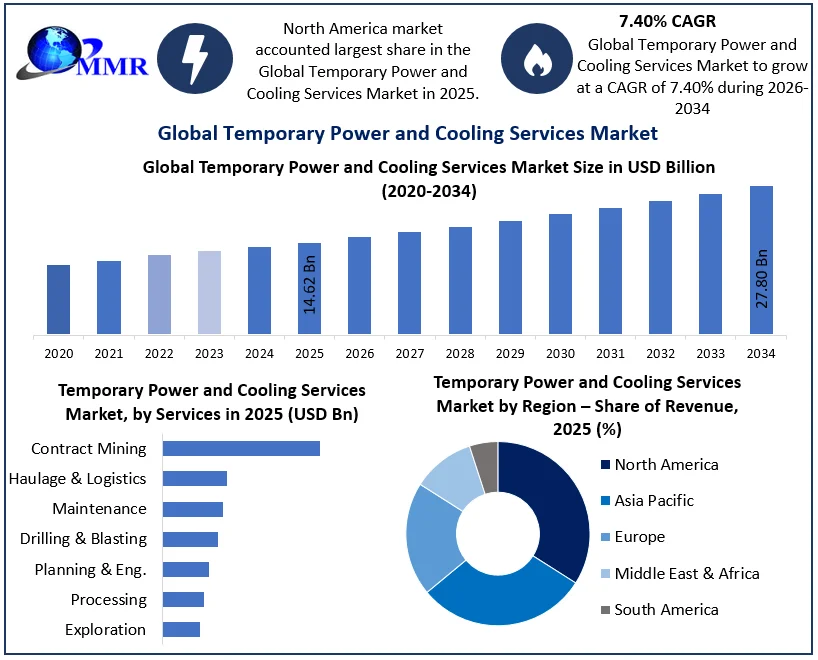
The Global Temporary Power and Cooling Services Market size was valued at USD 14.62 Billion in 2025 and the total market revenue is expected to grow at a CAGR of 7.40% from 2025 to 2034, reaching USD 27.80 Billion by 2034.
The Global Temporary Power and Cooling Services Market encompasses the short-term rental, deployment, installation, operation, and maintenance of mobile generators, standby power systems, chillers, air conditioners, cooling towers, transformers, switchgears, and associated distribution equipment used to maintain operational continuity when permanent power and cooling infrastructure is unavailable, undergoing maintenance, or insufficient. Temporary power rental and temporary cooling rental solutions support data centers, utilities, industrial plants, construction sites, commercial buildings, pharmaceutical facilities, large events, and emergency and disaster response operations across the world. The market is influenced by electricity demand growth, data center expansion, grid reliability concerns, extreme weather events, industrial maintenance cycles, infrastructure investment, and the increasing preference for rental over equipment ownership.
In terms of deployed rental fleet capacity, the market is estimated at XX GW of temporary power and XX MW of temporary cooling capacity in 2025 and is projected to reach XX GW and XX MW respectively by 2034. Temporary power services are primarily delivered through portable generators, standby generators, containerized power modules, and hybrid systems that combine generators with battery storage, supported by transformers, switchgears, and cabling for safe load connection. Temporary cooling services are delivered through rental chillers, air-cooled and water-cooled systems, cooling towers, air conditioners, and mobile cooling units designed for process cooling, comfort cooling, and critical infrastructure thermal management.
The MMR report on the Global Temporary Power and Cooling Services Market provides a comprehensive assessment of the industry, covering temporary power rental, temporary cooling rental, integrated power and cooling services, emergency deployment solutions, and installation, maintenance and technical support. The study evaluates market size, historical performance and future growth prospects, supported by analysis across product type, technology, power rating, application and region. It examines demand from data centers, utilities, industrial facilities, construction projects, commercial establishments and emergency response operations. The report also assesses the competitive positioning of rental service providers, equipment manufacturers and cooling specialists through company profiling, financial benchmarking, fleet capabilities, service portfolios, geographic presence and strategic developments. These insights help stakeholders identify growth opportunities, evaluate market competition, assess customer requirements and make informed decisions regarding fleet investment, service expansion, partnerships and market entry.
Global Temporary Power and Cooling Services Market Growth and Share Analysis
To know about the Research Methodology :- Request Free Sample Report
|
Parameter |
Value |
|
Market Size (2025) |
USD 14.62 Billion |
|
Market Size (2034) |
USD 27.80 Billion |
|
CAGR |
7.40% |
|
Historical Period |
2020 to 2025 |
|
Forecast Period |
2026 to 2034 |
Global Temporary Power and Cooling Services Market Key Highlights:
Shift Towards AI-Enabled, Hybrid and Modular Temporary Infrastructure
The Temporary Power and Cooling Services Market is gradually evolving from conventional equipment rental towards intelligent, integrated energy and thermal management solutions. The adoption of AI-enabled monitoring, predictive maintenance, remote diagnostics and real-time load optimization is creating opportunities for service providers to deliver more efficient and reliable temporary infrastructure. An emerging innovation is the integration of battery energy storage systems, renewable power sources, hybrid generators and modular cooling units into scalable solutions that can be deployed according to site-specific requirements. This approach is particularly relevant for data centers, industrial facilities and critical infrastructure, where uninterrupted operations, energy efficiency and reduced emissions are becoming essential procurement considerations. As a result, providers capable of combining temporary power, precision cooling, digital monitoring and low-emission technologies are positioned to strengthen their competitive differentiation and develop higher-value service offerings.
Global Temporary Power and Cooling Services Market Dynamics:
Rising Data Center Investments and Critical Infrastructure Uptime Requirements to Drive Global Temporary Power and Cooling Services Market
The rapid expansion of cloud computing, artificial intelligence, and digital services is driving large-scale investment in data centers, which require uninterrupted power and precise thermal management. During construction, commissioning, equipment upgrades, and utility interconnection delays, operators frequently depend on temporary power rental and temporary cooling rental to keep facilities operational and meet delivery timelines. Telecommunications networks, hospitals, and other mission-critical facilities also rely on rapidly deployable backup power and cooling to maintain service continuity.
The International Energy Agency (IEA) estimated global data centre electricity consumption at around 415 TWh in 2024 and projects it to roughly double to around 945 TWh by 2030, with accelerated servers for artificial intelligence a major contributor. Growth at this scale is increasing demand for bridging power, load banks, and chilled-water capacity while permanent grid connections and cooling plants are being built.
Furthermore, data center operators increasingly specify service-level agreements covering response times, redundancy, and equipment availability. Providers with large regional fleets, containerized power modules, and integrated chiller and generator offerings are better positioned to win multi-year framework contracts with hyperscale and colocation customers.
Growing Grid Maintenance, Power Outages, and Extreme Weather Events to Create Market Opportunities
Utilities and power generation operators perform routine maintenance, refurbishment, and upgrade work that requires planned shutdowns of generation units, substations, and cooling systems. Temporary power generators, mobile transformers, rental chillers, and cooling towers allow operators to maintain supply and process temperatures during these outages, reducing downtime and revenue loss.
Emergency deployments are also rising as hurricanes, floods, heatwaves, wildfires, and cold snaps stress aging transmission and distribution networks. Governments, utilities, hospitals, and commercial building owners increasingly maintain emergency framework agreements with rental providers for rapid mobilization of power and cooling equipment during unplanned events.
The increasing importance of power reliability across industries, combined with grid modernization programs and the integration of variable renewable generation, is creating additional need for temporary capacity during commissioning, testing, and interconnection phases. Providers offering 24/7 emergency response, strategically located depots, and pre-positioned fleets are expected to benefit from this trend.
Technological Advancements in Smart Monitoring, Hybrid Power Systems, and Fleet Management
Technological advancements in telematics, IoT integration, and remote monitoring are improving the operational efficiency of temporary power and cooling equipment. Modern rental fleets increasingly include connected generators and chillers that transmit real-time data on load, fuel level, temperature, and fault conditions, enabling proactive intervention before failures occur.
Furthermore, predictive maintenance technologies, automated load management, and digital dispatch platforms are helping providers improve fleet utilization, reduce unplanned downtime, and shorten deployment times. Customers benefit from transparent reporting, optimized fuel consumption, and verifiable uptime performance under service-level agreements.
The development of hybrid power systems that integrate generators with battery energy storage, and of containerized modular units, is also influencing fleet modernization strategies. These systems reduce fuel consumption, noise, and emissions, and are particularly valuable in urban sites, data centers, and emissions-restricted locations.
Increasing Investments in Rental Fleet Expansion and the Shift from Equipment Ownership to Rental Models
Industrial operators, construction contractors, event organizers, and utilities are increasingly choosing rental over ownership to avoid high capital expenditure, storage costs, and the maintenance burden of equipment that is used intermittently. Rental models provide access to the latest technology, flexible contract durations, and technical support, which is particularly attractive for short-term projects and unpredictable demand.
Major rental companies and equipment manufacturers are investing in fleet expansion, depot networks, and specialized equipment such as high-capacity chillers, containerized generators, and mobile substations. Strategic acquisitions are also strengthening regional coverage, fleet capacity, and technical capabilities, supporting the growth of integrated temporary power and cooling offerings.
However, equipment lead times, component and generator-set supply constraints, fuel price volatility, skilled technician availability, and logistics for oversized equipment remain important considerations for providers when planning fleet investments and emergency response capacity.
Stringent Emission Regulations and Refrigerant Standards to Influence Rental Fleet Operations
Temporary power and cooling equipment is subject to increasing regulatory scrutiny related to engine emissions, noise, fuel storage, refrigerant use, and workplace safety. Regulations such as the European Union Stage V standards for non-road mobile machinery engines and the United States Environmental Protection Agency Tier 4 Final standards for non-road diesel engines are encouraging rental providers to replace older generators with cleaner, more efficient units.
In cooling, refrigerant regulations such as the revised European Union F-gas Regulation and the global Kigali Amendment to the Montreal Protocol are driving a gradual phase-down of high global-warming-potential hydrofluorocarbons. These developments are encouraging chiller and air-conditioner fleet renewal and the adoption of lower-GWP refrigerants and higher-efficiency designs.
Furthermore, customers are increasingly including sustainability requirements in procurement criteria, favoring providers with low-emission fleets, hybrid systems, and transparent reporting. Companies that invest early in compliant, fuel-efficient equipment and responsible end-of-life management are better positioned to address evolving customer and regulatory requirements.
Global Temporary Power and Cooling Services Market Segment Analysis
The Global Temporary Power and Cooling Services Market is segmented into product type, service type, technology, power rating, application, and region. Each segment reflects different equipment specifications, deployment requirements, contract structures, and commercial demand patterns across the temporary power rental and temporary cooling rental landscape.
By Service Type
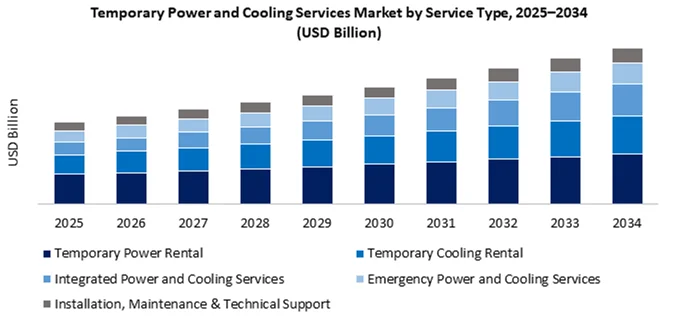
Based on service type, the global market is segmented into temporary power rental, temporary cooling rental, integrated power and cooling services, emergency power and cooling services, and installation, maintenance, and technical support.
The temporary power rental segment is expected to hold a significant share of the global market owing to continuous demand for generators, containerized power modules, transformers, and distribution equipment from utilities, construction projects, industrial plants, and events. Flexible contract durations, avoidance of capital expenditure, and access to modern fuel-efficient equipment are supporting demand for temporary power rental services across both planned and unplanned requirements.
The temporary cooling rental segment is witnessing increasing demand due to the need for rental chillers, cooling towers, air conditioners, and mobile cooling units during utility maintenance, process shutdowns, heatwaves, and data center expansion. Industries such as chemicals, pharmaceuticals, food and beverage, and power generation depend on precise temperature control, creating steady demand for rapidly deployable cooling capacity.
The integrated power and cooling services segment is gaining importance as customers prefer a single provider capable of delivering generators, chillers, fuel, installation, and round-the-clock monitoring under one contract. Emergency power and cooling services are expected to grow steadily on the back of grid disruptions and extreme weather, while installation, maintenance, and technical support services remain essential for equipment reliability and safe operation.
By Application
Based on application, the market is segmented into data centers and critical infrastructure, utilities and power infrastructure, industrial process cooling, construction and events, emergency and disaster response, commercial facilities, and other applications.
Data centers and critical infrastructure represent one of the fastest-growing applications, supported by hyperscale and colocation construction, artificial intelligence workloads, and stringent uptime requirements. Temporary power supports commissioning and bridging until permanent utility connections are available, while temporary cooling provides capacity during expansion, maintenance, and equipment upgrades.
The utilities and power infrastructure segment relies on temporary power and cooling during planned maintenance outages, substation work, and generation unit refurbishment, ensuring supply continuity and thermal management at electrical facilities. Industrial process cooling serves manufacturing, chemical, pharmaceutical, and food processing operations that require temperature-controlled processes during shutdowns, capacity additions, or equipment failures.
Construction and events create short-duration, high-volume demand for mobile generators, distribution equipment, and cooling units, whereas emergency and disaster response requires rapid mobilization capability. Commercial facilities, including hospitals, hotels, shopping centers, and office buildings, use temporary systems for chiller replacement projects, peak-season cooling, and backup power, while other applications include telecommunications, oil and gas, mining, and government projects.
By Power Rating
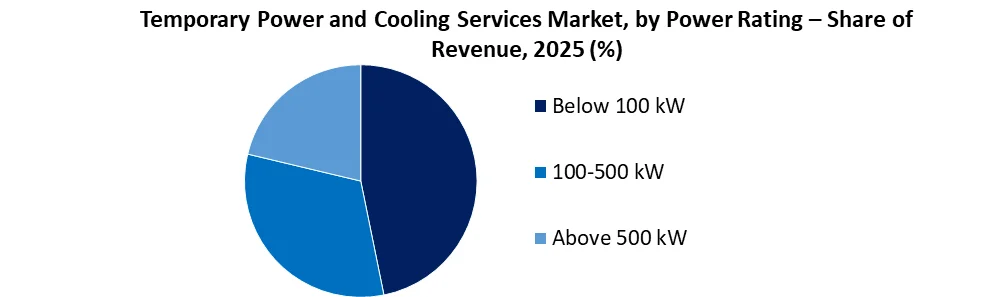
By power rating, the market is segmented into below 100 kW, 100 to 500 kW, and above 500 kW. Systems below 100 kW serve small construction sites, events, and commercial facilities, while the 100 to 500 kW range addresses mid-sized industrial and commercial loads. The above 500 kW category, including large generators, containerized power plants, and high-capacity chillers, is expected to record strong growth as data centers, utilities, and large industrial plants require high-capacity temporary solutions.
Global Temporary Power and Cooling Services Market Regional Insights:
North America is expected to account for the largest market share of 34% in 2025, driven by large-scale data center construction, aging grid infrastructure, frequent weather-related outages, and a mature rental ecosystem led by companies such as United Rentals, Sunbelt Rentals, Herc Rentals, and Aggreko. The United States leads regional demand, while Canada and Mexico contribute through industrial, mining, and infrastructure activity. Asia Pacific holds a share of around 30% and is projected to be the fastest-growing region, supported by industrial expansion, rapid urbanization, data center investment, and infrastructure development across China, India, Japan, South Korea, Australia, and Southeast Asia. Growing electricity demand, manufacturing growth, and large construction projects are increasing adoption of temporary power rental and cooling solutions in the region.
Europe maintains steady demand for temporary power and cooling services, supported by infrastructure reliability requirements, energy transition projects, industrial maintenance activity, and data center growth in Germany, the United Kingdom, France, the Netherlands, Italy, and the Nordic countries. Stringent emission and refrigerant regulations are encouraging fleet modernization and the adoption of hybrid and low-emission equipment. The Middle East & Africa is a significant market, with Saudi Arabia, the UAE, Qatar, Oman, Egypt, Turkey, and South Africa investing in power generation, oil and gas, construction, and mega-projects, while hot climates and capacity shortfalls support demand for both temporary power and cooling. Emergency power requirements in several African countries further expand the addressable market. South America is gaining importance through mining, energy, industrial, and infrastructure investment in Brazil, Argentina, Chile, and Colombia, where rental power and cooling support project timelines and grid reliability needs.
Global Temporary Power and Cooling Services Market Recent Developments:
|
Date |
Recent Developments |
|
16-Apr-26 |
Aggreko released its Breaking |
|
24-Apr-26 |
Trane Rental Services highlighted |
|
29-Jun-26 |
Amazon outlined its upcoming data |
|
01-Sep-26 |
The City of Clifton, New Jersey, |
|
25-Sep-26 |
Aggreko deployed emergency |
|
02-Nov-26 |
Aggreko returned as the Official |
Global Temporary Power and Cooling Services Market Competitive Landscape
The global temporary power and cooling services market is moderately fragmented, with competition driven by equipment rental capabilities, service reliability, geographical presence, fleet capacity, and the ability to provide integrated power generation and temperature control solutions. Leading companies are focusing on expanding their rental fleets, strengthening service networks, and developing energy-efficient and hybrid solutions to address the growing demand from construction, manufacturing, oil and gas, utilities, data centers, and large-scale infrastructure projects.
Aggreko plc is among the prominent players in the market, offering integrated temporary power generation, temperature control, and energy solutions for industrial and commercial applications. The company competes through its global service network, application engineering capabilities, and customized rental solutions. United Rentals, Inc. and Sunbelt Rentals strengthen their market positions through extensive equipment rental fleets and specialized power and HVAC rental services, particularly across North America.
Similarly, Herc Holdings Inc. provides temporary power and climate control equipment through its equipment rental operations, while Atlas Copco AB offers mobile power generation, cooling, and industrial utility solutions through its Specialty Rental business. Caterpillar Inc. and Cummins Inc. maintain strong competitive positions through their generator technologies, power systems, and equipment rental networks. Meanwhile, Trane Technologies plc and Carrier Global Corporation contribute to the competitive landscape through temporary HVAC, chiller, and temperature control solutions.
The market also includes specialized service providers such as APR Energy, Rental Solutions & Services (RSS), Modular Cooling Solutions, Inc., and Cooling Power Corp., which compete through customized temporary power and cooling installations for industrial facilities and large-scale projects. Increasing investments in data center infrastructure, grid reliability, and emergency power requirements are encouraging companies to strengthen their integrated service portfolios, improve equipment efficiency, and expand their geographical reach. Strategic partnerships, acquisitions, fleet modernization, and technological advancements are expected to remain important competitive strategies.
Global Temporary Power and Cooling Services Market – Industry Analysis
The objective of the report is to present a comprehensive analysis of the Global Temporary Power and Cooling Services Market, covering all major stakeholders across the equipment manufacturing, rental, utility services, and critical infrastructure industries. The study evaluates the historical and current market scenario, industry developments, market size, deployed rental capacity, and future growth outlook through 2034.
The report provides an in-depth assessment of market dynamics, including major growth drivers, restraints, opportunities, and challenges influencing temporary power and cooling services demand. It also examines electricity demand growth, data center investment, utility maintenance activity, industrial production trends, rental fleet composition, equipment utilization, pricing and total cost of ownership, fuel costs, and procurement criteria.
The study further evaluates the competitive positioning of leading rental companies, equipment manufacturers, HVAC and cooling specialists, and regional service providers. Company-level analysis includes fleet size, equipment capacity, geographic presence, financial performance, revenue growth, profitability, capital expenditure, strategic developments, and business expansion initiatives.
PORTER's Five Forces, PESTLE, and SWOT analyses are incorporated to evaluate the competitive environment and the influence of macroeconomic, regulatory, technological, and environmental factors on the industry. The report also provides regional market assessments and country-level forecasts to identify emerging opportunities and future investment hotspots.
The research helps investors, rental companies, equipment manufacturers, utilities, data center operators, industrial facility owners, contractors, and emergency response agencies understand the evolving temporary power and cooling services landscape and make informed strategic business decisions.
Global Temporary Power and Cooling Services Market Scope: Inquire before buying
|
Global Temporary Power and Cooling Services Market |
|||
|
Report Coverage |
Details |
||
|
Base Year: |
2025 |
Forecast Period: |
2026-2034 |
|
Historical Data: |
2020 to 2025 |
Market Size in 2025: |
USD 14.62 Billion |
|
Forecast Period 2026 to 2034 CAGR: |
7.40% |
Market Size in 2034: |
USD 27.80 Billion |
|
Segments |
By Product Type |
Generators Portable Standby Cooling Units Others |
|
|
By Service Type |
Temporary Power Rental Temporary Cooling Rental Integrated Power and Cooling Services Emergency Power and Cooling Services Installation, Maintenance, and Technical Support |
||
|
By Technology |
Smart Systems Remote Traditional Systems Conventional Manual |
||
|
By Power Rating |
Below 100 kW 100-500 kW Above 500 kW |
||
|
By Application |
Data Centers and Critical Infrastructure Utilities and Power Infrastructure Industrial Process Cooling Construction and Events Emergency and Disaster Response Commercial Facilities Other Applications |
||
Temporary Power and Cooling Services Market, by Region
North America (United States, Canada and Mexico)
Europe (Germany, United Kingdom, France, Italy, Netherlands, Spain, Norway, Denmark, Sweden, Finland, Poland, Switzerland, Russia and Rest of Europe)
Asia Pacific (China, Japan, South Korea, India, Australia, Singapore, Indonesia, Malaysia, Thailand, Vietnam, Taiwan, Philippines and Rest of Asia Pacific)
Middle East and Africa (Saudi Arabia, UAE, Turkey, South Africa, Qatar, Egypt, Oman and Rest of Middle East & Africa)
South America (Brazil, Argentina, Chile, Colombia and Rest of South America)
Temporary Power and Cooling Services Key Players:
Temporary Power and Cooling Services Market, Major Key Players
A. Integrated Temporary Power and Cooling Service Providers – 20 Companies
1. Aggreko
2. United Rentals
3. Sunbelt Rentals
4. Herc Rentals
5. Carrier Rental Systems
6. Andrews Sykes
7. ICS Cool Energy
8. Coolworld Rentals
9. Cross Rental Services
10. Rental Solutions and Services (RSS)
11. Al Faris Group
12. Altaaqa Global Energy Services
13. APR Energy
14. Energyst Rental Solutions
15. Byrne Equipment Rental
16. CES Power
17. Atlas Copco Rental
18. Modern Hiring Service
19. Power Electrics
20. Shenton Group
B. Temporary Cooling, HVAC, and Temperature Control Specialists – 20 Companies
21. Johnson Controls
22. All Seasons Hire
23. Acclimatise
24. Cahill Heating Rentals
25. Critical Rental Solutions
26. OnSite HVAC Rentals
27. Mobile Air & Power Rentals
28. Chase Chillers
29. Axis Portable Air
30. Rescue Cooling
31. Aqua Cooling
32. Celsius Hire
33. Newsome
34. National Rental Chillers
35. 1st Cooling
36. ChillCo
37. HRS Rental
38. REIC Specialty Rentals
39. EquipmentShare
40. Ohio CAT
C. Temporary Power Rental and Utility Support Providers – 20 Companies
41. Caterpillar
42. Cummins
43. Ashtead Group
44. HIMOINSA
45. Bredenoord
46. Wärtsilä
47. Generac
48. Kohler
49. FG Wilson
50. Pramac
51. Multiquip
52. Wacker Neuson
53. Rolls-Royce Power Systems
54. Finning International
55. Toromont CAT Power Systems
56. Ring Power
57. Holt of California
58. Foley Power Solutions
59. Worldwide Power Products
60. Newburn Power Rental
D. Additional Regional Rental Companies and Equipment Suppliers – 15 Companies
61. Boels Rental
62. Loxam
63. Speedy Hire
64. HSS Hire
65. Generator Power
66. Trinity Power Rentals
67. Smart Energy Solutions
68. Temp-Power
69. Sudhir Power
70. Powerica
71. Quippo Energy
72. Marco Gensets
73. Kirloskar Oil Engines
74. Daikin Rental Solutions
75. Trane Rental Services
Others
Frequently Asked Questions:
1. What is the Global Temporary Power and Cooling Services Market size?
Ans: The Global Temporary Power and Cooling Services Market was valued at USD 14.62 Billion in 2025 and is projected to reach USD 27.80 Billion by 2034, growing at a CAGR of 7.40% during 2025 to 2034.
2. What is the CAGR of the Global Temporary Power and Cooling Services Market?
Ans: The market is expected to grow at a CAGR of 7.40% from 2025 to 2034, supported by data center expansion, grid maintenance requirements, extreme weather events, and the rising preference for rental over ownership.
3. Which service types are covered in the market?
Ans: The market includes temporary power rental, temporary cooling rental, integrated power and cooling services, emergency power and cooling services, and installation, maintenance, and technical support.
4. Which region is expected to dominate the Global Temporary Power and Cooling Services Market?
Ans: North America is expected to dominate the global market in 2025 with a share of around 34%, while Asia Pacific is projected to be the fastest-growing region during the forecast period.
5. Who are the major key players in the Global Temporary Power and Cooling Services Market?
Ans: Major companies include Aggreko, United Rentals, Sunbelt Rentals, Herc Rentals, Carrier Rental Systems, Andrews Sykes, APR Energy, Atlas Copco Rental, Johnson Controls, Caterpillar, Cummins, Generac, Wärtsilä, Boels Rental, Speedy Hire, and others.
6. What is the forecast period for the Global Temporary Power and Cooling Services Market?
Ans: The report considers 2020–2025 as the historical period and 2026–2034 as the forecast period, with 2025 as the base year.