
Rainwater Harvesting Market - Industry Structure Evaluation, Demand Drivers Analysis, Growth Analysis and Identification, Competitive Positioning Review & Market Size Forecast to 2034
Overview
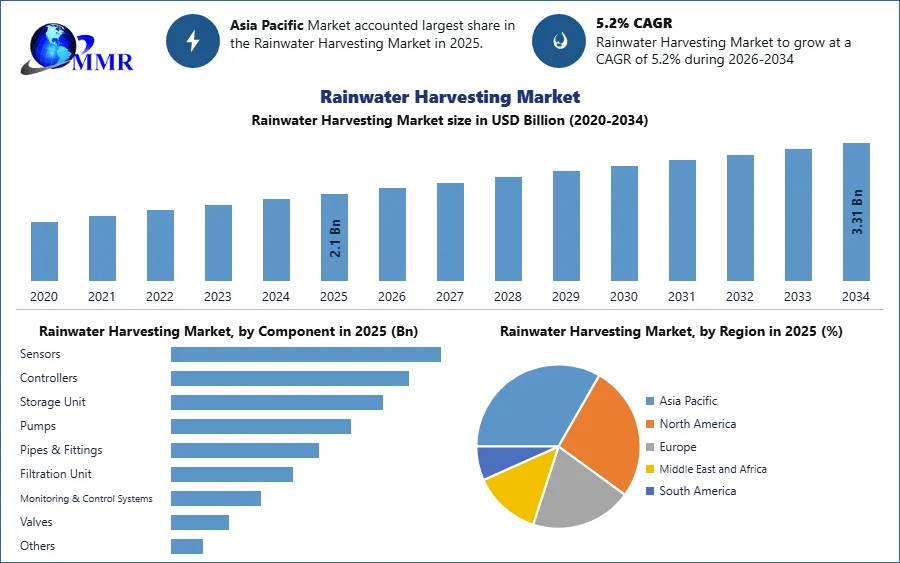
The Rainwater Harvesting Market size was valued at USD 2.1 Billion in 2025 and the total Rainwater Harvesting revenue is expected to grow at a CAGR of 5.2% from 2025 to 2034, reaching nearly USD 3.31 Billion by 2034.
Rainwater Harvesting Market Overview
Rainwater harvesting is a system designed to collect, filter, and store rainwater from roofs or other surfaces for later use, which reduces dependence on municipal water supply. These products usually include gutters, storage tanks, filters, and distribution mechanisms, which promote permanent water management and protection. Ideal for residential, commercial, or agricultural use, they help in conserving water resources, reducing utility costs. The demand for rainwater harvesting products is increasing due to water scarcity, urbanization, and stability trends, while the supply is expanding with innovative, cost-effective solutions from manufacturers to meet residential, commercial, and agricultural needs.
To know about the Research Methodology:-Request Free Sample Report
Rainwater Harvesting Market Dynamics
Growing Water Scarcity and Urbanization to Boost the Rainwater Harvesting Market Growth
Rising global water stress, exacerbated by climate change and rapid urbanization, is the primary driver for rainwater harvesting adoption. Depleting groundwater levels and unreliable municipal water supplies are pushing households, industries, and governments to implement rainwater collection systems. Urban areas, facing increased water demand due to population growth, are particularly investing in decentralized solutions. Government mandates in water-scarce regions like India, Australia, and South Africa further accelerate market growth. Additionally, sustainable development goals (SDGs) and corporate water stewardship programs are promoting rainwater harvesting as a cost-effective and eco-friendly alternative to traditional water sources.
High Initial Costs and Maintenance to Create Rainwater Harvesting Market Challenge
The upfront investment required for rainwater harvesting systems, including storage tanks, filtration units, and installation, remains a significant barrier, especially in developing economies. Maintenance costs for cleaning gutters, replacing filters, and preventing algae growth add to long-term expenses. Lack of technical expertise and awareness in rural areas further limits adoption. Seasonal rainfall variability also affects system reliability, discouraging potential users. Without adequate subsidies or financing options, these financial and operational challenges hinder widespread implementation, despite the long-term water-saving benefits.
Technological Advancements and Green Incentives to Create Rainwater Harvesting Market Opportunity
Innovations in smart water management, IoT-enabled monitoring, and modular designs present lucrative growth opportunities. Solar-powered pumps and hybrid systems enhance efficiency, while government incentives like tax rebates and green building certifications boost demand. The agriculture sector offers untapped potential, with micro-irrigation projects reducing farmers’ dependency on monsoons. Corporate sustainability initiatives and CSR programs are also driving large-scale installations. As climate adaptation becomes a priority, rainwater harvesting is poised to expand in both developed and emerging markets, supported by favourable policies and increasing environmental awareness.
Rainwater Harvesting Market Segment Analysis
By Component
The Storage Unit segment dominated the market in 2025, accounting for the largest share due to its fundamental role in collecting, storing, and managing harvested water for residential, commercial, industrial, and agricultural applications. Storage units represent the core infrastructure of harvesting systems, ensuring a reliable water supply during periods of low rainfall and reducing dependence on municipal water networks. Increasing concerns regarding water scarcity, groundwater depletion, and climate variability encouraged governments, businesses, and homeowners to invest in larger and more durable storage solutions. Polyethylene, fiberglass, reinforced concrete, and steel storage tanks gained widespread adoption because of their durability, corrosion resistance, and low maintenance requirements. Rapid urbanization across developing economies further accelerated demand for compact modular tanks suitable for residential buildings, while industrial and municipal projects increasingly adopted high-capacity storage reservoirs. Integration of smart monitoring technologies, including water-level sensors and automated control systems, enhanced storage efficiency and system reliability.
By Type
The Above-Ground segment dominated the market in 2025, supported by its lower installation costs, ease of maintenance, faster deployment, and broad suitability across residential, commercial, institutional, and industrial applications. Above-ground systems require minimal excavation and civil engineering work, making them highly attractive for both new construction projects and retrofit installations. Property owners increasingly preferred above-ground tanks because they offer easy inspection, cleaning, repair, and capacity expansion compared to underground alternatives. The segment also benefited from the availability of modular polyethylene, fiberglass, and steel storage tanks that can be installed in limited spaces while maintaining high durability and weather resistance. Government-supported water conservation programs and building regulations encouraged homeowners and businesses to adopt above-ground rainwater harvesting systems due to their affordability and straightforward installation process.
Rainwater Harvesting Market Regional Analysis
Asia Pacific dominated the global market in 2025, driven by rapid urbanisation, increasing water scarcity, expanding infrastructure development, and strong government initiatives promoting sustainable water management. Countries including China, India, Japan, Australia, South Korea, Indonesia, and Singapore significantly increased investments in rainwater harvesting infrastructure to address growing freshwater demand and declining groundwater resources. India remained one of the largest markets due to mandatory rainwater harvesting regulations implemented across multiple states, increasing residential construction, and rising awareness regarding water conservation.
China accelerated adoption through sustainable urban development initiatives and investments in smart city infrastructure incorporating advanced water management systems. Australia, facing recurring drought conditions, continued promoting rainwater harvesting for residential and agricultural applications through supportive government policies and financial incentives. Rapid industrialization and population growth throughout Southeast Asia also contributed to higher demand for storage tanks, filtration systems, pumps, and monitoring technologies. The region benefits from a strong manufacturing base for water storage equipment, competitive production costs, and expanding distribution networks, making advanced harvesting systems more affordable.
Rainwater Harvesting Market Competitive Landscape
The Rainwater Harvesting Market in 2025 is led by two major players: Kingspan Group and WISY AG. Ireland-based Kingspan Group, leveraging its innovative water storage solutions and global sustainability initiatives, reported approximately $8.2 billion in revenue in 2024. Germany-based WISY AG, a specialist in filtration and harvesting systems, offers smart IoT-enabled products and benefits from a strong presence in the European market, generating around $120 million in revenue the same year.
Both companies prioritize R&D and have demonstrated outstanding performance in commercial projects, while also leading in residential and modular systems. Their competitive edge is driven by technological advancements, strategic partnerships, and compliance with stringent water conservation regulations, positioning them as market pioneers. Emerging contenders such as Graf Group and Watts Water Technologies are close behind, but Kingspan and WISY AG remain the industry benchmarks.
Rainwater Harvesting Market Key Recent Development
February 12, 2025 – Xylem Inc.
In February 2025, Xylem Inc. announced its FY2024 financial results, reporting revenue of approximately US$8.6 billion, supported by strong growth across its Water Infrastructure and Applied Water businesses. The company continued expanding its smart water management portfolio by integrating digital monitoring, intelligent pumping solutions, and advanced water reuse technologies into municipal, commercial, and industrial water systems. During 2025, Xylem increased investments in IoT-enabled water management platforms capable of monitoring rainwater collection, storage levels, leakage detection, and water quality in real time. The company also expanded its analytics-driven Vue digital platform, enabling utilities and commercial facilities to optimize rainwater utilization and improve operational efficiency. Xylem strengthened partnerships with municipalities implementing climate-resilient infrastructure projects designed to reduce stormwater runoff and improve urban water conservation. The company further invested in sustainable pumping systems with lower energy consumption for rainwater harvesting and decentralized water reuse applications.
February 13, 2025 – Pentair plc
In February 2025, Pentair plc reported FY2024 revenue of approximately US$4.1 billion, reflecting continued demand for residential, commercial, and industrial water treatment and water management solutions. Pentair strengthened its rainwater harvesting portfolio by expanding integrated storage, filtration, pumping, and water reuse systems designed for sustainable building applications. The company introduced enhanced smart monitoring technologies capable of remotely tracking water levels, pump performance, filtration status, and overall system efficiency through connected digital platforms. Pentair continued investing in energy-efficient pumping equipment and advanced filtration technologies that improve harvested rainwater quality for irrigation, flushing, and non-potable applications. The company also expanded collaborations with green building developers and infrastructure contractors to support water conservation initiatives aligned with LEED and other sustainable construction standards. Growing investments in climate resilience and water efficiency across commercial buildings, residential communities, and industrial facilities contributed to higher adoption of Pentair's integrated solutions.
Rainwater Harvesting Market Key Recent Trends
• Smart Technology Integration
Modern rainwater harvesting systems now incorporate Internet of Things (IoT) and Artificial Intelligence (AI) for better efficiency. Sensors monitor water levels, quality, and usage patterns, while automated controls optimize storage and distribution. Mobile apps allow users to track consumption in real time, reducing waste and improving convenience.
• Compact and Urban-Friendly Designs
With space constraints in cities, manufacturers are introducing sleek, modular tanks that fit into small areas like balconies, rooftops, and basements. Green roofs with built-in rainwater collection are also gaining popularity, blending sustainability with urban aesthetics.
• Government Support and Regulations
Many governments are enforcing mandatory rainwater harvesting policies, especially in water-stressed regions. Incentives such as tax rebates, subsidies, and faster building approvals encourage adoption. Countries like India, Australia, and Brazil have implemented successful large-scale RWH projects.
• Sustainable and Cost-Effective Materials
Innovations in materials, such as recycled plastic tanks and fibrocement storage systems, make RWH more affordable and eco-friendlier. Natural filtration methods, like bio-sand filters, ensure clean water without expensive treatments.
Rainwater Harvesting Market Scope: Inquire before buying
| Rainwater Harvesting Market | |||
|---|---|---|---|
| Report Coverage | Details | ||
| Base Year: | 2025 | Forecast Period: | 2026-2034 |
| Historical Data: | 2020 to 2025 | Market Size in 2025: | 2.1 USD Billion |
| Forecast Period 2026-2034 CAGR: | 5.2% | Market Size in 2034: | 3.31 USD Billion |
| Segments Covered: | by Component | Sensors Controllers Storage Unit Pumps Pipes & Fittings Filtration Unit Monitoring & Control Systems Valves Others |
|
| by Storage Capacity | Below 1,000 Liters 1,000–5,000 Liters 5,001–10,000 Liters 10,001–50,000 Liters Above 50,000 Liters |
||
| by Core Architecture | ARM x86 RISC-V MIPS Power Architecture Others |
||
| by Type | Above-Ground Underground Modular Portable Fixed |
||
| by System | Standalone System Integrated System Smart System Hybrid System |
||
| by Harvesting Method | Rooftop Harvesting Surface Runoff Harvesting Stormwater Harvesting Infiltration Harvesting Groundwater Recharge |
||
| by Installation | New Installation Retrofit Installation By Service Provider OEMs/Manufacturers EPC Contractors System Integrators Installation & Maintenance Service Providers Consulting Firms |
||
| by End User | Residential Commercial Industrial Municipal Agriculture Institutional Healthcare Educational Government Others |
||
Key players/Competitors profiles covered in the Rainwater Harvesting Market report in a strategic perspective
- CST Industries
- Watts Water Technologies, Inc.
- Xylem Inc.
- Pentair plc
- Kingspan Group plc
- Watts Water Technologies, Inc.
- Roth Industries GmbH & Co. KG
- Wavin B.V.
- Stormsaver Ltd
- Rainwater Harvesting Ltd
- HarvestH2o Market Values (HarvestH2o)
- Innovative Water Solutions LLC
- Hitachi energy
- Heritage Water Tanks
- Graf UK Ltd
- The Toro Company
- The RainCatcher
- Barr Plastics Inc.
- Rainwater Management Solutions
- Norwesco, Inc.
- HarvestRain
- Aquascape Inc
- Rain Harvesting Pty Ltd,
- WISY AG
- Mall GmbH
- Polypipe
- Hauraton
- Alumasc Water Management Solutions
- BH Tank
- Pioneer Water Tanks
- Rainwater Products Ltd
- Rainostora Systems
- Water Field Technologies Pvt. Ltd.
- Ecoaqua Solutions
- Isla Urbana
- Rotoplas
- Metito Holdings
- Water Field Technologies Pvt. Ltd.
- D&D Ecotech Services
- Innovative Water Solutions LLC
- Others
Table of Contents
- Global Rainwater Harvesting Market Size (USD Bn.), 2025–2034
- Market Definition, Scope, and Key Segmentation Criteria for Global Rainwater Harvesting Market
- Global Rainwater Harvesting Market Ecosystem: System Manufacturers, Storage Tank Suppliers, Filtration Providers, EPC Contractors, Water Utilities, Technology Providers, and End Users
- Competitive Landscape Overview: Global Leaders, Regional Specialists, Technology Innovators, and Emerging Participants
- Revenue at Stake: TAM / SAM / SOM Analysis
- Total Addressable Rainwater Harvesting Opportunity
- Serviceable Market Opportunity by End User
- Revenue Opportunity by Region
- Global Rainwater Harvesting Market Trends
- Global Rainwater Harvesting Market DROC Analysis
- Drivers
- Rising Water Scarcity and Groundwater Depletion
- Increasing Climate Change Events and Drought Frequency
- Growing Urbanization and Water Demand
- Government Water Conservation Regulations
- Smart City and Sustainable Infrastructure Development
- Restraints
- Opportunities
- Challenges
- Drivers
- PORTER’s Five Forces Analysis
- Supplier power
- Buyer power
- Threat of substitutes
- Threat of new entrants
- Competitive rivalry
- PESTLE Analysis
- Supply Chain Dynamics for Rainwater Harvesting Components
- Overview of the Global Rainwater Harvesting Ecosystem
- Value Chain Mapping: Raw Materials, Manufacturing, Distribution, Installation, and Aftermarket Services
- Breakdown of Key Stages from Procurement to Installation
- Supply Risk Assessment
- Regional Manufacturing Footprint Analysis
- Distribution Network Assessment
- Installed Base Across Residential, Commercial, Industrial, Agricultural, and Municipal Sectors
- Penetration in New Construction vs Retrofit Projects
- Adoption Across Water-Stressed and Non-Water-Stressed Regions
- Country-wise and Region-wise Penetration Trends
- Impact of Water Conservation Policies and Regulatory Mandates
- Smart Monitoring and Automation Adoption Trends
- Adoption by System Type and Storage Capacity
- Adoption Rates by Residential, Commercial, Industrial, Agricultural, and Municipal Sectors
- Consumer Awareness Levels Across Key Countries
- Key Drivers of Adoption in Different End-User Segments
- Preferences for System Types and Components
- Factors Influencing Purchasing Decisions
- Adoption by Harvesting Type
- Rooftop Rainwater Harvesting Systems
- Surface Runoff Harvesting Systems
- Hybrid Harvesting Systems
- Groundwater Recharge Systems
- Adoption by Water Conservation Objective
- Total Water Savings Generated by Rainwater Harvesting Systems
- Average Annual Water Savings by Residential Buildings
- Average Annual Water Savings by Commercial Facilities
- Average Annual Water Savings by Industrial Facilities
- Water Demand Offset Achieved Through Harvested Rainwater
- Water Collection Efficiency by Harvesting Type
- Water Reuse Efficiency Analysis
- Groundwater Recharge Contribution Analysis
- Adoption by Region: North America, Europe, Asia Pacific, Middle East & Africa, South America
- Urban vs Rural Adoption Analysis
- Regional Market Size and Forecast
- Government and Community Projects by Region
- Water Stress and Scarcity Assessment by Region
- Regional Market Share by End User
- Regional Water Conservation Performance Assessment
- Growth of Rainwater Reuse for Residential Applications
- Adoption for Commercial Building Water Management
- Industrial Water Reuse Applications
- Agricultural Irrigation Applications
- Groundwater Recharge Applications
- Stormwater Management Applications
- Flood Mitigation Applications
- Landscape Irrigation Applications
- HVAC Cooling Applications
- Future Growth of Smart Water Reuse System
- AI & IoT-enabled Water Management Systems
- Smart Water Monitoring Platforms
- Advanced Filtration and Treatment Technologies
- Solar-powered Water Management Systems
- Hybrid Collection and Groundwater Recharge Systems
- Automated Distribution Systems
- Smart Storage Technologies
- Building Management System Integration
- Overview of Rainwater Harvesting Pricing
- Rainwater Harvesting Cost Breakdown by Component
- Price Variations by Product Type
- Price Analysis by Installation Type (New Construction vs Retrofit)
- Regional Price Comparison
- Developed vs Developing Market Price Assessment
- Key Factors Influencing Pricing
- Lifetime Cost Analysis
- Impact of Drought Events on Rainwater Harvesting Adoption
- Impact of Extreme Rainfall Events on Water Storage Infrastructure
- Flood Mitigation Through Rainwater Capture Systems
- Groundwater Depletion and Recharge Trends
- Urban Water Stress and Water Security Assessment
- Climate Resilience Benefits of Rainwater Harvesting Systems
- Water Conservation Performance During Climate Events
- Future Climate Adaptation Opportunities
- Climate Risk Mapping by Region
- High Water-Stressed Countries Analysis
- Drought-Prone Regions Adoption Analysis
- Flood-Prone Urban Areas Opportunity Assessment
- Climate Vulnerability Index by Region
- Rainfall Variability and Collection Potential Assessment
- Water Security Investment Opportunities
- Future Growth Opportunities from Climate Adaptation Programs
- Role of Rainwater Harvesting in Climate Adaptation
- Climate Resilience Framework for Urban Areas
- Climate Resilience Framework for Industrial Facilities
- Agricultural Climate Adaptation Strategies
- Community Water Resilience Programs
- Future Climate Adaptation Investments
- Climate Resilience Scorecard by Region
- Country-wise Water Security Index
- Water Resilience Ranking by Region
- Infrastructure Readiness Assessment
- Water Conservation Preparedness Analysis
- Climate Vulnerability vs Water Security Mapping
- Future Water Resilience Opportunities
- Strategic Investment Priority Areas
- Moderate Climate Change Scenario
- Severe Drought Scenario
- Extreme Rainfall Scenario
- Urban Flooding Scenario
- Groundwater Crisis Scenario
- Impact Assessment on Rainwater Harvesting Demand
- High Water-Stress Countries
- Drought Hotspots
- Flood-Prone Urban Areas
- Regions with Declining Groundwater Levels
- Emerging Water Conservation Markets
- Investment Attractiveness Matrix
- Opportunity Ranking by Country
- Overview of Key Components of a Rainwater Harvesting System
- Overview of System Integration Process
- Installation Process Analysis
- Integration with Existing Water Infrastructure
- Technological Integration Analysis
- Integration Challenges
- Post-installation Performance Analysis
- Maintenance Requirements and Best Practices
- Demographic Analysis by End User
- Income Group and Adoption Assessment
- Urban vs Rural Adoption Analysis
- Adoption Trends by Region
- Consumer Preferences by Harvesting Type
- Consumer Preferences by Storage Capacity
- Adoption Maturity Assessment
- Financial Support Programs for End Users
- Government Subsidy Programs
- Financing Mechanisms from Financial Institutions
- Green Financing and Sustainability-linked Loans
- Public Sector Funding Programs
- Role of Climate Adaptation Funds
- Role in Emergency Water Supply
- Drought Preparedness Strategies
- Flood Recovery and Water Management Applications
- Humanitarian and Emergency Shelter Applications
- Government and NGO Preparedness Programs
- Case Studies of Emergency Water Projects
- Consumer Awareness of Water Scarcity Issues
- Interest in Sustainable Water Solutions
- Willingness to Pay for Rainwater Harvesting Systems
- Factors Influencing Adoption Decisions
- Cultural and Social Factors Affecting Demand
- ESG-driven Adoption Trends
- Integration with Smart Cities and Urban Water Systems
- Circular Economy Applications in Water Conservation
- Role in Sustainable Agriculture
- Future Trends in Smart Water Infrastructure
- Adoption of Green Building Standards
- Future Water Security Outlook
- Global Water Demand vs Supply Analysis
- Regional Water Deficit Assessment
- Urban Water Stress Mapping
- Water Security Index Analysis
- System Design and Installation Phase
- Operational Performance Assessment
- Impact of Regular Maintenance
- System Lifespan Analysis
- Reliability and Durability Assessment
- Industry Standards and Best Practices
- Environmental Benefits of Rainwater Harvesting Systems
- Water Footprint Reduction Analysis
- Groundwater Conservation Benefits
- Environmental Impact Assessment Methodology
- Sustainable Component Sourcing Analysis
- Carbon Emission Reduction Potential
- Government Funding and Incentives
- Private Investment Trends
- Venture Capital Activity in Water Infrastructure
- Climate Adaptation Investment Opportunities
- Regional Investment Potential Assessment
- Funding Opportunities for Technology Development
- Operational Risk Assessment
- Climate Variability and Rainfall Dependency Risks
- Regulatory and Compliance Risks
- Raw Material Cost Sensitivity Analysis
- Technology Adoption Risks
- Risk Mitigation Strategies
- Long-term Market Stability Assessment
- Global Rainwater Harvesting Market Size and Forecast, By Component
- Storage Tanks
- Filtration Systems
- Pumps & Conveyance Systems
- Distribution Systems
- Others
- Global Rainwater Harvesting Market Size and Forecast, By Type
- Surface runoff
- Open Drainage Collection Systems
- Paved Catchment Collection Systems
- Unpaved Catchment Collection Systems
- Runoff Channel & Swale Systems
- Retention & Detention Pond Systems
- Permeable Surface Collection Systems
- Others
- Rooftop rainwater
- Gutter‑Based Collection Systems
- Downspout & Conductor Pipe Systems
- Rooftop Storage & Conveyance Systems
- First‑Flush Diverter Systems
- Rooftop Filtration & Screening Units
- Sloped Roof Collection Systems
- Others
- Hybrid Rainwater
- Integrated Roof & Surface Collection Systems
- Rainwater Harvesting With Groundwater Recharge Systems
- Green Infrastructure Integrated Collection Systems
- Smart Monitoring & Control Enabled Collection Systems
- Others
- Global Rainwater Harvesting Market Size and Forecast, By System
- Wet System
- Dry System
- Gravity-Based System
- Pump-Based System
- Global Rainwater Harvesting Market Size and Forecast, By Harvesting Method
- Above Ground Systems
- Below Ground Systems
- Global Rainwater Harvesting Market Size and Forecast, By Storage Capacity
- 1,000–10,000 Liters
- 10,000–50,000 Liters
- 50,000–100,000 Liters
- Above 100,000 Liters
- Global Rainwater Harvesting Market Size and Forecast, By Service Provider
- Original Equipment Manufacturer
- Independent Supplier
- Global Rainwater Harvesting Market Size and Forecast, By End User
- Commercial
- Residential
- Industrial
- Agricultural
- Public & Municipal
- Others
- Global Rainwater Harvesting Market Size and Forecast, By Region
- North America
- United States
- Canada
- Mexico
- Europe
- United Kingdom
- France
- Germany
- Italy
- Spain
- Sweden
- Russia
- Rest of Europe
- Asia Pacific
- China
- Korea
- India
- Japan
- Australia
- Indonesia
- Philippines
- Malaysia
- Vietnam
- Thailand
- Rest of Asia Pacific
- Middle East and Africa
- South Africa
- GCC
- Turkey
- Egypt
- Nigeria
- Rest of ME&A
- South America
- Brazil
- Argentina
- Chile
- Colombia
- Rest Of South America
- North America
- Surface runoff
- Key Players Benchmarking
- Company Name
- Headquarters
- Year of Establishment
- Employee Strength
- Revenue Contribution from Water Management Segment
- Product Portfolio Breadth
- Rainwater Harvesting System Portfolio
- Storage Capacities Covered
- Technology Stack Adoption
- IoT / Smart Monitoring Integration
- AI-based Water Analytics Capabilities
- Modularity & Scalability of Solutions
- Regional Presence
- Country-wise Operational Coverage
- End-User Focus
- Quality Certifications
- Water Quality Compliance Standards
- Green Building Compliance Capabilities
- Presence in Online Marketplaces
- Direct vs Channel Sales Mix
- Distribution Network Strength
- After-Sales Service Coverage
- Others
- Strategic partnerships between rainwater harvesting system providers, EPC firms, municipalities, water utilities, and infrastructure developers
- Mergers and acquisitions among water management, stormwater management, filtration, and rainwater harvesting companies
- Collaborations for IoT-enabled monitoring, automation, and smart water management integration
- Expansion partnerships for sustainable water conservation and climate-resilient infrastructure projects
- Technology licensing and joint development agreements for advanced filtration, storage, and groundwater recharge systems
- ESG-focused strategic investments and alliances supporting water conservation and climate adaptation initiatives
- Adoption of IoT-enabled smart rainwater harvesting and monitoring systems
- Development of advanced filtration, purification, and water reuse technologies
- Integration of AI-based water analytics and automated management solutions
- Smart building and BMS-integrated rainwater harvesting innovations
- Investment in sustainable, energy-efficient, and modular harvesting infrastructure
- Technology-driven differentiation and R&D leadership among key market players
- Market Share of Top 10 Companies by Revenue
- Market Share of Top 10 Companies by Installed Base
- Market Share by System Type
- Market Share by End User
- Market Share by Region
- Market Share by Technology Type
- Market Share by Storage Capacity
- Market Share by Distribution Model
- New Entrants Market Share in the Last 3 Years
- OEM vs Independent Supplier Market Share Analysis
- Smart Systems vs Conventional Systems Market Share
- Advanced Filtration Systems
- Solar-powered Rainwater Harvesting Systems
- IoT & Smart Rainwater Management Systems
- AI-driven Water Optimization Systems
- Modular and Scalable Systems
- Energy-efficient Water Pumps
- Water Quality Monitoring and Automation
- Groundwater Recharge Technologies
- Stormwater Management Technologies
- Smart Building Integration Capabilities
- Predictive Water Consumption Analytics
- Climate-adaptive Water Management Solutions
- Overview
- Business Portfolio
- Financial Overview
- SWOT Analysis
- Strategic Analysis
- Recent Developments
-
- CST Industries
- Watts Water Technologies, Inc.
- Xylem Inc.
- Pentair plc
- Kingspan Group plc
- Watts Water Technologies, Inc.
- Roth Industries GmbH & Co. KG
- Wavin B.V.
- Stormsaver Ltd
- Rainwater Harvesting Ltd
- HarvestH2o Market Values (HarvestH2o)
- Innovative Water Solutions LLC
- Hitachi energy
- Heritage Water Tanks
- Graf UK Ltd
- The Toro Company
- The RainCatcher
- Barr Plastics Inc.
- Rainwater Management Solutions
- Norwesco, Inc.
- HarvestRain
- Aquascape Inc
- Rain Harvesting Pty Ltd,
- WISY AG
- Mall GmbH
- Polypipe
- Hauraton
- Alumasc Water Management Solutions
- BH Tank
- Pioneer Water Tanks
- Rainwater Products Ltd
- Rainostora Systems
- Water Field Technologies Pvt. Ltd.
- Ecoaqua Solutions
- Isla Urbana
- Rotoplas
- Metito Holdings
- Water Field Technologies Pvt. Ltd.
- D&D Ecotech Services
- Innovative Water Solutions LLC
- Others
- Strategic Outlook