
Global Steam Trap Market by Product, By Material, By Application, by End-User, by Region and Forecast 2034
Overview
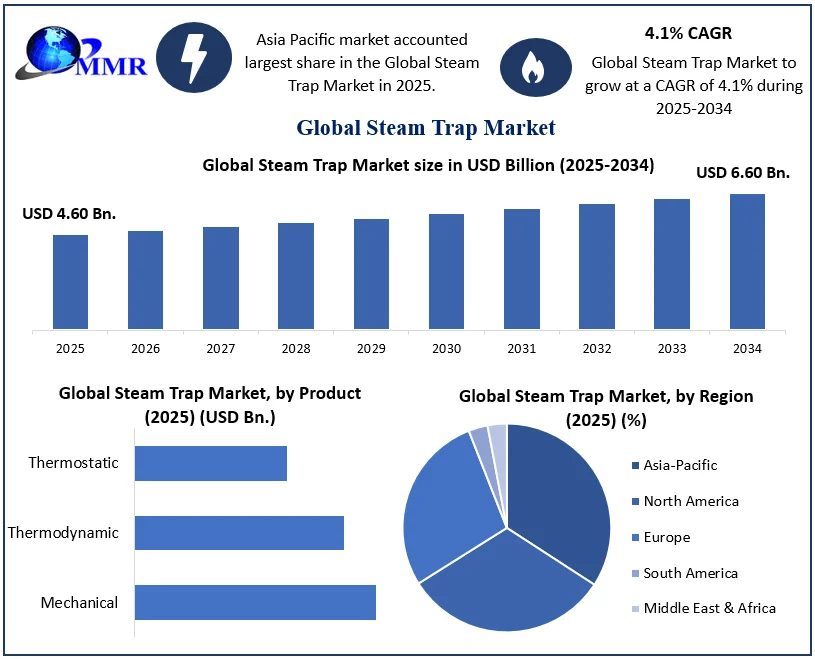
Global Steam Trap Market size was valued at USD 4.60 Billion in 2025 and the total Gas Turbine revenue is expected to grow by 4.1 % from 2025 to 2034, reaching USD 6.60 Billion by 2034.
Steam Trap Market Overview
The global steam trap market is experiencing steady growth, driven by the increasing demand for energy-efficient industrial steam systems, rapid industrialization, and stringent government regulations on energy consumption and carbon emissions. The global steam trap market refers to the industry involved in the manufacturing, distribution, and sale of steam traps used in industrial steam systems to automatically discharge condensate, air, and non-condensable gases without allowing live steam to escape. Steam traps improve energy efficiency, optimize heat transfer, prevent water hammer, reduce steam loss, and enhance operational reliability. The market includes different types of steam traps, such as mechanical, thermostatic, and thermodynamic steam traps, which serve industries including oil and gas, chemicals, pharmaceuticals, food and beverage, power generation, and manufacturing.
The objective of the report is to present a comprehensive assessment of the market and contains thoughtful insights, facts, historical data, industry-validated market data and projections with a suitable set of assumptions and methodology. The report also helps in understanding global steam trap market dynamics, structure by identifying and analyzing the market segments and project the global market size. Further, the report also focuses on the competitive analysis of key players by product, price, financial position, product portfolio, growth strategies, and regional presence. The report also provides PEST analysis, PORTER’s analysis, SWOT analysis to address questions of shareholders to prioritizing the efforts and investment in the near future to the emerging segment in the global steam trap market.
Global Steam Trap Market: Key Highlights
• Market Size and Forecast: The global steam trap market reaches USD 4.60 billion in 2025 and is projected to reach USD 6.60 billion by 2034, registering a CAGR of 4.1% during 2025–2034.
• Market Growth Drivers: Rising demand for energy-efficient steam systems, industrial automation, condensate recovery, and sustainable manufacturing practices supports global steam trap market growth.
• Product Segment: The mechanical steam trap segment dominates the market due to its durability, operational reliability, and ability to handle varying condensate loads. The thermostatic segment benefits from increasing demand for precise temperature control and efficient air removal.
• Application Segment: The tracing application segment supports temperature maintenance in pipelines, tanks, and process equipment, while process and drip applications serve industrial heating and condensate drainage requirements.
• Regional Insights: Asia-Pacific leads the global steam trap market, supported by industrialization, refinery expansion, rising electricity demand, and investments in manufacturing and energy infrastructure.
• Competitive Landscape: Spirax Sarco, Armstrong International, TLV Corporation, Emerson Electric, Forbes Marshall, and other industrial engineering companies compete through product innovation, monitoring technologies, and steam management solutions.
• Recent Industry Developments: Developments in wireless steam trap sensors, automated diagnostic applications, and AI-driven monitoring platforms strengthen the industry's focus on predictive maintenance and digital steam management.
Global Steam Trap Market Size, Growth and Share Analysis
To know about the Research Methodology :- Request Free Sample Report
Global Steam Trap Market Dynamics
The global steam trap market is driven by the growing demand for energy-efficient steam systems, industrial automation, advanced condensate management, and sustainable manufacturing practices. Increasing investment in power generation, chemical processing, pharmaceuticals, food and beverage production, and oil and gas infrastructure further supports market expansion. At the same time, high installation costs, recurring maintenance expenses, and steam trap failures create challenges for market participants.
Steam Trap Market Driver:
• Growing Demand for Energy-Efficient Steam Systems: The steam trap market grows as industries increasingly focus on energy conservation, fuel savings, and operational cost reduction. Steam traps automatically remove condensate and non-condensable gases while preventing live steam loss, improving heat transfer efficiency, and protecting equipment against water hammer. Rising energy costs and sustainability targets encourage industries to replace inefficient steam traps with advanced, energy-efficient alternatives. Growing investments in heat recovery steam generators (HRSGs), power generation infrastructure, and industrial heating systems further strengthen demand.
• Steam Trap Market Restraint:
• High Installation and Maintenance Costs: High initial investment and recurring maintenance expenses restrain the adoption of advanced steam trap systems, particularly among small and medium-sized industrial enterprises. Installation costs include equipment procurement, piping modifications, system integration, and commissioning. In addition, periodic inspection, cleaning, testing, and replacement increase operating expenditure. Businesses also require trained technicians and suitable diagnostic equipment to identify leakage, blockage, and malfunction. These costs can delay the replacement of outdated steam traps and limit investment in smart monitoring technologies, despite their long-term energy-saving benefits.
Steam Trap Market Opportunity:
• Integration of IoT Sensors and Predictive Maintenance: The integration of the Internet of Things (IoT), wireless sensors, artificial intelligence (AI), and predictive analytics creates significant opportunities in the global steam trap market. Smart steam trap monitoring systems provide real-time operating data, identify abnormal conditions, and help maintenance teams detect steam leakage and condensate blockages before they cause major disruptions. These technologies enable condition-based maintenance, reduce unplanned downtime, and improve energy efficiency across industrial facilities.
According to Spirax Sarco, it’s wireless monitoring solutions support continuous monitoring, data analytics, and early fault detection. The company reports that it has connected more than 12,000 steam traps since 2022, demonstrating the growing deployment of connected steam management solutions.
In addition, expanding power generation capacity, industrial infrastructure investment, and pharmaceutical manufacturing in emerging economies create opportunities for manufacturers offering advanced steam traps, automated valve stations, and integrated condensate recovery systems.
Steam Trap Market Challenge:
• Steam Trap Failures and Blockages: Steam trap failures, internal blockages, scale accumulation, and incorrect installation challenge the efficiency and reliability of industrial steam systems. Failed-open traps allow valuable live steam to escape, increasing fuel consumption and carbon emissions, while failed-closed or blocked traps restrict condensate discharge and increase the risk of water hammer, waterlogging, and equipment damage. These issues require regular inspection, skilled maintenance personnel, and effective diagnostic systems.
The U.S. Department of Energy states that steam systems without maintenance for three to five years may have failure rates of 15%–30% of installed steam traps. In contrast, systems with regularly scheduled maintenance keep leaking traps below 5% of the installed population.
Steam Trap Market Trends
• Smart Steam Trap Monitoring and Industrial Digitalization: Manufacturers increasingly introduce wireless sensors, digital dashboards, and remote monitoring solutions to improve steam trap performance. These technologies provide continuous condition visibility, identify steam leakage, and support predictive maintenance, helping industrial facilities reduce energy waste and maintenance costs.
• Energy Efficiency and Carbon Emission Reduction: Industries prioritize efficient steam management to reduce fuel consumption, improve thermal performance, and achieve sustainability objectives. The replacement of inefficient steam traps and the adoption of condensate recovery systems support lower operating costs and reduced emissions.
• Advanced Valve Design and Reliable Steam Management: Innovations in mechanical, thermostatic, and thermodynamic steam traps improve reliability across different pressure conditions and condensate loads. Advanced trap stations and application-specific designs support easier maintenance, improved operational safety, and efficient condensate discharge.
• Industrial Modernization and Growing Replacement Demand: Manufacturing plants, refineries, pharmaceutical facilities, and power generation units increasingly modernize ageing steam infrastructure. Demand for reliable, low-maintenance steam traps grows as companies seek to improve equipment life, production continuity, and plant efficiency.
How Is Artificial Intelligence (AI) Revolutionizing the Steam Trap Market?
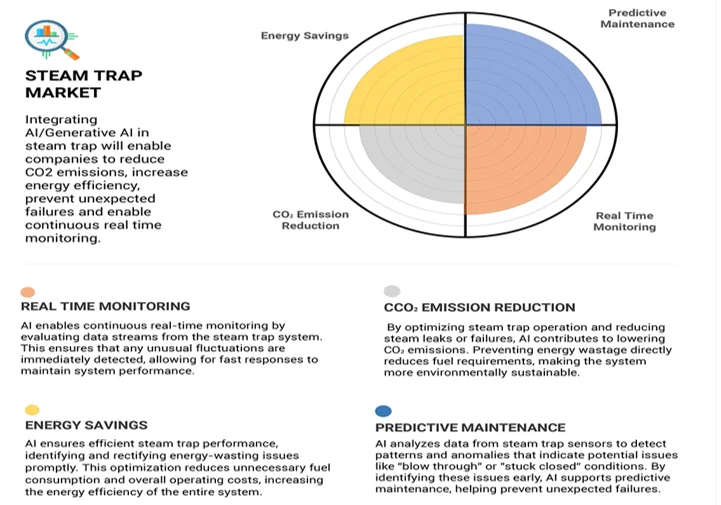
Artificial Intelligence (AI) is transforming the global steam trap market by improving energy efficiency, predictive maintenance, operational reliability, and industrial safety. AI-powered monitoring systems analyze real-time data from temperature sensors, ultrasonic detectors, acoustic sensors, and other connected devices to identify steam leakage, condensate blockages, and abnormal operating conditions. Machine learning algorithms help maintenance teams detect potential failures early, reduce unplanned downtime, and minimize steam and energy losses.
The integration of AI, the Internet of Things (IoT), and advanced data analytics enables industries to move from reactive maintenance towards predictive and condition-based maintenance. These technologies help facility managers identify faulty steam traps, prioritize maintenance activities, optimize resource utilization, and extend equipment lifespan. By improving steam system performance and reducing unnecessary fuel consumption, AI-driven solutions also support lower operating costs and reduced carbon emissions.
Furthermore, AI-powered steam trap monitoring supports data-driven decision-making across energy-intensive industries, including oil and gas, chemicals, pharmaceuticals, food and beverage, and power generation. As industries increasingly prioritize industrial automation, sustainability, and energy conservation, the adoption of AI-enabled steam management solutions strengthens market growth and creates opportunities for advanced steam trap manufacturers.
Overall, AI in the steam trap market enhances operational efficiency, improves fault detection, reduces maintenance expenses, and supports sustainable industrial steam management. These capabilities make artificial intelligence an important technology for the modernization of industrial steam systems
Global Steam Trap Market Segment Analysis
By Product, The mechanical steam trap segment dominates the global steam trap market due to its durability, reliability, and ability to handle varying condensate loads in industrial applications. The thermostatic steam trap segment is experiencing strong growth, driven by increasing demand for energy efficiency, precise temperature control, and effective air removal. The thermodynamic steam trap segment also maintains demand due to its compact design, simple construction, and suitability for high-pressure steam distribution systems.
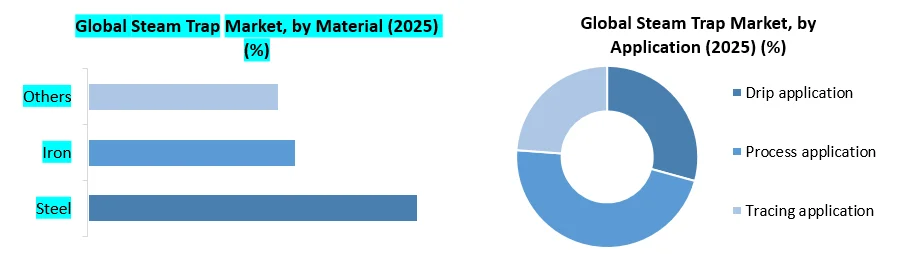
By Material, The steel segment dominates the global steam trap market due to its strength, durability, and suitability for high-pressure and high-temperature industrial applications. Its reliability, design flexibility, and recyclability support energy-efficient and sustainable steam management. The iron segment maintains demand because of its cost-effectiveness and durability in suitable operating conditions. Other materials serve specialized applications requiring specific corrosion resistance, lightweight construction, or performance characteristics. Growing demand from the oil and gas, chemical processing, power generation, and manufacturing industries supports the use of steel and iron steam traps.
By Application,The tracing application segment represents a key area of the global steam trap market, as industries use steam tracing to maintain temperatures in pipelines, tanks, and process equipment. The process application segment supports heating, sterilization, and production operations across pharmaceutical, chemical, and food processing industries. The drip application segment removes condensate from steam distribution lines, helping prevent water hammer and improve system reliability. Growing demand for energy efficiency, temperature control, and reliable industrial steam systems supports all three application segments.
Global Steam Trap Market Regional Insights
• North America: North America maintains strong demand for steam traps due to its established oil and gas, pharmaceutical, chemical, food processing, and power generation industries. The United States drives regional demand through refinery operations, industrial modernization, and energy-efficiency investments. Canada's oil sands industry and steam-assisted gravity drainage (SAGD) operations also support demand for reliable steam management and tracing systems.
• Europe: Europe supports steam trap market growth through stringent energy-efficiency requirements, industrial decarbonization initiatives, and the modernization of ageing steam infrastructure. Germany, the United Kingdom, and France generate demand from chemical manufacturing, pharmaceuticals, food processing, power generation, and district heating. Investments in industrial automation, condensate recovery, and smart steam trap monitoring further strengthen regional demand.
• Asia-Pacific: Asia-Pacific leads the global steam trap market, driven by rapid industrialization, expanding refinery activities, rising electricity demand, and growing manufacturing investments. China, India, Japan, and South Korea generate demand across power generation, chemicals, pharmaceuticals, textiles, and petrochemicals. Increasing adoption of energy-efficient steam systems and IoT-enabled monitoring further supports regional market growth.
• Middle East and Africa: The Middle East and Africa steam trap market benefits from investments in oil and gas, refining, petrochemicals, power generation, and industrial infrastructure. Saudi Arabia and the United Arab Emirates drive demand through refinery expansion and industrial diversification, while South Africa contributes through mining, manufacturing, and energy-related applications. The growing focus on fuel efficiency, operational reliability, and cost reduction supports market development.
• South America: South America experiences growing demand for steam traps across food and beverage processing, pulp and paper, chemicals, mining, oil and gas, and power generation. Brazil represents a key regional market due to its diverse industrial base, while Argentina contributes through energy, food processing, and manufacturing activities. Industrial modernization and increasing adoption of energy-efficient steam systems support demand for reliable condensate management solutions.
Global Steam Trap Market Competitive Landscape
The global steam trap market features established industrial engineering companies and emerging technology providers competing through product innovation, energy efficiency, digital monitoring, and maintenance services. Key players include Spirax Sarco, Armstrong International, and TLV Corporation, which offer steam traps, condensate management solutions, and diagnostic technologies for industrial applications. Competition increasingly focuses on IoT-enabled steam trap monitoring, predictive maintenance, reduced steam loss, and operational reliability. Company-specific product information confirms that digital monitoring is an important area of development across the industry.
Key Companies and Competitive Strategies
1. Spirax Sarco: Spirax Sarco strengthens its market position through steam traps, condensate recovery systems, and wireless steam trap monitoring. Its monitoring solutions provide 24/7 status updates, data analytics, and fault alerts to help industrial customers reduce energy losses and unplanned downtime.
2. Armstrong International: Armstrong International focuses on steam trap technology, condensate management, and real-time monitoring. Its AIM and SteamEye solutions use temperature and ultrasonic measurements to detect abnormal steam trap performance. Integration with its SAGE software supports reporting, maintenance planning, and energy-loss analysis.
3. TLV Corporation: TLV Corporation offers steam traps, condensate recovery equipment, and diagnostic solutions. Its TrapMan system combines ultrasonic and temperature measurements with software-based analysis to identify faulty traps, estimate steam leakage, and support systematic maintenance programs.
4. Imperium Technologies: Imperium Technologies develops InteliTrap, an electronically controlled, self-monitoring steam trap, and SteamView, a connected monitoring platform. The solution tracks parameters such as pressure, temperature, condensate removal, and valve operation to identify abnormal conditions and support predictive maintenance. On March 10, 2026, the company announced that it had raised more than USD 2 million to advance AI-driven monitoring and industrial steam infrastructure decarbonization.
5. DCO Systems: DCO Systems develops Easy STM, a compact, wireless steam trap monitoring solution that uses thermal energy harvesting to operate without conventional battery replacement. Its sensors measure steam-side and condensate-side temperatures, with optional ultrasonic monitoring for earlier leak detection. The technology supports large-scale monitoring deployments and data-driven preventive and predictive maintenance.
Steam Trap Industry Ecosystem
Steam Trap Market Recent Developments
| Date | Company | Recent development |
|---|---|---|
| April 15, 2026 |
IMI | Introduces the Neon Sonic wireless sensor, combining acoustic and temperature measurements to monitor steam traps and detect leakage or blockage. It supports LoRaWAN connectivity and hazardous-area applications. |
| April 16, 2026 |
SONOTEC | Enhances its SONAPHONE SteamExpert app with automatic condition assessment during measurement, helping technicians evaluate steam trap performance using ultrasonic and temperature data. |
| March 10, 2026 |
Imperium Technologies |
Raises more than USD 2 million to expand its InteliTrap smart steam trap and SteamView AI-driven monitoring platform, supporting industrial energy efficiency and decarbonization. |
| January 27, 2026 |
TLV Corporation |
Releases information on the CMRecorder app, which supports digital management of inspection and condition-monitoring data, and promotes the Pocket TrapMan PT3 inspection tool for steam traps, valves, and other equipment. |
Steam Trap Market Scope: Inquire before buying
| Steam Trap Market | |||
|---|---|---|---|
| Report Coverage | Details | ||
| Base Year: | 2025 | Forecast Period: | 2026-2034 |
| Historical Data: | 2020 to 2025 | Market Size in 2025: | USD 4.60 Bn. |
| Forecast Period 2026 to 2034 CAGR: | 4.1% | Market Size in 2034: | USD 6.60 Bn. |
| Segments Covered: | by Product | Thermodynamic Mechanical Thermostatic |
|
| By Material | Steel Iron Others |
||
| By Application | Drip Application Process Application Tracing Application |
||
| by End-User | Oil & Gas Energy and Power Pharmaceuticals Food & Beverage Pulp & Paper Others |
||
Steam Trap Market, by Region
North America (United States, Canada and Mexico)
Europe (UK, France, Germany, Italy, Spain, Sweden, Austria and Rest of Europe)
Asia Pacific (China, South Korea, Japan, India, Australia, Indonesia, Malaysia, Vietnam, Taiwan, Bangladesh, Pakistan and Rest of APAC)
Middle East and Africa (South Africa, GCC, Egypt, Nigeria and Rest of ME&A)
South America (Brazil, Argentina Rest of South America)
Steam Trap Market Key Players:
1. Weir Group PLC
2. Watson Mcdaniel Company
3. Tunstall Corporation
4. Emerson Electric Co.
5. Schlumberger N.V.
6. Watts Water Technologies, Inc.
7. Tlv International, Inc.
8. Spirax-Sarco Engineering PLC
9. Pentair PLC
10. Flowserve Corporation
11. Circor International, Inc.
12. Thermax Limited
13. Velan Inc.
14. Marck & Care Engineers Ltd.
15. Armstrong International Inc.
16. Miyawaki Inc.
17. Hawa Engineers Ltd.
18. Bestobell Steam Traps
19. Thermal Energy International Inc.
20. Esco India
21. Neta Valves Pvt. Ltd.
22. Colton Industries
23. Ayvaz
24. Venn.Co, Ltd.
25. Bell & Gossett
26. Forbes Marshall
27. Xylem Inc.
28. ARI-Armaturen
29. GESTRA AG
30. Yoshitake Inc.
31. Uni Klinger Limited
32. Delta Steam Systems
33. DSC (Drayton Steam Corporation)
34. Barnes & Jones
35. Thermomegatech
36. United Brass Works
37. Valsteam ADCA Engineering
38. Kunkle Valve
39. Richards Industrials
40. Hongfeng Mechanical
Frequently Asked Questions:
1. Which region has the largest Global Steam Trap Market share?
Ans: The Asia Pacific region holds the highest share in 2025.
2. What is the growth rate of the Global Steam Trap Market?
Ans: The Global Steam Trap Market is growing at a CAGR of 4.1% during the forecasting period 2026-2034.
3. What is the scope of the Global Steam Trap market report?
Ans: The Steam Trap Market report helps with the PESTEL, PORTER, and COVID-19 Impact analysis, Recommendations for Investors & Leaders, and market estimation of the forecast period.
4. Who are the key players in the Global Steam Trap market?
Ans: The important key players in the Global market are Weir Group PLC, Watson Mcdaniel Company, Tunstall Corporation, Emerson Electric Co. and Others.
5. What is the study period of this market?
Ans: The Global market is studied from 2020 to 2034.