
Global Olive Vegetable Water Market Size by Product Type, Distribution Channel, and Region – Segment-Level Demand Assessment, Growth Opportunity Analysis, Competitive Landscape Mapping & Forecast to 2034
Overview
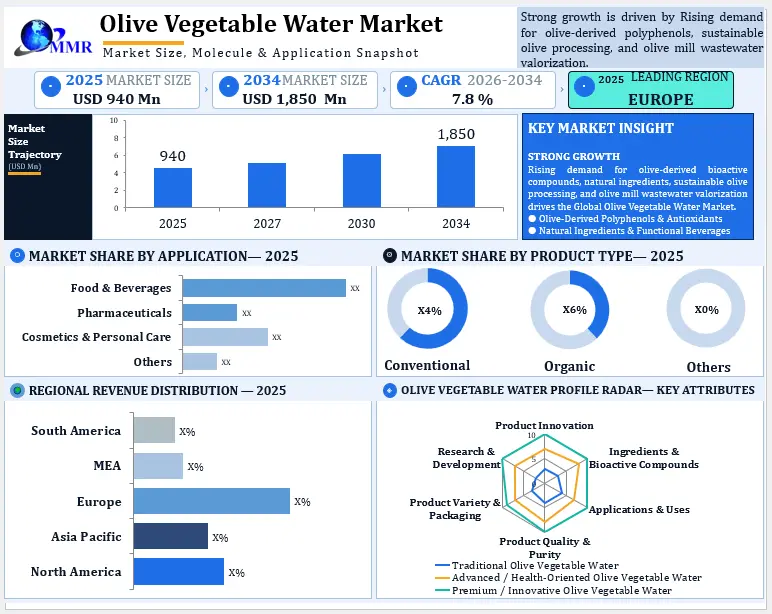
The Global Olive Vegetable Water Market size was valued at USD 940 million in 2025 and the total Olive Vegetable Water revenue is expected to grow at a CAGR of 7.8 % from 2026 to 2034, reaching USD 1,850 Million by 2034.
Global Olive Vegetable Water Market Overview:
The Global Olive Vegetable Water Market is defined as the worldwide industry involved in the production, collection, treatment, purification, recovery, distribution, and utilization of liquid residues derived from olive fruit processing and olive oil extraction. It includes conventional wastewater management solutions and emerging technologies that recover organic matter, phenolic compounds, and other potentially valuable constituents for agricultural, environmental, and industrial applications.
The global olive vegetable water market is anticipated to register fast growth in the coming years due to its increased usage by framers, Olive vegetable water, a liquid by-product of olives is becoming one of the most preferred options of biofertilizers for farmers, which is generated by processing virgin olives through a mechanical process that makes vegetable water to sink down and oil to come on top. Olive vegetable water (OVW) contains minerals and nutrients that help in increasing the mineral content of the soil.
There are so many types of fertilizer present in the market but with time use of olive vegetable, water has increased due to its additional advantage for the growth of plants and crops. That has led to the increase in the production of olive plants and trees. Olive vegetable water contains pectin, lipids, sugar, polyalcohol, and other elements which helps in developing more soil content due to which it is in high production in recent years globally.
The market covers the supply and use of olive vegetable water and its processed derivatives across agricultural applications, food processing research, bio-based ingredient development, and environmental management. However, untreated olive mill wastewater is not automatically suitable for food, cosmetic, or pharmaceutical use; such applications require appropriate purification, safety assessment, and regulatory compliance.
The global Olive Vegetable Water market report is a comprehensive analysis of the industry, market, and key players. The report has covered the market by demand and supply-side by segments. The global Olive Vegetable Water market report also provides trends by market segments, technology, and investment with a competitive landscape.
Olive Vegetable Water Market Growth and Share Analysis
To know about the Research Methodology :- Request Free Sample Report
Global Olive Vegetable Water Market Key Highlights
1. Sustainable Market Growth: The Global Olive Vegetable Water Market gains momentum through sustainable olive processing, olive waste valorization, and increasing adoption of circular economy solutions.
2. Rising Demand for Natural Ingredients: Growing interest in antioxidant-rich ingredients, olive-derived polyphenols, and clean-label products creates new market opportunities.
3. Europe Leads Regional Development: Spain, Italy, and Greece support the olive vegetable water industry through established olive oil production, advanced processing infrastructure, and olive mill wastewater management.
4. Emerging High-Value Applications: Cosmetics and personal care, nutraceutical research, agricultural applications, bio-based materials, and wastewater treatment expand the potential applications of olive-derived compounds.
5. Technology Drives Future Opportunities: Advanced filtration, membrane separation, water reuse, and bioactive compound recovery strengthen the Global Olive Vegetable Water Market outlook through 2034.
Global Olive Vegetable Water Market Dynamics
Global Olive Vegetable Water Market Drivers
• Rising Demand for Functional Beverages and Natural Ingredients: Increasing consumer preference for functional beverages, antioxidant-rich ingredients, plant-based nutrition, and clean-label products supports demand for olive vegetable water. Its naturally occurring polyphenols and other bioactive compounds attract interest from food and beverage manufacturers seeking differentiated wellness products.
• Expansion of Sustainable Olive Processing and Resource Recovery: Growing emphasis on sustainable olive oil production, agricultural waste valorization, and circular economy practices encourages investment in olive vegetable water processing and recovery. In March 2026, the European Commission highlighted research into converting treated olive mill wastewater into biodegradable packaging materials, strengthening interest in olive waste valorization and sustainable processing technologies.
Global Olive Vegetable Water Market Restraints
• High Processing Costs and Product Standardization Requirements: Advanced extraction, filtration, purification, quality testing, and sustainable packaging increase production costs for olive vegetable water manufacturers. Variations in olive varieties, processing methods, and polyphenol concentrations also make it difficult to maintain consistent product quality and commercial scalability.
• Limited Consumer Awareness and Market Penetration: Limited awareness of olive vegetable water, its applications, and its differentiation from olive oil and olive leaf extract restricts adoption in emerging markets. Manufacturers require consumer education, effective product positioning, and stronger retail distribution to expand the olive vegetable water market beyond established Mediterranean markets.
Global Olive Vegetable Water Market Opportunities
• Expansion into Cosmetics, Nutraceuticals, and Pharmaceutical Ingredients: The growing use of olive-derived polyphenols in antioxidant skincare, natural personal care formulations, and nutraceutical research creates opportunities for value-added olive vegetable water products. Manufacturers can explore purified extracts, specialized formulations, and partnerships with cosmetic and healthcare ingredient companies, subject to safety and regulatory requirements.
• Investment in Olive Wastewater Treatment and Water Reuse: Advanced membrane filtration, reverse osmosis, and biological treatment create opportunities to recover usable water and valuable compounds from olive processing residues. A recent industrial case reported by Water & Wastewater Asia describes an upgraded wastewater treatment plant at Coosur's olive oil facility in Spain, where treatment enables water reuse for industrial cleaning. This demonstrates the commercial potential of olive wastewater treatment and resource recovery.
Global Olive Vegetable Water Market Challenges
• Environmental Risks and Complex Wastewater Management: Untreated olive mill wastewater contains high organic loads and phenolic compounds that can negatively affect soil microorganisms and water quality. Manufacturers and olive oil processors face challenges in controlling wastewater discharge, managing treatment residues, and meeting environmental standards while maintaining cost-effective production.
• Supply Chain Variability and Regulatory Compliance: Olive harvest fluctuations, seasonal production, climate-related agricultural risks, and differences in raw material composition can affect olive vegetable water availability and pricing. Companies also need to meet applicable food safety, cosmetic ingredient, labeling, and environmental regulations before commercializing products across international markets.
Global Olive Vegetable Water Market Trends
• Growth of Organic, Premium, and Functional Olive Water Products: The olive vegetable water industry increasingly emphasizes organic positioning, premium formulations, functional beverage applications, and products containing naturally derived bioactive ingredients. Product differentiation through enhanced formulations, convenient packaging, and clean-label marketing supports brand development and consumer engagement.
• Adoption of Circular Economy and Advanced Processing Technologies: Olive vegetable water processing increasingly intersects with membrane filtration, wastewater reuse, bioactive compound recovery, and waste-to-value technologies. Research into converting olive processing residues into biodegradable materials and other useful resources supports the broader trend toward sustainable olive production, industrial water reuse, and circular bioeconomy solutions.
Global Olive Vegetable Water Market Segment Analysis
Based on Product Type, the Global Olive Vegetable Water Market is segmented into conventional olive vegetable water and organic olive vegetable water. Conventional olive vegetable water represents a significant segment due to its established availability, competitive pricing, and use in olive processing, food and beverage formulations, and industrial applications. This segment includes conventionally produced olive-derived water that undergoes varying levels of filtration, treatment, and quality control depending on its intended use. Organic olive vegetable water gains attention as manufacturers and consumers increasingly prioritize organic ingredients, sustainable olive farming, clean-label products, and environmentally responsible production practices. Organic products depend on certified agricultural sourcing and compliance with relevant organic standards. Both conventional and organic olive vegetable water support market development through applications involving natural ingredients, olive-derived bioactive compounds, wastewater recovery, and value-added olive processing solutions.
Based on Application, the Global Olive Vegetable Water Market is segmented into food and beverages, cosmetics and personal care, pharmaceuticals, and others. The food and beverages segment includes functional beverage development, natural ingredient research, specialty food formulations, and applications involving recovered olive-derived compounds, subject to appropriate safety and regulatory approval. Cosmetics and personal care applications include research into antioxidant-rich ingredients, skincare formulations, cleansing products, and personal care products incorporating purified olive-derived compounds. The pharmaceuticals segment includes research into olive-derived phenolic compounds, antioxidant properties, and potential pharmaceutical ingredient applications, although clinical validation and regulatory authorization are required for therapeutic claims. The others segment encompasses agricultural applications, soil and irrigation research, industrial wastewater treatment, water recovery, and bio-based material development. Increasing interest in olive mill wastewater treatment, sustainable resource utilization, and agricultural waste valorization supports innovation across these application segments.
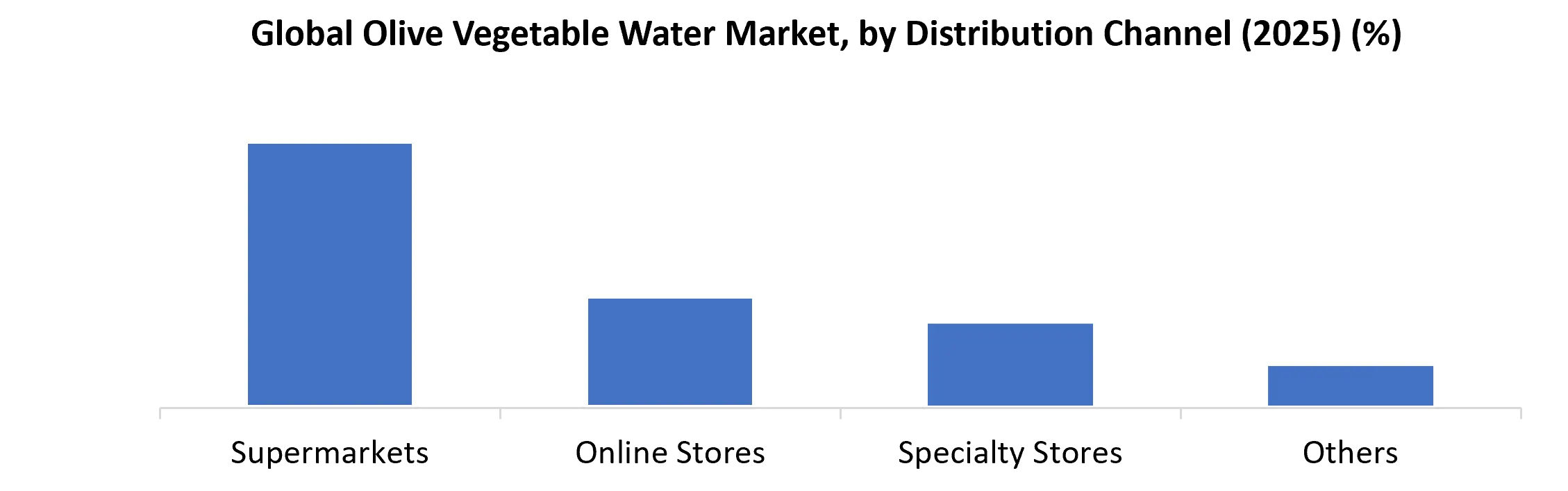
Based on Distribution Channel, the Global Olive Vegetable Water Market is segmented into supermarkets and hypermarkets, online stores, specialty stores, and others. Supermarkets and hypermarkets provide access to packaged olive-derived beverages and related consumer products, offering established retail networks, product visibility, and opportunities for consumer education. Online stores support the expansion of olive vegetable water products through e-commerce platforms, direct-to-consumer websites, digital marketing, and convenient product delivery. Specialty stores include organic food retailers, health food outlets, natural ingredient suppliers, and selected wellness product retailers that focus on differentiated and premium products. The others segment includes business-to-business ingredient distributors, industrial suppliers, agricultural supply channels, and direct sales to food processors, cosmetics manufacturers, and wastewater treatment operators.
Global Olive Vegetable Water Market Regional Insights:
North America represents an emerging market for olive vegetable water, olive mill wastewater treatment, olive-derived bioactive ingredients, and sustainable olive processing solutions. The United States, Canada, and Mexico support regional demand through food and beverage manufacturing, natural ingredient development, specialty food distribution, and investment in agricultural wastewater management. The table olive industry in the United States also generates processing wastewater, creating opportunities for advanced filtration, wastewater treatment, water recycling, and olive waste valorization. Market development depends on consumer awareness, product standardization, regulatory compliance, and commercially viable extraction technologies.
Europe represents a major regional market for olive vegetable water, olive vegetation water, and olive mill wastewater valorization because Spain, Italy, and Greece maintain established olive cultivation and olive oil production industries. The region generates substantial olive processing by-products, creating demand for wastewater treatment, phenolic compound recovery, agricultural resource recycling, and circular economy solutions. European research initiatives focus on converting olive oil production residues into biogas, polyphenols, fertilizers, bio-based materials, and reusable water. The EU-funded OLinWASTE project, running from 2025 to 2029, develops integrated biorefinery solutions for converting olive mill waste into biofertilizers, biopesticides, bioplastics, and bioenergy. These initiatives strengthen opportunities in sustainable olive processing, industrial wastewater management, natural ingredient extraction, and olive by-product commercialization.
Asia-Pacific offers growth opportunities for the Global Olive Vegetable Water Market through expanding food processing, increasing interest in natural ingredients, and the adoption of sustainable industrial wastewater treatment technologies. China, India, Japan, Australia, and other regional markets provide opportunities for olive-derived ingredient distribution, functional beverage development, natural skincare formulations, and agricultural water management. Although olive vegetable water remains a specialized market in many Asia-Pacific countries, demand for botanical extracts, antioxidant ingredients, organic products, and sustainable manufacturing solutions creates opportunities for market expansion. Food manufacturers and ingredient suppliers can explore purified olive-derived polyphenols, specialty formulations, and olive processing technologies, while agricultural and industrial operators can investigate wastewater treatment, water reuse, and waste-to-value applications.
South America presents opportunities for olive vegetable water processing, olive mill wastewater treatment, and agricultural by-product utilization, particularly in Argentina, Chile, Brazil, and other olive-producing areas. Regional olive cultivation and olive oil manufacturing generate processing residues that require effective wastewater management, environmental protection, and sustainable resource recovery. Research on table olive wastewater identifies South America as a region where olive processing creates wastewater management requirements, although its overall production base is smaller than that of the Mediterranean region. Advanced filtration, biological treatment, membrane separation, and recovery of olive-derived phenolic compounds offer potential applications for food processors, agricultural operators, and industrial wastewater treatment providers.
The Middle East and Africa region offers opportunities for olive vegetable water treatment, olive mill wastewater recycling, and olive waste valorization, particularly in Türkiye, Tunisia, Morocco, Jordan, and other olive-producing Mediterranean countries. Water scarcity, seasonal olive processing, and the environmental risks associated with untreated olive mill wastewater increase the importance of effective wastewater management and resource recovery. Research covering the Middle East and North Africa identifies challenges involving wastewater storage, limited treatment infrastructure, and risks to surface water and groundwater resources. These conditions create opportunities for biological wastewater treatment, membrane filtration, phenolic compound extraction, irrigation water recovery, and sustainable agricultural waste management. Regional olive processors can explore circular economy approaches that recover water, organic matter, and bioactive compounds while reducing environmental impacts.
The objective of the report is to present a comprehensive analysis of the Global Olive Vegetable Water market to the stakeholders in the industry. The past and current status of the industry with the forecasted market size and trends are presented in the report with the analysis of complicated data in simple language. The report covers all the aspects of the industry with a dedicated study of key players that include market leaders, followers, and new entrants.
PORTER, SVOR, PESTEL analysis with the potential impact of micro-economic factors of the market have been presented in the report. External as well as internal factors that are supposed to affect the business positively or negatively have been analyzed, which will give a clear futuristic view of the industry to the decision-makers.
The report also helps in understanding the Global Olive Vegetable Water Market dynamics, structure by analyzing the market segments and project the Global Olive Vegetable Water Market size. Clear representation of competitive analysis of key players by product, price, financial position, product portfolio, growth strategies, and regional presence in the Global Olive Vegetable Water Market make the report investor’s guide.
Global Olive Vegetable Water Market Competitive landscape
The Global Olive Vegetable Water Market is driven by competition among olive processing companies, fertilizer manufacturers, and emerging organic agricultural solution providers. Key companies in the broader industry ecosystem include Haifa Group, Nutrien, ICL Fertilizers, Syngenta AG, EuroChem, Borges, and Gallo. Companies are focusing on sustainable production, nutrient recovery, product innovation, and agricultural waste utilization to strengthen their competitive position.
Europe, particularly Spain and Italy, plays a significant role in the Global Olive Vegetable Water Market due to its established olive oil industry and availability of processing by-products. Increasing demand for organic fertilizers, sustainable agriculture, and wastewater recycling is encouraging technological innovation and strategic partnerships. Market competition is influenced by processing efficiency, environmental regulations, product quality, and distribution capabilities.
Global Olive Vegetable Water Market Recent Development
| Exact date | Company / organization | Recent development |
| August 6, 2026 | The Olive Mill Water Company | Announces the launch of a bottled beverage made from fermented olive mill water, positioning an olive oil production by-product as a polyphenol-rich functional beverage. |
| July 2, 2026 | Membracon / Coosur | Reports an upgraded wastewater treatment system at Coosur's olive oil facility in Spain. Dissolved air flotation, membrane bioreactor treatment, and reverse osmosis enable treated water reuse for industrial cleaning. |
| May 11, 2026 | American Chemical Society research publication | Publishes research on olive mill wastewater as a potential natural approach to nitrate contamination control and lettuce cultivation quality, highlighting agricultural applications for treated olive-derived wastewater. |
| April 14, 2026 | Leibniz Institute of Freshwater Ecology and Inland Fisheries (IGB) | Reports field research activity in Morocco under the CYCLOLIVE project, investigating nature-based treatment and reuse of olive mill wastewater through smart irrigation systems. |
| March 20, 2026 | CIRC2SAVE / Sociedad Cooperativa Montevirgen | Publishes a case study on wastewater reuse in Spanish table olive production. The approach reduces wastewater generation and water consumption while lowering waste management costs at pilot scale. |
Global Olive Vegetable Water Market Scope: Inquire before buying
| Olive Vegetable Water Market | |||
|---|---|---|---|
| Report Coverage | Details | ||
| Base Year: | 2025 | Forecast Period: | 2026-2034 |
| Historical Data: | 2020 to 2025 | Market Size in 2025: | 940 USD Million |
| Forecast Period 2026-2034 CAGR: | 7.8 % | Market Size in 2034: | 1,850 USD Million |
| Segments Covered: | by Product Type | Conventional Olive Vegetable Water Organic Olive Vegetable Water |
|
| by Application | Food and Beverages Cosmetics and Personal Care Pharmaceuticals Others |
||
| by Distribution Channel | Supermarkets/Hypermarkets Online Stores Specialty Stores Other |
||
Global Olive Vegetable Water Market, by Region
North America (United States, Canada and Mexico)
Europe (UK, France, Germany, Italy, Spain, Sweden, Austria and Rest of Europe)
Asia Pacific (China, South Korea, Japan, India, Australia, Indonesia, Malaysia, Vietnam, Taiwan, Bangladesh, Pakistan and Rest of APAC)
Middle East and Africa (South Africa, GCC, Egypt, Nigeria and Rest of ME&A)
South America (Brazil, Argentina Rest of South America)
Global Olive Vegetable Water Market Key Players
1. Haifa Group
2. CF Industries Holdings, Inc.
3. Nutrien
4. K+S Aktiengesellschaft
5. The OCP Group
6. ICL Fertilizers
7. Syngenta AG
8. Sumitomo Chemical Co., Ltd.
9. IFFCO
10. EuroChem
11. Saudi Arabian Fertilizer Company (SAFCO)
12. Uralkali PJSC
13. Borges International Group
14. Minerva
15. Gallo Worldwide
16. Bertolli
17. Lucini Italia
18. California Olive Ranch
19. Olive Gourmet
20. K.G. Eichenberger
21. Gaea Products
22. Filippo Berio
23. Colavita
24. Olivar
25. Cora Muenster
26. Ybarra Group
27. Salov Group
28. Pompeian, Inc.
29. Bell-Carter Foods, Inc.
30. Musco Family Olive Co.
31. Roland Foods, LLC
32. CreAgri Inc.
33. Genosa
34. Bionap S.r.l.
35. Euromed S.A.
36. Monteloeder
37. Seppic
38. Indena S.p.A.
39. BioActor
40. Phenolic Compounds S.L.
Frequently Asked Questions:
1. What is the global olive vegetable water market?
Ans: The Global Olive Vegetable Water Market covers olive-derived liquid products and related processing applications, including natural ingredient development, olive mill wastewater treatment, bioactive compound recovery, and sustainable resource utilization. Market scope depends on the definition used by each research publisher.
2. What are the key drivers of the global olive vegetable water market?
Ans: Key growth drivers include rising demand for natural and organic ingredients, expanding functional food and beverage applications, increasing interest in olive-derived antioxidants, and investment in sustainable olive oil processing and wastewater treatment.
3. Which product types segment the global olive vegetable water market?
Ans: The market is segmented into organic olive vegetable water and conventional olive vegetable water. Organic products appeal to buyers seeking certified organic sourcing, while conventional products support broader availability and cost-sensitive applications.
4 Which region dominates the global olive vegetable water market?
Ans: Europe is identified as the leading region in DataIntelo's market overview, supported by established olive oil production in Spain, Italy, and Greece.
5. Which countries offer growth opportunities in the global olive vegetable water market?
Ans: Spain, Italy, Greece, the United States, Canada, China, India, Japan, Australia, Argentina, Chile, Türkiye, Tunisia, and Morocco offer potential opportunities across olive processing, ingredient development, wastewater management, and resource recovery.