
Oilfield Equipment Market– Industry Structure Evaluation, Demand Drivers Analysis, Regional Growth Analysis and Identification, Competitive Positioning Review & Global Market Size Forecast to 2032
Overview
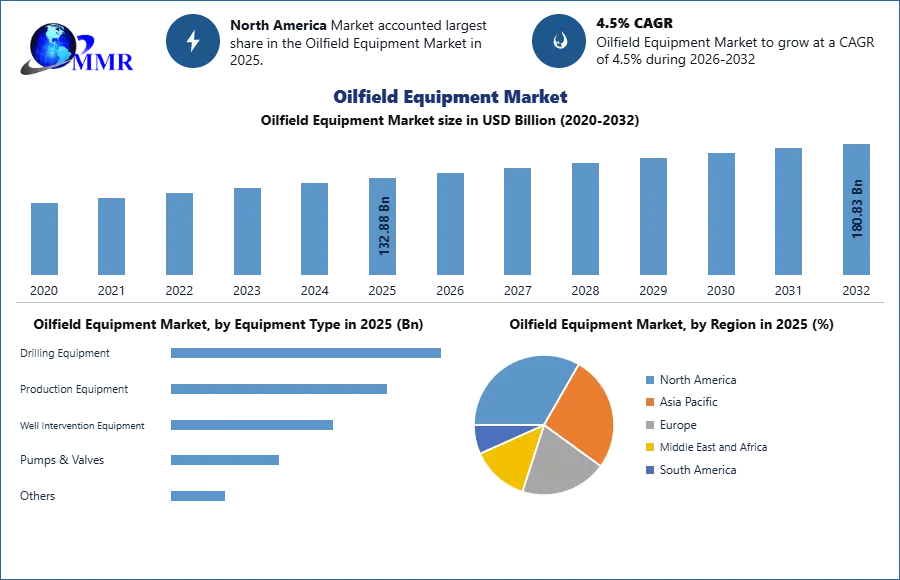
Oilfield Equipment Market size was valued at USD 132.88 Bn. in 2025 and is expected to grow by 5.2% from 2026 to 2032, reaching nearly USD 180.83 Bn. in 2032
Oilfield Equipment Market Overview:
The oilfield equipment is exploration, drilling, production, and well intervention activities spanning the global oil and gas industry. This includes drilling rigs, blowout preventers, wellheads, pumps, valves, pipe-handling equipment, and downhole tools. Oilfield equipment is manufactured to withstand high pressure, high temperature, and corrosive environments. Oilfield equipment is used onshore and offshore to support upstream activity from seismic exploration through enhanced oil recovery (EOR) projects. The marketplace has transitioned from conventional, manned rigs to automated, digitally integrated and IoT-enabled systems capable of real-time monitoring, predictive maintenance, and achieving the most performance-driven drilling. As ongoing oilfield projects continue to attract investment, demand for oilfield equipment will continue to grow globally. Deepwater oil and gas projects continue to generate investment, while shale oil & gas development are underlining deliverables in industrialized offshore and land-based re-contextualized brownfields. The companies utilizing advanced drilling rigs and appropriate pressure control equipment for high-pressure, high-temperature (HPHT) offshore fields, alongside companies adopting modular, mobile rigs onshore in remote locations in Africa and the Middle East.
 To know about the Research Methodology :- Request Free Sample Report
The report contains a Oilfield Equipment Market drivers such as growing global energy demand, technological advancements for improved drilling efficiencies, continued focus on offshore and unconventional reserves, and equipment standardization to accommodate more stringent safety regulations. The report examines Oilfield Equipment Market segments. The top companies with operations around the globe are GE Oil and Gas (U.S.), Weatherford International (U.S.), Schlumberger (U.S.), Halliburton (U.S.), National Oilwell Varco, Inc. (U.S.), Baker Hughes Company (U.S.), and ABB Oil, Gas and Petrochemical Business Unit (Switzerland). The value chain analysis, it is clear that companies will continue to develop increasingly smart, modular and environmentally friendly equipment that allows operating cost efficiencies through enhanced safety. The report describes trends such as the use of AI and big data analytics in drilling, increased offshore wind-to-oilfield hybrids, the rollout of digital twins to monitor equipment, and lighter, corrosion-resistant materials for subsea applications in North America, the Middle East, and Asia Pacific.
Oilfield Equipment Market Dynamics
Technological Advancements and Digitalization Driving Oilfield Equipment Market Trend
Increasing exploration and production (E&P) activities, particularly in unconventional reserves like shale gas and tight oil, are fueling the need for advanced drilling and production equipment. Innovations such as horizontal drilling, hydraulic fracturing, and deepwater drilling are expanding access to challenging reservoirs, while automation and IoT-enabled systems are optimizing operational efficiency. Digital solutions, including AI-driven predictive maintenance, real-time monitoring, and data analytics, are enhancing precision and minimizing downtime, significantly improving productivity. The adoption of remote-operated equipment and advanced control systems is further transforming upstream operations by ensuring safer and more efficient drilling processes. Additionally, increased offshore exploration in regions such as the Gulf of Mexico, the North Sea, and offshore Brazil is creating strong demand for technologically advanced rigs and subsea equipment. Growing investments in energy infrastructure and a shift towards sustainable exploration methods are also supporting Oilfield Equipment Market. These factors are driving the modernization of oilfield equipment, enabling companies to maximize resource extraction while improving safety, reducing costs, and minimizing environmental impacts.
Market Volatility and Regulatory Challenges Limiting Oilfield Equipment Market Growth
Volatility in crude oil prices remains a major concern, as fluctuations in global oil demand and supply often lead to reduced capital expenditure in exploration and production activities, directly affecting equipment demand. High capital costs associated with advanced offshore and deepwater drilling technologies also limit adoption, especially for smaller operators with constrained budgets. Moreover, the rising cost of raw materials, such as steel and alloys critical for drilling and production equipment, increases manufacturing expenses, pressuring profit margins. Stringent environmental and safety regulations across key market, including Additionally, a shortage of skilled labor in the oilfield sector hampers the integration and efficient operation of advanced machinery. Political instability and logistical challenges in emerging Oilfield Equipment Market compound these issues, disrupting supply chains and project timelines.
Integration in Electric and Hybrid-Powered Rigs To Boost Oilfield Equipment Market Demand
Increasing adoption of electric and hybrid-powered rigs is reshaping operations, offering reduced emissions and improved efficiency, particularly in regions with stringent environmental regulations. The integration of AI, IoT, and digital twins is opening new avenues for predictive analytics, enabling proactive maintenance and optimized drilling strategies. Rental and leasing models are gaining traction, providing cost-effective solutions for operators by reducing upfront capital expenditures and enabling flexible access to high-quality equipment.
The surge in offshore projects in South America, the Middle East, and Africa creates lucrative opportunities for advanced subsea equipment and automated systems. The industry’s pivot towards sustainable technologies, such as carbon capture integration and energy-efficient drilling tools, aligns with global decarbonization efforts and regulatory shifts. Rapid industrialization and infrastructure development in Asia-Pacific and Africa are driving demand for high-performance equipment. As digital transformation accelerates and new technologies, companies that invest in innovative solutions and strategic partnerships are well-positioned helps for the growth and strengthen their Oilfield Equipment Market.
Global Oilfield Equipment Market Segment Analysis
Global oilfield equipment market is segmented by equipment, type and region. Based on equipment the market is segmented into drilling equipment, field production machinery, pumps, valves, others. On the basis of type, market is classified as drilling (drill pipe, drill collars), pressure & flow control (bop, valves, manifold).
Based on Equipment, the Oilfield Equipment Market is segmented into drilling equipment, field production machinery, pumps, valves, others. Among these drilling equipment has dominated the market in 2025 and is expected to hold largest market share over forecast period. As one of the most critical components in both onshore and offshore exploration, drilling equipment plays a central role in enabling efficient extraction of hydrocarbons, particularly from unconventional reserves such as shale gas and deep-water oilfields. The rising global demand for oil and gas has driven an increase in drilling activity, which in turn has amplified the need for sophisticated, durable, and high-performance drilling systems.
The adoption of advanced technologies like horizontal drilling and hydraulic fracturing has been a key growth catalyst for this segment, as these techniques require highly specialized machinery capable of operating in complex and challenging geological formations. Furthermore, drilling equipment typically has a high replacement rate and frequent maintenance requirements, which ensures a consistent and recurring demand stream for manufacturers and service providers. This ongoing cycle of utilization, wear, and replacement makes drilling tools a sustainable revenue driver in the oilfield equipment market.
In addition to growing demand, continuous innovation in drilling technologies has enhanced operational efficiency, reduced downtime, and allowed access to deeper and more technically demanding reservoirs. With shale exploration and deep-water projects expanding globally, the drilling equipment segment is positioned to generate the largest share of revenues within the oilfield equipment market during the forecast period.
Based on Application, the Oilfield Equipment Market is segmented into Onshore & offshore.
Among these onshore segment has dominated the market in 2025 and is expected to hold largest market share over forecast period. In 2025, the onshore segment dominated the global oilfield equipment market and is expected to retain the largest market share over the forecast period. The dominance of this segment is primarily attributed to the high volume of drilling and production activities taking place onshore, which account for the majority of global oil and gas output. Onshore projects are generally more cost-effective compared to offshore operations, making them the preferred choice for many oil and gas companies.
The rising demand for hydrocarbons, coupled with growing exploration of unconventional reserves like shale gas and tight oil, has boosted the utilization of advanced onshore drilling equipment. Onshore exploration benefits from easier accessibility, lower capital requirements, and quicker project turnaround times, all of which sustain continuous investment in the segment. Moreover, technological advancements in horizontal drilling and hydraulic fracturing have fueled Oilfield Equipment Market growth by enhancing recovery rates from onshore fields.
Oilfield Equipment Market Regional Insights
North America held largest market share in 2025 extensive shale oil and gas exploration activities across the United States and Canada. The region has established itself as a hub for advanced oilfield technologies, with widespread adoption of hydraulic fracturing and horizontal drilling that enhance recovery rates from conventional and unconventional reserves. These cutting-edge technologies not only optimize exploration and production processes but also reduce operational costs, thereby fueling demand for high-performance oilfield equipment. North America’s dominance is further reinforced by the presence of a strong base of oilfield equipment manufacturers, service providers, and technology innovators who play a pivotal role in meeting the evolving requirements of the sector.
Supportive government policies and robust investments in energy infrastructure contribute to the region’s Oilfield Equipment market leadership. Initiatives aimed at bolstering energy independence and expanding domestic production have encouraged upstream operators to continue drilling and production activities, even amid fluctuating global crude oil prices. Additionally, North America possesses one of the world’s largest stocks of unconventional hydrocarbon reserves, particularly shale oil and gas, which has strengthened its position as a global energy leader. The development of resources has boosted production capacity, translating into heightened demand for a wide array of oilfield equipment, from drilling rigs and wellheads to pressure control and production systems.
Oilfield Equipment Market Competitive Landscape
The Global Oilfield Equipment Market is highly competitive driven by the advancement of drilling, completion, and digital services used for upstream operations. Schlumberger (SLB) and Halliburton Co. (HAL) are primary firms in this segment for the oil and gas sector, as they have service portfolios and have a global presence. Schlumberger predominates in the energy services sector with an estimated 32–35% market share and is significantly greater than Halliburton. Halliburton has still retained its focus on cementing and the downstream side of operations intervention, with an estimated ~37% share of cementing services in the U.S. and combined ~74% of the international land and ~88% of the offshore cementing market share with Schlumberger. Customer inputs and survey responses from completion equipment market suggest Schlumberger's loyalty and performance metrics have improved, growing market share from 16% to 21% (2016–2022), as well as its Net Promoter Score - establishing itself as premium or high-value provider. In contrast, Halliburton has focused on pricing competitiveness, and therefore it has established its value proposition to retain clients and regain its market share. Both firms are undoubtedly the leaders in the market, with Schlumberger as the technological innovator with the greatest oilfield equipment market share, and Halliburton balancing efficiencies and strong operational reach and service role offerings.
Oilfield Equipment Market Recent Development
At ADIPEC 2024, Jereh showcased its advanced digital oilfield technologies, driving smarter, data-driven energy operations. Key highlights included a $920 million contract with ADNOC Onshore to digitize over 2,000 wells using AI, 5G, and remote sensing, enabling real-time monitoring, predictive maintenance, and enhanced operational safety. Jereh also introduced its “one-click” electric fracturing control system, improving efficiency, safety, and reducing emissions. Strengthening its regional presence, Jereh established a manufacturing base in Dubai’s Jafza, supporting clients across the Middle East, North Africa, and Southeast Asia. These innovations reinforce Jereh’s leadership in integrated, intelligent solutions for a smarter and sustainable energy future.
In 2025, Halliburton (US) launched EcoStar eTRSV (electric tubing-retrievable safety valve), eliminating hydraulic actuation for improved safety and reliability. Also partnered with Sekal AS to deploy the world’s first integrated automated system for drilling operations on the Norwegian Continental Shelf.
Oilfield Equipment Market Recent Trends
| Category | Key Trend | Example Product | Market Impact |
| Digital Oilfield Solutions | Increased adoption of AI, IoT, and real-time data analytics for drilling optimization | Schlumberger’s DELFI Digital Platform | Enhances operational efficiency, reduces downtime, and lowers drilling costs |
| Automation in Drilling Equipment | Growing use of automated rigs and robotic pipe-handling systems | NOV’s Automated Drilling System | Improves safety, minimizes human error, and boosts drilling speed |
| Sustainable & Low-Emission Technologies | Rising demand for carbon-reducing equipment and eco-friendly drilling fluids | Halliburton’s CleanSuite™ Energy-Reduction Tools | Aligns with net-zero goals and attracts ESG-focused investments |
Recent Industry Developments
| Exact Date | Company | Development | Impact |
|---|---|---|---|
| 14 April 2026 | Transocean Ltd | The company secured a $445 million contract extension from Petrobras for the ultra-deepwater drillship Deepwater Corcovado in Brazil. | This development strengthens the company’s backlog and operational footprint in the high-growth pre-salt offshore equipment segment. |
| 16 April 2026 | Saipem | The firm was awarded two offshore contracts worth $400 million by Aramco for EPCI activities, including water injection platforms and wellheads. | The deal enhances regional supply chain dominance and demand for surface and subsea production equipment in the Middle East. |
| 17 December 2025 | Baker Hughes | Announced a major multi-year contract with Kuwait Oil Company to supply advanced artificial lift systems integrated with FusionPro and Leucipa digital tools. | This partnership accelerates the adoption of intelligent automation in mature fields, improving equipment reliability and reducing non-productive time. |
| 03 November 2025 | SLB | The company launched Tela, an agentic AI assistant designed to automate upstream energy tasks and optimize oilfield equipment performance. | The introduction of agentic AI is set to standardize digital-driven maintenance and operational efficiency across global upstream assets. |
| 25 September 2025 | TechnipFMC | Petrobras awarded the company a significant contract for subsea production systems and flexible risers for Brazilian greenfield and brownfield projects. | This reinforces the trend of asset revitalization and increases demand for specialized subsea extraction and pressure control hardware. |
| 28 February 2025 | Halliburton | Partnered with Sekal to deliver the world’s first fully automated on-bottom drilling system for Equinor operations in the North Sea. | The successful commercialization of this system sets a new industry benchmark for autonomous drilling equipment in harsh offshore environments. |
Oilfield Equipment Market Scope: Inquire before buying
| Oilfield Equipment Market | |||
|---|---|---|---|
| Report Coverage | Details | ||
| Base Year: | 2025 | Forecast Period: | 2026-2032 |
| Historical Data: | 2020 to 2025 | Market Size in 2025: | 132.88 USD Billion |
| Forecast Period 2026-2032 CAGR: | 4.5% | Market Size in 2032: | 180.83 USD Billion |
| Segments Covered: | by Equipment Type | Drilling Equipment Production Equipment Well Intervention Equipment Pumps & Valves Others |
|
| by Application | Onshore Offshore |
||
| by Process Stage | Exploration Drilling Production Well Intervention Others |
||
Oilfield Equipment Market, by Region
Asia Pacific (China, South Korea, Japan, India, Australia, Indonesia, Malaysia, Vietnam, Taiwan, Bangladesh, Pakistan and Rest of APAC)
Europe (UK, France, Germany, Italy, Spain, Sweden, Austria and Rest of Europe)
North America (United States, Canada and Mexico)
Middle East and Africa (South Africa, GCC, Egypt, Nigeria and Rest of ME&A)
South America (Brazil, Argentina Rest of South America)
Key Players / Competitors Profiles Covered in Brief in Global Oilfield Equipment Market Report in Strategic Perspective:
- SLB
- Baker Hughes Company
- Halliburton
- Weatherford International plc
- NOV Inc.
- TechnipFMC plc
- Saipem S.p.A.
- Sinopec Oilfield Equipment Corporation
- China Oilfield Services Limited
- Aker Solutions ASA
- Petrofac Limited
- Nabors Industries Ltd
- EthosEnergy Group Limited
- Subsea7
- Valaris Limited
- Noble Corporation plc
- Transocean Ltd
- Oil States International Inc.
- ChampionX
- Weir Group PLC
- Caterpillar Oil & Gas
- Seadrill Ltd
- Patterson-UTI Energy Inc.
- Helmerich & Payne
- Superior Energy Services Inc.