
Telepresence Robot Market Size by Type, Component, End User, Region – Revenue Pool Analysis, Margin Structure Assessment, Capital Flow Trends, Competitive Benchmarking & Forecast to 2032
Overview
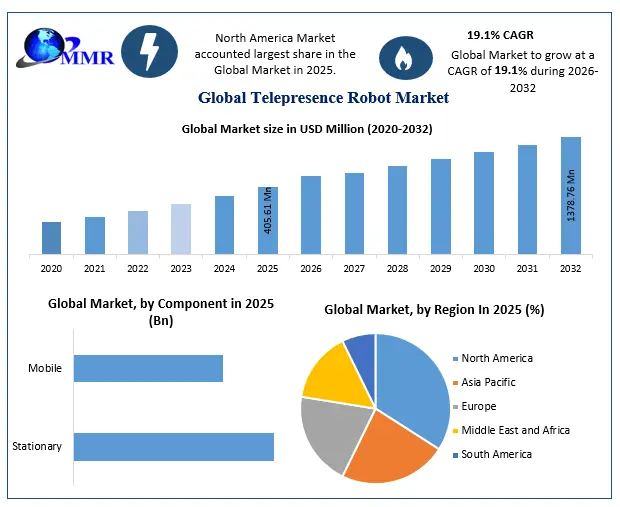
Telepresence Robot Market size was valued at US$ 405.61 USD Mn. in 2025 and the total revenue is expected to grow at a CAGR of 19.1% from 2026 to 2032, reaching nearly US$ 1378.76 Mn.
Telepresence Robot Market Overview:
To know about the Research Methodology :- Request Free Sample Report
Telepresence Robot Market Dynamics
Trend: A major trend in the Telepresence Robot Market is the integration of artificial intelligence, autonomous navigation, and cloud-based communication systems into telepresence platforms. Manufacturers are increasingly developing AI-enabled robots with facial recognition, voice assistance, obstacle avoidance, and autonomous mobility features to enhance user experience and operational efficiency. Another important trend is the growing adoption of telepresence robots in healthcare facilities for remote diagnostics, patient engagement, and medical consultations. Educational institutions and enterprises are also implementing advanced telepresence systems to support hybrid learning and remote workforce collaboration. Furthermore, the deployment of 5G-enabled telepresence robots is improving real-time communication quality, reducing latency, and enabling seamless virtual interaction across industries.
Driver: Increasing demand for remote communication and virtual collaboration solutions across healthcare, corporate, education, and industrial sectors. Organizations are adopting telepresence robots to improve remote interaction, operational efficiency, and workforce connectivity in hybrid working environments. In healthcare, these robots support remote patient monitoring, telemedicine consultations, and hospital assistance, reducing physical contact and improving patient care efficiency. Educational institutions are also utilizing telepresence robots for distance learning and interactive classroom participation. Additionally, advancements in AI, cloud computing, autonomous navigation, and 5G connectivity are significantly improving robot mobility, communication quality, and real-time interaction capabilities, accelerating market growth globally.
Opportunity: The expanding adoption of smart healthcare systems, digital education platforms, and hybrid workplace models presents significant opportunities for the Telepresence Robot Market. Increasing investments in telemedicine infrastructure, remote workforce management, and smart office technologies are creating strong demand for advanced telepresence solutions. Emerging economies are also witnessing rising adoption of telepresence robots in hospitals, educational institutions, and customer service applications due to rapid digital transformation initiatives. Additionally, advancements in AI-based navigation, cloud robotics, machine vision, and remote monitoring technologies are opening new opportunities for autonomous telepresence systems. Growing demand for contactless communication and remote industrial inspections in manufacturing, logistics, and defense sectors further supports long-term market growth opportunities globally.
Restraint: The high initial deployment cost and technical complexity associated with advanced robotic communication systems. Small and medium-sized enterprises often face financial limitations in adopting telepresence robots due to expensive hardware, software integration, maintenance, and network infrastructure requirements. In addition, cybersecurity concerns related to remote connectivity, data privacy, and unauthorized access create operational challenges for organizations using telepresence systems. Limited battery life, connectivity disruptions, and navigation issues in complex environments can also affect robot performance. Furthermore, lack of technical expertise and resistance to adopting robotic communication technologies in some industries may hinder widespread market penetration globally.
Telepresence Robot Market Segment Analysis
By Type , The body segment dominates the type category because it contains the essential operational components required for telepresence robot functionality, including power sources, sensors, and control systems. These components are critical for robot mobility, navigation accuracy, autonomous movement, and communication stability. Increasing demand for advanced autonomous telepresence robots with AI-enabled navigation, obstacle detection, and long battery life is driving strong growth in the body segment. Manufacturers are continuously investing in lightweight robotic structures, advanced sensor technologies, lithium-ion battery systems, and intelligent control platforms to improve robot efficiency and operational reliability. In addition, the growing adoption of mobile telepresence robots in healthcare, enterprise communication, education, and industrial monitoring applications is significantly increasing demand for sophisticated robotic body systems. Continuous technological advancements in AI, machine vision, and autonomous mobility further strengthen the dominance of the body segment in the Telepresence Robot Market.
By Component , The mobile segment is expected to dominate the component category during the forecast period, due to the increasing demand for flexible, autonomous, and remotely navigable telepresence robots across healthcare, corporate, education, and industrial environments. Mobile telepresence robots allow users to move freely within facilities, improving real-time communication, operational monitoring, and remote collaboration capabilities. Hospitals are extensively deploying mobile telepresence robots for remote consultations, patient interaction, and healthcare assistance, while enterprises use them for virtual meetings and hybrid workforce management. Educational institutions are also increasingly adopting mobile robots to support distance learning and classroom interaction. Technological advancements in autonomous navigation, AI-based obstacle avoidance, cloud connectivity, and 5G communication systems are further improving the performance and usability of mobile telepresence robots. Rising investments in smart infrastructure and remote communication technologies continue to support strong growth of the mobile segment globally.
Telepresence Robot Market Regional Analysis
North America dominated the Telepresence Robot Market in 2025 due to strong technological infrastructure, high adoption of advanced robotics solutions, and increasing investments in digital communication technologies. The United States holds the largest regional market share because of rising deployment of telepresence robots across healthcare, corporate, education, and industrial sectors. Healthcare institutions are extensively utilizing telepresence robots for telemedicine, remote patient monitoring, and virtual healthcare assistance to improve operational efficiency and patient care quality. The region also benefits from strong presence of leading robotics manufacturers, AI technology companies, and cloud communication solution providers. Growing adoption of hybrid workplace models and remote collaboration platforms is further increasing demand for telepresence systems in enterprises and educational institutions. In addition, rapid expansion of 5G infrastructure, smart hospitals, and AI-enabled autonomous robotics solutions continues to strengthen North America’s leadership position in the global Telepresence Robot Market.
Recent Developments
12 April 2026 – SoftBank Robotics Group (Japan)
SoftBank Robotics expanded its telepresence robotics portfolio by integrating advanced AI-driven communication and autonomous navigation capabilities into its service robots for healthcare, hospitality, and enterprise collaboration applications. The company focused on enhancing remote interaction quality, multilingual communication support, and cloud-based monitoring systems to improve hybrid workplace and telemedicine operations. SoftBank Robotics also increased partnerships with hospitals and smart office providers across North America and Asia-Pacific to strengthen deployment of telepresence solutions. The development highlights growing demand for AI-enabled remote communication technologies and supports increasing adoption of intelligent telepresence robots in commercial and healthcare environments globally.
18 March 2026 – KUKA AG (Germany)
KUKA AG announced the expansion of its intelligent robotics solutions with enhanced remote monitoring and teleoperation capabilities for industrial automation and smart manufacturing applications. The company integrated AI-based control systems, real-time video communication, and remote diagnostics into collaborative robotic platforms to improve industrial telepresence operations. KUKA also strengthened its cloud robotics ecosystem to support remote equipment management and virtual factory supervision. The development supports growing adoption of telepresence robotics in manufacturing facilities, warehouses, and industrial operations where remote collaboration and operational visibility are becoming increasingly important for Industry 4.0 transformation initiatives.
Telepresence Robot Market Scope: Inquire before buying
| Telepresence Robot Market | |||
|---|---|---|---|
| Report Coverage | Details | ||
| Base Year: | 2025 | Forecast Period: | 2026-2032 |
| Historical Data: | 2020 to 2025 | Market Size in 2025: | 405.61 USD Mn |
| Forecast Period 2026-2032 CAGR: | 19.1% | Market Size in 2032: | 1378.76 USD Mn |
| Segments Covered: | by Type | Head Camera Display Speaker Microphone Body Power Source Sensors & Control System Others |
|
| by Component | Stationary Mobile |
||
| by End User | Education Healthcare Enterprise Homecare Others |
||
Telepresence Robot Market, by Region
North America (United States, Canada and Mexico)
Europe (UK, France, Germany, Italy, Spain, Sweden, Austria and Rest of Europe)
Asia Pacific (China, South Korea, Japan, India, Australia, Indonesia, Malaysia, Vietnam, Taiwan, Bangladesh, Pakistan and Rest of APAC)
Middle East and Africa (South Africa, GCC, Egypt, Nigeria and Rest of ME&A)
South America (Brazil, Argentina Rest of South America)
Key players/Competitors profiles covered in the Telepresence Robot market report in strategic perspective
1. Qihan Technology Co. Ltd. (China)
2. Pilot AI Labs (USA)
3. Rethink Robotics (USA)
4. H-Bots Robotics Pvt Ltd (Bengaluru, India)
5. GreyOrange (Gurgaon, India)
6. Suitable Technologies, Inc. (USA)
7. KUKA AG (Germany)
8. PFF Group (Italy)
9. Yaskawa Electric Corporation (Japan)
10. ASIMOV Robotics Pvt Ltd (Gurugram, India)
11. SoftBank Robotics Group (Japan)
12. Orbis Robotics (USA)
13. Ekso Bionics (USA)
14. Locus Robotics (USA)
15. Emotix (Mumbai, India)
16. Anybots Inc. (USA)
17. Fetch Robotics (USA)
18. Telepresence Robotics Corporation (USA)
19. Gostai (France)
20. Awabot (France)
21. Omron Corporation (Japan)
22. Xenex Disinfection Services LLC (USA)
23. Robolab Technologies (Pune, India)
24. Vecna Technologies Inc. (USA)
25. HEBI Robotics (USA)
26. Planys Technologies (Chennai, India)
27. Mira Robotics (Japan)
28. Systemantics (Bengaluru, India)
29. VGo Communications, Inc. (USA)
30. Gridbots Technologies (Ahmedabad, India)
31. Robotnik (Spain)
32. Blue Ocean Robotics (Denmark)
33. Tend.ai (USA)