
Robotic Fruit Picker Market Size – Industry Structure Evaluation, Demand Drivers Analysis, Regional Growth Analysis and Identification, Competitive Positioning Review & Global Market Size Forecast to 2032
Overview
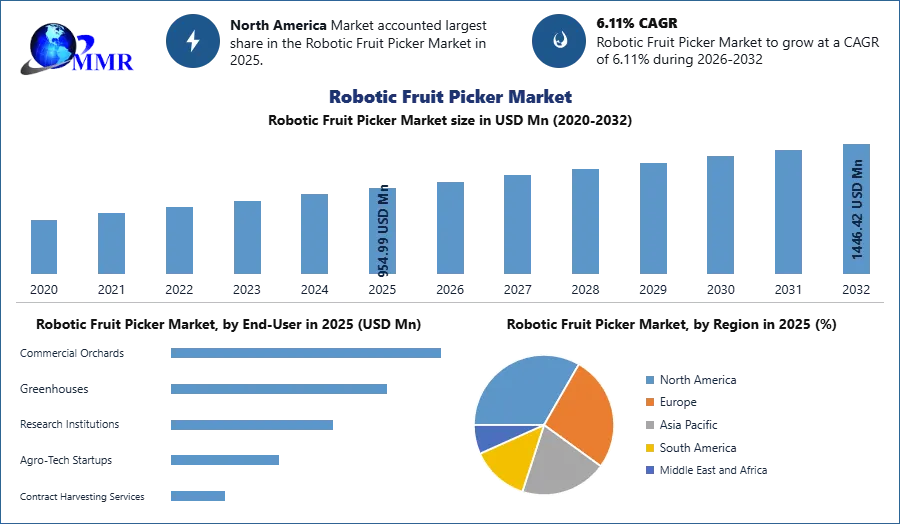
Global Robotic Fruit Picker Market size was valued at USD 954.99 Million in 2025, and the total Robotic Fruit Picker Market revenue is expected to grow by 6.11% from 2025 to 2032, reaching nearly USD 1446.4 Million
Robotic Fruit Picker Market Overview
A robotic fruit picker incorporates many integrated systems and allows crops to be identified, chosen, and harvested as they are passed in front of robotic arms, machine vision, AI, and various other systems. These robotic fruit picking systems can perform all of the actions a human picking fruit performs, and can pick fruit faster, more accurately, and with less waste.
 To know about the Research Methodology:-Request Free Sample Report
In this market report, we see a fast acceleration of robotic fruit picker market take-up, due to labour shortages, rising labour rates, and the absolute necessity to harvest with precision. Growers are rapidly moving to automation so that they can maximise outputs, save on costs, and minimise damage to fruits. The technology has progressed from rudimentary picking with a mechanical arm to complex picking with vision-guided, multi-arm, and drone-based produce picking systems that can makeover in a challenging environment.
There are strong signs of traction in North America and Europe, where commercial orchards want scalable, increased harvesting rates. In the Asia-Pacific region, which includes Japan, China, Australia and the region, accelerated growth is being catalysed through significant R&D (research and development) spending and government-supported Agri-tech initiatives.
Firms including Agrobot, Tevel Aerobotics, Ripe Robotics, and Harvest CROO Robotics keep advancing via AI-based systems, soft gripping horsepower, and autonomous navigation. In addition, the advancements among new crop types such as berries, grapes, and tomatoes bring other potential areas of growth.
Robotic Fruit Picker Market Dynamics
High Requirement for Automation to Drive the Growth of the Robotic Fruit Picker Market
Fresh fruit producers and agricultural companies are continuing to automate the harvesting process to lessen dependence on labour, reduce damage to crops and overall harvesting productivity. The increased demand for processed fruit(plants) of high quality with standardized harvest work cycle times along with the lack of available agricultural workers has hastened the introduction and uptake of robotic harvesting technologies around the world. Automated harvesting technologies mean more harvests of food can be made more rapidly while improving yield management systems boosting a culture of producer growth.
High Initial Investment and Integration Challenges to Restrain the Growth of the Robotic Fruit Picker Market
While there are many advantages, the high, up-front price of purchasing and integrating robotic fruit picking systems limits their mass adoption, particularly with small and medium scale farmers. The need for idiosyncratic infrastructures and technical expertise for maintenance and operation further limits market growth at a broader level, which is especially true in many developing markets.
Expansion of Application Areas to Create Lucrative Opportunities for Robotic Fruit Picker Market Growth
Once confined to the harvesting of apple and citrus crops only, robotic fruit pickers are being modified to harvest a variety of fruits such as berries, grapes, kiwifruit, and stone fruits. The expansion into different crops, the interest in precision agriculture, and the move to vision-guided systems and drone-based pickers offer fantastic opportunities for market growth.
Growth in Emerging Economies to Create Lucrative Opportunities for the Robotic Fruit Picker Market Growth
Developing agricultural economies in the Asia-Pacific, South America, and the Middle East & Africa are increasingly opening up to robotic fruit picking technologies to increase productivity and reduce labour costs. Having existing government programs promoting smart farming and Agri-tech in countries such as India, China, and Israel is expected to accelerate the introduction of robotic fruit pickers, potentially offering high growth opportunities for these economies.
Robotic Fruit Picker Market Segment Analysis
The Robotic Fruit Picker Market is segmented based on Type: Autonomous Robot Pickers, Semi-Autonomous Robot Pickers, Aerial (Drone-Based) Pickers, Multi-arm Robotic Pickers, Vision-Guided Pickers, and Vacuum-Based Pickers.
The Autonomous Robot Pickers segment is expected to grow at the highest CAGR over the projected period, owing to advancements in technology, such as AI and machine learning, that allow these robots to operate on their own in orchards, where, in some cases, they may include alternate terrain shapes and/or complex foliage. Autonomous fruit picking robots can identify ripe fruit while harvesting through the orchard and pick fruit without humans needing to do so.
Robotic Fruit Picker Market Regional Insights
North America is expected to dominate the robotic fruit picker market during the forecast period 2026–2032 due to the rapid adoption of advanced agricultural technologies and strong investment in farm automation. Countries such as the United States and Canada have highly developed agricultural sectors and large-scale fruit farming operations, which are increasingly adopting robotic harvesting systems to improve efficiency and reduce dependence on manual labor. Labor shortages in agricultural activities and rising labor costs are major factors accelerating the demand for robotic fruit pickers in the region.
In addition, North American farmers are actively implementing precision agriculture solutions, including AI-powered vision systems, machine learning-based fruit detection, and autonomous harvesting robots to improve productivity and minimize crop losses. Strong support from government initiatives and agricultural research institutions is also encouraging the development and deployment of advanced robotic harvesting technologies. Furthermore, the presence of leading agri-technology companies and continuous innovation in robotics and automation are strengthening the region’s market position. These factors collectively make North America the dominant regional market for robotic fruit pickers during the forecast period 2026–2032.
Robotic Fruit Picker Market Competitive Landscape:
In the robot fruit picker market, Agrobot (Spain) and Fieldwork Robotics (UK) introduce two separate yet competitive approaches to automate soft fruit harvesting. Agrobot has developed highly specific robotic systems for strawberry picking, which use advanced computer vision to assess crops and delicate weapons without crops. Their strength lies in the readiness and modular scalability of commercial deployment, which makes them suitable for large-scale fields throughout Europe and on the contrary, Fieldwork Robotics focuses on AI-operated selective cutting, in which the robot is designed to navigate the complex crop environment and selects a randomised rampage. Their innovation is concentrated around accurate agriculture and adaptability, especially in variable terrain and a changing climate. While Agrobot enters the real-world scalability and market, the field edge is linked in its state-of-the-art AI and crop-specific precision, both are located as key players with various price proposals-Agrobot for operational efficiency, and smart, optimised automation in special fruit fields.
Robotic Fruit Picker Market Key Developments:
• Jan-2025 – PeK Automotive- Europe
Presented enhanced fruit harvesting solutions at the World FIRA 2025, such as a new mechanical Grapes Collector and expanded aspects for the automated Apple Picker, along with the automatic Slopehelper platform.
• Aug-2024 – Fieldwork Robotics – UK
Unveiled an upgraded version of the reddest ‘Robocrop’ robot with the ability to selectively pick only ripe raspberries. The upgraded Fieldworker robot is destined for deployment in the UK, Australia, and Portugal with the intention of improving harvesting efficiency and decreasing crop wastage by using a selective harvesting robotic and autonomous system.
• Jan-2024 – Harvest Automation – USA
Unveiled the HV-100 robot, providing automated handling of plants in very high-density greenhouses (VHD). Designed to be profitable, the HV-100 reduces labour because it autonomously spaces, groups, and transports potted plants. The result: better efficiency and lower labour costs in horticulture
• Aug-2025 – Octinion Technology Group – Belgium
Announced the imminent showcasing of an autonomous, self-driving strawberry harvester at Fruit Logistica. The robot, which has been in development for over five years, will help reduce labour costs and damage to strawberries during harvesting but will also signify a much-needed innovative step-change across the soft fruit sector.
Robotic Fruit Picker Market Key Trends:
• Soft robotics for gentle harvesting
There is clearly a movement towards soft and flexible robot designs to avoid damage to fruit during automatic harvesting. Innovative designs, including Waikato’s soft gripper university for harvesting the strawberry picker of kiwifruit and octinion’s, emphasize brooking and reducing waste when using robots for especially delicate fruits for delicate fruits.
• 2. Lack of labour: a step towards automation
More technologies are emerging, including Slopehelper of Pek Automotive, the raspberry picker of fieldwork robotics, and HV-100 of Harvest Automation, describing a very visible change towards employing autonomous systems. Gardening is a purpose for autonomous events with robots lacking chronic labour that is provided to aid in frequent harvesting and reduce dependence on seasonal workers.
Robotic Fruit Picker Market: Inquire before buying
| Robotic Fruit Picker Market | |||
|---|---|---|---|
| Report Coverage | Details | ||
| Base Year: | 2025 | Forecast Period: | 2026-2032 |
| Historical Data: | 2020 to 2025 | Market Size in 2025: | 954.99 USD Mn |
| Forecast Period 2026-2032 CAGR: | 6.11% | Market Size in 2032: | 1446.42 USD Mn |
| Segments Covered: | by Type | Autonomous Robot Pickers Semi-Autonomous Robot Pickers Aerial (Drone-Based) Pickers Multi-arm Robotic Pickers Vision-Guided Pickers Vacuum-Based Pickers |
|
| by Fruit Type | Apples Strawberries Raspberries Tomatoes Peaches & Plums Citrus Fruits Grapes Others (e.g., blueberries, pears) |
||
| by Mobility | Wheeled Robots Tracked Robots Stationary Systems Drone-based Units |
||
| by End-User | Commercial Orchards Greenhouses Research Institutions Agro-Tech Startups Contract Harvesting Services |
||
Robotic Fruit Picker Market, by Region
North America (United States, Canada and Mexico)
Europe (UK, France, Germany, Italy, Spain, Sweden, Austria and Rest of Europe)
Asia Pacific (China, South Korea, Japan, India, Australia, Indonesia, Malaysia, Vietnam, Taiwan, Bangladesh, Pakistan and Rest of APAC)
Middle East and Africa (South Africa, GCC, Egypt, Nigeria and Rest of ME&A)
South America (Brazil, Argentina Rest of South America)
Robotic Fruit Picker Market, Key Players
North America
1. Harvest CROO Robotics
2. Harvest Automation (HV‑100)
3. Root Robotics / Root A.I.
Europe
1. Agrobot (Spain)
2. Fieldwork Robotics (UK)
3. Dogtooth Technologies (UK)
4. Octinion (Belgium)
5. KUKA CropBot (Germany)
6. Metomotion – GRoW (also active in Europe)
7. PeK Automotive (Europe)
Asia Pacific
1. Ripe Robotics (Australia)
2. Xihe Robotics (China)
3. Shibuya Seiki (Japan)
Middle East & Africa
1. FFRobotics (Israel)
2. Tevel Aerobotics Technologies (Israel)
3. Metomotion – GRoW (Israel)