
Inoculants Market By Function, By Microorganism, By Mode of Application, By Crop Type, By Formulation, By Farming System, By Cultivation Environment, By Distribution Channel and Regional Insights 2034
Overview
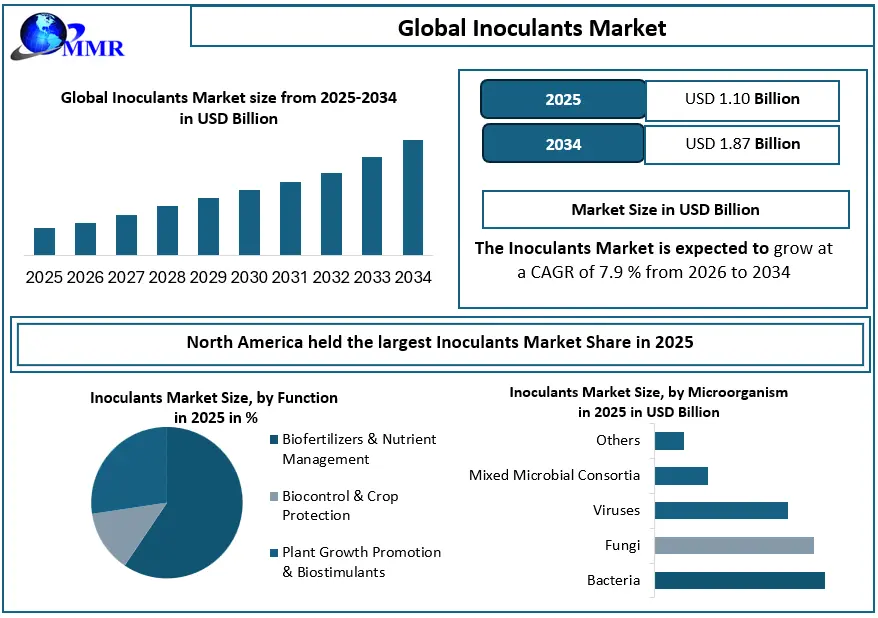
The Global Inoculants Market was valued at USD 1.10 Billion in 2025 and is projected to reach USD 1.87 Billion by 2034, growing at a CAGR of 7.9 % during the forecast period 2026–2034.
| Parameter | Value |
| Market Size (2025) | USD 1.10 Billion |
| Market Size (2034) | USD 1.87 Billion |
| CAGR | 7.9 % |
| Historical Period | 2020 to 2025 |
| Forecast Period | 2026 to 2034 |
Global Inoculants Market Overview
The Inoculants Market focuses on microbial formulations containing beneficial bacteria, fungi, and other microorganisms used to improve agricultural productivity, enhance nutrient availability, and support silage preservation. These products include agricultural and silage inoculants that contribute to nitrogen fixation, phosphate solubilization, root development, soil fertility, and forage quality. The Global Inoculants Market is gaining importance as farmers increasingly adopt biological alternatives to conventional fertilizers and chemical-based crop inputs. Inoculants help improve nutrient-use efficiency, strengthen crop establishment, enhance soil microbial activity, and maintain crop yields. The market was valued at USD 1.10 Billion in 2026 and is projected to reach USD 1.87 Billion by 2034, growing at a CAGR of 7.9 %.
The Inoculants Market Trends highlight increasing demand for multi-strain microbial formulations, liquid inoculants, seed-applied biological solutions, and crop-specific microbial technologies. Major buyers include agricultural input manufacturers, seed companies, commercial farming enterprises, and livestock producers. Emerging opportunities exist in nitrogen-fixing bacteria, phosphate-solubilizing microorganisms, mycorrhizal fungi, and customized microbial consortia. North America represents a leading regional market, supported by established agricultural biological industries, while Asia-Pacific offers growth opportunities through expanding agricultural production and sustainable farming adoption. Key industry participants include Novonesis, BASF SE, Corteva Agriscience, Bayer AG, Verdesian Life Sciences, Rizobacter, and Advanced Biological Marketing.
Maximize Market Research (MMR) Inoculants Market Analysis examines key growth drivers, microbial product categories, crop-specific demand, application methods, regional dynamics, competitive strategies, and investment opportunities. The research highlights how sustainable agriculture, rising fertilizer costs, biological nutrient management, and microbial strain development influence industry growth. It also evaluates challenges related to microbial shelf life, formulation stability, field-performance consistency, regulatory approvals, and distribution infrastructure. Increasing investment in microbial research, seed treatment technologies, and advanced biological formulations creates opportunities for agricultural biotechnology companies and biological input manufacturers. The Global Inoculants Market Growth Outlook through 2034 reflects the industry's focus on microbial innovation, nutrient-use efficiency, regenerative farming, and sustainable agricultural production.
Inoculants Market Growth Outlook
To know about the Research Methodology :- Request Free Sample Report
Global Inoculants Market Key Insights
• Strong Market Growth: The Global Inoculants Market is witnessing strong growth, supported by increasing adoption of microbial inoculants, including nitrogen-fixing bacteria, phosphate-solubilizing microorganisms, and biostimulants across agriculture, crop production, and sustainable farming practices.
• Agricultural Productivity and Soil Health Demand Accelerates: Rising demand for sustainable crop production, improved nutrient availability, and enhanced soil fertility drives the adoption of microbial inoculants, particularly in soybean, cereals, pulses, and other major agricultural crops.
• Asia-Pacific Strengthens Its Position in the Inoculants Market: China and India support regional growth through expanding agricultural activities, increasing awareness of biological fertilizers, government initiatives promoting sustainable farming, and growing adoption of microbial-based crop solutions.
• Advanced Microbial Technologies Transform Agricultural Practices: Increasing adoption of microbial consortia, biofertilizers, seed treatment technologies, and advanced microbial formulations creates opportunities to improve nutrient absorption, enhance crop resilience, and reduce dependence on chemical fertilizers.
• Leading Companies Drive Competitive Expansion: Novozymes, BASF, Corteva Agriscience, Bayer, Syngenta, Lallemand Plant Care, and Rizobacter compete through microbial product innovation, research investments, strategic partnerships, and expansion of sustainable agricultural inoculant portfolios.
Global Innoculants Market Dynamics
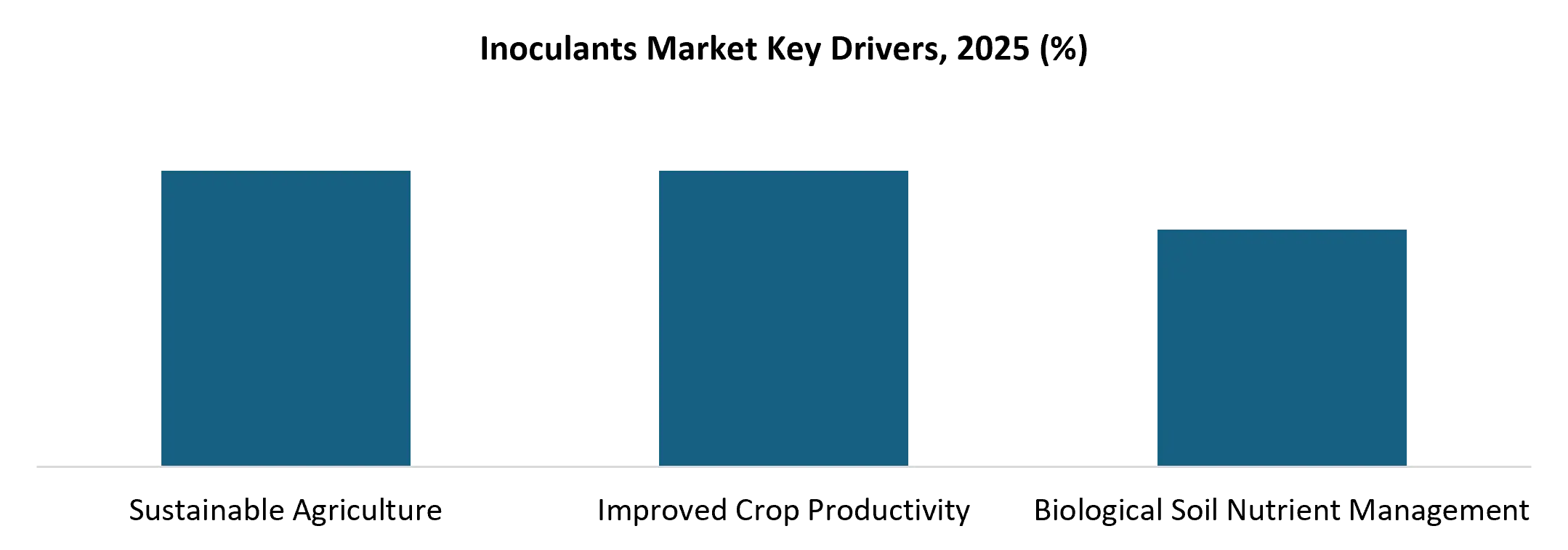
Drivers: Rising Demand for Sustainable Agriculture, Improved Crop Productivity, and Biological Soil Nutrient Management
The Inoculants Market Growth is driven by increasing adoption of microbial-based agricultural inputs, rising demand for higher crop productivity, and growing emphasis on sustainable farming practices. Agricultural inoculants containing beneficial microorganisms such as Rhizobium, Azotobacter, Azospirillum, and phosphate-solubilizing bacteria improve nitrogen fixation, nutrient availability, and root development. Increasing cultivation of soybean, cereals, pulses, and forage crops supports demand for specialized microbial formulations. For instance, an Indian soybean field study reported yields of 2,480 kg per hectare with combined Rhizobium and phosphate-solubilizing bacterial inoculation, compared with 2,191 kg per hectare without inoculation. Growing efforts to improve fertilizer-use efficiency and soil fertility strengthen the Global Inoculants Market.
Restraints: Microbial Viability Limitations, Storage Requirements, and Regulatory Compliance Challenges
The Inoculants Market faces restraints from difficulties in maintaining microbial viability, inconsistent field performance, limited product shelf life, and stringent quality requirements. Agricultural inoculants contain living microorganisms whose effectiveness depends on strain selection, carrier materials, moisture levels, and storage conditions. Exposure to unsuitable temperatures, prolonged storage, and incompatible chemical seed treatments can reduce viable microbial populations, affecting product performance. Manufacturers must maintain specified microbial counts, contamination-free production, and consistent formulation quality. Regulatory requirements for biofertilizer registration, strain identification, and field validation further increase commercialization costs, particularly for smaller manufacturers expanding across agricultural markets.
Opportunities: Expanding Biofertilizer Adoption, Advanced Microbial Formulations, and Integrated Crop Nutrition Solutions
The Inoculants Market Opportunities expand through growing adoption of biofertilizers, multifunctional microbial consortia, and biological seed treatment solutions. Manufacturers are investing in advanced fermentation, encapsulation, carrier technologies, and strain development to improve microbial survival and field performance. Increasing demand for crop-specific formulations, particularly for soybean, corn, cereals, and forage crops, creates opportunities for specialized manufacturers. Developments in nitrogen-fixing bacteria, phosphate-solubilizing microorganisms, and potassium-mobilizing microbes support integrated nutrient management and reduced chemical fertilizer dependency.
Challenges: Formulation Stability, Field Performance Variability, and Agricultural Distribution Constraints
The Inoculants Market Challenges include maintaining microbial effectiveness across different soil conditions, ensuring strain compatibility, and managing agricultural distribution networks. Microbial inoculants demonstrate varying performance depending on soil pH, moisture availability, temperature, and indigenous microbial populations. For example, Rhizobium inoculants developed for soybean may not deliver equivalent nitrogen-fixation performance across different legume species because of host-specific strain compatibility. Manufacturers must ensure that bacterial and fungal formulations retain viability during transportation, warehousing, and on-farm storage. Limited farmer awareness, fragmented distribution channels, and competition from established chemical fertilizer suppliers create additional commercialization barriers. Growing competition among biological input manufacturers further pressures companies to deliver cost-effective formulations with consistent field-level results.
Global Inoculants Market Trends
| Key Market Trends | Inoculants Market Trends and Industry Insights |
| Precision Microbial Strain Development and Consortia Formulations | Manufacturers increasingly develop multi-strain formulations combining nitrogen-fixing, phosphate-solubilizing, and potassium-mobilizing microorganisms to improve nutrient availability, root development, and crop productivity across diverse agricultural conditions. |
| Advanced Carrier Technologies and Extended Shelf-Life Formulations | Manufacturers adopt liquid formulations, peat-based carriers, encapsulation, and freeze-drying technologies to maintain microbial viability, with commercial formulations commonly targeting 10⁸–10⁹ CFU per gram or millilitre. |
| Precision Agriculture and Crop-Specific Microbial Applications | Precision farming encourages crop-specific inoculant applications through seed coating, in-furrow placement, and soil treatment, supporting targeted nutrient management across soybean, corn, pulses, and cereals. |
| Biological Nitrogen Fixation and Reduced Fertilizer Dependency | Growing adoption of Rhizobium, Azospirillum, and Azotobacter inoculants supports biological nitrogen fixation, with effective soybean-rhizobium associations potentially contributing 50–200 kg of nitrogen per hectare under suitable conditions. |
| Digital Monitoring and Next-Generation Microbial Formulations | Manufacturers increasingly explore microbial genomics, automated fermentation, and digital field monitoring to improve strain selection, formulation consistency, and field-level performance of agricultural inoculants. |
Global Inoculants Market Segment Analysis
Global Inoculants Market, by Type
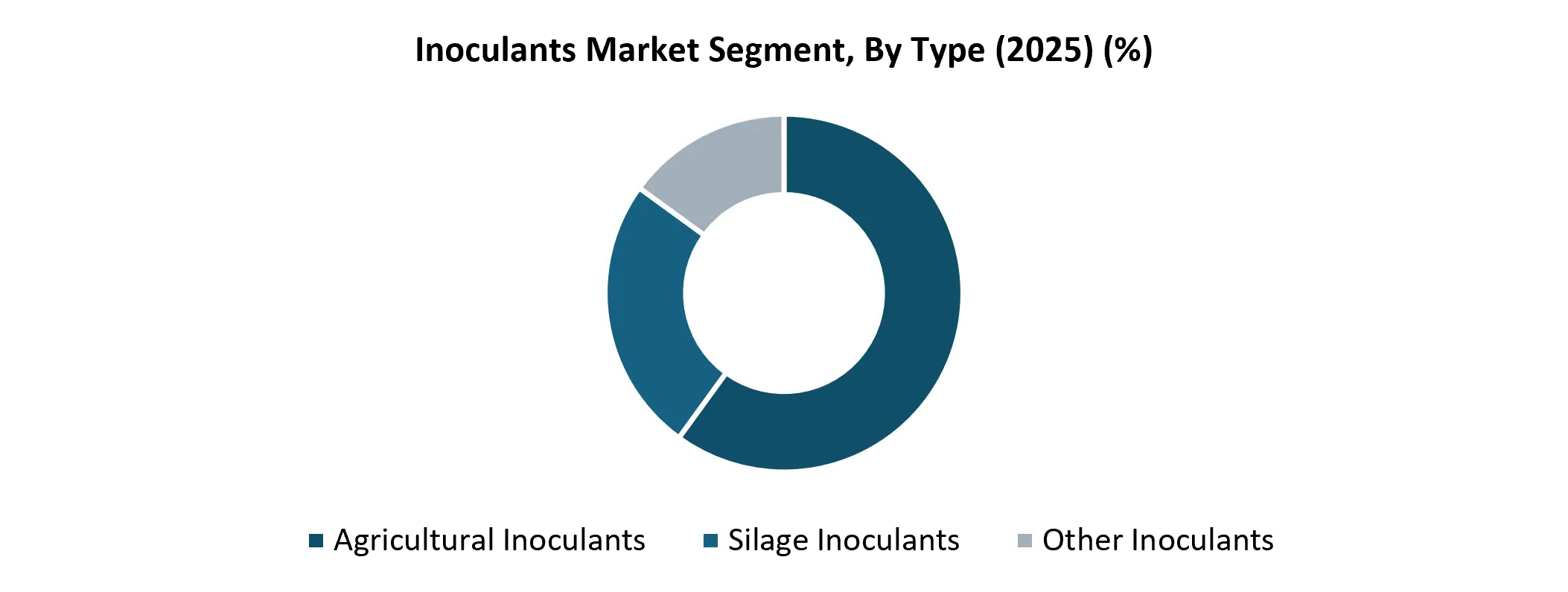
The Inoculants Market by Type is segmented into Agricultural Inoculants, Silage Inoculants, and Other Inoculants. Agricultural Inoculants generate demand for nitrogen-fixing bacteria, phosphate-solubilizing microorganisms, and plant growth-promoting bacteria that improve soil fertility and crop productivity. Rhizobium-based inoculants are widely used in soybean and pulse cultivation to support biological nitrogen fixation and reduce synthetic fertilizer dependency. Silage Inoculants utilize lactic acid bacteria, including Lactobacillus and Pediococcus, to accelerate fermentation, preserve feed quality, and minimize nutrient losses. Commercial silage formulations commonly contain approximately 10⁵–10⁶ CFU of lactic acid bacteria per gram of fresh forage. Increasing adoption of microbial technologies and biological feed preservation supports market growth across agricultural and livestock applications.
Global Inoculants Market, by Application
The Global Inoculants Market by Application is segmented into Seed Inoculation, Soil Inoculation, and Other Applications. Seed Inoculation generates demand for microbial formulations applied directly to seeds to establish beneficial microorganisms around developing roots. Rhizobium-based treatments are widely used in soybean and pulse cultivation, while Azospirillum supports nutrient uptake and root development in cereal crops. Soil Inoculation involves applying microbial formulations through soil treatment, irrigation systems, and in-furrow placement to improve nutrient availability and soil biological activity. Effective biological nitrogen fixation in soybean can contribute approximately 50–200 kg of nitrogen per hectare under suitable conditions. Growing adoption of precision farming, biological seed treatments, and integrated nutrient management supports market growth across crop production systems.
Global Inoculants Market Regional Analysis:
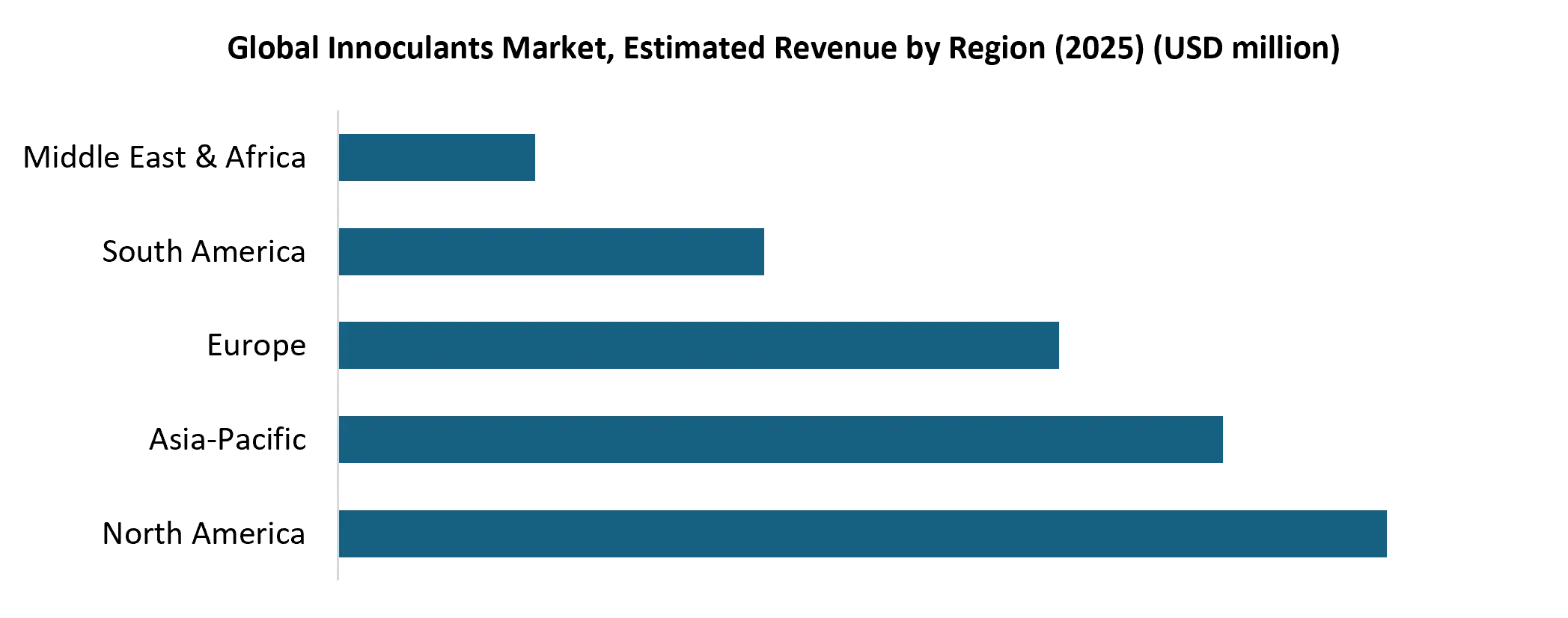
North America holds a leading position in the Global Inoculants Market, accounting for XX% of global revenue in 2025, with an estimated market value of USD 440 million. The United States and Canada represent major markets for nitrogen-fixing bacteria, phosphate-solubilizing microorganisms, and plant growth-promoting inoculants. Extensive soybean and corn cultivation strengthens demand for Rhizobium, Bradyrhizobium, and Azospirillum-based formulations. Established agricultural biotechnology companies, advanced seed treatment practices, and widespread adoption of biological crop inputs further strengthen regional market leadership.
Asia-Pacific presents significant Inoculants Market growth opportunities. China, India, Australia, and Japan support regional demand through expanding agricultural production and increasing adoption of biofertilizers. India represents an important growth market due to government initiatives promoting organic farming and biological nutrient management. China's microbial fermentation capabilities and growing use of phosphate-solubilizing bacteria strengthen regional production, while increasing demand for cost-effective agricultural inputs supports market expansion.
Europe's Inoculants Market accounted for approximately XX% of global revenue in 2025. Germany, France, Spain, Italy, and the Netherlands support demand for microbial fertilizers, seed inoculants, and biological crop enhancement solutions. The European Union's Farm to Fork Strategy targets a 50% reduction in nutrient losses by 2030, encouraging improved nutrient management and biological alternatives. Increasing investment in microbial research, precision agriculture, and sustainable crop nutrition creates opportunities for inoculant manufacturers and agricultural biotechnology companies.
South America's Inoculants Market accounted for XX% of global revenue in 2025. Brazil and Argentina represent important regional markets, particularly for Bradyrhizobium-based soybean inoculants. Brazil's soybean cultivation area exceeds 45 million hectares, creating substantial demand for commercial microbial formulations. The widespread adoption of biological nitrogen fixation helps soybean producers reduce dependence on synthetic nitrogen fertilizers. Increasing use of co-inoculation technologies combining Bradyrhizobium and Azospirillum further supports regional market expansion.
The Middle East & Africa's Inoculants Market accounted for XX% of global revenue in 2025. South Africa, Egypt, Kenya, Morocco, and Saudi Arabia represent emerging markets for microbial inoculants used in cereals, pulses, legumes, and horticultural crops. Limited arable land, water scarcity, and declining soil fertility encourage the adoption of microbial solutions that improve nutrient availability and root development. Government initiatives supporting agricultural productivity and growing awareness of biofertilizers create opportunities for microbial inoculant manufacturers and regional agricultural input suppliers.
 Global Perfume Ingredients Market Recent Developments
| Published Date | Recent Developments |
| October 2026 | Protealis launches MagNfix, a ready-to-sow soybean seed inoculant in Europe, designed to maintain performance for up to 90 days. Independent multi-location trials reported 31% higher average yield and 7% higher protein content compared with reference inoculants, strengthening innovation in pre-treated soybean seeds. |
| September 2026 | BioWorks launches BioRain Ax, a microbial inoculant designed to improve crop resilience under water-limited conditions. The formulation uses beneficial microorganisms to enhance soil structure, water retention, and nutrient availability, expanding applications across specialty crops, greenhouses, nurseries, and commercial agricultural production. |
| September 2026 | Lilac Agriculture secures USD 2.3 million in oversubscribed seed funding to advance next-generation Rhizobium inoculants for pulse growers. The investment supports its Guided Adaptation platform, which focuses on improving nitrogen fixation and microbial competitiveness against native soil bacteria. |
| September 2026 | Syngenta expands its Seedcare Institute in Australia to accelerate biological product development and evaluation. The expanded facility will focus on microbial inoculants, nutrient-use efficiency, and solutions addressing drought and heat stress, strengthening locally tested biological seed treatment technologies. |
Global Inoculants Market Competitive Landscape
The Inoculants Market Competitive Landscape features major companies such as Corteva Agriscience, Novonesis, BASF SE, Bayer AG, Syngenta, UPL Limited, Rizobacter, and Lallemand Plant Care. Corteva competes through biological seed treatments and microbial crop protection solutions, while Novonesis focuses on advanced microbial technologies and biological agricultural inputs. BASF and Bayer strengthen their positions through integrated biological crop solutions, while Syngenta emphasizes seed treatment technologies. UPL expands its presence through sustainable biological inputs, whereas Rizobacter and Lallemand specialize in nitrogen-fixing bacteria and crop-specific inoculants. Increasing demand for microbial fertilizers encourages manufacturers to differentiate through strain performance, formulation stability, and distribution capabilities.
The Inoculants Market Competitive Strategies focus on microbial innovation, strategic partnerships, production expansion, and crop-specific biological formulations. Companies increasingly invest in nitrogen-fixing bacteria, phosphate-solubilizing microorganisms, and microbial consortia to improve nutrient availability and crop productivity. For instance, Rizobacter reports approximately 23% global market share in soybean inoculants and production capacity of around 300,000 doses per day, highlighting its manufacturing capabilities. Novonesis advances microbial biotechnology, while Corteva and BASF strengthen their biological agricultural portfolios through product development and commercialization. Increasing investment in fermentation technologies, microbial encapsulation, and extended-shelf-life formulations intensifies competition. Leading manufacturers also prioritize field validation, regulatory approvals, and farmer-focused distribution networks to expand their presence across emerging agricultural markets.
Global Inoculants Market Scope:Inquire before buying
| Global Inoculants Market | |||
|---|---|---|---|
| Report Coverage |
Details | ||
| Base Year: |
2025 | Forecast Period: |
2026-2034 |
| Historical Data: |
2020 to 2025 | Market Size in 2025: | USD 1.10 Billion |
| Forecast Period 2026 to 2034 CAGR: |
7.9 % | Market Size in 2034: | USD 1.87 Billion |
| Inoculants Market Segments Covered: |
By Function | Biofertilizers & Nutrient Management Biocontrol & Crop Protection Plant Growth Promotion & Biostimulants Others |
|
| By Microorganism | Bacteria Fungi Viruses Mixed Microbial Consortia Others |
||
| By Mode of Application |
Seed Treatment Soil Application Foliar Application Irrigation/Fertigation Application Others |
||
| By Crop Type | Cereals & Grains Oilseeds & Pulses Fruits & Vegetables Commercial & Plantation Crops Turf & Ornamentals Others |
||
| By Formulation | Liquid Powder Granular Others |
||
| By Farming System | Conventional Agriculture Certified Organic Agriculture |
||
| By Cultivation Environment |
Open-Field Agriculture Protected Cultivation/Greenhouse Turf & Landscaping Others |
||
| By Distribution Channel | Direct Sales Agricultural Cooperatives Agrochemical Distributors Agricultural Retailers Online/E-Commerce Others |
||
Global Inoculants Market Region
North America (United States, Canada, and Mexico)
Europe (UK, France, Germany, Italy, Spain, Sweden, Austria, and the Rest of Europe)
Asia Pacific (China, South Korea, Japan, India, Australia, ASEAN, Indonesia, Philippines, Malaysia, Vietnam, Thailand, ASEAN, Rest of Asia Pacific)
Middle East & Africa (South Africa, GCC, Nigeria, Rest of ME&A)
South America (Brazil, Argentina, Rest of South America)
Key Players in the Global Inoculants Market
North America
1. Corteva Agriscience
2. Novonesis
3. BASF SE
4. Bayer AG
5. FMC Corporation
6. Valent BioSciences LLC
7. Indigo Agriculture
8. AgBiome, Inc.
9. BioWorks, Inc.
10. Certis Biologicals
11. Verdesian Life Sciences
12. Advanced Biological Marketing (ABM)
Europe
13. Syngenta AG
14. Koppert Biological Systems
15. Andermatt Biocontrol AG
16. Lallemand Inc.
17. Plant Health Care plc
18. Novagrica
19. Bionema
20. Econoculture
21. Kemin Industries
Asia-Pacific
22. UPL Limited
23. IPL Biologicals Limited
24. T. Stanes and Company Limited
25. Multiplex Group
26. Chennai Micro-Fertilizers
27. Kiwa Bio-Tech
28. Beijing Bio-Organic Fertilizer
29. Pacific Agriscience
30. Symbiont Agrotech
31. National Fertilizers Limited (NFL)
South America
32. Rizobacter Argentina S.A.
33. Bioceres Crop Solutions Corp.
34. Mosaic Fertilizantes
35. Nova América
36. Simbiose-Ag
37. Total Biotechnology
38. Ballagro Agro Tecnologia
Middle East & Africa
39. Nilotech
40. Meridiem Seeds Africa
41. Rolfes Agri
42. Bio-Agritech
43. Agro-Guard
44. Botanical Resources South Africa
45. Others
Global Inoculants Market FAQ:
1. What is the Global Inoculants Market size and forecast by 2034?
The Global Inoculants Market was valued at approximately USD 1.10 Billion in 2025 and is projected to reach USD 1.87 Billion by 2034, growing at a CAGR of 7.9 % during 2026–2034.
The Insight Partners
2. What are the major factors driving Inoculants Market growth?
Rising adoption of biological crop inputs, increasing fertilizer costs, declining soil fertility, demand for higher agricultural productivity, and the shift toward sustainable farming practices are driving global Inoculants Market growth.
3. Which region leads the Global Inoculants Market?
North America holds a leading position in the Inoculants Market, supported by widespread soybean and corn cultivation, established agricultural biotechnology companies, increasing adoption of seed inoculation, and growing demand for biological nutrient management.
Grand View Research+1
4. What are the major types of inoculants used in agricultural applications?
The Inoculants Market includes bacterial and fungal inoculants, particularly Rhizobium, Azotobacter, Azospirillum, Bacillus, and mycorrhizal fungi, which improve nitrogen fixation, nutrient absorption, root development, and soil fertility.
5. Who are the leading companies in the Global Inoculants Market?
Major Inoculants Market key players include Corteva Agriscience, Novonesis, BASF SE, Bayer AG, Syngenta AG, UPL Limited, Rizobacter Argentina, Lallemand Inc., Verdesian Life Sciences, and Valent BioSciences LLC.
6. What are the emerging trends and growth opportunities in the Inoculants Market?
Major Inoculants Market trends include multi-strain microbial formulations, advanced seed coating technologies, liquid inoculant development, nitrogen-fixing biological solutions, drought-resistant microbial strains, and precision agriculture integration.
7. What does the MMR Global Inoculants Market Report cover?
The MMR Inoculants Market Report covers market size, CAGR, bacterial and fungal inoculants, formulation types, crop applications, seed and soil inoculation, regional analysis, competitive landscape, technological developments, and investment opportunities through 2034.