
Agritourism Market By Activity, By Farm Type, By Tourist Type, By Visitor Group, By Booking Channel, By Visit Type and Regional Insights 2034
Overview
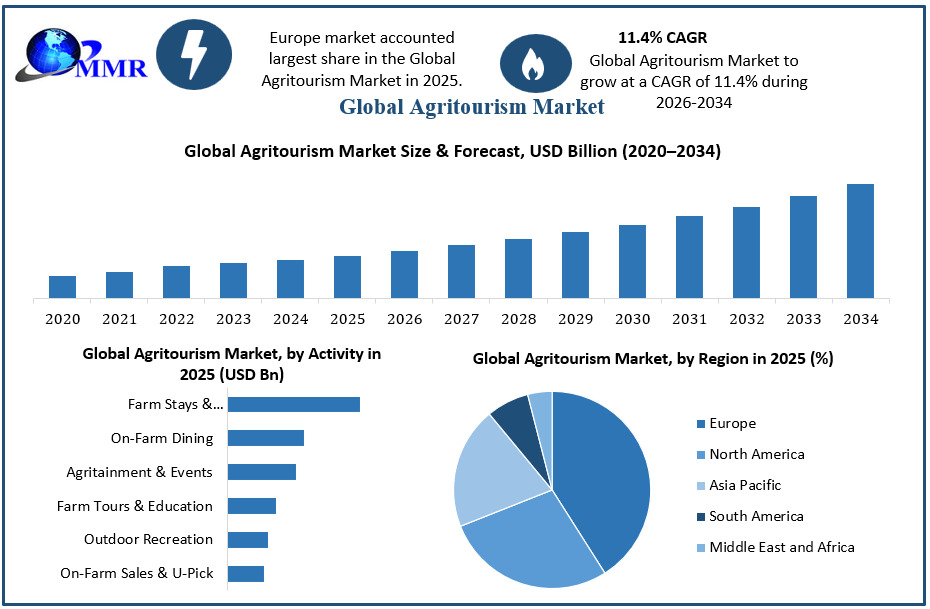
The Global Agritourism Market was valued at USD 11.6 billion in 2025 and is projected to reach USD 30.6 billion by 2034, growing at a CAGR of 11.4% during 2026–2034. Market growth is supported by demand for authentic rural and food experiences, pressure on farms to diversify income, the reach of farm-stay and outdoor-hospitality booking platforms, and rural development policies that position agritourism as a tool for farm resilience and village economies.
Key Market Takeaways
• Farm stays and on-farm accommodation generate the largest revenue share, because overnight guests spend several times more per visit than day visitors.
• Published market estimates differ by nearly tenfold; this report sizes direct on-farm visitor revenue and reconciles it against national farm census and agritourism registers.
• Farm operators increasingly treat hospitality, food service and digital distribution as core farm skills, moving agritourism from a seasonal side income to a planned enterprise.
• Booking platforms such as Airbnb, Booking.com, Hipcamp and Harvest Hosts are widening reach for small farms, while raising commission exposure and platform dependence.
• Liability statutes, zoning rules and food-safety licensing determine which activities a farm can legally offer, and regulatory clarity is one of the strongest predictors of regional growth.
• Europe holds the largest share through mature farm-stay systems, while Asia Pacific is the fastest-growing region as China, India and Japan link agritourism to rural revitalisation.
Agritourism Market Growth and Share Analysis
To know about the Research Methodology :- Request Free Sample Report
FIVE FORCES RESHAPING FARM-BASED TOURISM
| 01 EXPERIENCE ECONOMY Authentic rural stays |
02 FARM ECONOMICS Income diversification |
03 PLATFORMS Digital discovery |
04 POLICY SUPPORT Rural development |
05 FOOD & WELLNESS Farm-to-table demand |
|---|
Global Agritourism Market Overview
Global Agritourism Industry Definition
Agritourism covers revenue earned by working farms, ranches, vineyards, orchards, and plantations from receiving visitors on agricultural land. The report covers farm stays and on-farm accommodation, on-farm dining and farm-to-table experiences, farm tours and educational visits, agritainment such as corn mazes, harvest festivals and farm weddings, outdoor recreation including hunting, fishing and horse riding, and pick-your-own and on-farm retail linked to a visit. Agriculture must remain the primary land use, which separates agritourism from wider rural tourism, resorts and off-farm hospitality. Visitor spend on transport and off-farm lodging is excluded from the market value.
STRATEGIC INTERPRETATION
Agritourism has moved from a seasonal side income to a planned farm enterprise; the operators that grow fastest are those that treat hospitality, food and digital distribution as core farm skills rather than add-ons.
Global Agritourism Market Size and Demand Indicators
| Year | USD Billion | Year | USD Billion |
| 2025 | 11.6 | 2030 | 19.9 |
| 2026 | 12.9 | 2031 | 22.2 |
| 2027 | 14.4 | 2032 | 24.7 |
| 2028 | 16.0 | 2033 | 27.5 |
| 2029 | 17.9 | 2034 | 30.6 |
Official farm data confirm the depth of the supply base behind these estimates. Italy counted 26,360 authorised agriturismi in 2024, roughly double the 2003 level, and the 2022 US Census of Agriculture recorded about 28,600 farms and ranches earning agritourism and recreational income. Growth is coming from higher spend per visit, longer stays, and international guests rather than from visitor volume alone.
Agritourism Industry Ecosystem and Value Chain
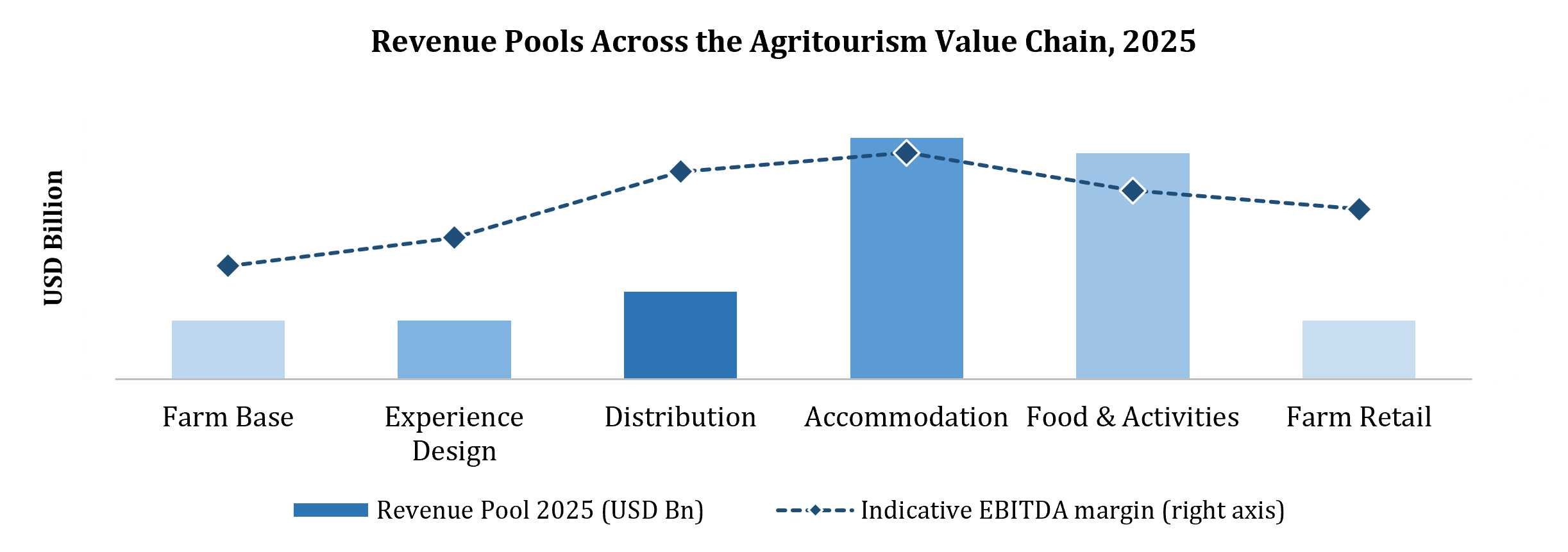
The value chain links farm assets and producers with experience design, distribution platforms, on-farm hospitality and visitor spend capture, with the balance of value varying sharply between farm-stay, agritainment and destination-estate models.
| Value-chain layer | Representative activities and participants | Commercial considerations |
| Farm assets and production | Working land, crops, livestock, vineyards, orchards, heritage buildings and farm families | Landscape quality, product story, biosecurity and the balance between farming and visitor use. |
| Experience design and packaging | Farm-stay design, tasting menus, harvest activities, workshops, tour operators and destination trails | Authenticity, safety, seasonality of the offer and ability to sell bundled experiences. |
| Distribution and discovery | OTAs, farm-stay marketplaces, RV and camping networks, tourism boards, social video and farm websites | Commission levels, review scores, search visibility and direct-booking share. |
| On-farm hospitality | Accommodation, food and beverage, guided tours, events, recreation and farm retail | Staffing, licensing, service consistency, occupancy and spend per visitor. |
| Support services | Insurance, liability advice, booking software, payment systems, training and extension services | Insurance cost, compliance support, digital tools and hospitality skills in rural areas. |
| Visitor and community outcome | Families, couples, schools, corporate groups, international guests and surrounding villages | Repeat visits, local sourcing, community acceptance and carrying capacity. |
Agritourism Value Chain and Revenue Pools.
| Farm Base › | Experience Design › | Distribution › | Accommodation › | Food & Activities › | Farm Retail |
| 8% of revenue pool | 8% of revenue pool | 12% of revenue pool | 33% of revenue pool | 31% of revenue pool | 8% of revenue pool |
 Global Agritourism Market Dynamics
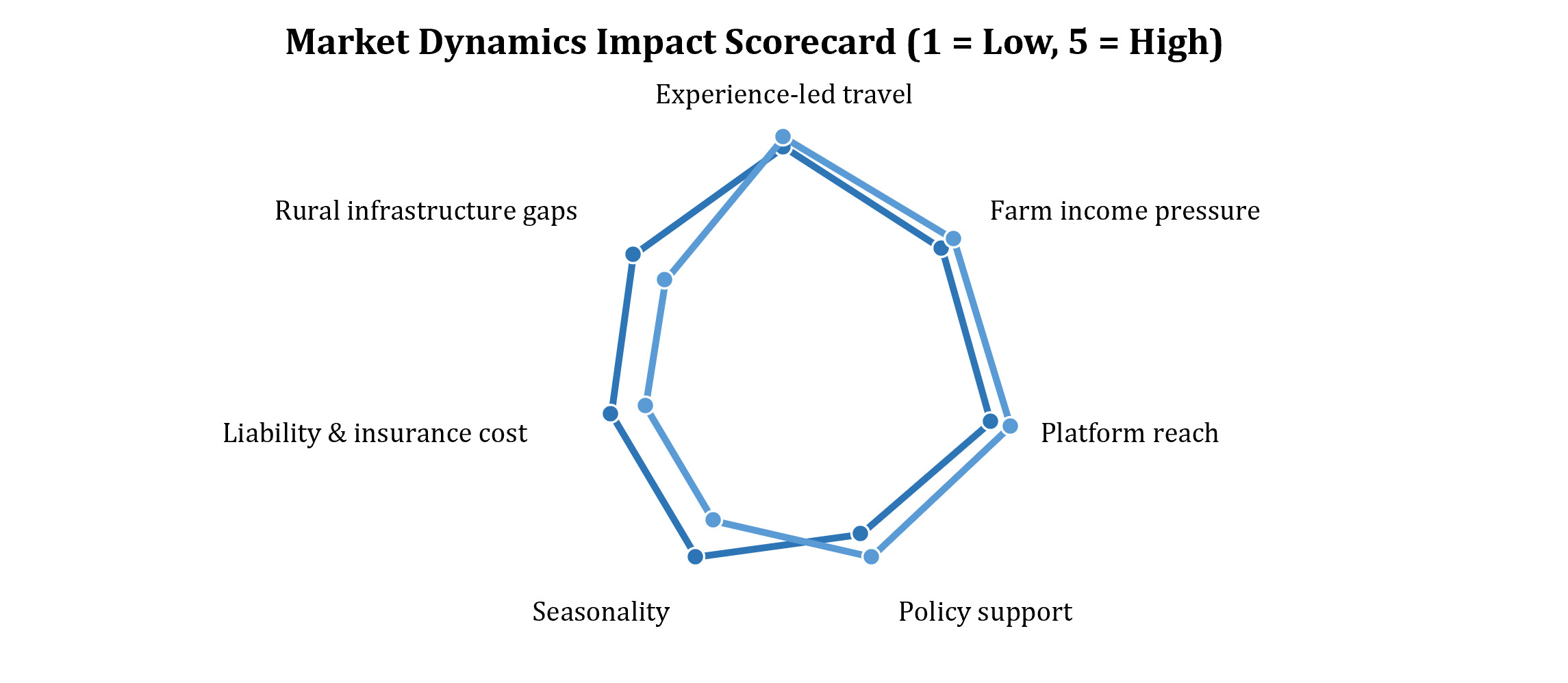
Global Agritourism Market Drivers
Rising Demand for Authentic, Experience-Led Rural Travel
Travellers increasingly look for slower, nature-based and food-focused experiences, and working farms offer what conventional hospitality cannot copy: real landscapes, livestock, harvest cycles and the farming family. Families, younger urban travellers and international guests are the core of this demand. Italian agriturismi recorded more than 4 million arrivals and 15.5 million overnight stays in 2023, with foreign guests accounting for 58% of nights, showing how strongly international visitors value farm-based stays.
Farm Income Pressure and Diversification
Volatile commodity prices, rising input costs and the phasing out of direct payments in markets such as England push farms toward steadier non-farm income. Agritourism uses assets the farm already holds and earns higher margins than many commodity enterprises. In England, 72% of farm businesses reported diversified activity in 2024/25, and in the United States agritourism and recreational income reached USD 1.26 billion in 2022, up 12.4% in real terms from 2017.
Global Agritourism Market Restraints
Seasonality, Liability Exposure and Rural Infrastructure Gaps
Demand concentrates around harvest periods, school holidays and good weather, so many farms earn most of their annual visitor revenue in a few weeks. Liability and insurance costs remain a concern; at least 39 US states have enacted agritourism limited-liability statutes, but protection differs by activity and state. Zoning rules, food-safety licensing, weak rural roads, patchy mobile coverage and a shortage of hospitality skills add cost and limit how far small farms can scale.
 Global Agritourism Market Opportunities
Premium Farm Stays and Destination Estates
Vineyard retreats, olive-estate stays, chef-led farm dining and glamping on working land command rates well above rural averages and attract international guests with longer stays. Branded quality networks, such as Austria’s Urlaub am Bauernhof cluster of around 2,350 farm hosts and 28,900 beds, show how shared standards and marketing can lift small farms into the premium segment.
Educational Tourism and Emerging Asian Demand
School trips, university field programmes and corporate team-building fill mid-week and off-season capacity. In India, Maharashtra’s 2020 agritourism policy roughly doubled registered centres to around 2,800, while Gansu province in China received 176 million rural tourism visitors in 2024. Demand of this scale rewards operators and investors that can package safe, well-run farm experiences for first-time rural travellers.
Global Agritourism Market Challenges
Fragmentation and Inconsistent Service Quality
Most operators are family farms with limited capital, so safety practices, guest facilities and service standards vary widely. In the United States, the number of farms reporting agritourism income has fallen from its 2012 peak of 33,161 even as revenue has grown, pointing to consolidation around larger, professionally managed operations and leaving smaller farms exposed on quality and visibility.
Over-Tourism, Carrying Capacity and Platform Dependence
Popular rural destinations face traffic, crowding and pressure on water, waste systems and farmland, which can erode community support. At the same time, reliance on a small number of booking platforms raises commission costs, weakens the direct relationship with guests and makes visibility dependent on review algorithms rather than farm quality alone.
Global Agritourism Market Trends
| Trend | Market development | Commercial implication |
| Farm-stay platform categories | Accommodation platforms and RV networks now feature dedicated farm, vineyard and ranch listings; Harvest Hosts alone lists more than 9,700 host locations. | Small farms gain reach without a sales team, but must manage reviews, pricing and commission exposure. |
| Short-form video discovery | Social video drives rural trip decisions; Douyin reported 19.9 million rural tourists booking through its platform over one year. | Visual storytelling and online booking links become core marketing tools for farms. |
| Regenerative and organic storytelling | Farms use soil health, biodiversity and organic practices as part of the guest experience and education. | Sustainability credentials support premium pricing and school and corporate demand. |
| Year-round programming | Weddings, concerts, wellness retreats, winter stays and workshops extend the season beyond harvest. | Smoother revenue improves staffing and justifies capital investment in permanent facilities. |
| Professional operating tools | Timed ticketing, dynamic pricing, season passes and membership models spread across agritainment farms. | Higher spend per visitor and better crowd control on peak weekends. |
The 2022 US Census of Agriculture recorded about 28,600 farms and ranches earning agritourism and recreational income, averaging around USD 44,000 in gross receipts per operation. The figures show that agritourism is now a meaningful farm enterprise in its own right, and that revenue growth is coming from higher spend per farm rather than a rising number of participants.
Global Agritourism Market Segment Analysis
| Segment Category | Sub-Segments | Key Insights |
| By Activity | Farm Stays & Accommodation; On-Farm Dining; Agritainment & Events; Farm Tours & Education; Outdoor Recreation; On-Farm Sales & U-Pick | Farm stays lead revenue through higher spend per guest and longer stays, while agritainment and educational tourism grow fastest, supported by family, school and event demand near metropolitan areas. |
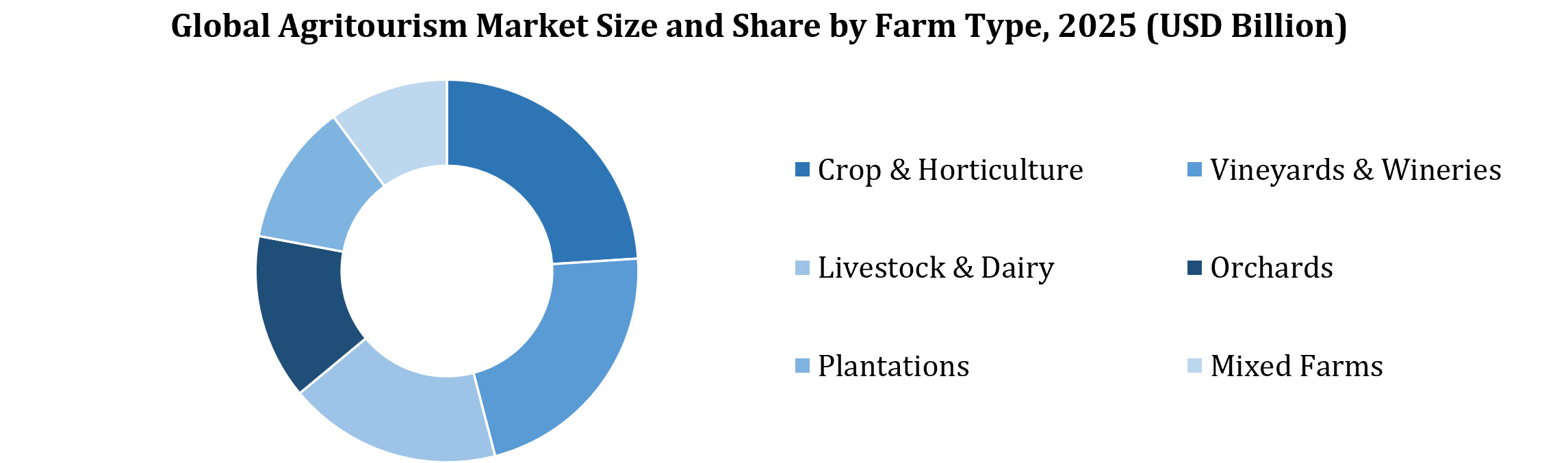
| By Farm Type | Crop & Horticulture Farms; Vineyards & Wineries; Orchards; Livestock & Dairy Farms; Plantations; Mixed Farms | Vineyards and wineries capture high value per visitor through tastings, dining and events, while crop, orchard and livestock farms drive volume through tours, pick-your-own and seasonal attractions. |
| By Tourist Type | Domestic; International | Domestic visitors account for most trips and day visits, while international guests stay longer and spend more, particularly in Italy, Austria, France and wine regions. |
| By Visitor Group | Families; Couples; Solo Travellers; School & Educational Groups; Corporate Groups | Families form the core of demand, couples drive premium stays and dining, and school and corporate groups provide valuable mid-week and off-season business. |
| By Booking Channel | Direct Booking; OTAs & Farm-Stay Platforms; Travel Agents & Tour Operators | Direct booking still leads due to local and repeat visitors, while OTAs and farm-stay platforms are the fastest-growing channel for overnight and international guests. |
| By Visit Type | Day Visits; Short Stays (1–3 Nights); Extended Stays (4+ Nights) | Day visits dominate volume, but short and extended stays generate the larger share of revenue through accommodation, food and activity bundles. |
Global Agritourism Market Size and Share by Farm Type, 2025
 Global Agritourism Market Regional Analysis:
The Global Agritourism Market shows distinct regional models shaped by farm structure, rural policy, tourism maturity and digital booking adoption. Europe relies on long-established farm-stay systems and food and wine tourism, North America on seasonal agritainment and event venues near cities, and Asia Pacific on government-led rural revitalisation and very large domestic travel markets.
REGIONAL OPPORTUNITY ASSESSMENT
| Region | Policy support | Product maturity | Suggested starting point |
| North America | Moderate | High | Agritainment and farm stays near metros |
| Europe | High | High | Premium farm stays and food and wine routes |
| Asia Pacific | High | Emerging | Village, plantation and educational tourism |
| Middle East & Africa | Selective | Emerging | Wine, date and safari-linked farms |
| South America | Selective | Moderate | Coffee, wine and estancia routes |
North America: The North America Agritourism Market is led by the United States, where farms and ranches earned USD 1.26 billion from agritourism and recreational services in 2022. The US model leans on pumpkin patches, corn mazes, pick-your-own, Christmas tree farms, wineries and event venues within driving distance of metropolitan areas. Texas has the largest number of agritourism businesses, while Vermont, Pennsylvania, Virginia and California combine strong local demand with orchard, maple, dairy and wine experiences. Canada adds farm-stay, orchard and wine tourism in Ontario, British Columbia and Quebec. Rising insurance costs, zoning disputes and labour availability remain key constraints.
Europe: The European Agritourism Market holds the largest share, supported by EU rural development funding, national legal frameworks and strong food and wine tourism. Italy is the reference market, with 26,360 authorised agriturismi in 2024, roughly double the 2003 level. Austria’s Urlaub am Bauernhof operates a quality-graded network of farm hosts, while Germany, France, Spain and the United Kingdom provide extensive farm-holiday, vineyard and gîte capacity. Planning restrictions, labour shortages and reinvestment needs in ageing farm buildings remain key challenges.
Asia Pacific: The Asia Pacific Agritourism Market is the fastest-growing region, driven by large domestic travel markets and policies that use tourism to raise rural incomes. China promotes leisure agriculture through designated leisure villages, rural tourism routes and village-level investment, and its rural tourism sector recorded about 3.3 billion visits before the pandemic. India is formalising agritourism through Maharashtra’s policy framework, with interest growing in Kerala, Karnataka, Goa and Punjab. Japan’s green tourism programmes, Australia’s wine and farm-gate trails, and plantation tourism in Sri Lanka, Thailand and Vietnam add further depth, though standards and rural infrastructure remain uneven.
India: India offers one of the least developed but most promising agritourism markets in Asia Pacific. Agriculture contributed nearly 16.5% of India's gross value added in 2019–20, and around two-thirds of the population depends on farming for income, giving the country a very large base of farms able to earn from visitors. The organised sector dates back to 2005, when Pandurang Taware set up the Agri-Tourism Development Corporation (ATDC) in Pune to diversify the rural economy, create rural employment and provide training and infrastructure support to farmers. Maharashtra remains the anchor state, with established centres such as the Baramati Agritourism Centre at Palshiwadi, and its 2016 tourism policy made an educational tour mandatory for students in classes V to X, creating a dependable school-visit segment. Farm stays in Kerala, Coorg in Karnataka, Goa, the Nilgiris, Darjeeling, Uttarakhand and Rajasthan extend the offer beyond Maharashtra, as Uttarakhand, Punjab, Rajasthan and Karnataka gradually adopt the model. Growth is held back by fragmented landholdings, limited access to credit, weak market orientation among farmers, low awareness of the concept, and uneven government support, so organised operators and state-level policy frameworks determine how quickly the Indian market scales.
Middle East & Africa: The Middle East and Africa Agritourism Market is at an early stage but developing. South Africa leads through the Cape Winelands, fruit routes and game farms that combine agriculture with wildlife tourism. Kenya, Morocco and Egypt offer tea, coffee, olive and date farm experiences linked to established tourism circuits, while Saudi Arabia, the UAE and Oman use date farms, highland fruit farms and desert agriculture to diversify tourism under national economic programmes. Water scarcity, limited rural infrastructure and uneven regulation restrict scale.
South America: The South America Agritourism Market is supported by coffee, wine and cattle-ranch experiences with strong international appeal. Argentina’s Mendoza wineries and estancias, Chile’s Central Valley vineyards, Colombia’s Coffee Cultural Landscape and Brazil’s farm hotels and Serra Gaúcha wine route lead regional demand, with Peru and Ecuador adding cacao and Andean farming experiences. Security perceptions, currency volatility, transport gaps and limited finance for small farms encourage route-based clusters rather than isolated farm projects.
Operating Models, Regulation and Sustainability Assessment
Farm-Level Operating Models and Revenue Mix
Agritourism operations usually follow one of three models. The overnight farm-stay model, built on rooms or cabins, meals and guided farm activities, delivers steadier year-round revenue. The agritainment model, built on admissions, seasonal attractions, food and retail, generates large revenue in short peaks near population centres. The destination-estate model, typically vineyards, olive estates or heritage farms, combines premium accommodation, a restaurant, events and product sales. Each model carries a distinct capital requirement, staffing profile and risk exposure, and the right choice depends more on location and farm assets than on operator preference.
Sustainability, Community Benefit and Carrying Capacity
Well-run agritourism keeps visitor spend in the local economy, supports small producers through farm shops and menus, and helps keep farmland in agricultural use by improving its economics. Poorly planned growth, however, strains water supply, roads, waste systems and neighbour relations. Operators and destination authorities increasingly track visitor caps, energy and water use, local sourcing and local employment, and these measures are becoming part of certification schemes, platform listings and public funding criteria.
Investment Prioritization
Agritourism investment decisions depend on catchment and travel time, farm product distinctiveness, regulatory readiness, seasonality, hospitality capability and booking-channel strategy. Staged investment, beginning with low-capital tours, events or glamping before committing to permanent accommodation or dining, reduces downside risk and builds review history before larger capital is deployed.
Regulatory Landscape and Policy Framework
Regulation shapes what a farm can legally offer and how quickly a regional agritourism sector develops. Liability statutes, zoning and land-use rules, food-safety and accommodation licensing, tax treatment and rural development funding all influence the product mix. Clear national definitions, such as Italy’s agriturismo law and Maharashtra’s agritourism policy, tend to unlock investment, while uncertain rules keep farms limited to low-risk day activities.
| Policy area | Market relevance | Business response |
| Liability and insurance | At least 39 US states limit liability for inherent agritourism risks when required signage and notices are in place. | Post statutory warnings, document safety procedures and match insurance cover to each activity. |
| Zoning and land use | Rules decide whether events, overnight stays and on-farm restaurants are permitted on agricultural land; Maharashtra allows registered centres without commercial land conversion. | Engage planners early, phase investments and design activities within permitted use. |
| Rural development and tourism policy | EU rural development funds, national agritourism laws and state policies provide grants, tax benefits and promotion. | Align projects with funding criteria, quality grading and regional trail programmes. |
Global Agritourism Market Future Outlook through 2034
Over the forecast horizon, agritourism is likely to become a mainstream farm enterprise and a recognised tourism category, supported by rural development policy, platform distribution and consumer interest in food origins. The pace of growth depends on clearer regulation in emerging markets, better rural infrastructure and the ability of small farms to deliver consistent hospitality. Investment should prioritise year-round products, premium and educational experiences, digital distribution and quality certification. Location, product authenticity, and operating discipline, rather than the number of farms opening their gates, determine durable returns.
Competitive Landscape and Key Market Participants
The agritourism market is highly fragmented, with tens of thousands of independent farm operators alongside booking platforms, national farm-stay associations and branded destination estates. Competition rests on location, landscape, authenticity, food quality, safety and reviews at the farm level, and on reach, trust and commission terms at the platform level. The organisations listed below participate in one or more covered activities; their inclusion does not indicate market ranking.
| Participant type | Representative organisations | Basis of competition |
| Booking and experience platforms | Airbnb; Booking Holdings; Expedia Group (Vrbo); Tripadvisor (Viator); GetYourGuide; Klook | Listing reach, trust and reviews, commission rates, search ranking and payment services. |
| Farm-stay and outdoor marketplaces | Hipcamp; Harvest Hosts; Glamping Hub; The Dyrt; Canopy & Stars; Agriturismo.it; Farmstay US; Farm Stay UK | Niche audience, farm-specific filters, host onboarding and low-capital listing models. |
| National farm-stay associations | Urlaub am Bauernhof Österreich; Agriturist; Terranostra; Turismo Verde; Bienvenue à la Ferme; Gîtes de France; WWOOF; NAFDMA | Quality grading, shared marketing, member standards and policy representation. |
| Destination farm estates | Blackberry Farm; Borgo Santo Pietro; Rosewood Castiglion del Bosco; Masseria Torre Maizza; Castello Banfi; Babylonstoren; Daylesford Organic; Robert Mondavi Winery; Treasury Wine Estates; Sula Vineyards | Premium hospitality, culinary reputation, landscape and brand. |
| Agritainment and heritage farms | Cox Farms; Shelburne Farms; Billings Farm & Museum; Stone Barns Center; Farm Tomita; Mother Farm; Koiwai Farm; Singha Park | Seasonal attractions, education programmes, visitor volume and repeat local demand. |
| Agritourism developers and networks | Agri Tourism Development Corporation (ATDC); Saguna Baug; Hacienda Venecia; Kiambethu Tea Farm | Farmer training, centre development, rural packaging and inbound demand. |
Key Market Participants
| Organisation | Organisation |
| 1. Airbnb, Inc. | 2. Booking Holdings Inc. |
| 3. Expedia Group, Inc. (Vrbo) | 4. Tripadvisor, Inc. (Viator) |
| 5. GetYourGuide AG | 6. Klook Travel Technology Limited |
| 7. Hipcamp, Inc. | 8. Harvest Hosts |
| 9. Glamping Hub | 10. The Dyrt |
| 11. Canopy & Stars (Sawday's) | 12. Agriturismo.it |
| 13. Farmstay US | 14. Farm Stay UK |
| 15. Urlaub am Bauernhof Österreich | 16. Agriturist (Confagricoltura) |
| 17. Terranostra (Coldiretti) | 18. Turismo Verde (CIA – Agricoltori Italiani) |
| 19. Bienvenue à la Ferme | 20. Gîtes de France |
| 21. WWOOF International | 22. North American Farmers' Direct Marketing Association (NAFDMA) |
| 23. Blackberry Farm | 24. Borgo Santo Pietro |
| 25. Rosewood Castiglion del Bosco | 26. Masseria Torre Maizza (Rocco Forte Hotels) |
| 27. Castello Banfi | 28. Babylonstoren |
| 29. Daylesford Organic | 30. Stone Barns Center for Food and Agriculture |
| 31. Cox Farms | 32. Shelburne Farms |
| 33. Billings Farm & Museum | 34. Robert Mondavi Winery |
| 35. Treasury Wine Estates | 36. Farm Tomita |
| 37. Mother Farm | 38. Koiwai Farm |
| 39. Singha Park | 40. Kiambethu Tea Farm |
| 41. Hacienda Venecia | 42. Sula Vineyards |
| 43. Agri Tourism Development Corporation (ATDC) | 44. Saguna Baug |
Agritourism Market Scope and Research Coverage:Inquire before buying
| Coverage parameter | Definition/coverage |
|---|---|
| Market | Global Agritourism Market |
| Base year | 2025 |
| Historical period | 2020–2025 |
| Forecast period | 2026–2034 |
| 2025 market size | USD 11.6 Billion |
| 2034 market forecast | USD 30.6 Billion |
| CAGR | 11.4% during 2026–2034 |
| By Activity | Farm Stays & Accommodation On-Farm Dining Agritainment & Events Farm Tours & Education Outdoor Recreation On-Farm Sales & U-Pick |
| By Farm Type | Crop & Horticulture Farms Vineyards & Wineries Orchards Livestock & Dairy Farms Plantations Mixed Farms |
| By Tourist Type | Domestic International |
| By Visitor Group | Families Couples Solo Travellers School & Educational Groups Corporate Groups |
| By Booking Channel | Direct Booking OTAs & Farm-Stay Platforms Travel Agents & Tour Operators |
| By Visit Type | Day Visits Short Stays (1–3 Nights) Extended Stays (4+ Nights) |
| Regions | North America Europe; Asia Pacific Middle East & Africa South America |
Frequently Asked Questions
What is the Global Agritourism Market size?
The market is estimated at USD 11.6 billion in 2025.
What is the forecast value of the market by 2034?
The market is projected to reach USD 30.6 billion by 2034.
What is the expected CAGR?
The market is projected to grow at a CAGR of 11.4% during 2026–2034.
What are the key growth drivers?
Key growth drivers include demand for authentic rural and food experiences, farm income diversification, the reach of farm-stay and outdoor-hospitality platforms, and government rural development and agritourism policies.
Which region dominates the market?
Europe leads the agritourism market, supported by mature farm-stay systems in Italy, Austria, Germany, France, and the United Kingdom, while Asia Pacific is the fastest-growing region.
What are the emerging trends?
Emerging trends include dedicated farm-stay categories on booking platforms, short-form video discovery, regenerative farming narratives, year-round programming such as weddings and wellness retreats, and the use of timed ticketing and dynamic pricing.
Who are the key players in the market?
The market is highly fragmented. Leading participants include booking and experience platforms such as Airbnb, Booking Holdings, Expedia Group, Tripadvisor, Hipcamp and Harvest Hosts; farm-stay associations such as Urlaub am Bauernhof Österreich, Agriturist, Terranostra and Bienvenue à la Ferme; and destination estates and agritourism operators such as Blackberry Farm, Borgo Santo Pietro, Babylonstoren, Stone Barns Center and Sula Vineyards.