
Image Intensifier Market By Product, By Type of Intensifier, By Diameter, By End-Use Industry, By Application and by Regional Insight 2034
Overview
Global Image Intensifier Market Size & Forecast:
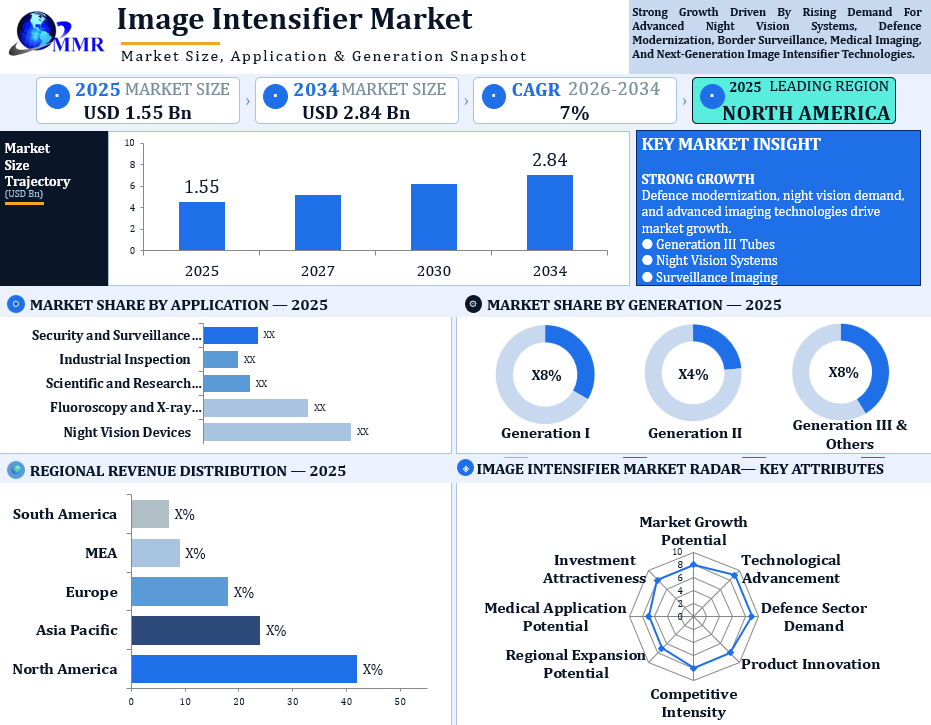
Image Intensifier market was valued at US$ 1.55 Bn in 2025 and expected to grow at a CAGR of 7.00% during the forecast period (2025-2034).
| Parameter | Value |
| Market Size (2025) | USD 1.55 Billion |
| Market Size (2034) | USD 2.84 Billion |
| CAGR 7.00% | 7.00% |
| Historical Period | 2020–2025 |
| Forecast Period | 2026-2034 |
Image Intensifier Market Overview:
The Global Image Intensifier Market comprises electronic optical devices designed to amplify low levels of light and convert weak optical signals into brighter, clearer, and more visible images. Image intensifiers use photocathodes, electron multiplication systems, microchannel plates, and phosphor screens to improve image brightness and visibility in low-light environments. These devices are widely used in night vision goggles, monoculars, binoculars, surveillance cameras, weapon sights, X-ray imaging systems, fluoroscopy equipment, and scientific imaging instruments. The market scope covers image intensifier tubes and related devices used across defence, healthcare, industrial, and scientific applications.
The global image intensifier market is evolving with increasing defence modernization, rising military expenditure, border surveillance requirements, and advancements in low-light imaging technologies. Growing adoption of Generation II and Generation III image intensifier tubes, compact night vision systems, high-sensitivity imaging components, and advanced medical fluoroscopy equipment is creating new growth opportunities. North America represents a major regional market, supported by substantial defence procurement, established military technology manufacturers, and advanced healthcare infrastructure, while Asia Pacific is gaining importance through increasing defence investments and medical imaging modernization. Key industry participants, including L3Harris Technologies, Elbit Systems, Exosens, Hamamatsu Photonics, and Canon, are focusing on product innovation, improved image resolution, lightweight tube designs, and advanced optical technologies to strengthen their market positions.
Maximize Market Research's Global Image Intensifier Market Report provides a comprehensive assessment of market size, market share, growth trends, industry dynamics, and competitive positioning across major regions and countries. The report evaluates market segmentation by generation, phosphor type, diameter, application, end-use vertical, and geography, along with detailed analysis of key growth drivers, restraints, opportunities, and emerging technological developments. It also examines the competitive landscape, leading manufacturers, product portfolios, strategic developments, and regional demand patterns to help clients identify high-growth segments, assess investment opportunities, understand competitive strategies, and make informed business decisions in the global image intensifier industry.
Global Image Intensifier Market Growth Outlook
To Know about the Research Methodology: Request Free Sample Report
Global Image Intensifier Market Key Highlights:
• Leading Region: North America holds a prominent position, supported by defence modernization, military surveillance investments, and advanced medical imaging infrastructure.
• Fastest-Growing Region: Asia Pacific is witnessing increasing demand due to rising defence expenditure, border security requirements, and healthcare infrastructure development.
• Key Application: Night vision and defence surveillance applications represent major demand areas for image intensifier technology.
• Major Growth Driver: Increasing adoption of Generation II and Generation III image intensifier tubes is supporting demand for advanced low-light imaging systems.
Global Image Intensifier Market Dynamics:
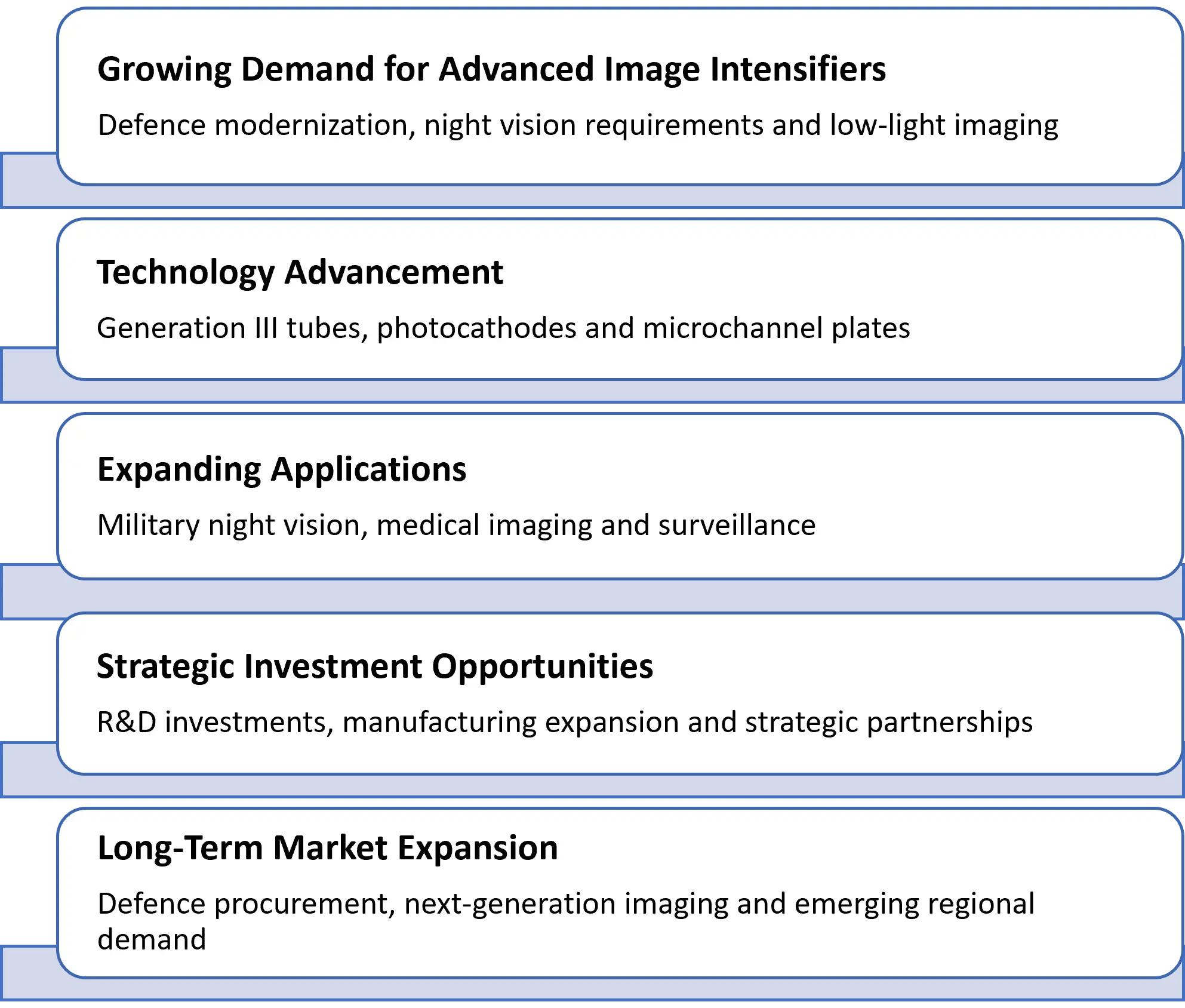
Rising Defence Modernization and Increasing Demand for Night Vision Surveillance Systems Drive Market Growth
Increasing defence modernization programmes, military spending, border security requirements, and tactical surveillance activities are driving demand in the global image intensifier market. Image intensifier tubes are extensively used in night vision goggles, weapon sights, binoculars, monoculars, and military surveillance equipment to improve visibility in low-light environments. According to MMR Analysis, global military expenditure reached USD 2.718 trillion in 2024, increasing by 9.4% compared with 2023. This growing defence investment supports procurement of advanced Generation II and Generation III image intensifier tubes, high-performance night vision devices, and electro-optical systems. Increasing demand for 24/7 battlefield monitoring and border protection is further strengthening the adoption of image intensifier technology.
High Manufacturing Costs and Increasing Availability of Digital Night Vision Alternatives Restrain Market Growth
The global image intensifier market faces restraints due to high manufacturing costs, complex optical component integration, and the specialized production requirements of high-performance image intensifier tubes. Advanced Generation III image intensifiers require sophisticated photocathode materials, microchannel plates, vacuum processing, and precision phosphor screen technologies, increasing production expenses. Additionally, digital night vision cameras, thermal imaging systems, and complementary metal-oxide-semiconductor (CMOS) sensors provide alternative low-light imaging solutions for defence, security, and industrial applications. These technologies offer features such as digital recording, image enhancement, and easier integration with electronic systems. Price-sensitive customers and smaller defence organizations may therefore experience challenges in adopting premium image intensifier equipment, limiting market penetration.
Technological Advancements in Next-Generation Image Intensifier Tubes Create Lucrative Market Opportunities
Continuous advancements in photocathode sensitivity, microchannel plate technology, phosphor screen performance, and compact optical designs are creating significant opportunities in the global image intensifier market. Manufacturers are focusing on developing lightweight, high-resolution, low-noise, and energy-efficient image intensifier tubes to improve night vision performance across military and civilian applications. The development of Generation III and advanced thin-filmed image intensifier technologies is supporting improved image clarity and detection capabilities under extremely low-light conditions. Furthermore, increasing investments in defence modernization, unmanned surveillance platforms, aerospace imaging, and advanced medical fluoroscopy systems are creating opportunities for image intensifier manufacturers. Strategic partnerships, product innovation, and expansion into emerging defence markets can further strengthen industry growth through 2034.
Technical Limitations and Competition from Thermal Imaging Technologies Challenge Market Expansion
The global image intensifier market faces challenges associated with performance limitations, component reliability, technological competition, and integration requirements. Image intensifier devices depend on available ambient light and may experience reduced visibility in extremely dark environments without supplementary illumination. Exposure to intense light can also damage or temporarily degrade certain image intensifier tubes, creating operational limitations in changing lighting conditions. Additionally, thermal imaging cameras can detect heat signatures without relying on visible ambient light, creating strong competition in military surveillance, security monitoring, and search-and-rescue applications. Manufacturers must also address challenges related to product miniaturization, image resolution, power consumption, durability, and compliance with defence export regulations. Balancing technological performance with manufacturing costs remains important for maintaining competitiveness.
Global Image Intensifier Market Trends:
| Key Market Trends | Description | Impact on the Market |
| Advancements in Image Intensifier Technology | Development of advanced Gen 3 and 5G tubes with improved resolution, sensitivity, and image clarity. | Drives demand for technologically advanced night vision devices. |
| Growing Adoption of White Phosphor Technology | Increasing preference for white phosphor tubes offering better contrast and detailed image perception. | Supports adoption in military goggles, weapon sights, and surveillance systems. |
| Increasing Demand for Binocular Night Vision Systems | Growing use of binocular night vision devices to enhance depth perception and situational awareness. | Increases demand for dual-tube image intensifier systems. |
| Integration with Thermal Imaging | Integration of image intensifier tubes with thermal sensors for improved visibility and target identification. | Expands demand for multi-sensor night vision and surveillance equipment. |
| Rising Military Modernization | Increasing defence investments in soldier modernization, border security, and night vision equipment. | Boosts procurement of advanced image intensifier tubes for military applications. |
| Miniaturization of Image Intensifier Devices | Development of compact and lightweight tubes for helmet-mounted goggles and portable night vision devices. | Improves device portability and supports wider adoption among defence personnel. |
| Expansion of Domestic Manufacturing | Government initiatives supporting local production and technology development in defence imaging equipment. | Strengthens domestic supply chains and creates opportunities for regional manufacturers. |
Global Image Intensifier Market Segment Analysis:
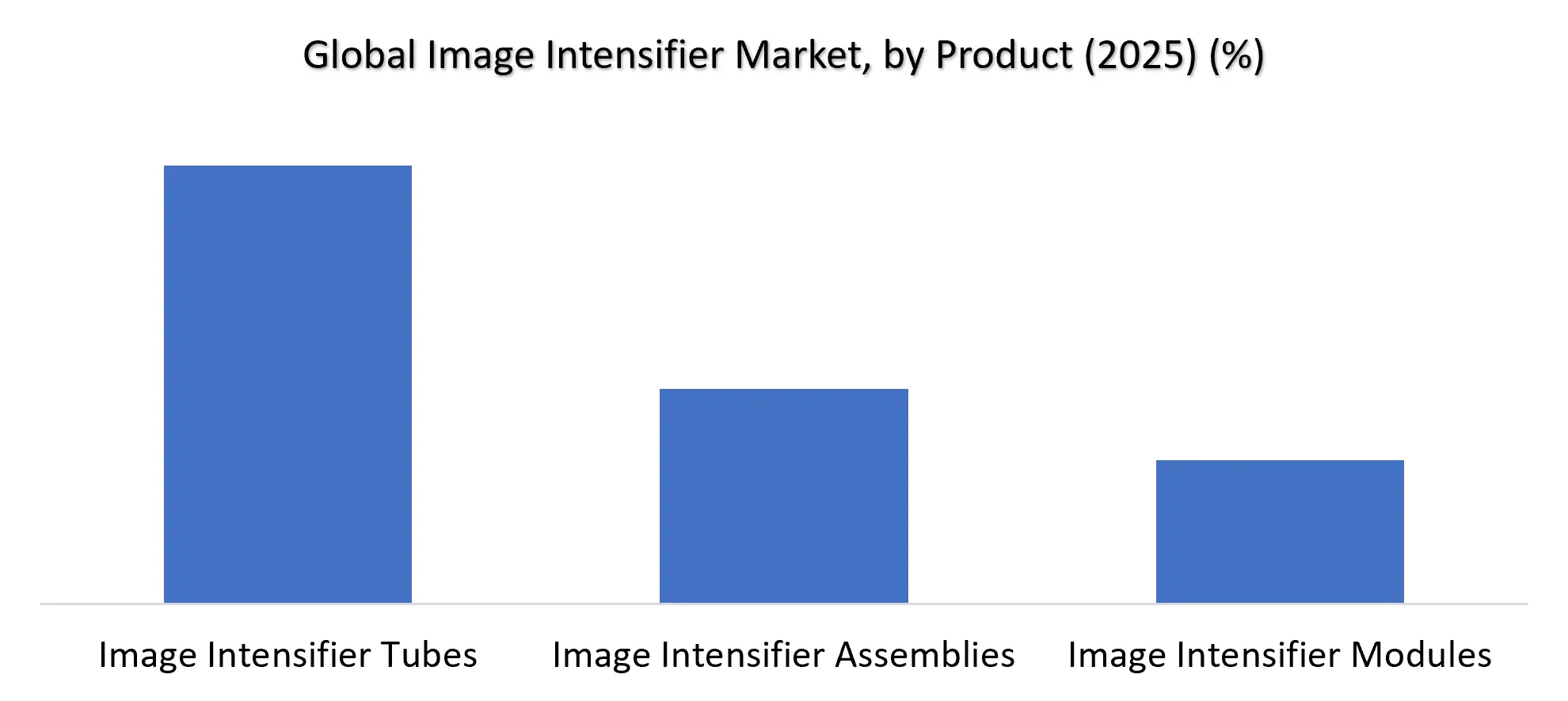
Global Image Intensifier Market, By Product
Image intensifier tubes account for the core product category in the global image intensifier market, driven by their extensive use in night vision goggles, monoculars, binoculars, surveillance systems, and medical imaging equipment. Image intensifier assemblies support integrated imaging solutions by combining intensifier tubes with optical and electronic components. Image intensifier modules also gain relevance as manufacturers focus on compact, ready-to-integrate imaging solutions for defence, security, industrial, and healthcare applications. Growing demand for advanced low-light imaging and high-performance night vision equipment supports product development across these categories.
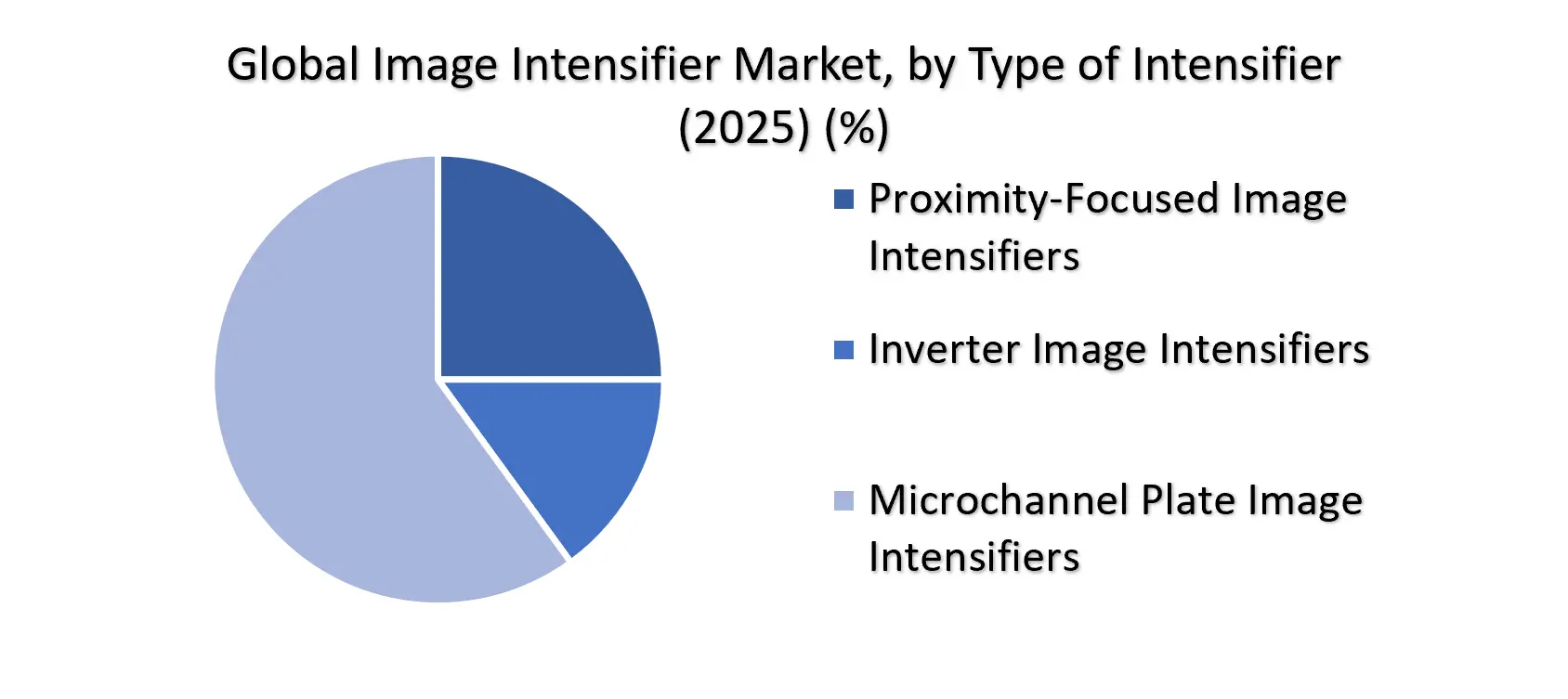
Global Image Intensifier Market, By Type of Intensifier
Microchannel plate image intensifiers represent an important technology category in the global image intensifier market due to their high electron multiplication capability, improved image brightness, and enhanced low-light sensitivity. These intensifiers are widely incorporated into advanced night vision devices used in military operations, border surveillance, and security applications. Proximity-focused image intensifiers support compact imaging configurations, while inverter image intensifiers are used in applications requiring image conversion and specialized optical arrangements. Continuous improvements in image resolution, sensitivity, and compact device design support technology adoption across defence, medical, and industrial imaging applications.
Global Image Intensifier Market Regional Analysis:
North America represents an important market for image intensifier technology, supported by strong defence spending, military modernization, and advanced homeland security infrastructure. The United States drives regional demand through the procurement of night vision goggles, image intensifier tubes, weapon sights, surveillance equipment, and low-light imaging systems for military operations. Canada also contributes through defence surveillance, border monitoring, and healthcare imaging investments, while Mexico offers opportunities in law enforcement and public security applications. The presence of established manufacturers and advanced research facilities further strengthens the regional image intensifier market, particularly across defence, medical imaging, and industrial inspection applications.
Asia Pacific is gaining importance in the global image intensifier market due to rising defence expenditure, military modernization, and expanding healthcare infrastructure. China and India contribute to demand through investments in night vision devices, border surveillance systems, military optics, and advanced imaging technologies. Japan and South Korea support the market through their established electronics, photonics, and medical imaging industries. Australia also creates opportunities through defence surveillance and military equipment modernization. Furthermore, increasing hospital infrastructure, diagnostic imaging requirements, industrial inspection, and scientific research activities support the adoption of image intensifier tubes and imaging assemblies. These developments strengthen regional demand for compact and high-performance low-light imaging solutions.
Europe maintains a strong position in the global image intensifier market, supported by defence modernization, advanced optical manufacturing, and established healthcare infrastructure. Germany, France, and the United Kingdom contribute to regional demand through military procurement, night vision technology development, and investments in advanced surveillance systems. Countries such as Italy, Spain, and Poland also support market growth through defence equipment upgrades and border security requirements. The region benefits from established image intensifier manufacturers and research capabilities, particularly in Generation II and Generation III technologies, photocathodes, and microchannel plate systems. Demand for medical fluoroscopy, scientific imaging, and industrial inspection further strengthens the European image intensifier market.
The Middle East & Africa image intensifier market is supported by defence modernization, border surveillance, homeland security, and investments in healthcare infrastructure. Saudi Arabia and the United Arab Emirates are important demand centres due to their focus on military equipment upgrades, security systems, and advanced surveillance technologies. Israel and Türkiye also contribute through defence electronics, night vision equipment, and optical technology development. In Africa, South Africa and Egypt represent potential markets for image intensifier tubes used in defence, security, and medical imaging applications. Growing requirements for night vision goggles, low-light cameras, fluoroscopy systems, and industrial inspection equipment create opportunities for manufacturers and technology suppliers across the region.
South America presents emerging opportunities in the global image intensifier market as governments strengthen border protection, public safety, and defence surveillance capabilities. Brazil represents a significant regional market through its military modernization initiatives, security requirements, and investments in surveillance technologies. Argentina, Chile, and Colombia also contribute to demand for night vision devices, image intensifier tubes, and low-light imaging equipment across military, law enforcement, and border monitoring applications. Healthcare infrastructure development creates additional opportunities for image intensifier-based fluoroscopy and X-ray imaging systems. Increasing interest in advanced security equipment and modernization of diagnostic imaging facilities supports the gradual expansion of the regional market.
Global Image Intensifier Market Recent Developments:
| Date | Recent Development | Market Impact |
| January 2026 | Exosens secured an order from ACTinBlack for more than 7,000 5G image intensifier tubes for European Special Forces night vision systems. | Creates opportunities for advanced night vision tubes and military imaging equipment manufacturers. |
| April 2026 | L3Harris Technologies was selected by the U.S. Army to supply its NOVA night vision goggle system under the BiNOD program, through a contract worth up to USD 465 million. | Strengthens defence-sector demand for image intensifier tubes and integrated night vision assemblies. |
| August 2026 | Photonis Defense, an Exosens subsidiary, received its first delivery order for 1,600 complete systems under the U.S. Army's BiNOD program. | Supports manufacturing expansion and creates opportunities for image intensifier system suppliers. |
| October 2026 | L3Harris received an additional USD 55 million award from the U.S. Army to supply NOVA night vision goggle systems under the BiNOD program. | Supports continued demand for image intensifier technology in military modernization and defence surveillance. |
Global Image Intensifier Market Competitive Landscape:
The global image intensifier market is highly competitive, with leading players focusing on Generation III image intensifier tubes, advanced photocathode technology, microchannel plates, night vision systems, and defence imaging solutions. Companies such as Exosens, L3Harris Technologies, Elbit Systems, THEON International, Hamamatsu Photonics, Excelitas Technologies, Thales, Photek, and Teledyne FLIR strengthen their market positions through product innovation, strategic acquisitions, manufacturing expansion, and defence contracts. Exosens expanded its night vision capabilities through the acquisition of NVLS in 2025 and launched its advanced 5G image intensifier tubes. It also extended its long-term supply agreement with THEON International through 2030 and secured a major order from ACTinBlack in 2026. Similarly, L3Harris Technologies received a U.S. Army contract worth up to USD 465 million for its NOVA night vision goggle system, while Elbit Systems secured a development and testing contract for its binocular night vision system. These developments highlight how technological advancements, strategic partnerships, mergers and acquisitions, and growing military procurement are shaping competition in the global image intensifier market.
Global Image Intensifier Market Scope: Inquiry Before Buying
| Global Image Intensifier Market | |||
|---|---|---|---|
| Report Coverage | Details | ||
| Base Year: | 2025 | Forecast Period: | 2026-2034 |
| Historical Data: | 2020 to 2025 | Market Size in 2025: | USD 1.55 Billion |
| Forecast Period 2026 to 2034 CAGR: | 7% | Market Size in 2034: | USD 2.84 Billion |
| Segments Covered: | By Product | Image Intensifier Tubes Image Intensifier Assemblies Image Intensifier Modules |
|
| By Type of Intensifier | Proximity-Focused Image Intensifiers Inverter Image Intensifiers Microchannel Plate Image Intensifiers |
||
| By Diameter |
Below 18 mm 18 mm 25 mm Above 25 mm |
||
| By End-Use Industry | Defense and Military Healthcare Law Enforcement and Homeland Security Industrial Manufacturing Research and Academia |
||
| By Application | Night Vision Devices Fluoroscopy and X-ray Imaging Scientific and Research Imaging Industrial Inspection Security and Surveillance Imaging |
||
Global Image Intensifier Market, by Region
• North America (United States, Canada and Mexico)
• Europe (UK, France, Germany, Italy, Spain, Sweden, Austria and Rest of Europe)
• Asia Pacific (China, South Korea, Japan, India, Australia, Indonesia, Malaysia, Vietnam, Taiwan, Bangladesh, Pakistan and Rest of APAC)
• Middle East and Africa (South Africa, GCC, Egypt, Nigeria and Rest of ME&A)
• South America (Brazil, Argentina, Rest of South America)
Global Image Intensifier Market Key Players:
1. Exosens S.A.
2. L3Harris Technologies, Inc.
3. Hamamatsu Photonics K.K.
4. Excelitas Technologies Corp.
5. KATOD LLC
6. Intevac, Inc.
7. Photek Limited
8. ProxiVision GmbH
9. Andor Technology Ltd.
10. Stanford Computer Optics, Inc.
11. Lambert Instruments B.V.
12. Teledyne FLIR LLC
13. MKU Limited
14. New Vision Display (Shenzhen) Co., Ltd.
15. Suzhou Rixin Optoelectronics Co., Ltd.
16. Beijing Etron Technology Inc.
17. Hubei Photonics Electronic Technology Co., Ltd.
18. Elbit Systems Ltd.
19. Thales Group
20. Night Vision Devices, Inc.
21. BAE Systems plc
22. Theon International Plc
23. Xi'an Guangke Zhitong Electronic Technology Co., Ltd.
24. ONEX Corporation Ltd.
25. Night Hawk Technology, Inc.
26. IRIS USA, Inc.
27. ASELSAN A.Ş.
28. ATN Corporation
29. Kappa optronics GmbH
30. Princeton Instruments
31. Northrop Grumman Corporation
32. Canon Medical Systems Corporation
33. GE HealthCare Technologies Inc.
34. Koninklijke Philips N.V.
35. Siemens Healthineers AG
36. Shimadzu Corporation
37. RTX Corporation
38. Photonic Science and Engineering Limited
39. Optronics International
40. ITT Inc.
Frequently Asked Questions:
1. Which region has the largest share in the Image Intensifier Market?
Ans: North America holds the largest share of the global image intensifier market, driven by strong defence spending and military modernization.
2. What is the growth rate of the Image Intensifier Market?
Ans: The Image Intensifier Market is growing at a CAGR of 7.00 % during the forecasting period 2025-2034.
3. What segments are covered in the Image Intensifier Market?
Ans: The Image Intensifier Market is segmented into diameter, application, and end-user.
4. Who are the key players in the Image Intensifier Market?
Ans: L3 Technologies, Thales, Flir Systems, Photonis, Harris, Canon Medical Systems, Siemens, Alpha Optics Systems, Katod, Photek, Argus Imaging, Meomed, Aselsan, Harder Digital, Dantec Dynamics, Lambert Instruments, Yukon Advanced Optics, Proxivision, DEP Technologies, TAK Technologies, Optexim JSC
5. What is the study period of this market?
Ans: The Image Intensifier Market is studied from 2020 to 2034.