
System on Chip Market – Industry Structure Evaluation, Demand Drivers Analysis, Regional Growth Analysis and Identification, Competitive Positioning Review & Global Market Size Forecast to 2034
Overview
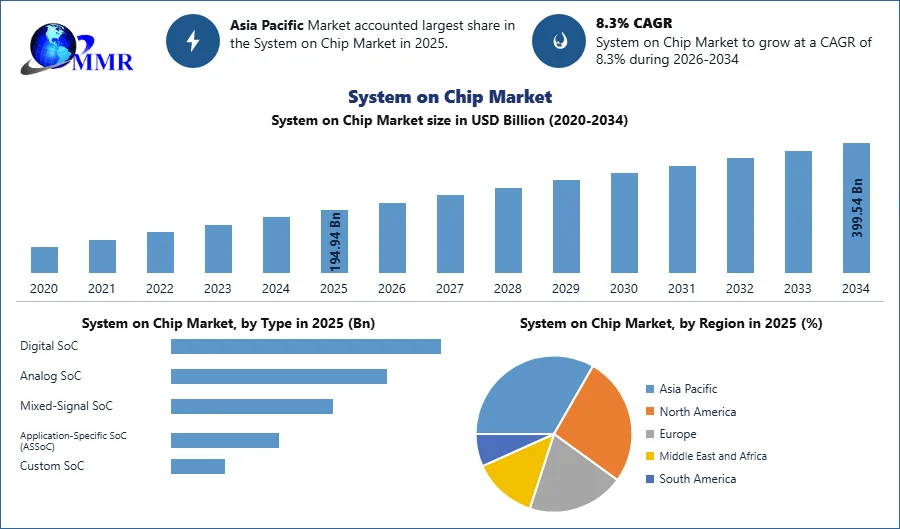
The System on Chip Market size was valued at USD 194.94 billion in 2025, and the total System on Chip revenue is expected to grow at a CAGR of 8.3% from 2025 to 2034, reaching nearly USD 399.54 billion.
System on Chip Market Overview:
System-on-chip (SoC) is an integrated circuit (IC). It consists of several components like memory blocks, timing units, control units, and interfaces mounted on one single chip. It is similar to the central processing unit (CPU) of the computer. Currently, growth of the global semiconductor industry is driven by the demand for cutting-edge electronic devices like desktops, laptops and wireless communication products. An increase in deployment solution of cloud-based computing is expected to drive the market growth. The Growth is expected to continue with new application drivers for the high-performance computer technology.
System on Chip Market Size, Growth & Share Analysis
To know about the Research Methodology :- Request Free Sample Report
System on Chip Market Dynamics:
The System-on-Chip (SoC) industry has developed rapidly from producing VLSI devices that integrated a processor and a few memory components onto a single chip to high-performance SoCs that incorporate hundreds of IP blocks. An increase in popularity of the Internet of Things (IoT) has increased the demand and development of products, which contain System on a Chip (SoC) technology. Many consumers are opting for devices, which have better battery back-up, better efficiency and minimum power consumption. An increase in consumer demand for electronics products, which deliver enhanced performance as well as consume less power are expected to boost the market growth. SoC provides faster execution of tasks because of its memory and high-speed processor features. The demand for smart and power-efficient electronic devices are increasing, which is expected to drive the system-on-chip market growth in the near future.
The global system on chip market is driven by high investment in 5G technology across globe. The compact nature of SOC and the adoption of IoT are boosting the demand for system on chip. The demand for smart and power-efficient electronic devices are also impelling the market growth. The cost reduction benefits of each function of integrated circuits (IC scalable ICs in the), the need for multi-core technologies and embedded graphics are some of the driving factors, which are expected to drive market growth in the near future. On the other hand, high initial cost of design & development is limiting the market growth. The requirement for electronics products miniaturization is expected to create lucrative opportunities in the global system on chip market.
The Amount of Data Growing Exponentially: Drives the Adoption of System On Chip
In the current market scenario, the amount of data is growing exponentially, which become trend that will be accelerated by the rollout of 5G networks across developing economies. The more servers are required to high data processing and storage. The high-end central processing units (CPUs) and graphical processing units (GPUs) are the heart of servers. It also supports a host of datacentre applications like supercomputing and high-performance-computing as a service. The future of the semiconductor industry is leveraging technology trends like artificial intelligence (AI) and the internet of things (IoT) that is expected to increase the need for system on chip.
Opportunity: The System on Chip is widely used in smartphones, tablets, and wearables products. SoCs integrate all the components of a computer onto one small piece. It combines the hardware products like central processing unit, internal memory, and input/output ports, into one unit. The multitasking functionality of Soc enables powerful computer processing on compact motherboard configurations. SoCs need less energy to power and can operate using internal batteries and offers benefits like it helps to reduce power consumption. More than 30% of the global SoC patents are registered to major tech service providers like Intel, Samsung, Qualcomm, Ericsson, and Huawei. As the demand for SoC technology is expected to grow continuously source SoC components put quality assurance and customer service at the forefront.
Slow Down in the global economy: Limit the market Growth
The system on chip technologies serves mostly industrial customers. Despite the increased the demand for the system on chip in the consumer electronics and the automotive sector, key players are facing some problems like market slowdown in key customers segments in particular the automotive industry and electronics industry. The economic environment of the market growth has characterized by persisting economic and geopolitical risk and decline in the demand from major industries.
System on Chip Market Segment Analysis:
By SoC Type
The Digital SoC (System-on-Chip) segment dominated the market in 2025, accounting for the largest share due to its extensive deployment across smartphones, personal computers, AI-enabled devices, networking equipment, automotive electronics, and industrial automation systems. Digital SoCs integrate processing cores, graphics engines, memory controllers, communication interfaces, and security modules onto a single silicon die, enabling higher computing performance while reducing power consumption and manufacturing costs. Their ability to execute complex digital workloads efficiently has made them the preferred architecture for high-volume semiconductor applications.
The rapid expansion of artificial intelligence, 5G infrastructure, edge computing, and cloud services significantly accelerated demand for Digital SoCs. Leading semiconductor manufacturers including Qualcomm, Apple, MediaTek, NVIDIA, Samsung, AMD, Intel, and Broadcom continued investing in advanced Digital SoC platforms fabricated using 3 nm, 4 nm, and 5 nm process technologies to improve computational performance and energy efficiency. These chips increasingly integrate AI accelerators, dedicated neural processing units (NPUs), advanced GPUs, and hardware security modules, allowing manufacturers to deliver higher performance within compact device footprints.
By Application
The Smartphones & Tablets segment held as the largest application segment in 2025, supported by consistently high global shipment volumes and the increasing integration of advanced System-on-Chip (SoC) platforms into mobile devices. Modern smartphones rely on highly integrated SoCs that combine CPUs, GPUs, AI accelerators, image signal processors (ISPs), modem processors, connectivity modules, memory controllers, and security engines within a single semiconductor package. This integration reduces component count, improves battery life, lowers manufacturing costs, and delivers higher computing performance.
Global demand for 5G smartphones, AI-enabled mobile applications, computational photography, augmented reality, mobile gaming, and on-device generative AI significantly increased the adoption of high-performance SoCs. Major semiconductor vendors such as Qualcomm, Apple, MediaTek, Samsung, Google, and Huawei continued introducing increasingly sophisticated SoCs manufactured using advanced semiconductor nodes below 5 nm, incorporating dedicated neural engines capable of executing billions of AI operations per second.
System on Chip Market Regional Insights:
Asia Pacific dominated the global System-on-Chip (SoC) Market in 2025, accounting for the largest market share due to its well-established semiconductor manufacturing ecosystem, extensive consumer electronics production, and strong presence of leading chip designers, foundries, and electronics manufacturers. Countries including China, Taiwan, South Korea, Japan, and India collectively formed the world's largest semiconductor production and consumption hub.
China continued expanding domestic semiconductor capabilities through significant investments in chip design, manufacturing capacity, AI processors, and indigenous semiconductor technologies under various national development initiatives. The country's massive smartphone, automotive electronics, industrial automation, and IoT markets generated substantial demand for integrated SoC solutions despite ongoing geopolitical and technology-related challenges. India experienced rapid growth in semiconductor design services, electronic manufacturing, and government-semiconductor fabrication initiatives, supported by the Semiconductor Mission and Production Linked Incentive (PLI) schemes aimed at strengthening domestic chip production.
Asia Pacific also benefits from a highly integrated electronics supply chain encompassing wafer fabrication, assembly, testing, packaging, PCB manufacturing, and final electronic device assembly. Rising adoption of artificial intelligence, 5G infrastructure, electric vehicles, industrial automation, cloud computing, and smart consumer electronics continues to drive regional demand for advanced SoCs.
Recent Developments
In July 2025, Apple Inc. reported strong quarterly results driven by continued demand for its proprietary A-series and M-series System-on-Chip (SoC) platforms, which remain the foundation of the company's integrated hardware ecosystem. During the quarter, Apple generated US$94.0 billion in revenue, reflecting growth across iPhone, Mac, and Services businesses. The company's in-house silicon strategy continued to strengthen its competitive position by delivering superior performance-per-watt, longer battery life, and tighter hardware-software integration across consumer devices. Apple expanded deployment of its latest-generation SoCs across iPhones, iPads, MacBooks, and desktop computers while enhancing on-device artificial intelligence capabilities through upgraded Neural Engines.
In July 2025, Qualcomm Incorporated announced quarterly revenue of approximately US$10.4 billion, supported by strong demand for its Snapdragon System-on-Chip portfolio across smartphones, automotive platforms, industrial IoT, extended reality (XR), and AI-enabled edge devices. The company continued expanding its Snapdragon ecosystem by integrating advanced AI engines, high-performance CPUs, GPUs, NPUs, and 5G modem technologies into next-generation SoCs. Qualcomm strengthened its automotive business through increased adoption of Snapdragon Digital Chassis solutions for digital cockpit systems, advanced driver-assistance systems (ADAS), connected vehicles, and autonomous driving applications. The company also accelerated expansion into AI PCs through strategic collaborations with leading laptop manufacturers, enabling on-device generative AI processing with improved energy efficiency. Qualcomm's diversification strategy reduced dependence on smartphone revenues by increasing investments in industrial automation, robotics, networking infrastructure, and intelligent edge computing platforms.
System on Chip Market Scope: Inquiry Before Buying
| System on Chip Market | |||
|---|---|---|---|
| Report Coverage | Details | ||
| Base Year: | 2025 | Forecast Period: | 2026-2034 |
| Historical Data: | 2020 to 2025 | Market Size in 2025: | 194.94 USD Billion |
| Forecast Period 2026-2034 CAGR: | 8.3% | Market Size in 2034: | 399.54 USD Billion |
| Segments Covered: | by Type | Digital SoC Analog SoC Mixed-Signal SoC Application-Specific SoC (ASSoC) Custom SoC |
|
| by Component | CPU GPU NPU / AI Accelerator DSP Memory Controller Connectivity IP (Wi-Fi, Bluetooth, Ethernet, Cellular) Security Module I/O Interfaces Others |
||
| by Core Architecture | ARM x86 RISC-V MIPS Power Architecture Others |
||
| by Process Node | Below 5 nm 5 nm 7 nm 10 nm 14–16 nm 22–28 nm Above 28 nm |
||
| by Sales Channel | Direct Sales (OEMs) Authorized Distributors Value-Added Resellers (VARs) Online/E-commerce Others |
||
| by Application | Smartphones & Tablets Personal Computers & Laptops Automotive Electronics Consumer Electronics Industrial Automation Networking & Telecommunications IoT Devices Wearables Data Centers & AI Computing Medical Devices Others |
||
| by End-Use Industry | Consumer Electronics Automotive Telecommunications Industrial Healthcare Aerospace & Defense IT & Data Centers Retail Energy & Utilities Others |
||
System on Chip Market, by Region
North America (United States, Canada and Mexico)
Europe (UK, France, Germany, Italy, Spain, Sweden, Austria and Rest of Europe)
Asia Pacific (China, South Korea, Japan, India, Australia, Indonesia, Malaysia, Vietnam, Taiwan, and Rest of APAC)
Middle East and Africa (South Africa, GCC, Egypt, Nigeria and Rest of ME&A)
South America (Brazil, Argentina Rest of South America)
Key players/Competitors profiles covered in the System on Chip Market report in a strategic perspective
- Apple Inc.
- Qualcomm Inc.
- MediaTek Inc.
- Samsung Electronics Co. Ltd.
- Intel Corporation
- NVIDIA Corp.
- Broadcom Inc.
- Marvell Technology, Inc.
- HiSilicon (Shanghai) Technologies Co., Ltd.
- NXP Semiconductors N.V.
- Renesas Electronics Corporation
- Texas Instruments
- STMicroelectronics N.V.
- Infineon Technologies
- Microchip Technology Inc.
- onsemi
- Socionext Inc.
- Sony Corporation
- Allwinner Technology Co., Ltd.
- Amlogic, Inc.
- Realtek Semiconductor Corp.
- Novatek Microelectronics Corp.
- Advanced Micro Devices (AMD)
- Efinix, Inc.
- Kneron, Inc.
- Esperanto Technologies, Inc.