Food Flavors Market Size by Application, Type, Origin, Form, Region – Revenue Pool Analysis, Margin Structure Assessment, Capital Flow Trends, Competitive Benchmarking & Forecast to 2034

4.8%
CAGR (2026-2034)
20.71 USD Bn.
Forecast Market Size
314
Report Pages
163
Market Tables

Overview

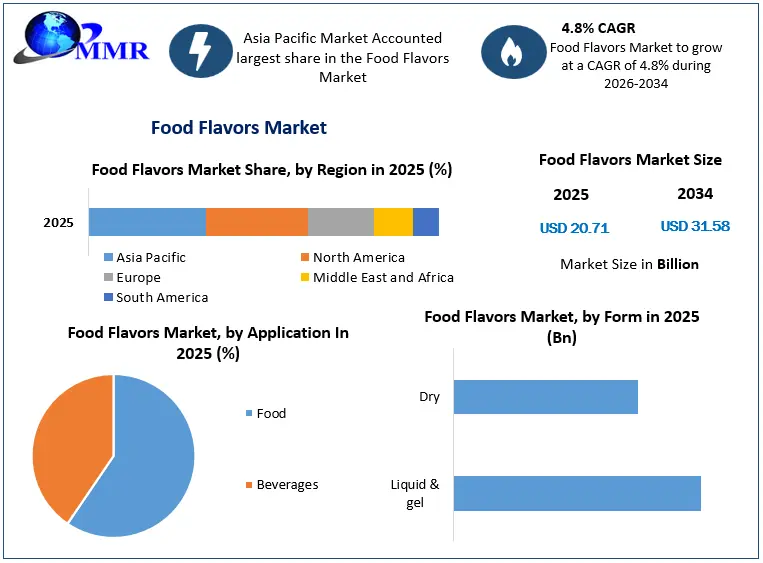
The Food Flavors Market size was valued at USD 20.71 Billion in 2025 and the total Food Flavors revenue is expected to grow at a CAGR of 4.8% from 2026 to 2034, reaching nearly USD 31.58 Billion.

Food Flavors Market Overview:

The Food Flavors market was valued at US $ 20.71 Bn. in , and it is expected to reach US $ 31.58 Bn. by with a CAGR of 4.8% during the forecast period. Artificial sweeteners are used to flavor food. Artificially flavored food has less nutritional value. Flavors of the food industry are divided into natural flavors, natural-identical flavors, and artificial/synthetic. Each flavor has been regulated by the U.S. Food and Drug Administration (FDA), and food additives must also be accepted. Flavor extracts play a vital role in imparting flavor to food by using nutritional constituents, like certain proteins, omega-3s, botanicals, fibers, vitamins, and minerals.

Food Flavors Market Growth Analysis 
Food Flavors Market Growth

To know about the Research Methodology :- Request Free Sample Report

The food flavor is a preparation added to food products to boost a unique flavor, to preserve the flavor after processing, to change previously existing flavor, and to avoid an unwanted flavor.

Food Flavors Market Dynamics:

Market vendors are progressively concentrating on the development of innovative technologies to produce improved varieties of natural and synthetic food flavors. The development of multisensory technologies will also help in flavor increase and improving the consumer experience. Also, general technologies, like supercritical carbon dioxide technology, solid-liquid extraction (SLE), high power ultrasound, and supercritical fluid extraction (SFE), have helped in holding the flavors derived from natural ingredients, mainly fruits. Such innovations and technological advancements are expected to force the growth of the food flavors market in the upcoming years. The increase in systematized retail chains in the emerging countries, which are mostly dependent on revenues of different types of food & beverages, contributes to the development of demand for food flavor products of variable types.

However, the availability of fake and low-priced food flavorings ingredients is obstructing the development in the forthcoming industry of meat flavorings.

Food Flavors Market Segment Analysis:

The Global Food Flavors Market is segmented by Type, Origin, Form, and Application.

Based on the Type, the market is segmented into Chocolate & brown, Vanilla, Fruit & nut, Dairy, Spices & savory, and other flavors include honey, mint, and vegetables. Vanilla segment is expected to grow rapidly at a CAGR of xx% during the forecast period. Vanilla is the most commonly used flavor on the globe. Vanilla is used in ice cream, candy, cakes, and cookies, but it also increases the taste of sweetness and other flavors (like those in chocolate, coffee, fruit, and nuts). These are the key benefit that drives the growth of the vanilla flavor segment in the global market during the forecast period.

Based on the Origin, the market is segmented into Natural, Natural-identical, and Artificial/Synthetic. Natural and Artificial/Synthetic segment is expected to hold the largest market shares of xx% by 2034. In order to meet customer demand for a variety of safe and tasty products, both natural and artificial flavorings have a role in the US food supply. Artificial flavours have been used in food and beverage production for decades, and they have a number of advantages.

Artificial flavours, for example, allow people with food allergies to safely absorb flavours they might not otherwise be able to enjoy. They also enable people to experience a wide range of food flavours even when they are not in season. Natural and artificial flavors both contribute to the deliciousness of our foods and beverages. These are the key benefits of Natural and Artificial/Synthetic segment that drives the growth of the global market during the forecast period.

Based on the Application, the market is segmented into Food, and Beverages. Food segment is expected to grow rapidly at a CAGR of xx% during the forecast period. Food Flavors are widely utilized in food applications, like dairy products, bakery and confectionary, meat products, and other applications, like sauces and condiments. This is the key factor that drives the growth of the Food segment in the global market during the forecast period.

Food Flavors Market Regional Insights:

Asia Pacific dominates the Global Market during the forecast period 2026-2034. Asia Pacific is expected to hold the largest market shares of xx% by 2034. This is due to the high production of dairy & dairy-based products like yogurt, ice-cream, and cheese.

The demand for natural food flavors among end-user companies and increasing consumption of ultra-processed foods containing artificial flavors are the factors which is expected to drive food flavors market growth in the Asia Pacific region in the forecast period. China and Japan are significant markets for food flavors in the Asia Pacific region.

The objective of the report is to present a comprehensive analysis of the Global Food Flavors Market to the stakeholders in the industry. The past and current status of the industry with the forecasted market size and trends are presented in the report with the analysis of complicated data in simple language. The report covers all the aspects of the industry with a dedicated study of key players that include market leaders, followers, and new entrants.

PORTER, PESTEL analysis with the potential impact of micro-economic factors of the market have been presented in the report. External as well as internal factors that are supposed to affect the business positively or negatively have been analyzed, which will give a clear futuristic view of the industry to the decision-makers.

The reports also helps in understanding the Global Food Flavors Market dynamic, structure by analyzing the market segments and project the Global Food Flavors Market size. Clear representation of competitive analysis of key players by product, price, financial position, product portfolio, growth strategies, and regional presence in the Global Food Flavors Market make the report investor’s guide.

Food Flavors Market Recent Industry Developments:

Date Company Development Impact
30 April 2025 Givaudan Givaudan unveiled Myromi, a handheld aroma device engineered to accelerate flavor development across its global network. The innovation significantly enhances R&D efficiency and streamlines customer-facing flavor creation workflows.
30 June 2026 International Flavors & Fragrances IFF launched SENSORA™, an advanced pro-fragrance technology platform designed to transform sensory longevity and delivery. The technology extends scent perception for up to 20 days, directly addressing rising consumer demands for lasting performance.
05 May 2026 International Flavors & Fragrances IFF reported solid first-quarter financial results driven by volume growth and proactive operational productivity gains. The strong performance enabled the firm to reaffirm its 2026 financial guidance amid a persistently unsettled macroeconomic environment.
23 July 2026 Givaudan Givaudan posted a 4.3% organic sales growth, outperforming market expectations as its core flavors division recovered. The momentum marks the first acceleration in organic sales since late 2024, signaling robust market demand stabilization.

Food Flavors Market Scope: Inquire before buying

Food Flavors Market
Report Coverage Details
Base Year: 2025 Forecast Period: 2026-2034
Historical Data: 2020 to 2025 Market Size in 2025: USD 20.71 Bn.
Forecast Period 2026 to 2034 CAGR: 4.8% Market Size in 2034: USD 31.58 Bn.
Segments Covered: by Application Food
Beverages
by Type Chocolate & brown
Vanilla
Fruit & nut
Dairy
Spices & savory
Other flavors1
Other flavors include honey, mint, and vegetables
by Origin Natural
Natural-identical
Artificial/Synthetic
by Form Liquid & gel
Dry

Food Flavors Market, by Region

North America (United States, Canada and Mexico)
Europe (UK, France, Germany, Italy, Spain, Sweden, Austria and Rest of Europe)
Asia Pacific (China, South Korea, Japan, India, Australia, Indonesia, Malaysia, Vietnam, Taiwan, Bangladesh, Pakistan and Rest of APAC)
Middle East and Africa (South Africa, GCC, Egypt, Nigeria and Rest of ME&A)
South America (Brazil, Argentina Rest of South America)

Food Flavors Market, Key Players are:

1. DuPont
2. Archer Daniels Midland (ADM)
3. Givaudan
4. Kerry Group
5. International Flavors & Fragrances
6. Firmenich
7. Symrise
8. MANE
9. Taiyo International
10.T. Hasegawa
11.Synergy Flavors
12.Sensient
13.Bell Flavors and Fragrances
14.Flavorchem
15.Takasago
16.Keva Flavours
17.Huabao Flavors & Fragrances
18.Tate & Lyle
19.Robertet
20.McCormick & Company
21.Wanxiang International
22.Treatt
23.China Flavors and Fragrances
24.Lucta
25.Solvay

Frequently Asked Questions:

1. Which region has the largest share in Global Food Flavors Market?
Ans: Asia Pacific region holds the highest share in 2025.

2. What is the growth rate of Global Food Flavors Market?
Ans: The Global Food Flavors Market is growing at a CAGR of 4.8% during forecasting period 2026-2034.

3. What is scope of the Global Food Flavors market report?
Ans: Global Food Flavors Market report helps with the PESTEL, PORTER, COVID-19 Impact analysis, Recommendations for Investors & Leaders, and market estimation of the forecast period.

4. Who are the key players in Global Food Flavors market?
Ans: The important key players in the Global Food Flavors Market are – DuPont, Archer Daniels Midland (ADM), Givaudan, Kerry Group, International Flavors & Fragrances, Firmenich, Symrise, MANE, Taiyo International, T. Hasegawa, Synergy Flavors, Sensient, Bell Flavors and Fragrances, Flavorchem, Takasago, Keva Flavours, Huabao Flavors & Fragrances, Tate & Lyle, Robertet, McCormick & Company, Wanxiang International, Treatt, China Flavors and Fragrances, Lucta, and Solvay.

5. What was the Global Food Flavors Market size in 2025?
Ans:
The Global Food Flavors Market size was USD 20.71 Billion in 2025.

Table of Contents

1. Food Flavors Market Introduction 1.1. Study Assumption and Market Definition 1.2. Scope of the Study 1.3. Executive Summary 2. Global Food Flavors Market: Competitive Landscape 2.1. MMR Competition Matrix 2.2. Competitive Landscape 2.3. Key Players Benchmarking 2.3.1. Company Name 2.3.2. Business Segment 2.3.3. End-user Segment 2.3.4. Revenue (2025) 2.3.5. Company Locations 2.4. Leading Food Flavors Market Companies, by market capitalization 2.5. Market Structure 2.5.1. Market Leaders 2.5.2. Market Followers 2.5.3. Emerging Players 2.6. Mergers and Acquisitions Details 3. Food Flavors Market: Dynamics 3.1. Food Flavors Market Trends by Region 3.1.1. North America Food Flavors Market Trends 3.1.2. Europe Food Flavors Market Trends 3.1.3. Asia Pacific Food Flavors Market Trends 3.1.4. Middle East and Africa Food Flavors Market Trends 3.1.5. South America Food Flavors Market Trends 3.2. Food Flavors Market Dynamics by Region 3.2.1. North America 3.2.1.1. North America Food Flavors Market Drivers 3.2.1.2. North America Food Flavors Market Restraints 3.2.1.3. North America Food Flavors Market Opportunities 3.2.1.4. North America Food Flavors Market Challenges 3.2.2. Europe 3.2.2.1. Europe Food Flavors Market Drivers 3.2.2.2. Europe Food Flavors Market Restraints 3.2.2.3. Europe Food Flavors Market Opportunities 3.2.2.4. Europe Food Flavors Market Challenges 3.2.3. Asia Pacific 3.2.3.1. Asia Pacific Food Flavors Market Drivers 3.2.3.2. Asia Pacific Food Flavors Market Restraints 3.2.3.3. Asia Pacific Food Flavors Market Opportunities 3.2.3.4. Asia Pacific Food Flavors Market Challenges 3.2.4. Middle East and Africa 3.2.4.1. Middle East and Africa Food Flavors Market Drivers 3.2.4.2. Middle East and Africa Food Flavors Market Restraints 3.2.4.3. Middle East and Africa Food Flavors Market Opportunities 3.2.4.4. Middle East and Africa Food Flavors Market Challenges 3.2.5. South America 3.2.5.1. South America Food Flavors Market Drivers 3.2.5.2. South America Food Flavors Market Restraints 3.2.5.3. South America Food Flavors Market Opportunities 3.2.5.4. South America Food Flavors Market Challenges 3.3. PORTER's Five Forces Analysis 3.4. PESTLE Analysis 3.5. Technology Roadmap 3.6. Regulatory Landscape by Region 3.6.1. North America 3.6.2. Europe 3.6.3. Asia Pacific 3.6.4. Middle East and Africa 3.6.5. South America 3.7. Key Opinion Leader Analysis For Food Flavors Industry 3.8. Analysis of Government Schemes and Initiatives For Food Flavors Industry 3.9. Food Flavors Market Trade Analysis 3.10. The Global Pandemic Impact on Food Flavors Market 4. Food Flavors Market: Global Market Size and Forecast by Segmentation (in USD Billion) 2025-2034 4.1. Food Flavors Market Size and Forecast, by Application (2025-2034) 4.1.1. Food 4.1.2. Beverages 4.2. Food Flavors Market Size and Forecast, by Type (2025-2034) 4.2.1. Chocolate & brown 4.2.2. Vanilla 4.2.3. Fruit & nut 4.2.4. Dairy 4.2.5. Spices & savory 4.2.6. Other flavors1 4.2.7. Other flavors include honey, mint, and vegetables 4.3. Food Flavors Market Size and Forecast, by Origin (2025-2034) 4.3.1. Natural 4.3.2. Natural-identical 4.3.3. Artificial/Synthetic 4.4. Food Flavors Market Size and Forecast, by Form (2025-2034) 4.4.1. Liquid & gel 4.4.2. Dry 4.5. Food Flavors Market Size and Forecast, by Region (2025-2034) 4.5.1. North America 4.5.2. Europe 4.5.3. Asia Pacific 4.5.4. Middle East and Africa 4.5.5. South America 5. North America Food Flavors Market Size and Forecast by Segmentation (in USD Billion) 2025-2034 5.1. North America Food Flavors Market Size and Forecast, by Application (2025-2034) 5.1.1. Food 5.1.2. Beverages 5.2. North America Food Flavors Market Size and Forecast, by Type (2025-2034) 5.2.1. Chocolate & brown 5.2.2. Vanilla 5.2.3. Fruit & nut 5.2.4. Dairy 5.2.5. Spices & savory 5.2.6. Other flavors1 5.2.7. Other flavors include honey, mint, and vegetables 5.3. North America Food Flavors Market Size and Forecast, by Origin (2025-2034) 5.3.1. Natural 5.3.2. Natural-identical 5.3.3. Artificial/Synthetic 5.4. North America Food Flavors Market Size and Forecast, by Form (2025-2034) 5.4.1. Liquid & gel 5.4.2. Dry 5.5. North America Food Flavors Market Size and Forecast, by Country (2025-2034) 5.5.1. United States 5.5.1.1. United States Food Flavors Market Size and Forecast, by Application (2025-2034) 5.5.1.1.1. Food 5.5.1.1.2. Beverages 5.5.1.2. United States Food Flavors Market Size and Forecast, by Type (2025-2034) 5.5.1.2.1. Chocolate & brown 5.5.1.2.2. Vanilla 5.5.1.2.3. Fruit & nut 5.5.1.2.4. Dairy 5.5.1.2.5. Spices & savory 5.5.1.2.6. Other flavors1 5.5.1.2.7. Other flavors include honey, mint, and vegetables 5.5.1.3. United States Food Flavors Market Size and Forecast, by Origin (2025-2034) 5.5.1.3.1. Natural 5.5.1.3.2. Natural-identical 5.5.1.3.3. Artificial/Synthetic 5.5.1.4. United States Food Flavors Market Size and Forecast, by Form (2025-2034) 5.5.1.4.1. Liquid & gel 5.5.1.4.2. Dry 5.5.2. Canada 5.5.2.1. Canada Food Flavors Market Size and Forecast, by Application (2025-2034) 5.5.2.1.1. Food 5.5.2.1.2. Beverages 5.5.2.2. Canada Food Flavors Market Size and Forecast, by Type (2025-2034) 5.5.2.2.1. Chocolate & brown 5.5.2.2.2. Vanilla 5.5.2.2.3. Fruit & nut 5.5.2.2.4. Dairy 5.5.2.2.5. Spices & savory 5.5.2.2.6. Other flavors1 5.5.2.2.7. Other flavors include honey, mint, and vegetables 5.5.2.3. Canada Food Flavors Market Size and Forecast, by Origin (2025-2034) 5.5.2.3.1. Natural 5.5.2.3.2. Natural-identical 5.5.2.3.3. Artificial/Synthetic 5.5.2.4. Canada Food Flavors Market Size and Forecast, by Form (2025-2034) 5.5.2.4.1. Liquid & gel 5.5.2.4.2. Dry 5.5.3. Mexico 5.5.3.1. Mexico Food Flavors Market Size and Forecast, by Application (2025-2034) 5.5.3.1.1. Food 5.5.3.1.2. Beverages 5.5.3.2. Mexico Food Flavors Market Size and Forecast, by Type (2025-2034) 5.5.3.2.1. Chocolate & brown 5.5.3.2.2. Vanilla 5.5.3.2.3. Fruit & nut 5.5.3.2.4. Dairy 5.5.3.2.5. Spices & savory 5.5.3.2.6. Other flavors1 5.5.3.2.7. Other flavors include honey, mint, and vegetables 5.5.3.3. Mexico Food Flavors Market Size and Forecast, by Origin (2025-2034) 5.5.3.3.1. Natural 5.5.3.3.2. Natural-identical 5.5.3.3.3. Artificial/Synthetic 5.5.3.4. Mexico Food Flavors Market Size and Forecast, by Form (2025-2034) 5.5.3.4.1. Liquid & gel 5.5.3.4.2. Dry 6. Europe Food Flavors Market Size and Forecast by Segmentation (in USD Billion) 2025-2034 6.1. Europe Food Flavors Market Size and Forecast, by Application (2025-2034) 6.2. Europe Food Flavors Market Size and Forecast, by Type (2025-2034) 6.3. Europe Food Flavors Market Size and Forecast, by Origin (2025-2034) 6.4. Europe Food Flavors Market Size and Forecast, by Form (2025-2034) 6.5. Europe Food Flavors Market Size and Forecast, by Country (2025-2034) 6.5.1. United Kingdom 6.5.1.1. United Kingdom Food Flavors Market Size and Forecast, by Application (2025-2034) 6.5.1.2. United Kingdom Food Flavors Market Size and Forecast, by Type (2025-2034) 6.5.1.3. United Kingdom Food Flavors Market Size and Forecast, by Origin (2025-2034) 6.5.1.4. United Kingdom Food Flavors Market Size and Forecast, by Form (2025-2034) 6.5.2. France 6.5.2.1. France Food Flavors Market Size and Forecast, by Application (2025-2034) 6.5.2.2. France Food Flavors Market Size and Forecast, by Type (2025-2034) 6.5.2.3. France Food Flavors Market Size and Forecast, by Origin (2025-2034) 6.5.2.4. France Food Flavors Market Size and Forecast, by Form (2025-2034) 6.5.3. Germany 6.5.3.1. Germany Food Flavors Market Size and Forecast, by Application (2025-2034) 6.5.3.2. Germany Food Flavors Market Size and Forecast, by Type (2025-2034) 6.5.3.3. Germany Food Flavors Market Size and Forecast, by Origin (2025-2034) 6.5.3.4. Germany Food Flavors Market Size and Forecast, by Form (2025-2034) 6.5.4. Italy 6.5.4.1. Italy Food Flavors Market Size and Forecast, by Application (2025-2034) 6.5.4.2. Italy Food Flavors Market Size and Forecast, by Type (2025-2034) 6.5.4.3. Italy Food Flavors Market Size and Forecast, by Origin (2025-2034) 6.5.4.4. Italy Food Flavors Market Size and Forecast, by Form (2025-2034) 6.5.5. Spain 6.5.5.1. Spain Food Flavors Market Size and Forecast, by Application (2025-2034) 6.5.5.2. Spain Food Flavors Market Size and Forecast, by Type (2025-2034) 6.5.5.3. Spain Food Flavors Market Size and Forecast, by Origin (2025-2034) 6.5.5.4. Spain Food Flavors Market Size and Forecast, by Form (2025-2034) 6.5.6. Sweden 6.5.6.1. Sweden Food Flavors Market Size and Forecast, by Application (2025-2034) 6.5.6.2. Sweden Food Flavors Market Size and Forecast, by Type (2025-2034) 6.5.6.3. Sweden Food Flavors Market Size and Forecast, by Origin (2025-2034) 6.5.6.4. Sweden Food Flavors Market Size and Forecast, by Form (2025-2034) 6.5.7. Austria 6.5.7.1. Austria Food Flavors Market Size and Forecast, by Application (2025-2034) 6.5.7.2. Austria Food Flavors Market Size and Forecast, by Type (2025-2034) 6.5.7.3. Austria Food Flavors Market Size and Forecast, by Origin (2025-2034) 6.5.7.4. Austria Food Flavors Market Size and Forecast, by Form (2025-2034) 6.5.8. Rest of Europe 6.5.8.1. Rest of Europe Food Flavors Market Size and Forecast, by Application (2025-2034) 6.5.8.2. Rest of Europe Food Flavors Market Size and Forecast, by Type (2025-2034) 6.5.8.3. Rest of Europe Food Flavors Market Size and Forecast, by Origin (2025-2034) 6.5.8.4. Rest of Europe Food Flavors Market Size and Forecast, by Form (2025-2034) 7. Asia Pacific Food Flavors Market Size and Forecast by Segmentation (in USD Billion) 2025-2034 7.1. Asia Pacific Food Flavors Market Size and Forecast, by Application (2025-2034) 7.2. Asia Pacific Food Flavors Market Size and Forecast, by Type (2025-2034) 7.3. Asia Pacific Food Flavors Market Size and Forecast, by Origin (2025-2034) 7.4. Asia Pacific Food Flavors Market Size and Forecast, by Form (2025-2034) 7.5. Asia Pacific Food Flavors Market Size and Forecast, by Country (2025-2034) 7.5.1. China 7.5.1.1. China Food Flavors Market Size and Forecast, by Application (2025-2034) 7.5.1.2. China Food Flavors Market Size and Forecast, by Type (2025-2034) 7.5.1.3. China Food Flavors Market Size and Forecast, by Origin (2025-2034) 7.5.1.4. China Food Flavors Market Size and Forecast, by Form (2025-2034) 7.5.2. S Korea 7.5.2.1. S Korea Food Flavors Market Size and Forecast, by Application (2025-2034) 7.5.2.2. S Korea Food Flavors Market Size and Forecast, by Type (2025-2034) 7.5.2.3. S Korea Food Flavors Market Size and Forecast, by Origin (2025-2034) 7.5.2.4. S Korea Food Flavors Market Size and Forecast, by Form (2025-2034) 7.5.3. Japan 7.5.3.1. Japan Food Flavors Market Size and Forecast, by Application (2025-2034) 7.5.3.2. Japan Food Flavors Market Size and Forecast, by Type (2025-2034) 7.5.3.3. Japan Food Flavors Market Size and Forecast, by Origin (2025-2034) 7.5.3.4. Japan Food Flavors Market Size and Forecast, by Form (2025-2034) 7.5.4. India 7.5.4.1. India Food Flavors Market Size and Forecast, by Application (2025-2034) 7.5.4.2. India Food Flavors Market Size and Forecast, by Type (2025-2034) 7.5.4.3. India Food Flavors Market Size and Forecast, by Origin (2025-2034) 7.5.4.4. India Food Flavors Market Size and Forecast, by Form (2025-2034) 7.5.5. Australia 7.5.5.1. Australia Food Flavors Market Size and Forecast, by Application (2025-2034) 7.5.5.2. Australia Food Flavors Market Size and Forecast, by Type (2025-2034) 7.5.5.3. Australia Food Flavors Market Size and Forecast, by Origin (2025-2034) 7.5.5.4. Australia Food Flavors Market Size and Forecast, by Form (2025-2034) 7.5.6. Indonesia 7.5.6.1. Indonesia Food Flavors Market Size and Forecast, by Application (2025-2034) 7.5.6.2. Indonesia Food Flavors Market Size and Forecast, by Type (2025-2034) 7.5.6.3. Indonesia Food Flavors Market Size and Forecast, by Origin (2025-2034) 7.5.6.4. Indonesia Food Flavors Market Size and Forecast, by Form (2025-2034) 7.5.7. Malaysia 7.5.7.1. Malaysia Food Flavors Market Size and Forecast, by Application (2025-2034) 7.5.7.2. Malaysia Food Flavors Market Size and Forecast, by Type (2025-2034) 7.5.7.3. Malaysia Food Flavors Market Size and Forecast, by Origin (2025-2034) 7.5.7.4. Malaysia Food Flavors Market Size and Forecast, by Form (2025-2034) 7.5.8. Vietnam 7.5.8.1. Vietnam Food Flavors Market Size and Forecast, by Application (2025-2034) 7.5.8.2. Vietnam Food Flavors Market Size and Forecast, by Type (2025-2034) 7.5.8.3. Vietnam Food Flavors Market Size and Forecast, by Origin (2025-2034) 7.5.8.4. Vietnam Food Flavors Market Size and Forecast, by Form (2025-2034) 7.5.9. Taiwan 7.5.9.1. Taiwan Food Flavors Market Size and Forecast, by Application (2025-2034) 7.5.9.2. Taiwan Food Flavors Market Size and Forecast, by Type (2025-2034) 7.5.9.3. Taiwan Food Flavors Market Size and Forecast, by Origin (2025-2034) 7.5.9.4. Taiwan Food Flavors Market Size and Forecast, by Form (2025-2034) 7.5.10. Rest of Asia Pacific 7.5.10.1. Rest of Asia Pacific Food Flavors Market Size and Forecast, by Application (2025-2034) 7.5.10.2. Rest of Asia Pacific Food Flavors Market Size and Forecast, by Type (2025-2034) 7.5.10.3. Rest of Asia Pacific Food Flavors Market Size and Forecast, by Origin (2025-2034) 7.5.10.4. Rest of Asia Pacific Food Flavors Market Size and Forecast, by Form (2025-2034) 8. Middle East and Africa Food Flavors Market Size and Forecast by Segmentation (in USD Billion) 2025-2034 8.1. Middle East and Africa Food Flavors Market Size and Forecast, by Application (2025-2034) 8.2. Middle East and Africa Food Flavors Market Size and Forecast, by Type (2025-2034) 8.3. Middle East and Africa Food Flavors Market Size and Forecast, by Origin (2025-2034) 8.4. Middle East and Africa Food Flavors Market Size and Forecast, by Form (2025-2034) 8.5. Middle East and Africa Food Flavors Market Size and Forecast, by Country (2025-2034) 8.5.1. South Africa 8.5.1.1. South Africa Food Flavors Market Size and Forecast, by Application (2025-2034) 8.5.1.2. South Africa Food Flavors Market Size and Forecast, by Type (2025-2034) 8.5.1.3. South Africa Food Flavors Market Size and Forecast, by Origin (2025-2034) 8.5.1.4. South Africa Food Flavors Market Size and Forecast, by Form (2025-2034) 8.5.2. GCC 8.5.2.1. GCC Food Flavors Market Size and Forecast, by Application (2025-2034) 8.5.2.2. GCC Food Flavors Market Size and Forecast, by Type (2025-2034) 8.5.2.3. GCC Food Flavors Market Size and Forecast, by Origin (2025-2034) 8.5.2.4. GCC Food Flavors Market Size and Forecast, by Form (2025-2034) 8.5.3. Nigeria 8.5.3.1. Nigeria Food Flavors Market Size and Forecast, by Application (2025-2034) 8.5.3.2. Nigeria Food Flavors Market Size and Forecast, by Type (2025-2034) 8.5.3.3. Nigeria Food Flavors Market Size and Forecast, by Origin (2025-2034) 8.5.3.4. Nigeria Food Flavors Market Size and Forecast, by Form (2025-2034) 8.5.4. Rest of ME&A 8.5.4.1. Rest of ME&A Food Flavors Market Size and Forecast, by Application (2025-2034) 8.5.4.2. Rest of ME&A Food Flavors Market Size and Forecast, by Type (2025-2034) 8.5.4.3. Rest of ME&A Food Flavors Market Size and Forecast, by Origin (2025-2034) 8.5.4.4. Rest of ME&A Food Flavors Market Size and Forecast, by Form (2025-2034) 9. South America Food Flavors Market Size and Forecast by Segmentation (in USD Billion) 2025-2034 9.1. South America Food Flavors Market Size and Forecast, by Application (2025-2034) 9.2. South America Food Flavors Market Size and Forecast, by Type (2025-2034) 9.3. South America Food Flavors Market Size and Forecast, by Origin (2025-2034) 9.4. South America Food Flavors Market Size and Forecast, by Form (2025-2034) 9.5. South America Food Flavors Market Size and Forecast, by Country (2025-2034) 9.5.1. Brazil 9.5.1.1. Brazil Food Flavors Market Size and Forecast, by Application (2025-2034) 9.5.1.2. Brazil Food Flavors Market Size and Forecast, by Type (2025-2034) 9.5.1.3. Brazil Food Flavors Market Size and Forecast, by Origin (2025-2034) 9.5.1.4. Brazil Food Flavors Market Size and Forecast, by Form (2025-2034) 9.5.2. Argentina 9.5.2.1. Argentina Food Flavors Market Size and Forecast, by Application (2025-2034) 9.5.2.2. Argentina Food Flavors Market Size and Forecast, by Type (2025-2034) 9.5.2.3. Argentina Food Flavors Market Size and Forecast, by Origin (2025-2034) 9.5.2.4. Argentina Food Flavors Market Size and Forecast, by Form (2025-2034) 9.5.3. Rest Of South America 9.5.3.1. Rest Of South America Food Flavors Market Size and Forecast, by Application (2025-2034) 9.5.3.2. Rest Of South America Food Flavors Market Size and Forecast, by Type (2025-2034) 9.5.3.3. Rest Of South America Food Flavors Market Size and Forecast, by Origin (2025-2034) 9.5.3.4. Rest Of South America Food Flavors Market Size and Forecast, by Form (2025-2034) 10. Company Profile: Key Players 10.1. DuPont 10.1.1. Company Overview 10.1.2. Business Portfolio 10.1.3. Financial Overview 10.1.4. SWOT Analysis 10.1.5. Strategic Analysis 10.1.6. Scale of Operation (small, medium, and large) 10.1.7. Details on Partnership 10.1.8. Regulatory Accreditations and Certifications Received by Them 10.1.9. Awards Received by the Firm 10.1.10. Recent Developments 10.2. Archer Daniels Midland (ADM) 10.3. Givaudan 10.4. Kerry Group 10.5. International Flavors & Fragrances 10.6. Firmenich 10.7. Symrise 10.8. MANE 10.9. Taiyo International 10.10. T. Hasegawa 10.11. Synergy Flavors 10.12. Sensient 10.13. Bell Flavors and Fragrances 10.14. Flavorchem 10.15. Takasago 10.16. Keva Flavours 10.17. Huabao Flavors & Fragrances 10.18. Tate & Lyle 10.19. Robertet 10.20. McCormick & Company 10.21. Wanxiang International 10.22. Treatt 10.23. China Flavors and Fragrances 10.24. Lucta 10.25. Solvay 11. Key Findings 12. Industry Recommendations 13. Food Flavors Market: Research Methodology 14. Terms and Glossary

Custom Market Research Services

We Will Customise The Research For You, In Case The Report Listed Above Does Not Meet With Your Requirements