
Digital Map Market Size by Types, Services, Application, Usage, Region, Industry-Wide Analysis, Competitive Landscape Assessment & Long-Term Forecast to 2034
Overview
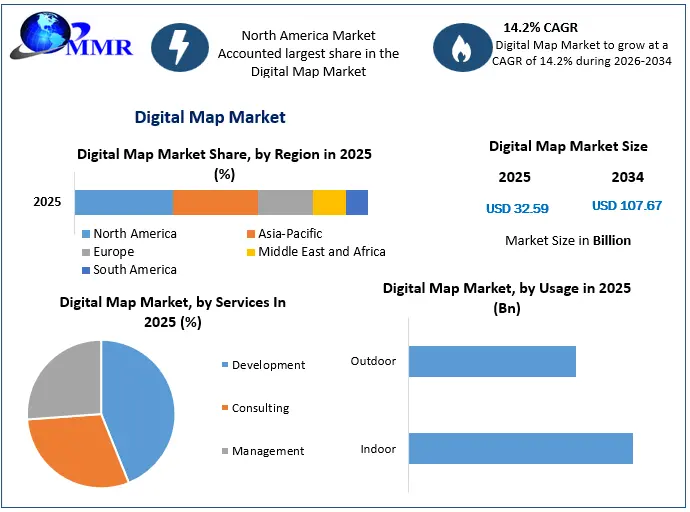
The Digital Map Market size was valued at USD 32.59 Bn in 2025 and the total Digital Map Market revenue is expected to grow at a CAGR of 14.2% from 2026 to 2034, reaching nearly USD 107.67 Bn.
Digital Map Market Overview
The digital map market has experienced significant growth and change due to growing dependence on location-based services and technological improvements. Leading companies in the market, like Google Maps, Apple Maps, Microsoft's Bing Maps, and, control the terrain by providing extensive mapping platforms with integrated navigation, real-time traffic updates, and location-based suggestions. Through GIS software and mapping APIs, these platforms support a variety of businesses in addition to meeting the demands of consumers, such as urban planning, transportation, logistics, and healthcare. The emergence of autonomous vehicles, IoT integration, and smart city projects are driving the market's expansion and highlighting the significance of precise and current geospatial data.
Digital Map Market Snapshot
To know about the Research Methodology :- Request Free Sample Report
Real-time routing and congestion updates are required for applications like smart parking, location, traffic, logistics management, and congestion intelligence. Digital cartography has significantly advanced technologically, enabling data flows and information to enable various applications. Furthermore, it is expected that the growing number of companies utilizing location-based services for marketing and advertising will further fuel demand development in the upcoming years.
The Digital Map Market dynamics are still influenced by issues like data privacy and regulatory compliance, but continuous developments in artificial intelligence, machine learning, and augmented reality hold the potential to improve mapping functionality and accuracy. As it develops to satisfy the needs of a digitally linked world, the digital map market is expected to increase in the future, providing cutting-edge solutions for location-based services, navigation, and spatial analysis to global clients.
The public and government sectors are adopting geographical and environmental information systems at a faster rate due to the increased demand for them. Furthermore, the Digital Map Market is expected to develop due to the increasing requirement for information system maintenance for law enforcement, defense forces, and local governing bodies as a result of the noticeable rise in both natural and man-made hazards. To facilitate seamless integration between information systems and maps, industry participants are concentrating on data integration technologies in digital maps, which will drive Digital Map Market development throughout the forecast period. It is expected that the major players will engage in investments to enhance their digital map products, preserve their competitive advantage, and increase their profitability.
Digital Map Market Dynamics
The digital map market is pushed by several key drivers, including the rising demand for location-based services (LBS) driven by the widespread adoption of smartphones and IoT devices. It was estimated by the World Economic Forum that there were more than 9 billion phone subscriptions actively working in 2025. This humongous demand fuels the need for accurate mapping solutions that can provide real-time navigation and personalized location-based experiences. Furthermore, the integration of digital maps in autonomous vehicles and smart city initiatives enhances their utility in urban planning, transportation optimization, and infrastructure management. Technological advancements in AI and machine learning also contribute by improving map accuracy and enabling predictive analytics, thereby expanding the market's capabilities and appeal across various industries.
However, the Digital Map Market faces significant restraints such as data privacy concerns and regulatory challenges. The collection and use of sensitive location data raise privacy issues and compliance requirements, impacting user trust and necessitating stringent data protection measures. One of the recent incidents of such data infringement was with Facebook in 2021. Hackers leaked the data of more than 533 million people on the dark net which also included their location. Maintaining the safety, accuracy, and relevance of map data requires ongoing updates and substantial investment, which can be a barrier for smaller companies entering the Digital Map Market. Regulatory complexities across different regions further add to operational challenges, requiring compliance with varying legal frameworks and restrictions.
The established mapping systems of IT giants such as Google and Apple present stiff competition for smaller businesses and newcomers fighting for market share. Companies that don't innovate and adapt quickly are being crushed by technological disruptions and rapid developments. Cyber security concerns continue to be major dangers that might compromise the operational integrity and confidence of the digital map ecosystem. These risks include data breaches and vulnerabilities in mapping software. Furthermore, the industry's development and profitability may be impacted by market and economic volatility as well as investments in mapping infrastructure and technical breakthroughs.
Despite these difficulties, digital map producers have a lot of potential. With more and more emerging economies implementing digital mapping technology for urbanization and economic development initiatives, there is tremendous growth potential for expansion. Digital maps and augmented reality (AR) together create new opportunities for location-based marketing and immersive navigation. Moreover, there are chances to use digital maps for sustainability and social benefit through the use of mapping technology in resource planning, disaster relief, and environmental monitoring.
Digital Map Market Segment Analysis:
Based on Application:
Based on the application Digital Map Market can be majorly divided into airports, Malls, Departmental Stores, Automotive Navigation, Mobile and the Internet, Public Sector Agencies, Enterprises, etc. Amongst them Automotive segment is expected to grow at a higher pace, as demand for automotive is increasing in developing countries. However mobile navigation will hold the major share in the digital map market due to its affordability and compactness.
Based on Usage:
Based on the location of use Indoor and outdoor are two main division categories. Outdoor navigation involves traveling and navigating through open spaces, such as streets, highways, trails, and rural areas which mainly use GPS and GNSS technologies. Users optimize routes based on factors like traffic conditions, shortest distance, or fastest route to reach their destination efficiently.
Indoor navigation refers to navigating within enclosed spaces such as buildings, shopping malls, airports, and large venues where GPS signals are limited or unavailable. Indoor navigation relies on technologies like Wi-Fi, Bluetooth Low Energy, RFID, and beacons to provide accurate location information within buildings. Mobile apps and navigation systems designed for indoor environments provide step-by-step directions, proximity alerts, and location-based services (LBS) such as finding nearby amenities or stores.
Based on Types: The digital map industry is divided into several kinds, including digital orthophotography, aerial photography, GIS, LiDAR, and others. Due to the increasing usage of digital maps in urban development and city infrastructure planning, the GIS category is projected to have a sizable market share over the projection period. Additionally, businesses have enhanced their business intelligence systems and accurately analyzed market demographics by fusing traditional business analytics with geographic information systems. The digital orthophotography and LiDAR sector is anticipated to increase quickly over the forecast period since these data collection technologies are widely used and offer several benefits.
Digital Map Market by Region:
Increasing adoption of digital technology by several enterprises for end-to-end map solutions in the era of digital transformation, North America is expected to hold a significant portion of the market during the projected decade. Governments in the North American region have invested in digital mapping infrastructure for urban planning, emergency response, environmental management, and public service. This has given a chance to the private player to collaborate with the government and reduce their infrastructural cost. The USA and Canada have emerged to be the major players in this region.
However, due to the sharp rise in demand for GIS systems, geospatial data, and associated services, the Asia-Pacific market is expected to grow at the highest pace throughout the forecast period. Moreover, growing digital infrastructure in countries like China and India is opening up new business prospects for providers, which is driving the growth of the regional market. Another reason for this market's expansion is the flourishing E-commerce industry, which is anticipated to require a significant amount of digital mapping. GPS monitoring and geographic information system (GIS) solutions have been invested in by major e-commerce companies such as Flipkart and Alibaba. PlaceIQ is one of the companies that uses location to modulate and identify customer behavior and choices.
Digital Map Market Recent Industry Developments:
| Date | Company | Development | Impact |
|---|---|---|---|
| 12 February 2026 | Launched AI-powered immersive view for indoor navigation in major international airports and shopping centers. | Enhances user experience by providing high-fidelity visual guidance in complex indoor environments. | |
| 05 March 2026 | HERE Technologies | Partnered with a major European automotive manufacturer to deploy HD Live Maps for Level 3 autonomous driving. | Significantly improves vehicle safety and operational efficiency through real-time lane-level precision. |
| 18 April 2026 | TomTom | Released an automated map maintenance engine utilizing LiDAR data from fleet vehicles. | Drastically reduces the time required for map updates, ensuring high data accuracy for enterprise clients. |
| 22 May 2026 | Mapbox | Announced a strategic integration with Smart City infrastructure to optimize urban traffic flow in Tokyo. | Decreases carbon emissions and urban congestion by providing real-time predictive routing for public transport. |
Digital Map Market Report Scope : Inquire before buying
| Global Digital Map Market | |||
|---|---|---|---|
| Report Coverage | Details | ||
| Base Year: | 2025 | Forecast Period: | 2026-2034 |
| Historical Data: | 2020 to 2025 | Market Size in 2025: | US $ 32.59 Bn. |
| Forecast Period 2026 to 2034 CAGR: | 14.2% | Market Size in 2034: | US $ 107.67 Bn. |
| Segments Covered: | by Types | Digital Orthophotography Aerial Photography GIS LiDAR Others |
|
| by Services | Development Consulting Management |
||
| by Application | Airports Malls Departmental Stores Automotive Navigation Mobile and the Internet Public Sector Agencies Enterprises Others |
||
| by Usage | Indoor Outdoor |
||
Digital Map Market, by Region
North America (United States, Canada and Mexico)
Europe (UK, France, Germany, Italy, Spain, Sweden, Austria and Rest of Europe)
Asia Pacific (China, South Korea, Japan, India, Australia, Indonesia, Malaysia, Vietnam, Taiwan, Bangladesh, Pakistan and Rest of APAC)
Middle East and Africa (South Africa, GCC, Egypt, Nigeria and Rest)
South America (Brazil, Argentina Rest of South America)
Digital Map Market Key Players:
1. Apple Inc.
2. Google Inc
3. HERE
4. Micello, Inc.
5. TomTom International BV
6. MiTAC International Corporation
7. ARC Aerial Imaging Limited
8. Esri
9. Nearmap Ltd.
10. MAPQUEST
11. TomTom
12. Digital Map Products Inc.
13. Magellan
14. Yahoo
15. AutoNavi
16. MapWise
17. Jibestream
18. Indoor Atlas
19. Mapillary
FAQs:
1. What are the growth drivers for the Digital Map Market?
Ans. Increasing Demand for navigation in the Transport sector, internet penetration, Technological development etc.
2. What is the major restraint for the Digital Map Market growth?
Ans. High Initial Investments and tough competition by existing players are major restrains for new entrants.
3. Which Region is expected to lead the global Digital Map Market during the forecast period?
Ans. North America is expected to lead the global Digital Map Market during the forecast period.
4. What is the projected Europe Digital Map Market size & growth rate of the Digital Map Market?
Ans. The Digital Map Market size was valued at USD 32.59 Bn in 2025 and the total Anime revenue is expected to grow at a 14.2% CAGR of from 2026 to 2034, reaching nearly USD 107.67 Bn.
5. What segments are covered in the Digital Map Market report?
Ans. The segments covered in the Digital Map Market report are Application, Type, Service and Usage.