
Public Safety Wireless Communication Market Size – Industry Structure Evaluation, Demand Drivers Analysis, Regional Growth Analysis and Identification, Competitive Positioning Review & Global Market Size Forecast to 2032
Overview
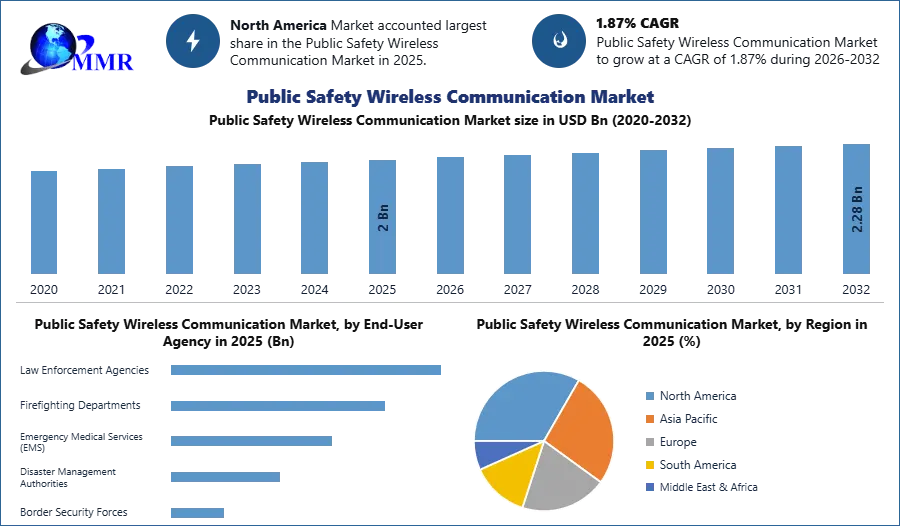
Global Public Safety Wireless Communication Market size was valued at USD 2.00 Bn in 2025 and is expected to reach USD 2.28 Bn by 2032 at a CAGR of 1.87% during the forecast period.
The global Public Safety Wireless Communication market report is a comprehensive analysis of the industry, market, and key players. The report has covered the market by demand and supply-side by segments. The global Public Safety Wireless Communication report also provides trends by market segments, technology, and investment with a competitive landscape.
Overview of Public Safety Wireless Communication:
A wireless communication system for public safety is wireless communication technology. It entails cooperation across several departments, including the emergency response service, the police force, the cybersecurity team, and the criminal justice system. By sharing information and ensuring functional interoperability, the entire network contributes to public safety. Medical services, police departments, fire departments, and others use the public safety wireless communication system.
Global Public Safety Wireless Communication Market Dynamics:
The multiple benefits of such networks, which include increased coordination, real-time information transfer, decreased travel costs, improved mobility, and improved coordination amongst various aspects of a city are driving the market for public safety wireless communication. Furthermore, market growth is aided by factors such as rising government initiatives for the installation of public safety applications. The global use of the Internet and the growing use of modern wireless technologies in public safety have been increased. Currently, advanced broadband infrastructure such as 3G, 4G, 5G, and LTE is expected to be widely deployed. Telecommunications service networks are constantly evolving in most parts of the world. Secure phone communications, mission-critical LTE, advanced terrestrial trunked radio networks, and other innovations are expected to drive market growth.
Because of the rapid installation of outdoor networks, developing countries have a lot of opportunities for market growth. However, many developing countries are also fueling market growth due to rapid commercialization, urbanization, infrastructure development, rising GDPs, and improving population standards of living.
The advent of wireless technology has altered the global communication system's view. Artificial intelligence, crowdsourcing, and data analytics are just a few of the key applications of wireless technology. It has been widely implemented for data analysis and client engagement purposes. In addition, communication networks play an important part in a country's security system.
6 Types of IoT Wireless Technology:
• Cellular (3G/4G/5G)
• Zigbee and Other Mesh Protocols
• LPWANs
• Bluetooth and BLE (Bluetooth Low-Energy)
• Wi-Fi
• RFID
1. Cellular:
Cellular networks, which are well-established in the consumer mobile industry, provide a reliable broadband connection that supports a variety of phone calls and video streaming apps. On the negative side, they have extremely high operating expenses and power requirements.
While cellular networks are not suitable for the bulk of IoT applications based on battery-operated sensor networks, they are appropriate for specialized use cases such as linked cars or fleet management in transportation and logistics. In-car infotainment, traffic routing, advanced driver assistance systems (ADAS), as well as fleet telematics and tracking services, can all rely on cellular connectivity's ubiquitous and high bandwidth.
The future of autonomous vehicles and augmented reality is expected to be cellular next-generation 5G, which is expected to offer high-speed mobility and ultra-low latency. Real-time video surveillance for public safety, real-time mobile transfer of medical data sets for connected health, and various time-sensitive industrial automation applications are all projected to be enabled by 5G.
2. BLE:
BLE-enabled devices are generally used in conjunction with electronic devices, such as smartphones, which act as a hub for data transfer to the cloud. BLE is now widely used in the fitness and medical wearables (such as smartwatches, glucose meters, and pulse oximeters) as well as Smart Home devices (such as door locks), allowing data to be easily transferred to and viewed on smartphones.
Global Public Safety Wireless Communication Market Segmentation:
To know about the Research Methodology :- Request Free Sample Report
Based on the tools, the public safety wireless communication market is segmented into video surveillance cameras, unattended sensors, and others. In 2019, the video surveillance segment had the largest market share XX%. Furthermore, during the projection period, it is expected to grow at a significant CAGR of XX%.
Citizens understand the desire to feel safe when walking down the street and the safety given by high-quality video surveillance has contributed to the development of a healthy environment for all. For example, while tracking a city's street corners, protecting a busy train, or even ensuring the health of rhinos in a protected habitat, one factor that must be assured is security and safety. The cameras and thermal imaging systems must be networked 24 hours a day, seven days a week for real-time uploads.
Wireless technology has made video surveillance networks more accessible all around the world. Many of these solutions are transportable, but the wireless advantage extends far beyond smartphone apps, necessitating deployments in locations where wired solutions are either prohibitively expensive or physically inaccessible are geared for instant event-based use.
Next-Generation Commercial Cellular Systems:
The creation of next-generation networks (NGN) for public safety communications should include networks that are broadband, IP-based, and capable of processing multimedia material such as voice, data, pictures, and video. The cost of capital investment for public safety to construct a dependable and pervasive network is very important, possibly even more so than the communications requirements.
Public safety may benefit from the capabilities of next-generation commercial cellular systems and one of the simplest options could be for emergency responders to embrace commercial wireless type services for their communications networks, as many agencies now do.
The Federal Communications Commission (FCC) envisions such broadband services for public safety and the mutual benefits of shared countrywide network infrastructure through a public-private partnership.
Global Public Safety Wireless Communication Market Regional Insights:
North America dominated the global Public Safety Wireless Communication Market in 2025 and is expected to maintain its dominance throughout the forecast period (2026–2032). The region’s leadership was driven by strong government funding, advanced technological infrastructure, and early adoption of mission-critical communication technologies such as LTE, 5G, and integrated Land Mobile Radio (LMR) systems. The presence of well-established public safety networks, including nationwide broadband initiatives, along with strict regulatory frameworks for emergency response communication, further strengthened market growth. Additionally, increasing investments in AI-enabled command centers, real-time data sharing, and interoperable communication systems continued to enhance operational efficiency across public safety agencies.
Asia Pacific was expected to witness the fastest growth during the forecast period due to rapid digitalization, industrialization, and rising investments in advanced communication technologies. The increasing adoption of smartphones, handheld devices, and mobile applications, along with continuous advancements in cellular networks, significantly drove market expansion in the region. Furthermore, growing demand for real-time connectivity, improved emergency response systems, and enhanced data availability accelerated the adoption of public safety wireless communication solutions across emerging economies.
Europe held a significant market share owing to ongoing modernization of public safety communication infrastructure and strong regulatory support for secure and interoperable networks. Meanwhile, South America and the Middle East & Africa experienced steady growth driven by increasing investments in public safety infrastructure and the gradual adoption of advanced wireless communication technologies.
The objective of the report is to present a comprehensive analysis of the Global Public Safety Wireless Communication Market to the stakeholders in the industry. The past and current status of the industry with the forecasted market size and trends are presented in the report with the analysis of complicated data in simple language. The report covers all the aspects of the industry with a dedicated study of key players that include market leaders, followers, and new entrants.
PORTER, SVOR, PESTEL analysis with the potential impact of micro-economic factors of the market have been presented in the report. External as well as internal factors that are supposed to affect the business positively or negatively have been analysed, which will give a clear futuristic view of the industry to the decision-makers.
The report also helps in understanding the Global Public Safety Wireless Communication Market dynamics, structure by analyzing the market segments and project the global Public Safety Wireless Communication market size. Clear representation of competitive analysis of key players By Tools, price, financial position, product portfolio, growth strategies, and regional presence in the Global Public Safety Wireless Communication Market make the report investor’s guide.
Global Public Safety Wireless Communication Market Recent Industry Developments (2025–2026)
| Date | Company | Development | Impact |
|---|---|---|---|
| 26 March 2026 | Ericsson | Signed a multi-year framework agreement with SoftBank Corp. to deploy next-generation cloud-native dual-mode 5G Core solutions. | This accelerates the transition to 5G Standalone (SA) and enhances network autonomy for mission-critical infrastructure. |
| 05 March 2026 | Hytera Communications | Announced that its PNC660 450MHz mission-critical smart device received whitelist certification by 450Connect at MWC 2026. | Enables full commercial deployment across European 450MHz private broadband networks for energy and critical infrastructure sectors. |
| 03 March 2026 | Nokia Corporation | Partnered with Google Cloud to integrate agentic AI capabilities into Nokia's Network as Code platform. | The collaboration allows enterprise agents to program and consume advanced network capabilities without complex coding. |
| 13 February 2026 | L3Harris Technologies | Successfully completed the first phase of the P25 transition for the Florida Statewide Law Enforcement Radio System (SLERS). | Provides law enforcement agencies with enhanced interoperability and flexible digital communication across the state. |
| 29 September 2025 | Motorola Solutions | Collaborated with Nokia to develop a modular tactical communications hub combining TETRA and 5G technologies. | Delivers rapidly deployable, high-bandwidth secure connectivity for defense and emergency field operations. |
Global Public Safety Wireless Communication Market Scope: Inquire before buying
| Public Safety Wireless Communication Market | |||
|---|---|---|---|
| Report Coverage | Details | ||
| Base Year: | 2025 | Forecast Period: | 2026-2032 |
| Historical Data: | 2020 to 2025 | Market Size in 2025: | 2 USD Bn |
| Forecast Period 2026-2032 CAGR: | 1.87% | Market Size in 2032: | 2.28 USD Bn |
| Segments Covered: | by Network Type | Private LTE Networks Public LTE Networks Hybrid LTE Networks 5G Standalone (SA) Networks 5G Non-Standalone (NSA) Networks |
|
| by Communication Mode | Mission-Critical Voice (MCV) Mission-Critical Data (MCD) Mission-Critical Video (MCVd) |
||
| by Deployment Environment | Urban Areas Rural Areas Remote & Hazard-Prone Areas Indoor Critical Infrastructure |
||
| by Device Type | Rugged Smartphones Handheld Radios Vehicle-Mounted Communication Systems Wearable Communication Devices Drones / UAV Communication Systems |
||
| by End-User Agency | Law Enforcement Agencies Firefighting Departments Emergency Medical Services (EMS) Disaster Management Authorities Border Security Forces |
||
Global Public Safety Wireless Communication Market, by Region
North America (United States, Canada and Mexico)
Europe (UK, France, Germany, Italy, Spain, Sweden, Austria and Rest of Europe)
Asia Pacific (China, South Korea, Japan, India, Australia, Indonesia, Malaysia, Vietnam, Taiwan, Bangladesh, Pakistan and Rest of APAC)
Middle East and Africa (South Africa, GCC, Egypt, Nigeria and Rest of ME&A)
South America (Brazil, Argentina Rest of South America)
Global Public Safety Wireless Communication Market Key Players
- Motorola Solutions, Inc.
- Nokia Corporation
- Telefonaktiebolaget LM Ericsson
- Cisco Systems, Inc.
- L3Harris Technologies Inc.
- Hytera Communications Corporation Limited
- JVCKENWOOD Corporation
- Samsung Electronics Co. Ltd.
- AT&T Inc.
- ZTE Corporation
- Huawei Technologies Co. Ltd.
- Thales Group
- Airbus DS Communications
- Tait Communications
- Leonardo S.p.A.
- Sepura Ltd.
- Icom Inc.
- Codan Limited
- Ascom Holding AG
- Bittium Corporation
- Inmarsat Global Limited
- General Dynamics Corporation
- Mentura Group Oy
- Aviat Networks Inc.
- Cambium Networks Ltd.