
Active Hemostatic Agents Market by Product Type, Form Factor, Mode of Action, Application, End-User and Region – Global Market Size Estimation, Industry-Wide Analysis, Competitive Landscape Assessment & Long-Term Forecast to 2032
Overview
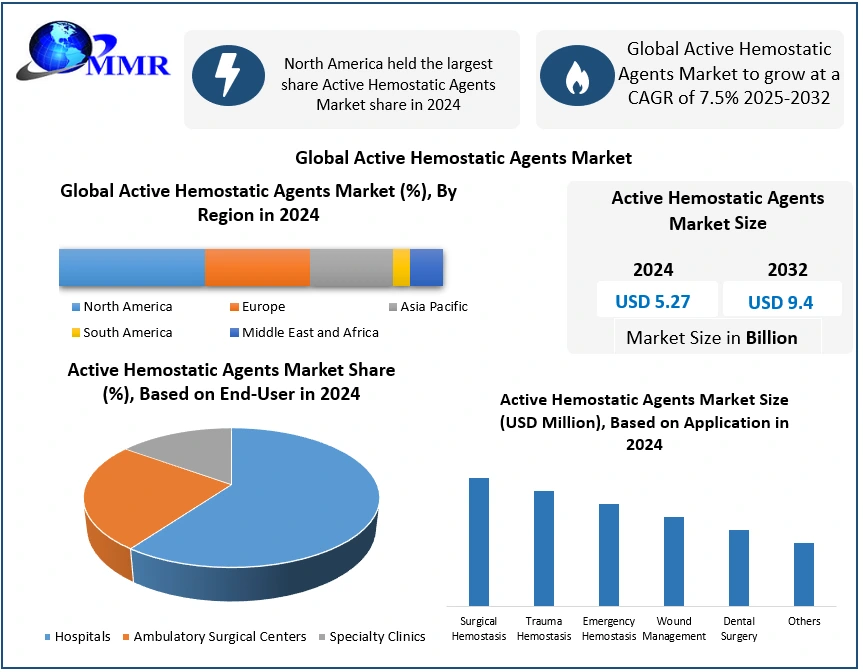
The Global Active Hemostatic Agents Market size was valued at USD 5.27 Bn. in 2024, and the total Global Active Hemostatic Agents Market revenue is expected to grow by 7.5% from 2024 to 2032, reaching nearly USD 9.4 Bn.
Global Active Hemostatic Agents Market Overview
The Active hemostatic agents are standard surgical techniques to manage bleeding from surgical surfaces. Active hemostatic agents are used in a wide variety of surgical settings, and the evolution of this class of surgical tools helps in the progress of active hemostats into present-day surgery and urology. The global Active Hemostatic Agents Market is driven by the increase in surgical procedures, trauma cases, and a preference for minimally invasive procedures. The demand for effective control of bleeding in cardiovascular, orthopedic, and general surgeries continues to drive the demand for active hemostatic agents. Additionally, the growing geriatric population and increased access to surgical interventions in developing regions are providing additional opportunities for market growth.
 To know about the Research Methodology :- Request Free Sample Report
The Active Hemostatic Agents companies, such as Medtronic, Ethicon (Johnson & Johnson), Baxter, and Stryker, as key players in the Active Hemostatic Agents Market with a strong range of products and substantial global presence. The market perception of innovation as a process and an important competitive strategy is accentuated with new products focused on faster clotting, safety, and biodegradability. North America and Europe are currently the market leaders; however, the Asia-Pacific market is rapidly developing due to the developing healthcare infrastructure and increased volume of surgical procedures in China, India, and Japan.
Global Active Hemostatic Agents Market Dynamics
Increasing prevalence of Surgical and Trauma Cases to drive demand for Effective Active Hemostatic Agents Market
Each year, approximately 310 million major surgeries are performed worldwide, including 40–50 million in the United States and 20 million in Europe. These procedures carry significant risks, with 1–4% of patients dying, up to 15% experiencing serious postoperative complications, and 5–15% requiring readmission within 30 days. In India alone, over 3 crore surgeries are conducted annually, with nearly 82% performed in small and medium-sized hospitals, underscoring the need for cost-effective yet high-performance hemostatic products across varied healthcare settings. Beyond elective operations, the increasing incidence of traumatic injuries from road accidents, industrial incidents, and natural disasters boosts Active Hemostatic Agents Market demand.
Effective active hemostatic agents are essential in these scenarios to rapidly achieve hemostasis, reduce blood loss, minimize surgical time, and improve patient recovery outcomes. Advances in minimally invasive surgeries, an aging population with complex medical needs, and higher global access to surgical care are amplifying this demand. As healthcare systems prioritize patient safety, faster recovery, and reduced postoperative complications, the adoption of advanced active hemostatic agents is set to accelerate across both developed and emerging markets.
High Cost and Limited Accessibility to Restrain Active Hemostatic Agents Market Growth
The materials that are used in these products are expensive, and they are produced under stringent manufacturing criteria that limit accessibility for facilities with budget considerations. Low levels of awareness of such products among the medical community and patients (in particular, those who live in rural settings) limit utilization. Regulatory barriers and limits on approval also slow down the number of items available for use. In addition to this, there are also safety concerns that limit the use of hemostatic devices in sensitive cases, which can include allergic reactions. This combination of reasons overall limits the extent to which active hemostatic agents are used broadly in global healthcare systems, which hampers the Active Hemostatic Agents Market growth.
Ongoing R&D and Innovation in Delivery Systems Create Lucrative Opportunities in Active Hemostatic Agents Market
Leading biotechnology firms, medical device manufacturers, and research institutions are actively exploring novel biomaterials, recombinant technologies, and synthetic polymers to create hemostatic agents with faster action times, improved biocompatibility, and minimal adverse reactions. These innovations aim to address current limitations such as delayed clot formation, potential immune responses, and storage instability. The advanced delivery systems enhance the precision, ease of use, and efficiency of hemostatic agents during surgery or emergency care. Innovations such as pre-loaded applicators, sprayable formulations, flowable gels, and bioresorbable matrices allow surgeons to control bleeding in hard-to-reach anatomical sites with greater accuracy and less operative disruption. The ongoing improvements in minimally invasive and laparoscopic surgery-compatible delivery tools are expanding the application range of these agents, driving the Active Hemostatic Agents Market growth.
Global Active Hemostatic Agents Market Segment Analysis
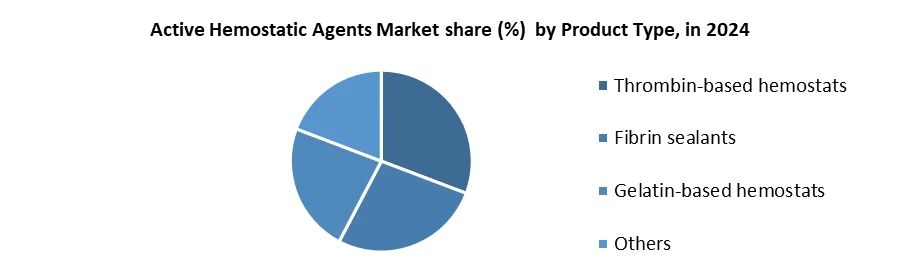
By Product Type, the Active Hemostatic Agents Market is categorized into the Thrombin-based hemostats, Fibrin sealants, Gelatin-based hemostats and Others. Thrombin-based hemostat product is widely used by surgeons during various surgical procedures. Thrombin-based hemostats hold a dominant position due to their widespread use by surgeons across diverse surgical specialties, including cardiovascular, neurosurgical, and orthopedic procedures. Thrombin is a critical enzyme in the coagulation cascade, and its exogenous application significantly accelerates the clotting process at bleeding sites. The Active Hemostatic Agents have found advancements, such as the development and FDA approval of recombinant thrombin-based hemostats, which are minimally antigenic and eliminate the risk of viral transmission associated with plasma-derived products. This innovation has been a major driver in adoption rates, with thrombin being used in over 1 million patients annually in the United States, generating approximately US$250 million in revenue. The segment’s growth is supported by expanding research on thrombin’s multifunctional roles in hemostasis, inflammation modulation, and cell signaling, making it an increasingly versatile surgical tool.
By End-User, the hospital segment commanded the largest Active Hemostatic Agents Market share in the Active Hemostatic Agents Market. Hospitals dominate the Active Hemostatic Agents Market, reflecting their central role in performing complex and high-volume surgical procedures where rapid and reliable bleeding control is essential. Hospitals are increasingly integrating standardized hemostatic management protocols into operating rooms to improve surgical outcomes and reduce perioperative complications. Educational initiatives, such as continuing education programs for perioperative registered nurses (RNs), play a vital role in enhancing knowledge and application of advanced hemostatic techniques. The availability of various hemostatic modalities, including topical agents, sealants, and biologically active products, enables surgeons to tailor interventions based on surgical type, bleeding severity, and patient condition.
Global Active Hemostatic Agents Market Regional Insights
North America dominates the global Active Hemostatic Agents Market and it is expected to maintain its position in the forecast period. The region reports a high prevalence of cardiovascular diseases, trauma cases, and chronic conditions that often necessitate surgical intervention, directly increasing the demand for effective bleeding control solutions. Additionally, higher adoption rates of advanced surgical technologies, including minimally invasive and robotic-assisted procedures, have driven the consistent use of active hemostatic agents to ensure precision and patient safety during complex operations.
A well-developed public healthcare infrastructure, combined with robust private sector participation, enables faster adoption of innovative products such as recombinant thrombin-based agents and next-generation fibrin sealants. favorable reimbursement policies in the United States and Canada encourage the integration of premium hemostatic solutions into standard surgical protocols. The increasing volume of elective and emergency surgical procedures, alongside a growing geriatric population with higher surgical needs, continues to boost market growth in the region. Ongoing research collaborations between leading medical institutions and biotechnology companies in North America are further advancing product innovation, safety profiles, and clinical effectiveness.
Global Active Hemostatic Agents Market Competitive Landscape
The global Active Hemostatic Agents Market is characterized by a competitive nature and consists of a mix of multinational companies and relatively new regional companies, all trying to develop their market position through innovation, mergers and acquisitions, and partnerships. Medtronic Plc., Ethicon Inc., Pfizer Inc., Baxter International Inc., and BD are major players in the global hemostatic agents market due to a diversified product portfolio, substantial R&D investments, and distribution networks established around the world. Many of these companies are developing next-generation hemostatic products with better efficacy and faster clotting times.
The new companies, CryoLife Inc., Advanced Medical Solutions Group plc, and Z-Medica LLC, are developing competitive advantages to gain market shares through their technologies and specialty products specific to certain surgical applications. There is a consistent emphasis on biodegradable and bioresorbable hemostatic products throughout the Active Hemostatic Agents Market, which reflects an increasing demand for minimally invasive and patient-safe options.
Many companies are entering emerging, high-growth markets, particularly the Asia-Pacific region and Latin America, and are making strategic alliances with hospitals and research institutions. Another key factor in maintaining competitiveness in the emerging and exciting active hemostatic agents market is that companies have aligned product development cycles to accepted surgical practices, while adhering to stringent regulatory standards.
Global Active Hemostatic Agents Market Trends
| Category | Key Trend | Example | Market Impact |
| Innovation in Bioabsorbable Products | Surge in demand for biodegradable and bioresorbable hemostats | Development of collagen-based, gelatin-based, and chitosan-based agents for enhanced biocompatibility | Improves patient outcomes, minimizes need for removal, and aligns with regulatory safety standards |
| Minimally Invasive Surgery Demand | Rising usage in laparoscopic and robotic surgeries | Agents designed for precise application and faster hemostasis in delicate, closed surgical procedures | Expands usage scope and increases demand in specialty and ambulatory surgical centers |
| Strategic Collaborations & Global Expansion | Partnerships with hospitals and expansion in emerging markets (Asia-Pacific, Latin America) | Players like AMS and Z-Medica forging alliances for wider distribution | Enhances brand reach, boosts sales, and addresses underserved surgical markets |
Global Active Hemostatic Agents Market Recent Development
• Ethicon / Johnson & Johnson (USA)
On Nov 15, 2023, received CE mark approval for ETHIZIA™ Hemostatic Sealing Patch, a first-of-its-kind synthetic polymer patch built for adaptability and rapid hemostasis. It achieved control in 80% of cases within 30 seconds, six times faster than standard fibrin patches, and is rolling out across EMEA, North America, APAC, and LATAM.
• Baxter International Inc. (USA)
In January 2024, acquired PerClot, a powdered hemostatic agent from CryoLife. This expanded Baxter’s portfolio into fast-action combination hemostats that are well-suited for trauma and surgical applications.
• Integra LifeSciences Corporation (USA)
In December 2023, Secured FDA clearance for a self-adaptive hemostatic agent that demonstrated a 25% reduction in blood loss in trauma patients compared to standard treatments.
• CryoLife Inc. (USA)
In 2023–2024, developed a polymer-based hemostat with 50% improved sealing capacity, specifically designed for cardiovascular surgeries. This product strengthens CryoLife’s position in specialized surgical interventions.
• Medcura, Inc. (USA)
In September 2024, the company was awarded the Spine Technology Award for LifeGel, a flowable absorbable hemostatic gel featuring a chitosan‑gelatin hybrid formulation. LifeGel offers a fast, swelling‑free application and received FDA Breakthrough Device Designation for spinal surgeries.
Active Hemostatic Agents Market Report Scope: Inquire before buying
| Global Active Hemostatic Agents Market | ||||
|---|---|---|---|---|
| Report Coverage | Details | |||
| Base Year: | 2024 | Forecast Period: | 2025-2032 | |
| Historical Data: | 2019 to 2024 | Market Size in 2024: | USD 5.27 Bn. | |
| Forecast Period 2025 to 2032 CAGR: | 7.5% | Market Size in 2032: | USD 9.4 Bn. | |
| Segments Covered: | by Product Type | Thrombin-based hemostats Fibrin sealants Gelatin-based hemostats Others |
||
| by Form Factor | Powders Films Others |
|||
| by Mode of Action | Mechanical Biological Chemical |
|||
| by Application | Surgical Hemostasis Trauma Hemostasis Emergency Hemostasis Wound Management Dental Surgery Others |
|||
| by End User | Hospitals Ambulatory Surgical Centers (ASCs) Specialty Clinics |
|||
Global Active Hemostatic Agents Market by Region
• North America (United States, Canada, Mexico)
• Europe (United Kingdom, France, Germany, Italy, Spain, Sweden, Russia, Rest of Europe)
• Asia Pacific (China, South Korea, Japan, India, Australia, Indonesia, Malaysia, Philippines, Thailand, Vietnam, Rest of Asia Pacific)
• Middle East and Africa (MEA) (South Africa, GCC, Nigeria, Rest of MEA)
• South America (Brazil, Argentina, Colombia, Chile, Rest of South America)
Global Active Hemostatic Agents Market, Key Players
North America
1. Medtronic Plc. (USA)
2. Ethicon Inc. (Johnson & Johnson) (USA)
3. Pfizer Inc. (USA)
4. Baxter International Inc. (USA)
5. CryoLife Inc. (USA)
6. Integra LifeSciences Corporation (USA)
7. Stryker Corporation (USA)
8. BD (Becton, Dickinson and Company) (USA
9. C.R. Bard (USA)
10. Z-Medica LLC (USA)
11. Warrior Tactical, LLC (USA)
Europe
1. Biom’up (France)
2. B. Braun Melsungen AG (Germany)
3. GELITA AG (Germany)
4. Advanced Medical Solutions Group plc (United Kingdom)
Asia-Pacific
1. Samyang Biopharmaceuticals Corp. (South Korea)
2. Takeda Pharmaceutical Company Limited (Japan)
3. Hualan Biological Engineering Inc. (China)
4. Jianerkang Medical Dressing Co., Ltd. (China)
5. Jiangsu Yuyue Medical Instruments Co., Ltd. (China)
6. Asahi Kasei Corporation (Japan)
7. Ningbo Yare Biotech Co., Ltd. (China)
Frequently Asked Questions
1. Which region has the largest share in the Global Active Hemostatic Agents Market?
Ans: North America held the highest Active Hemostatic Agents Market share in 2024.
2. What is the growth rate of the Global Active Hemostatic Agents Market?
Ans: The Global Active Hemostatic Agents Market is expected to grow at a CAGR of 7.5% during the forecast period 2025-2032.
3. What is the scope of the Global Active Hemostatic Agents Market report?
Ans: The Global Active Hemostatic Agents Market report helps with the PESTEL, Porter's Analysis, Recommendations for Investors and leaders, and market estimation for the forecast period.
4. Who are the key players in the Global Active Hemostatic Agents Market?
Ans: The important key players in the Global Active Hemostatic Agents Market are Medtronic Plc. (USA), Ethicon Inc. (Johnson & Johnson) (USA), Pfizer Inc. (USA), Baxter International Inc. (USA), CryoLife Inc. (USA), B. Braun Melsungen AG (Germany), and GELITA AG (Germany).
5. What is the study period of this market?
Ans: The Global Market is studied from 2024 to 2032.