
Global Prescription Pharmaceuticals Market By Product Type, by Therapeutic Area, by Formulations, By Distribution Channels, by Region and Forecast 2034
Overview
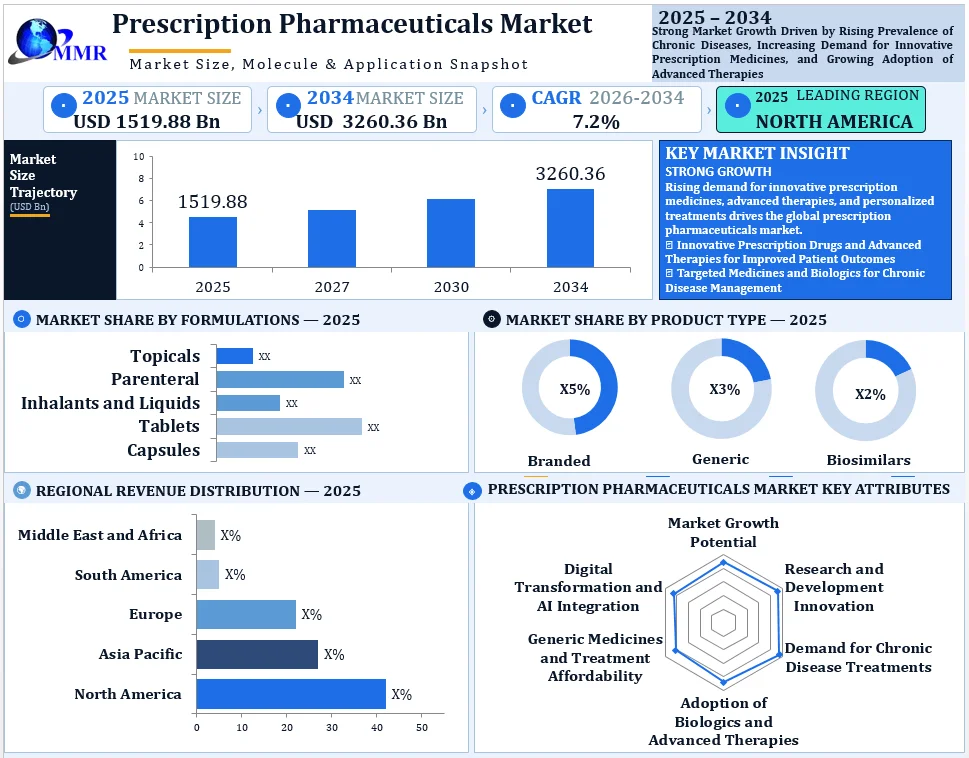
The Global Prescription Pharmaceuticals Market size was valued at USD 1519.88 Billion in 2025 and the total Prescription Pharmaceuticals revenue is expected to grow at a CAGR of 8.85% from 2025 to 2034, approaching to USD 3260.36 Billion by 2034.
Global Prescription Pharmaceuticals Market Overview
The market encompasses prescription medications used to treat, manage, and prevent a wide range of acute and chronic diseases, including cancer, cardiovascular disorders, diabetes, neurological conditions, and autoimmune diseases. Market growth is driven by the increasing prevalence of chronic illnesses, an aging global population, expanding healthcare access, and continuous pharmaceutical research and development. Advances in biologics, targeted therapies, personalized medicine, and specialty drugs are expanding treatment options and supporting the development of innovative prescription medicines. In addition, growing demand for generic drugs and biosimilars improves access to cost-effective treatments, while the expansion of hospital pharmacies, retail pharmacies, and online pharmaceutical distribution channels strengthens medicine accessibility.
The COVID-19 pandemic influenced prescription pharmaceutical sales through disruptions in global supply chains, changes in healthcare spending, delays in routine medical consultations, and increased demand for certain treatments. Pharmaceutical companies adapted to these challenges by strengthening supply chain resilience, expanding research and development activities, and accelerating the development of innovative therapies. The market continues to evolve through product launches, regulatory approvals, patent expirations, and increasing investment in advanced drug development.
The market is estimated by triangulation of data points obtained from various sources and feeding them into a simulation model created individually for each market. The data points are obtained from paid and unpaid sources along with paid primary interviews with key opinion leaders (KOLs) in the market. KOLs from both, demand and supply side were considered while conducting interviews to get an unbiased idea of the market. This exercise was done at a country level to get a fair idea of the market in countries considered for this study. Later this country-specific data was accumulated to come up with regional numbers and then arrive at the global market value for market.
Global Prescription Pharmaceuticals Market Growth and Share Analysis
To know about the Research Methodology :- Request Free Sample Report
Key Highlights – Global Prescription Pharmaceuticals Market
• Strong Market Growth: The global prescription pharmaceuticals market reaches USD 1,519.88 billion in 2025 and is projected to reach USD 3,260.36 billion by 2034, growing at a CAGR of 8.85% during 2025–2034.
• Rising Demand for Advanced Treatments: Increasing demand for oncology drugs, biologics, immunotherapies, and personalized medicines supports market expansion.
• Oncology and Chronic Disease Management: Growing demand for cancer treatments, diabetes medicines, cardiovascular drugs, and immunology therapies strengthens prescription drug consumption.
• Growing Generic and Biosimilar Adoption: Generic medicines and biosimilars improve treatment affordability, expand patient access, and intensify competition among pharmaceutical manufacturers.
• North America Leads the Market: Advanced healthcare infrastructure, strong pharmaceutical research capabilities, high medicine expenditure, and access to innovative therapies support regional leadership.
• Asia Pacific Offers Growth Opportunities: Expanding healthcare infrastructure, increasing access to medicines, pharmaceutical manufacturing capabilities, and rising treatment demand support regional growth.
• Innovation Drives Competition: Pharmaceutical companies prioritize targeted therapies, biologics, precision medicine, and advanced drug development to strengthen product portfolios and address unmet medical needs.
• Digital Transformation Supports Drug Development: Artificial intelligence, data analytics, and digital technologies improve drug discovery, clinical trial planning, and pharmaceutical manufacturing efficiency.
• Regulatory and Pricing Challenges Persist: High development costs, stringent approval requirements, patent expirations, and reimbursement restrictions influence product commercialization and profitability.
• Strategic Collaborations Strengthen Pipelines: Licensing agreements, biotechnology partnerships, acquisitions, and research collaborations help pharmaceutical companies access emerging technologies and expand their therapeutic portfolios.
Global Prescription Pharmaceuticals Market Dynamics
Global Prescription Pharmaceuticals Market Drivers
Rising Prevalence of Chronic Diseases Drives Prescription Drug Demand: The increasing burden of cancer, cardiovascular diseases, diabetes, and neurological disorders strengthens demand for prescription pharmaceuticals. The World Health Organization reports that noncommunicable diseases cause 41 million deaths annually, representing 74% of global deaths. This disease burden increases the need for long-term medication, advanced treatments, and continuous disease management. Pharmaceutical manufacturers expand their portfolios to address complex medical conditions and improve patient outcomes.
Increasing Adoption of Innovative Therapies Supports Market Expansion: Advances in biologics, immunotherapies, targeted medicines, and personalized treatments expand therapeutic options for complex diseases. Global prescription medicine spending reaches approximately USD 1.7 trillion at list prices in 2025, representing 10% year-on-year growth. Increasing demand for advanced therapies and rising medicine utilization encourage pharmaceutical companies to expand their product portfolios and invest in drug development.
Global Prescription Pharmaceuticals Market Restraints
High Prescription Drug Prices Restrict Treatment Accessibility: The high cost of innovative medicines, specialty drugs, and biologic therapies creates affordability challenges for patients and healthcare systems. Research expenditure, clinical trials, specialized manufacturing, and regulatory compliance contribute to drug development costs. High out-of-pocket expenses and restrictive reimbursement policies limit access to certain treatments, particularly in low- and middle-income countries. Pharmaceutical companies face pressure to balance investment recovery with affordable pricing and wider patient access.
Patent Expirations Increase Competitive Pressure: The expiration of patents on established prescription medicines allows generic drug and biosimilar manufacturers to introduce competing products. Lower-priced alternatives improve affordability but reduce the revenue and market share of originator companies. Manufacturers respond by expanding their product pipelines, developing next-generation therapies, and investing in specialty medicines to maintain competitiveness.
Global Prescription Pharmaceuticals Market Opportunities
Expanding Healthcare Infrastructure Creates Growth Opportunities: Improvements in healthcare infrastructure, insurance coverage, diagnostic facilities, and pharmaceutical distribution increase access to prescription medicines. Emerging economies, particularly China and India, offer opportunities through expanding healthcare services, rising treatment requirements, and growing domestic pharmaceutical manufacturing capabilities. Improved access to healthcare professionals and prescription services supports medicine adoption across hospital, retail, and online pharmacy channels.
Growth in Biologics and Personalized Medicine Expands Treatment Options: Advances in precision medicine, cell and gene therapies, immunotherapy, and targeted drug development create opportunities for differentiated prescription treatments. These technologies enable pharmaceutical companies to address specific disease mechanisms and patient populations. Biosimilar development also expands access to biologic medicines by introducing additional treatment options and increasing price competition.
Global Prescription Pharmaceuticals Market Challenges
High Research and Development Costs and Clinical Trial Complexity: Prescription pharmaceutical development requires substantial investment in drug discovery, preclinical evaluation, clinical trials, regulatory submissions, and post-marketing surveillance. Clinical trials require extensive safety and efficacy testing, which increases development costs and timelines. Antibiotic development illustrates this financial challenge, with research indicating an average development cost of USD 1.2 billion and a development timeline of around 13 years. These financial requirements and the risk of clinical failure create significant challenges for pharmaceutical manufacturers.
Stringent Regulatory Requirements Delay Product Commercialization: Pharmaceutical manufacturers must comply with strict requirements for clinical evidence, manufacturing quality, labeling, and post-approval safety monitoring. Differences in regulatory requirements across countries increase the complexity of international product launches. Additional clinical data requirements, manufacturing inspections, and approval delays increase development expenditure and postpone commercialization. Companies must maintain robust quality management systems and pharmacovigilance processes throughout a medicine's lifecycle.
Antimicrobial Resistance Reduces the Effectiveness of Existing Medicines: Antimicrobial resistance creates a major challenge for pharmaceutical companies developing treatments for bacterial infections. The World Health Organization reports that one in six laboratory-confirmed bacterial infections causing common infections worldwide in 2023 shows resistance to antibiotic treatments. Between 2018 and 2023, resistance increases in more than 40% of monitored pathogen–antibiotic combinations, with an average annual increase of 5–15%. These trends increase the need for new antibiotics and alternative therapies while highlighting gaps in pharmaceutical research and development.
Supply Chain Disruptions and Dependence on Pharmaceutical Ingredients: Prescription pharmaceutical production depends on reliable supplies of active pharmaceutical ingredients, excipients, packaging materials, and specialized manufacturing equipment. Geopolitical tensions, transportation delays, manufacturing interruptions, and raw material shortages disrupt production and medicine deliveries. Dependence on concentrated manufacturing sources increases vulnerability to supply interruptions. Pharmaceutical companies strengthen supplier diversification, inventory management, and manufacturing resilience to maintain product availability.
Pricing Pressures and Reimbursement Limitations Affect Profitability: Governments, insurers, and healthcare providers evaluate medicine prices against clinical benefits and budget constraints. Price negotiations, reimbursement restrictions, generic competition, and cost-containment policies influence pharmaceutical revenue. High-cost specialty drugs face particular scrutiny because treatment expenses place pressure on healthcare budgets. Manufacturers must demonstrate clinical value, treatment effectiveness, and economic benefits to secure market access and sustain demand.
Global Prescription Pharmaceuticals Market Segment Analysis
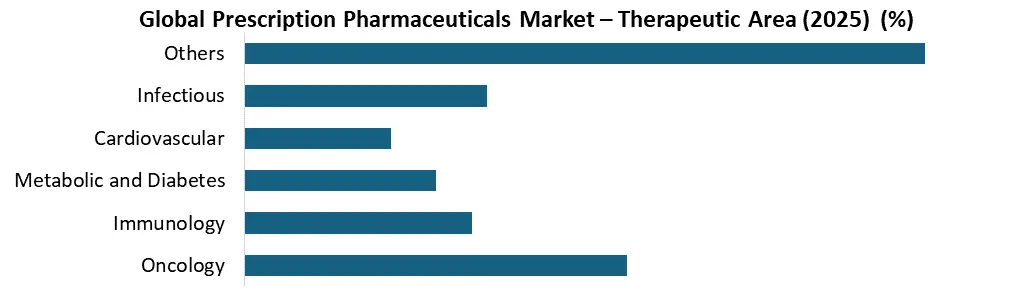
By Therapeutic Area: The Oncology segment holds a significant share of the global prescription pharmaceuticals market, driven by increasing demand for cancer treatments, targeted therapies, immunotherapies, and personalized medicine. Immunology benefits from rising demand for treatments for autoimmune and inflammatory disorders. Metabolic and Diabetes, Cardiovascular, and Infectious segments are supported by the need for long-term disease management, advanced therapies, and effective infection treatment. The Others segment includes prescription medicines for neurological, respiratory, and other medical conditions.
By Formulation: The Tablets segment holds a significant share of the market due to its ease of administration, cost-effectiveness, convenient storage, and suitability for large-scale manufacturing. Capsules offer convenient dosing and support the delivery of various active pharmaceutical ingredients. Inhalants and Liquids address specific needs, including respiratory conditions and patients who have difficulty swallowing solid dosage forms. Parenteral formulations play an important role in hospital-based treatments, biologics, and therapies requiring injections or infusions. Topicals are widely used for localized treatment of dermatological and other conditions.
By Distribution Channel: The Offline segment holds a significant share of the market, supported by hospital pharmacies, retail pharmacies, and established pharmaceutical distribution networks. These channels provide access to prescribed medicines, pharmacist guidance, and specialized treatments requiring professional supervision. The Online segment is gaining traction through digital pharmacy platforms, prescription verification, home delivery services, and convenient medicine ordering. Growing digital healthcare adoption and improved access to online pharmacy services support the expansion of this segment.
Global Prescription Pharmaceuticals Market Regional Insights
North America holds the leading position in the global prescription pharmaceuticals market in 2025, supported by advanced healthcare infrastructure, high healthcare expenditure, strong pharmaceutical research and development, and widespread access to innovative medicines. The United States represents the region’s primary market, driven by demand for oncology drugs, biologics, specialty medicines, and treatments for chronic diseases. Established insurance and pharmacy distribution networks further support market growth.
Asia Pacific represents a major growth region, driven by expanding healthcare infrastructure, increasing access to prescription medicines, rising healthcare expenditure, and a large patient population. China, India, and Japan contribute significantly through pharmaceutical manufacturing, domestic medicine demand, and the adoption of advanced treatments. Growing healthcare coverage and improved access to generic medicines further support regional expansion.
Europe maintains a significant position in the global prescription pharmaceuticals market, supported by established healthcare systems, strong pharmaceutical manufacturing capabilities, and demand for innovative and generic medicines. Germany, the United Kingdom, France, and Italy contribute through healthcare spending, pharmaceutical research, and the adoption of advanced therapies. Government pricing policies and regulatory requirements influence medicine accessibility and market competition.
South America experiences market growth through improving healthcare access, expanding pharmaceutical distribution networks, and increasing demand for treatments for chronic and infectious diseases. Brazil and Argentina represent important markets, supported by public healthcare services, private healthcare providers, and domestic pharmaceutical production. However, affordability constraints and differences in healthcare access influence the adoption of higher-cost prescription medicines.
Middle East and Africa present growth opportunities through healthcare infrastructure development, increasing disease awareness, and expanding access to prescription medicines. Investments in hospitals, pharmacies, and healthcare services support demand for treatments for chronic diseases, infections, and other medical conditions. However, dependence on imported medicines, affordability challenges, and uneven healthcare distribution continue to influence market expansion across the region.
Global Prescription Pharmaceuticals Market – Competitive Landscape
The global prescription pharmaceuticals market is shifting from conventional drug manufacturing toward innovation-led competition, specialized treatment platforms, and integrated patient care. Companies differentiate themselves through targeted therapies, biologics, obesity and diabetes medicines, advanced cancer treatments, and rare disease drugs. Competitive strength increasingly depends on the ability to develop differentiated medicines, accelerate clinical pipelines, secure regulatory approvals, and maintain reliable global supply chains.
Innovation and Pipeline Differentiation: Leading pharmaceutical companies prioritize high-value therapeutic areas, including oncology, immunology, and metabolic diseases. They invest in next-generation biologics, antibody-drug conjugates, and precision medicine to address unmet medical needs and strengthen product portfolios.
Patent Lifecycle and Portfolio Renewal: Pharmaceutical companies manage patent expirations by developing next-generation treatments, expanding approved indications, and introducing new formulations. Generic and biosimilar manufacturers create additional competition by offering lower-cost alternatives when market exclusivity ends.
Strategic Partnerships and External Innovation: Companies strengthen their development pipelines through biotechnology partnerships, licensing agreements, acquisitions, and research collaborations. These strategies provide access to emerging technologies, specialized drug candidates, and new therapeutic platforms.
Digital Transformation and AI Adoption: Pharmaceutical companies integrate artificial intelligence, data analytics, and digital technologies into drug discovery, clinical trial planning, and manufacturing. These capabilities support faster decision-making, improved research efficiency, and more targeted development strategies.
Manufacturing Capacity and Market Access: Companies invest in production facilities, supply chain resilience, and distribution networks to meet rising demand for specialized medicines. Pricing strategies, reimbursement agreements, regulatory compliance, and patient access programs also influence their ability to compete across international markets.
Key Competitive Differentiators
The market's competitive advantage increasingly comes from owning differentiated science, developing strong late-stage pipelines, scaling complex therapies, and expanding patient access rather than relying solely on established drug brands. Companies that combine innovation with manufacturing reliability and effective commercialization strengthen their positions in the global prescription pharmaceuticals market.
Global Prescription Pharmaceuticals Market: Recent Developments
| Date | Company | Development | Impact |
|---|---|---|---|
| October 19, 2026 | Roche and Hansoh Pharmaceutical | Entered a licensing partnership valued at over USD 15 billion to develop antibody-drug conjugates (ADCs) for cancer treatment. |
Strengthens Roche’s oncology pipeline and expands access to targeted cancer drug candidates through international development and commercialization. |
| July 1, 2026 | Mankind Pharma and Denovo Sciences | Announced an AI-led drug discovery collaboration to generate and evaluate potential drug candidates. |
Supports innovation-driven research, improves early-stage candidate prioritization, and aims to shorten drug discovery timelines. |
| June 5, 2026 | Sanofi and Owkin | Expanded their collaboration to develop AI-powered biopharmaceutical agents for drug research and development. |
Strengthens AI integration in pharmaceutical R&D and supports more efficient target identification and drug development. |
| May 28, 2026 | Pfizer and Innovent Biologics | Announced a global collaboration covering 12 early-stage and new cancer medicine candidates, including ADCs and multispecific antibodies. |
Expands Pfizer’s oncology pipeline and combines drug discovery expertise with global clinical development and commercialization capabilities. |
| April 14, 2026 | Apotex, Orbicular Pharmaceutical Technologies, and Gland Pharma | Received U.S. FDA approval for generic Infuvite Adult Injection products, with 180-day competitive generic therapy exclusivity eligibility for the pharmacy bulk package. |
Strengthens competition in injectable medicines and supports the availability of additional generic treatment options. |
| February 24, 2026 | Bayer | Announced expanded availability of Nubeqa in India for men with metastatic hormone-sensitive prostate cancer, offering a treatment option that does not require chemotherapy. |
Broadens treatment options for eligible prostate cancer patients and strengthens Bayer’s presence in India’s oncology market. |
Scope of the Prescription Pharmaceuticals Market report: Inquire before buying
The research report categorizes the Global market based on Therapeutic Segments, Formulations, and geography. Market size by value is estimated and forecasted with the revenues of leading companies operating in the Global market with key developments in companies and market trends
| Prescription Pharmaceuticals Market | |||
|---|---|---|---|
| Report Coverage | Details | ||
| Base Year: | 2025 | Forecast Period: | 2026-2034 |
| Historical Data: | 2020 to 2025 | Market Size in 2025: | 1519.88 USD Billion |
| Forecast Period 2026-2034 CAGR: | 8.85% | Market Size in 2034: | 3260.36 USD Billion |
| Segments Covered: | by Product Type | Branded Generic Biosimilars |
|
| by Formulations | Capsules Tablets Inhalants and Liquids Parenteral Topicals |
||
| by Distribution Channels | Online Offline |
||
Prescription Pharmaceuticals Market, by Region:
Asia Pacific (China, South Korea, Japan, India, Australia, Indonesia, Malaysia, Vietnam, Taiwan, Bangladesh, Pakistan and Rest of APAC)
Europe (UK, France, Germany, Italy, Spain, Sweden, Austria and Rest of Europe)
North America (United States, Canada and Mexico)
Middle East and Africa (South Africa, GCC, Egypt, Nigeria and Rest of ME&A)
South America (Brazil, Argentina Rest of South America)
Key players in the Global Prescription Pharmaceuticals Market :
1. Bayer AG
2. AstraZeneca plc
3. Gilead Sciences, Inc.
4. Johnson & Johnson
5. GSK plc
6. Novartis AG
7. Merck & Co., Inc.
8. Pfizer Inc.
9. Sanofi
10. F. Hoffmann-La Roche Ltd.
11. Eli Lilly and Company
12. AbbVie Inc.
13. Bristol Myers Squibb
14. Novo Nordisk A/S
15. Amgen Inc.
16. Takeda Pharmaceutical Company Limited
17. Boehringer Ingelheim
18. Biogen Inc.
19. Regeneron Pharmaceuticals, Inc.
20. Vertex Pharmaceuticals Incorporated
21. Astellas Pharma Inc.
22. Daiichi Sankyo Company, Limited
23. Eisai Co., Ltd.
24. Otsuka Pharmaceutical Co., Ltd.
25. CSL Limited
26. UCB S.A.
27. Ipsen
28. Chugai Pharmaceutical Co., Ltd.
29. Sandoz Group AG
30. Viatris Inc.
31. Teva Pharmaceutical Industries Ltd.
32. Sun Pharmaceutical Industries Ltd.
33. Dr. Reddy's Laboratories Ltd.
34. Cipla Limited
35. Lupin Limited
36. Zydus Lifesciences Limited
37. Aurobindo Pharma Limited
38. Hikma Pharmaceuticals PLC
39. Fresenius Kabi
40. Jazz Pharmaceuticals plc
41. Organon & Co.
42. Grifols S.A.
43. Servier
44. Menarini Group
45. Apotex Inc.
Frequently Asked Questions:
1. Which region has the largest share in Global Prescription Pharmaceuticals Market?
Ans: North America region holds the highest share in 2025.
2. What is the growth rate of Global Prescription Pharmaceuticals Market?
Ans: The Global Prescription Pharmaceuticals Market is growing at a CAGR of 8.85% during forecasting period 2026-2034.
3. What is scope of the Global Prescription Pharmaceuticals market report?
Ans: Global Prescription Pharmaceuticals Market report helps with the PESTEL, PORTER, COVID-19 Impact analysis, Recommendations for Investors & Leaders, and market estimation of the forecast period.
4. Who are the key players in Global Prescription Pharmaceuticals market?
Ans: The important key players in the Global Prescription Pharmaceuticals Market are – Bayer AG, AstraZeneca, Gilead Sciences, Johnson & Johnson, GlaxoSmithKline, Novartis A.G., Merck & Co., Pfizer, Sanofi S.A, F. Hoffmann-La Roche, Eli Lilly and Company, Lonza, AbbVie, Inc., Celgene Corporation, and Mallinckrodt Pharmaceuticals.
5. What is the study period of this market?
Ans: The Global Market is studied from 2020 to 2034.