
Glass Substrate Market Size by Type, End User, Region – Segment-Level Market Assessment, Growth Opportunity Analysis, Competitive Mapping & Forecast to 2034
Overview
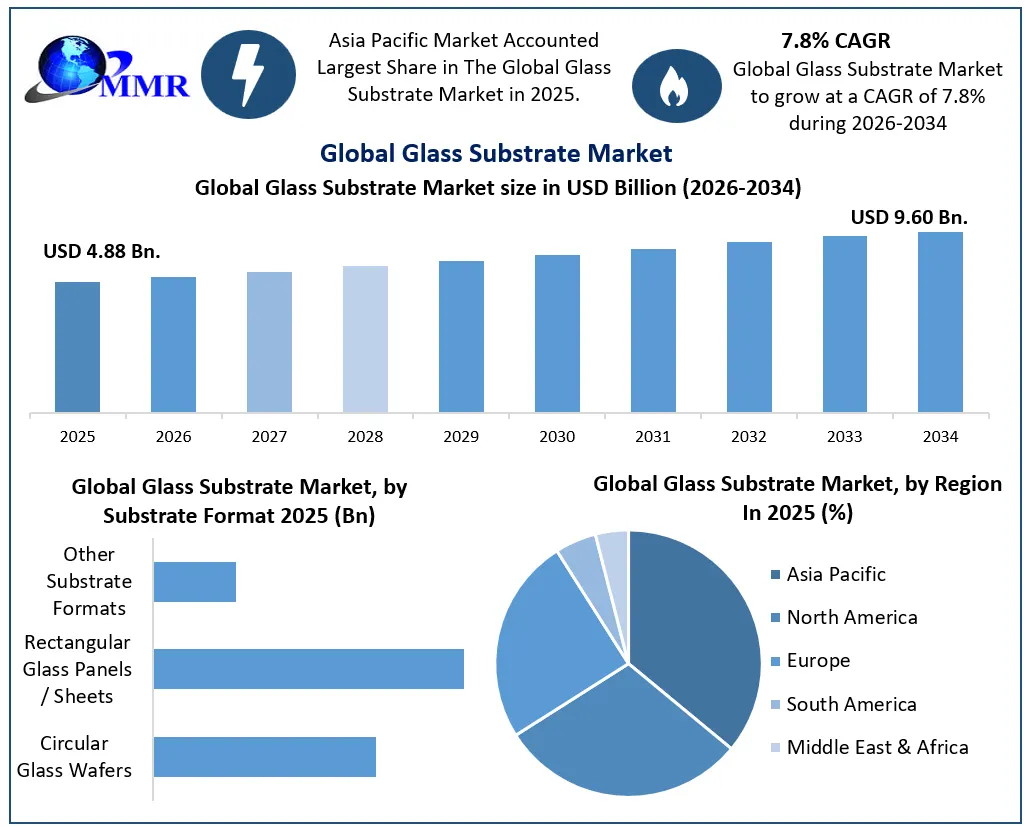
The Global Glass Substrate Market size was valued at USD 4.88 Bn. in 2025 and the total Glass Substrate Market revenue is expected to grow by 7.8 % from 2026 to 2034, approaching to USD 9.60 Bn.
Global Glass Substrate Market Overview:
In materials science and engineering, the substrate is the foundation component on which processing takes place. This layer is used to create new films or material coatings, e.g. deposited coverings. It might be the foundation to which paint, glue, or sticky tape adhere. A hard substrate, e.g. metal, cement, or glass, could be used to apply a layer.
Malleable substrates are also utilized. The report explores the Glass Substrate market's segments (Type, End-User Industry, and Region). Data has been provided by market participants, and regions (North America, Asia Pacific, Europe, Middle East & Africa, and South America). It provides a thorough analysis of the rapid advances that are currently taking place across all industry sectors. Facts and figures, illustrations, and presentations are used to provide key data analysis for the historical period from 2020-2025. The report investigates the Glass Substrate market's drivers, limitations, prospects, and barriers. This MMR report includes investor recommendations based on a thorough examination of the Glass Substrate market's contemporary competitive scenario.
Global Glass Substrate Market Growth Outlook
To know about the Research Methodology :- Request Free Sample Report
Global Glass Substrate Market Dynamics:
A major driver of the market is that in the automobile sector, there has been an increase in the usage of fiberglass composites.
Fiberglass offers a greater strength-to-weight ratio, which is significant in the automotive industry. Vehicles made of lightweight, high-strength materials provide higher mileage and better fuel economy. To minimize carbon dioxide emissions, the automobile sector has been subjected to rigorous restrictions. This has prompted the automotive industry to develop fuel-efficient compact cars to cut greenhouse gas emissions. In the automobile industry, fiberglass substrates are frequently utilized as an alternative to aluminum and steel in the production of lightweight cars.
The key opportunity in the market is that solar power-producing facilities have a lot of promise in the glass substrate industry.
The price of power is always rising; as a result, the need for alternative energy sources has increased during the previous decade. Solar energy is one of the substitutes for traditional energy sources. The functionality of photochromic smart glass substrates is affected by sunshine, either actively or passively.
The adoption of such smart glass substrates significantly reduces power usage, particularly for heating and cooling systems. Solar power-producing plants are one of the growing possible applications of smart glass substrates. Smart glass panels are used in solar panels to capture as much light as possible to create power. In the future, the solar power generating sector is likely to provide several potentials for smart glass technologies.
A major challenge in the market is that glass production consumes a lot of fuel.
A huge quantity of fuel is used in the glass-making process to liquefy raw ingredients. This also results in the release of hazardous gases e.g. carbon dioxide. There is a desire for novel production procedures that reduce fuel use.
Companies e.g. Nippon Sheet Glass (Japan), which are important participants in the insulated glass window industry, are developing innovative methods to cut fuel usage, which would not only lower manufacturing costs but also help them adhere to several carbon credits rules. This would assist these businesses in achieving long-term success.
Global Glass Substrate Market Segment Analysis:
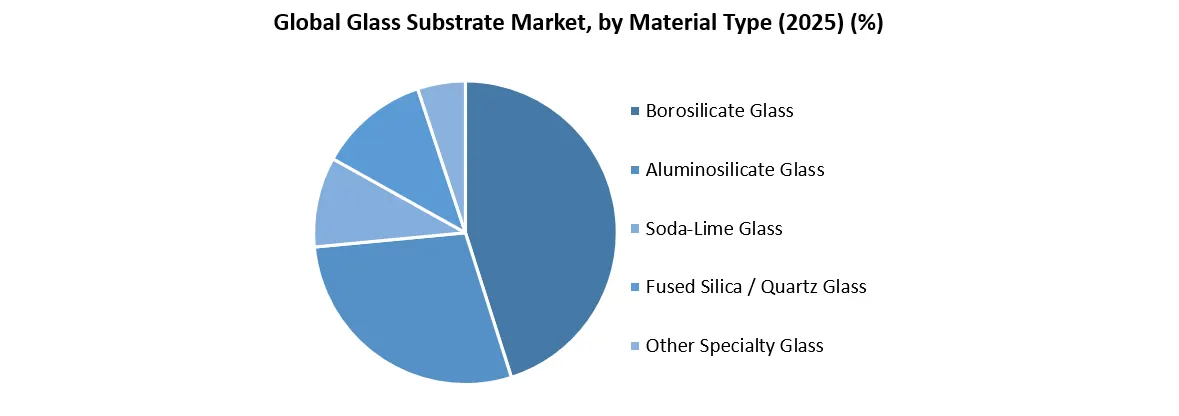
by Material Type, The glass substrate market is segmented into Borosilicate Glass, Aluminosilicate Glass, Soda-Lime Glass, Fused Silica / Quartz Glass, and Other Specialty Glass. Borosilicate Glass holds a significant market share due to its thermal resistance, chemical durability, and low thermal expansion. Aluminosilicate Glass gains demand from smartphones, displays, and electronic devices due to its strength and scratch resistance. Soda-Lime Glass is widely used in consumer electronics and automotive applications because of its cost-effectiveness. Fused Silica / Quartz Glass serves semiconductor and optical applications requiring high purity and thermal stability. Other Specialty Glass supports niche applications requiring customized optical, electrical, and mechanical properties.
by Substrate Format, The market is segmented into Circular Glass Wafers, Rectangular Glass Panels / Sheets, and Other Substrate Formats. Circular Glass Wafers account for significant demand due to their applications in semiconductor manufacturing, sensors, MEMS, and advanced packaging. Rectangular Glass Panels / Sheets witness growing adoption in display manufacturing, OLED technologies, and panel-level packaging due to their larger processing area. Other Substrate Formats include customized shapes and specialized glass structures for photonics, medical devices, and industrial applications.
by End User, The market is segmented into Consumer Electronics, Semiconductor & Electronics Manufacturing, Automotive, Healthcare & Medical Devices, Telecommunications, Industrial & Automation, Aerospace & Defense, Renewable Energy, and Other End-Use Industries. Consumer Electronics represents a major segment due to demand for smartphones, tablets, laptops, and display devices. Semiconductor & Electronics Manufacturing drives adoption through advanced packaging and electronic component production. Automotive demand increases with digital displays, infotainment systems, and ADAS. Healthcare applications include diagnostic equipment and biosensors, while telecommunications uses glass substrates in optical communication components. Industrial & Automation, Aerospace & Defense, and Renewable Energy support demand through sensors, optical systems, and solar technologies. Other industries include scientific instruments and specialized manufacturing.
Global Glass Substrate Market Regional Insights:
Due to increased consumption in countries e.g. China, India, and Japan, the APAC region is the main market and is anticipated to be the fastest-growing market. China is the world's largest producer of electronic goods. Not only does the country meet domestic consumption for electronics, but it also distributes electronic products to foreign countries. Electronics output is expected to increase further throughout the projection period, owing to rising middle-class spending power and rising demand for electronic items in nations purchasing digital products from China.
Furthermore, the country offers one of the world's largest medical fields. The Chinese government stresses welfare and technology in the 13th Five-Year Plan, which is likely to enhance expenditures in the biotechnology and pharmaceutical industry throughout the projection period. This, in turn, is predicted to boost the manufacturing of high-tech medical equipment used to relieve severe and age-related disorders in the nation, increasing demand for the market under consideration.
Global Glass Substrate Industry Ecosystem
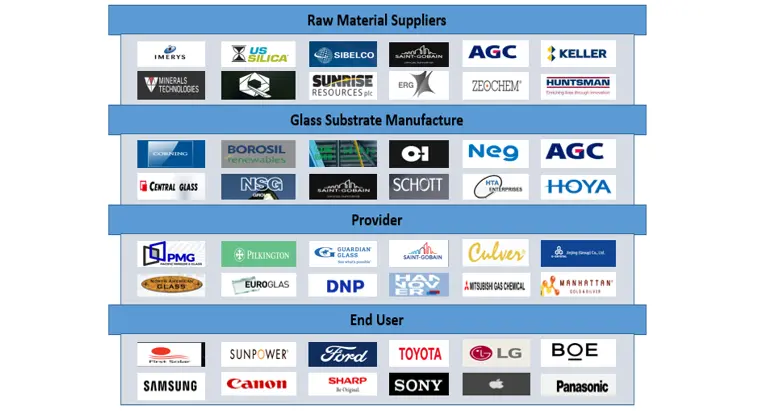
The objective of the report is to present a comprehensive analysis of the Glass Substrate market to the stakeholders in the industry. The past and current status of the industry with the forecasted market size and trends are presented in the report with the analysis of complicated data in simple language. The report covers all the aspects of the industry with a dedicated study of key players that include market leaders, followers, and new entrants.
PORTER, PESTEL analysis with the potential impact of micro-economic factors of the market have been presented in the report. External as well as internal factors that are supposed to affect the business positively or negatively have been analyzed, which will give a clear futuristic view of the industry to the decision-makers.
The report also helps in understanding the Glass Substrate market dynamics, and structure by analyzing the market segments and projecting the Glass Substrate market size. Clear representation of competitive analysis of key players by product, price, financial position, product portfolio, growth strategies, and regional presence in the Glass Substrate market make the report investor’s guide.
Global Glass Substrate Market Competitive Landscape
The global glass substrate market is moderately consolidated, with competition driven by material innovation, manufacturing capabilities, product quality, technological advancements, and strategic partnerships. Major players such as Corning Incorporated, AGC Inc., SCHOTT AG, Nippon Electric Glass Co., Ltd., and HOYA Corporation maintain strong market positions through extensive product portfolios, advanced glass-processing technologies, and established relationships with electronics and semiconductor manufacturers. Companies focus on developing high-performance glass substrates with improved thermal stability, mechanical strength, optical properties, and dimensional precision. Growing demand for advanced semiconductor packaging, OLED displays, and next-generation electronic devices encourages manufacturers to expand production capacities and invest in research and development. Emerging competition from Absolics Inc., Samsung Electro-Mechanics, and other technology companies is intensifying innovation in glass-core substrates and advanced packaging applications. Strategic collaborations, product launches, capacity expansions, and technological investments remain key competitive strategies.
Global Glass Substrate Market Recent Development
| Date | Company | Development | Impact |
|---|---|---|---|
| 21 August 2026 | Absolics | The company decided to conduct a rights issue worth about 400 billion KRW (~$289 million) to fund commercialization and facility upgrades for advanced glass substrates. | Accelerates mass production timelines and expands capacity for next-generation semiconductor packaging. |
| 24 June 2026 | Corning | Unveiled the Glass Bridge optical interconnect platform in Seoul, leveraging specialized glass substrates and waveguides for AI data centers. | Triggers a major industry shift toward glass-based optical architectures, reducing dependence on active alignment tools. |
| 30 March 2026 | Toshiba | Began sampling its advanced nearline hard disk drives built on glass substrates, offering capacities up to 34 TB. | Enhances mechanical durability and enables thinner enterprise storage designs using high-strength glass. |
| 04 November 2025 | Omdia | Reported that global display glass revenue reached a record high of JPY 270 billion in the third quarter of 2025. | Reflects a 14% year-over-year increase driven by higher pricing discipline and tight capacity management among major glass makers. |
Global Glass Substrate Market Scope: Inquiry Before Buying
| Global Glass Substrate Market | |||
|---|---|---|---|
| Report Coverage | Details | ||
| Base Year: | 2025 | Forecast Period: | 2026-2034 |
| Historical Data: | 2020 to 2025 | Market Size in 2025: | USD 4.88 Bn. |
| Forecast Period 2026 to 2034 CAGR: | 7.8% | Market Size in 2034: | USD 9.60 Bn. |
| Segments Covered: | by Material Type | Borosilicate Glass Aluminosilicate Glass Soda-Lime Glass Fused Silica / Quartz Glass Other Specialty Glass |
|
| by Substrate Format | Circular Glass Wafers Rectangular Glass Panels / Sheets Other Substrate Formats |
||
| by Substrate Thickness | Ultra-Thin Glass Substrates Thin Glass Substrates Standard-Thickness Glass Substrates Thick Glass Substrates |
||
| by Application | Display Substrates Semiconductor Packaging & Interposers MEMS & Sensor Substrates Photonics & Optoelectronics Photovoltaic Applications Microfluidics & Lab-on-a-Chip Other Applications |
||
| by End User | Consumer Electronics Semiconductor & Electronics Manufacturing Automotive Healthcare & Medical Devices Telecommunications Industrial & Automation Aerospace & Defense Renewable Energy Other End-Use Industries |
||
Global Glass Substrate Market, by Region
North America (United States, Canada and Mexico)
Europe (UK, France, Germany, Italy, Spain, Sweden, Austria and Rest of Europe)
Asia Pacific (China, South Korea, Japan, India, Australia, Indonesia, Malaysia, Vietnam, Taiwan, Bangladesh, Pakistan and Rest of APAC)
Middle East and Africa (South Africa, GCC, Egypt, Nigeria and Rest of ME&A)
South America (Brazil, Argentina Rest of South America)
Global Glass Substrate Market, Key Players
North America
1. Corning Incorporated
2. CoorsTek Inc.
3. Materion Corporation
4. Absolics Inc.
5. 3D Glass Solutions Inc.
6. Coresix Precision Glass Inc.
Europe
1. SCHOTT AG
2. Plan Optik AG
3. LPKF Laser & Electronics SE
4. IMT Masken und Teilungen AG
5. Saint-Gobain S.A.
Asia-Pacific
1. AGC Inc.
2. Nippon Electric Glass Co., Ltd.
3. Central Glass Co., Ltd.
4. Tunghsu Optoelectronic Technology Co., Ltd.
5. AvanStrate Inc.
6. Taiwan Glass Ind. Corp.
7. Tecnisco Ltd.
8. HOYA Corporation
9. Ohara Inc.
Others
1. Samsung Electro-Mechanics Co., Ltd.
2. Toppan Holdings Inc.
3. Nitto Boseki Co., Ltd.
Frequently Asked Questions:
1. Which is the potential market for the Glass Substrate in terms of the region?
Ans. APAC is the potential market for the Glass Substrate in terms of the region.
2. What are the opportunities for new market entrants?
Ans. The key opportunity in the market is that solar power-producing facilities have a lot of promise in the glass substrate industry.
3. What is expected to drive the growth of the Glass Substrate market in the forecast period?
Ans. A major driver of the market is that in the automobile sector, there has been an increase in the usage of fiberglass composites.
4. What is the projected market size & growth rate of the Glass Substrate Market?
Ans. Glass Substrate Market size was valued at USD 4.88 Billion in 2025 and the total Glass Substrate revenue is expected to grow by 7.8% from 2026 to 2034, approaching to USD 9.60 Billion.
5. What segments are covered in the Glass Substrate Market report?
Ans. The segments covered are Type, End-User Industry, and Region.