
Global Anti-Viral Coatings Market by Type of Coating, Type of Material, Application, Form, Region and Forecast 2034
Overview
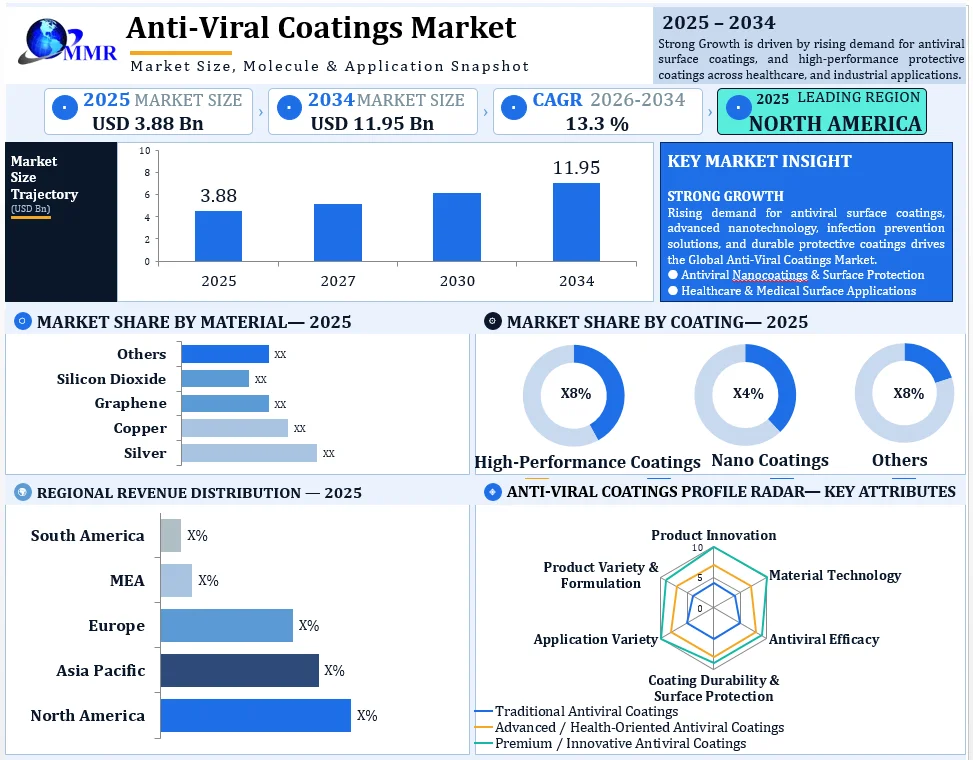
The Global Anti-Viral Coatings Market size was valued at USD 3.88 Billion in 2025 and the total Anti-Viral Coatings revenue is expected to grow at a CAGR of 13.3 % from 2026 to 2034, reaching USD 11.95 Billion by 2034.
The Global Anti-Viral Coatings Market refers to the worldwide industry involved in the development, manufacturing, distribution, and application of specialized surface coatings formulated to inactivate targeted viruses or reduce their persistence on treated materials. These coatings use active agents and advanced material technologies, including silver-based compounds, copper-based materials, titanium dioxide, graphene, antiviral polymers, and nanotechnology-enabled formulations. Their performance depends on coating composition, surface compatibility, environmental conditions, contact time, and validated antiviral testing.
The Global Anti-Viral Coatings Market experiences increasing demand for advanced antiviral surface coatings, antimicrobial protection technologies, infection prevention solutions, and high-performance protective coatings across healthcare, construction, transportation, packaging, and industrial applications. Growing awareness of healthcare-associated infections (HAIs), hygiene management, pathogen transmission, and surface contamination supports the adoption of antiviral coating technologies in hospitals, clinics, laboratories, public transportation, commercial buildings, schools, and high-touch environments. Manufacturers develop silver-based coatings, copper-based coatings, titanium dioxide coatings, graphene-based coatings, and antiviral nanocoatings to improve surface protection, durability, and functional performance.
Technological advancements in nanotechnology, photocatalytic coatings, ion-release mechanisms, polymer-based surface treatments, and long-lasting protective coatings expand the application potential of antiviral materials.
Anti-viral coatings are extensively used for the purpose that containing the virus on the surface. The nanoparticles attack the virus surface and do not allow protein formation, which reduces the spread of the virus. These factors contributing to the anti-viral coatings market growth.
The global Anti-Viral Coatings market report is a comprehensive analysis of the industry, market, and key players. The report has covered the market by demand and supply-side by segments. The global Anti-Viral Coatings report also provides trends by market segments, technology, and investment with a competitive landscape.
Global Anti-Viral Coatings Market Highlights
Global Anti-Viral Coatings Market Growth Outlook
To know about the Research Methodology :- Request Free Sample Report
Global Anti-Viral Coatings Market Dynamics:
Global Anti-Viral Coatings Market Drivers
• Rising Demand for Infection Prevention and Surface Protection: Increasing awareness of healthcare-associated infections, pathogen transmission, and hygiene management drives demand for antiviral surface coatings in hospitals, laboratories, medical facilities, public transportation, and commercial buildings.
• Advancements in Antiviral Nanotechnology: Innovations in silver-based coatings, copper-based coatings, antiviral polymers, and nanocoatings improve viral inactivation potential, surface compatibility, and long-lasting protective performance across multiple industries.
Global Anti-Viral Coatings Market Restraints
• High Development and Manufacturing Costs: Advanced antiviral coating formulations require specialized raw materials, research and development, performance validation, and quality control, which can increase production costs and limit adoption among cost-sensitive customers.
• Limited Standardization of Antiviral Efficacy Testing: Differences in test methods, target viruses, contact times, and surface materials complicate comparisons between antiviral coating products and make it harder for buyers to verify performance claims.
Global Anti-Viral Coatings Market Opportunities
• Expansion Across Healthcare and Medical Textiles: Increasing demand for antiviral coatings in medical gowns, masks, hospital curtains, medical equipment, and protective textiles creates opportunities for manufacturers to develop substrate-compatible and durable antiviral surface treatment solutions.
• Development of Sustainable, Metal-Free Antiviral Materials: Research into alternative antiviral materials creates opportunities to reduce dependence on silver- and copper-based formulations. In August 2026, Nippon Paint Holdings and the University of Tokyo reported findings on natural mordenite-type zeolite with strong antiviral activity, supporting research into potentially lower-cost, metal-free antiviral materials.
Global Anti-Viral Coatings Market Challenges
• Maintaining Long-Term Antiviral Effectiveness: Manufacturers face the challenge of preserving antiviral activity under repeated cleaning, abrasion, humidity, temperature fluctuations, and prolonged surface use without compromising coating adhesion or material quality.
• Demonstrating Real-World Antiviral Performance: Laboratory results do not automatically establish equivalent performance under everyday conditions. Companies need reliable testing across different viruses, substrates, contact times, and environmental conditions to substantiate antiviral coating effectiveness.
Global Anti-Viral Coatings Market Trends
• Rapid Innovation in Metal-Free and Bio-Based Coatings: Researchers explore environmentally conscious antiviral materials and polymer formulations to improve safety, durability, and material versatility. In September 2025, research into cardanol-based polymer coatings demonstrated antiviral properties alongside film stability, creating potential applications in medical devices, protective films, and filtration systems.
• Growth of Transparent and Light-Activated Antiviral Coatings: Advanced surface technologies, including visible-light-activated coatings and transparent nanomaterials, attract research interest because they offer potential viral inactivation without significantly altering the appearance of treated surfaces.
• Increasing Focus on Standardized Performance Validation: The industry places greater emphasis on measurable antiviral efficacy, coating durability, and credible product claims. Singapore introduced the SS 705 standard in April 2025 to assess the effectiveness and durability of antimicrobial surface disinfectants and coatings, supporting more consistent product evaluation.
Global Anti-Viral Coatings Market Segment Analysis:
By Type of Coating , High-performance coatings represent an important category in the Global Anti-Viral Coatings Market because they combine surface protection, durability, adhesion, and specialized functional properties. These coatings support applications in healthcare facilities, commercial buildings, medical equipment, and industrial environments where surfaces experience frequent cleaning and repeated contact. Nano coatings use engineered nanomaterials and nanoscale surface technologies to provide antiviral functionality, including formulations incorporating silver nanoparticles, copper-based materials, graphene, and silicon dioxide. Depending on their composition, these coatings aim to improve surface coverage, functional performance, and resistance to wear. The others category includes emerging polymer-based coatings, specialty protective coatings, and alternative formulations that do not fall within the first two categories. Product performance depends on validated antiviral efficacy, substrate compatibility, durability, and intended use.
By Type of Material, Material selection influences antiviral coating effectiveness, durability, manufacturing costs, and compatibility with different surfaces. Silver-based coatings use silver ions or silver-containing particles and are investigated for their antimicrobial properties and potential role in surface hygiene applications. Graphene-based coatings use graphene and related carbon materials to explore functional surface protection, improved coating strength, and advanced nanocomposite performance. Silicon dioxide-based coatings support surface engineering, protective layers, and functional coating formulations, although antiviral performance depends on the complete formulation rather than silicon dioxide alone. Copper-based coatings draw on copper's established antimicrobial properties and are investigated for high-touch surfaces, medical environments, and public infrastructure. The others category includes antiviral polymers, zinc-containing materials, titanium dioxide, bio-derived compounds, and other functional materials.
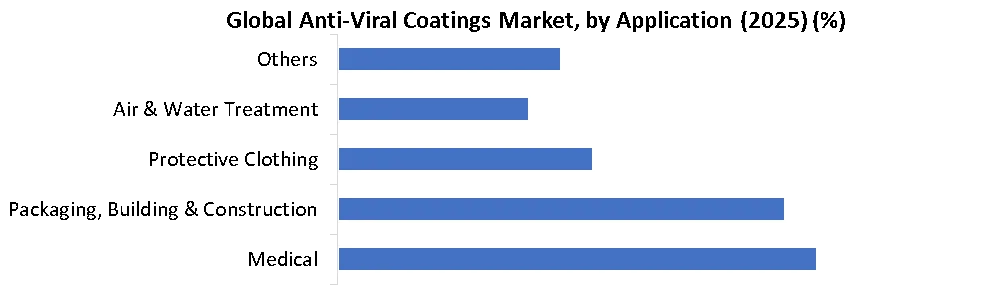
By Application, The application segment reflects demand for antiviral surface protection across healthcare, protective textiles, infrastructure, and environmental treatment systems. Medical applications include hospital surfaces, medical equipment, clinical environments, and selected healthcare products where validated antiviral coatings support hygiene management. Protective clothing includes treated textiles, gowns, uniforms, and other fabrics designed for specialized protective applications. Air and water treatment covers selected filtration components and treatment surfaces that incorporate functional coatings, although surface coatings do not replace validated disinfection or filtration processes. Packaging, building and construction includes packaging surfaces, wall coatings, doors, flooring, handrails, public facilities, and other high-touch surfaces where coating durability and material compatibility matter. Other applications include transportation interiors, consumer products, and industrial surfaces.
Anti-Viral Coatings Market Regional Insights:
North America represents a leading regional market for antiviral coatings, antiviral surface protection, antimicrobial coating technologies, and high-performance protective coatings. The United States, Canada, and Mexico support regional demand through healthcare infrastructure, medical equipment manufacturing, commercial building renovation, public transportation, and industrial surface protection. Growing attention to healthcare-associated infections, surface hygiene, validated antiviral efficacy, and durable coating technologies supports adoption across hospitals, laboratories, medical facilities, and high-touch environments. Established specialty chemical manufacturers, advanced materials research, and regulatory testing frameworks further strengthen the region's competitive position.
Europe maintains substantial demand for antiviral coatings, functional surface coatings, antimicrobial materials, and sustainable protective coating solutions. Germany, the United Kingdom, France, Italy, and Spain contribute through healthcare modernization, pharmaceutical manufacturing, public infrastructure, transportation, and commercial construction. Demand focuses on durable antiviral surface treatments, low-emission coating formulations, material safety, and verified product performance. European research and specialty chemical capabilities also support innovation in nanocoatings, polymer-based coatings, silver-based formulations, and copper-containing surface technologies. Regional growth depends on investment in healthcare facilities, building renovation, regulatory compliance, and demand for advanced surface hygiene solutions.
Asia-Pacific offers significant growth opportunities in the Global Anti-Viral Coatings Market because of expanding healthcare infrastructure, urbanization, manufacturing capacity, and construction activity. China, India, Japan, South Korea, and Southeast Asian countries support demand for antiviral paints, nanocoatings, medical surface coatings, protective textiles, and functional coatings for commercial buildings and transportation. Rising investment in hospitals, laboratories, medical devices, and industrial production strengthens the regional market. Asia-Pacific also offers opportunities for cost-effective antiviral formulations and scalable manufacturing, although adoption varies with product validation, regulatory requirements, and purchasing budgets.
South America represents an emerging market for antiviral coatings, antiviral protective surface treatments, antimicrobial coating technologies, and infection-control materials. Brazil, Argentina, Colombia, and other regional markets generate demand through healthcare infrastructure development, commercial construction, public transportation, and industrial modernization. Hospitals, clinics, laboratories, and public facilities create opportunities for silver-based coatings, copper-based coatings, polymer coatings, and antiviral nanocoatings. Market expansion depends on affordability, local distribution networks, product availability, and regulatory validation. Increasing investment in healthcare facilities and improved hygiene standards supports the long-term adoption of antiviral surface coatings across the region.
The Middle East & Africa market develops through healthcare infrastructure investment, hospital construction, urban development, tourism facilities, and demand for advanced surface protection. Saudi Arabia, the United Arab Emirates, South Africa, and other regional economies offer opportunities for antiviral paints, high-performance coatings, medical surface coatings, and protective materials. Hospitals, airports, hotels, commercial buildings, and public transportation systems create potential applications for durable antiviral surface treatments. Demand also benefits from infrastructure modernization and increased attention to hygiene management. However, adoption depends on product certification, procurement budgets, local manufacturing capabilities, and access to validated coating technologies.
The objective of the report is to present a comprehensive analysis of the Anti-Viral Coatings market to the stakeholders in the industry. The past and current status of the industry with the forecasted market size and trends are presented in the report with the analysis of complicated data in simple language. The report covers all the aspects of the industry with a dedicated study of key players that include market leaders, followers, and new entrants.
PORTER, SVOR, PESTEL analysis with the potential impact of micro-economic factors of the market have been presented in the report. External as well as internal factors that are supposed to affect the business positively or negatively have been analysed, which will give a clear futuristic view of the industry to the decision-makers.
The report also helps in understanding the Global Anti-Viral Coatings market dynamics, structure by analyzing the market segments and project the Global Anti-Viral Coatings market size. Clear representation of competitive analysis of key players by product, price, financial position, product portfolio, growth strategies, and regional presence in the Global Anti-Viral Coatings market make the report investor’s guide.
Global Anti-Viral Coatings Market Competitive Landscape
| Key Companies / Competitive Advantages |
Region | Competitive Landscape | Market Growth Outlook |
|---|---|---|---|
| PPG Industries, Sherwin-Williams, Axalta Coating Systems, Microban International, Hydromer, Cupron |
North America | Established coatings manufacturers and specialist antimicrobial technology providers compete through product innovation, surface-protection solutions, and healthcare applications. |
Strong established market. North America leads the combined antiviral and antimicrobial coatings market in 2025, supported by healthcare infrastructure, advanced materials research, and established distribution networks. |
| AkzoNobel, Arkema, BASF, Bio-Gate, BioCote, Nano-Care Deutschland, Hempel, Jotun |
Europe | Competition focuses on high-performance coatings, specialty polymers, functional surface technologies, industrial coatings, and material safety. |
Steady expansion. Healthcare modernization, industrial applications, sustainable materials, and investment in advanced coating technologies support market development. |
| Nippon Paint Holdings, Kansai Paint, Kobe Steel, NIPSEA Group, GrapheneCA, Asian Paints |
Asia-Pacific | Regional and multinational manufacturers compete through manufacturing scale, coating innovation, product affordability, and expanding distribution networks. |
Fastest-growing regional opportunity. Expanding healthcare infrastructure, construction, industrial manufacturing, and demand across China, India, Japan, and South Korea support future growth. |
| WEG, PPG Industries, AkzoNobel, Sherwin-Williams, regional coatings suppliers |
South America |
Competition is influenced by regional paint manufacturers, industrial coatings suppliers, distributors, and imported specialty coating technologies. |
Emerging growth market. Healthcare investment, commercial construction, and increasing demand for surface hygiene solutions create opportunities, although price sensitivity and distribution limitations can constrain adoption. |
| Jotun, Hempel, AkzoNobel, PPG Industries, Kansai Plascon, regional coating distributors |
Middle East & Africa | Competition centers on protective coatings, infrastructure applications, healthcare projects, and specialty surface treatments supplied through regional distributors. |
Developing market with long-term potential. Hospital construction, commercial infrastructure, transportation, and tourism-related investment create opportunities for antiviral coating suppliers. |
Global Anti-Viral Coatings Market Recent Development
| Exact Date | Company / Institution | Recent Development | Market Significance |
|---|---|---|---|
| 12 February 2026 | Nippon Paint Holdings and The University of Tokyo | Launched Phase II of their industry–academia collaboration, with approximately ¥300 million in funding and an agreement running through December 2028. The program builds on earlier antiviral coating research and expands into AI-enabled coating innovation and environmentally friendly materials. |
Supports antiviral coating R&D, materials innovation, and sustainable coating development in Asia-Pacific. |
| 30 March 2026 | PPG Industries / COMEX | A trade-news report describes the launch of VINIMEX TOTAL antiviral and antibacterial paint, with reported activity against selected viruses and bacteria, including influenza A H1N1 and SARS-CoV-2. |
Illustrates demand for antiviral paints in residential, healthcare, educational, and other high-traffic environments. Note: PPG's official announcement confirms the original product launch on 6 October 2021, so the March 2026 report does not establish a new product launch by PPG in 2026. |
| 6 August 2026 | The University of Tokyo and Nippon Paint | Published research on natural mordenite-type zeolite and its strong antiviral activity, identifying material structure and surface acidity as key factors. |
Supports research into potentially lower-cost, metal-free antiviral materials that may reduce reliance on silver- and copper-based formulations. |
| 24 August 2026 | Institute of Science Tokyo | Researchers reported that ball milling improves the antiviral activity of manganese-based oxides against an enveloped virus similar to SARS-CoV-2. The research identifies potential applications in coatings and self-disinfecting surfaces. |
Opens a research pathway for cost-conscious inorganic antiviral coatings and advanced functional surfaces. |
Anti-Viral Coatings Market Scope: Inquire before buying
| Anti-Viral Coatings Market | |||
|---|---|---|---|
| Report Coverage | Details | ||
| Base Year: | 2025 | Forecast Period: | 2026-2034 |
| Historical Data: | 2017 to 2022 | Market Size in 2025: | USD 3.88 Bn. |
| Forecast Period 2026 to 2034 CAGR: | 13.3% | Market Size in 2034: | USD 11.95 Bn. |
| Segments Covered: | by Type of Coating | High-Performance Coatings Nano Coatings Others |
|
| by Type of Material | Graphene Silver Silicon Dioxide Copper Others |
||
| by Application | Protective Clothing Medical Air & Water Treatment Packaging, Building & Construction Others |
||
| by Form | Spray Powder Liquid Others |
||
Anti-Viral Coatings Market, by Region
North America (United States, Canada and Mexico)
Europe (UK, France, Germany, Italy, Spain, Sweden, Austria and Rest of Europe)
Asia Pacific (China, South Korea, Japan, India, Australia, Indonesia, Malaysia, Vietnam, Taiwan, Bangladesh, Pakistan and Rest of APAC)
Middle East and Africa (South Africa, GCC, Egypt, Nigeria and Rest of ME&A)
South America (Brazil, Argentina Rest of South America)
Anti-Viral Coatings Market Key Players
1. Dais Corporation
2. Arkema
3. Kobe Steel, Ltd.
4. Hydromer
5. Nippon Paint Holdings Co., Ltd.
6. Nano-Care Deutschland AG
7. BioFence
8. EnvisionSQ
9. GrapheneCA
10. Bromoco International
11. Muse Nanobots
12. Kastus Technologies
13. Integricote
14. Nano Came Co. Ltd.
15. Bio-Gate AG
16. PPG Industries, Inc.
17. The Sherwin-Williams Company
18. Akzo Nobel N.V.
19. Axalta Coating Systems
20. BASF SE
21. Covestro AG
22. DuPont de Nemours, Inc.
23. 3M Company
24. RPM International Inc.
25. Lonza Group AG
26. Microban International Ltd.
27. BioCote Limited
28. Cupron Inc.
29. Sciessent LLC
30. Hempel A/S
31. Jotun A/S
32. Kansai Paint Co., Ltd.
33. Sika AG
34. Huntsman Corporation
35. Evonik Industries AG
36. Clariant AG
37. Novapura AG
38. Grand Polycoats
39. NanoGraphene Inc.
40. Nanovere Technologies
41. Sanitized AG
42. TIGER Coatings GmbH & Co. KG
43. Zochem Inc.
44. Dortrend International Ltd.
45. Antiviral Protection S.L.
Frequently Asked Questions:
1. Which form of anti-viral coating holds market potential?
Ans: The global anti-viral coatings market includes liquid coatings, spray coatings, powder coatings, and other forms.
2. What is the growth rate of Global Anti-Viral Coatings Market?
Ans: The Global Anti-Viral Coatings Market is growing at a CAGR of 13.3% during forecasting period 2026-2034.
3. What is scope of the Global Anti-Viral Coatings Market report?
Ans: Global Anti-Viral Coatings Market report helps with the PESTEL, PORTER, COVID-19 Impact analysis, Recommendations for Investors & Leaders, and market estimation of the forecast period.
4. Who are the key players in Global Anti-Viral Coatings Market?
Ans: The important key players in the Global Anti-Viral Coatings Market are – Dais Corporation, Arkema, Kobe Steel, Ltd., Hydromer, Nippon Paints, Nano Care Deutschland AG, Bio-Fence, EnvisionSQ, GrapheneCA, Bromoco International, Muse Nanobots, Kastus, Integricote, Nano Came Co. Ltd., Bio-Gate AG., Others
5. What is the study period of this Market?
Ans: The Global Anti-Viral Coatings Market is studied from 2020 to 2034.