
Europe’s Fashion Waste Crisis Just Created a New Billion-Dollar Industry — and Fast Fashion Giants Can No Longer Ignore It
Every second, a truckload of clothes is dumped or burned globally. Now textile recyclers are racing to turn fashion waste into the next industrial goldmine.
The fashion industry is facing a problem so massive that governments are beginning to force brands to clean it up.
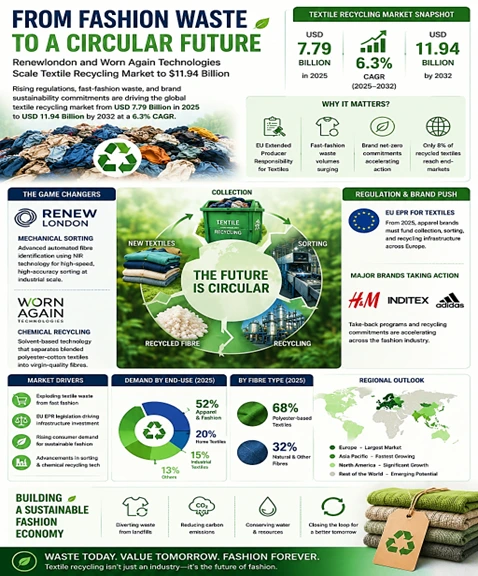
From 2025 onward, Europe’s new Extended Producer Responsibility (EPR) rules will make apparel brands financially responsible for collecting, sorting, and recycling textile waste.
That single regulation is now reshaping the Global Textile Recycling Market, valued at USD 7.79 billion in 2025 and projected to reach USD 11.94 billion by 2032, growing at a 6.3% CAGR, according to Maximize Market Research. And suddenly, textile waste is becoming one of fashion’s hottest investment categories.
The Biggest Fashion Problem Was Never Cotton — It Was Blended Fabric
For years, recycling old clothes sounded simple. In reality, it was nearly impossible. Most modern garments combine polyester and cotton blends that traditional recycling systems cannot separate cleanly. That is where Worn Again Technologies is changing the industry.
Its chemical recycling platform can now separate blended fabrics into virgin-equivalent fibres — solving what many executives called the fashion industry’s “unrecyclable problem.”
MMR Insight: Blended fabrics represent nearly 65% of global apparel production, making chemical recycling one of the market’s most commercially important breakthroughs.
Fast Fashion Is Quietly Being Forced Into Circularity
Meanwhile, Renewlondon is scaling automated fibre-sorting systems across UK garment collection networks using near-infrared spectroscopy to identify textile composition at industrial speed.
Why does that matter?
Because manual sorting simply cannot handle the scale of global fashion waste anymore. Now brands including:
- H&M
- Zara parent Inditex
- Adidas
are aggressively expanding take-back and recycling programs to comply with new EU regulations and net-zero commitments.
Europe Leads — But Asia Is Becoming the Fastest-Growing Opportunity
Europe currently dominates the textile recycling market because of:
- EPR legislation
- High Recycling Participation
- Aggressive Sustainability Mandates
But Asia-Pacific is emerging as the fastest-growing region as:
- Apparel Manufacturing Scales
- Waste Volumes Surge
- Circular Economy Investments Accelerate
Polyester-based textiles continue commanding the largest recycled fibre volume globally.
Final Take
Fashion brands spent decades optimizing speed and low-cost production. Now they are being forced to solve what happens after consumers throw clothes away. And that may create one of the next major industrial supply chains in fashion: recycled fibre infrastructure. Because in the next era of apparel manufacturing, the companies controlling textile recycling may become just as important as the companies designing the clothes themselves.