
The World’s Food Crisis Is Quietly Reviving One of Agriculture’s Most Controversial Chemicals
As climate pressure, shrinking farmland, and weed resistance intensify globally, atrazine is making an unexpected comeback inside modern farming systems.
The world is running into a dangerous agricultural equation: more people, less farmland, harsher climate conditions, and stronger weeds. And that pressure is pushing farmers back toward one of the most powerful — and controversial — herbicides in global agriculture.
The Global Atrazine Market, valued at USD 2.39 billion in 2025, is projected to reach nearly USD 3.62 billion by 2032, growing at a 6.1% CAGR, according to Maximize Market Research.
What makes the story explosive is this: despite years of environmental scrutiny, atrazine remains deeply embedded in global food production infrastructure.
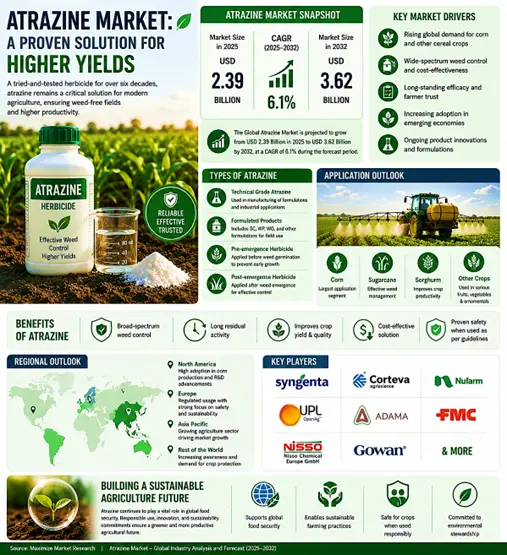
Corn Demand Is Quietly Driving a Massive Herbicide Dependency
Atrazine continues dominating large-scale corn farming because it delivers:
- Broad-spectrum weed control
- Lower labor dependence
- Higher yield protection
- Cost-efficient large-acreage farming
And global corn demand is exploding across:
- Food processing
- Livestock feed
- Ethanol & biofuels
- Industrial starch production
That means farmers increasingly cannot afford crop losses caused by aggressive weed resistance.
MMR Insight: Atrazine remains strategically important because few herbicides match its balance of affordability, scalability, and effectiveness across commercial cereal farming.
Asia-Pacific Is Becoming the Next High-Stakes Growth Zone
North America still leads the market due to:
- Massive corn cultivation
- Mechanized farming systems
- Heavy herbicide penetration
But Asia-Pacific is emerging as the fastest-growing battlefield.
Countries including:
- India
- China
- Vietnam
- Indonesia
are rapidly scaling:
- Maize farming
- Sugarcane cultivation
- Cereal production
- Export-oriented agriculture
to secure food supply and stabilize agricultural productivity.
At the same time, herbicide manufacturers are aggressively expanding rural distribution networks and agri-tech partnerships across emerging economies.
The Industry’s Biggest Threat Is Regulation
The market’s biggest paradox is this: demand is rising while regulatory pressure intensifies simultaneously. Atrazine continues facing scrutiny over:
- Groundwater contamination
- Ecological toxicity
- Human health concerns
And governments globally are tightening:
- Usage restrictions
- Environmental monitoring
- Residue compliance rules
That is forcing manufacturers to invest heavily in:
- Precision spraying systems
- Low-dose formulations
- Sustainable crop protection technologies
- Integrated weed management solutions
to defend long-term market access.
Final Take
Atrazine is no longer just a herbicide story. It is becoming a global food-security debate. Because as climate volatility, shrinking farmland, and rising food demand collide,
farmers are being forced to choose between:
- Agricultural productivity
- Environmental sustainability
- Regulatory compliance.
And that tension may define the future economics of global farming for the next decade.