
POET LLC Is Doubling Down and the World’s Largest Ethanol Producer Has a Plan That Goes Far Beyond Corn
POET quietly runs more ethanol biorefineries than anyone else on the planet. Now it is expanding capacity, integrating carbon capture, and positioning itself at the center of the next generation of low-carbon fuel.
What does the world’s largest ethanol producer do when the world starts demanding lower-carbon everything?
It builds more. Faster. And cleaner. That is the strategy unfolding at POET LLC, the South Dakota-based company that operates more bioethanol facilities than any other organization on earth and is aggressively expanding at precisely the moment the global Ethanol Market is entering its most commercially complex phase.
The Ethanol Market was valued at USD 116.47 billion in 2024 and is projected to reach USD 178.74 billion by 2032, growing at a 5.5% CAGR, according to Maximize Market Research. POE intends to capture a disproportionate share of that growth.
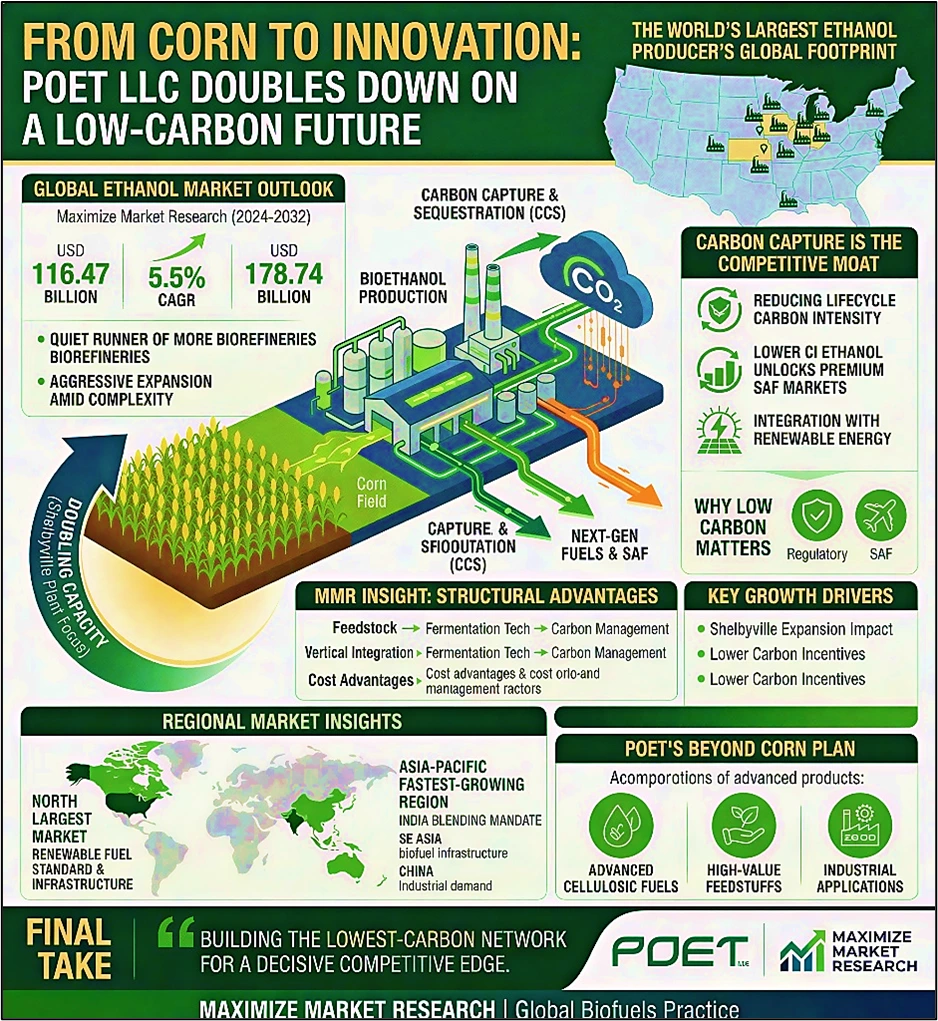
Doubling Capacity: One Plant at a Time
POET’s most visible recent move is the planned doubling of bioethanol production at its Shelbyville facility a major expansion that signals the company’s confidence in long-term demand even as the broader energy transition accelerates.
The Shelbyville expansion alone is projected to require millions of additional bushels of corn annually, creating substantial new market demand for local agricultural producers and generating long-term economic stimulus for the surrounding region.
But POET’s ambitions go further than any single plant.
The company has been described by industry analysts as positioned at a critical junction where scale, operational efficiency, and carbon capture integration converge giving it competitive advantages that smaller operators simply cannot replicate.
MMR Insight: POET’s vertical integration across feedstock procurement, fermentation technology, and carbon management creates structural cost advantages that deepen as low-carbon fuel incentives intensify globally.
Carbon Capture Is Becoming POET’s Competitive Moat
Here is where POET’s strategy gets particularly interesting.
The company is actively integrating carbon capture and sequestration (CCS) capabilities across its biorefinery network targeting a dramatic reduction in the lifecycle carbon intensity of its ethanol output.
Why does carbon intensity matter so much? Because the regulatory frameworks governing both the U.S. Renewable Fuel Standard and SAF incentive programs price credits directly against carbon scores. The lower the carbon intensity, the more valuable each gallon of ethanol becomes.
POET is quietly building infrastructure that turns low-carbon ethanol from a compliance product into a premium commodity:
- Carbon capture at fermentation facilities reduces direct emissions
- Lower-CI ethanol unlocks higher-value SAF feedstock markets
- Integration with renewable energy sources further compresses the carbon score
North America Leads but POET Is Watching Asia
North America currently accounts for the largest share of the global ethanol market driven by the Renewable Fuel Standard, high corn production infrastructure, and entrenched fuel blending mandates.
But Asia-Pacific is emerging as the fastest-growing consumption region as:
- India accelerates its 20% ethanol blending mandate
- Southeast Asian nations build biofuel infrastructure from scratch
- Industrial and pharmaceutical ethanol demand scales across China
POET’s scale positions it to serve export demand into these markets as they mature.
Final Take
The story of global ethanol is no longer just about fuel blending mandates and corn prices.
It is about which producers have built the infrastructure, the carbon management systems, and the operational scale to win in a world where every molecule of fuel carries a carbon score and that score determines its value.
POET built the largest bioethanol network on earth. Now it is making that network the lowest-carbon network it can be.
In the emerging low-carbon fuel economy, that combination may prove to be the most durable competitive advantage in the industry.