
Shooting Ranges Are Turning into Tech Businesses — and the Industry Is Quietly Heading Toward a $2.56 Billion Boom
From military simulators to “smart” indoor shooting lanes, the global shooting range industry is rapidly evolving beyond traditional firearm training.
The image of a shooting range as a simple target-and-lane facility is disappearing fast. Today’s newest facilities increasingly look more like:
- Digital Entertainment Centers
- Military Simulation Labs
- AI-assisted Training Hubs
And the money flowing into the industry is accelerating globally.
The Global Shooting Ranges Market, valued at USD 1.51 billion in 2025, is projected to reach USD 2.56 billion by 2032, growing at a 7.85% CAGR, according to Maximize Market Research.
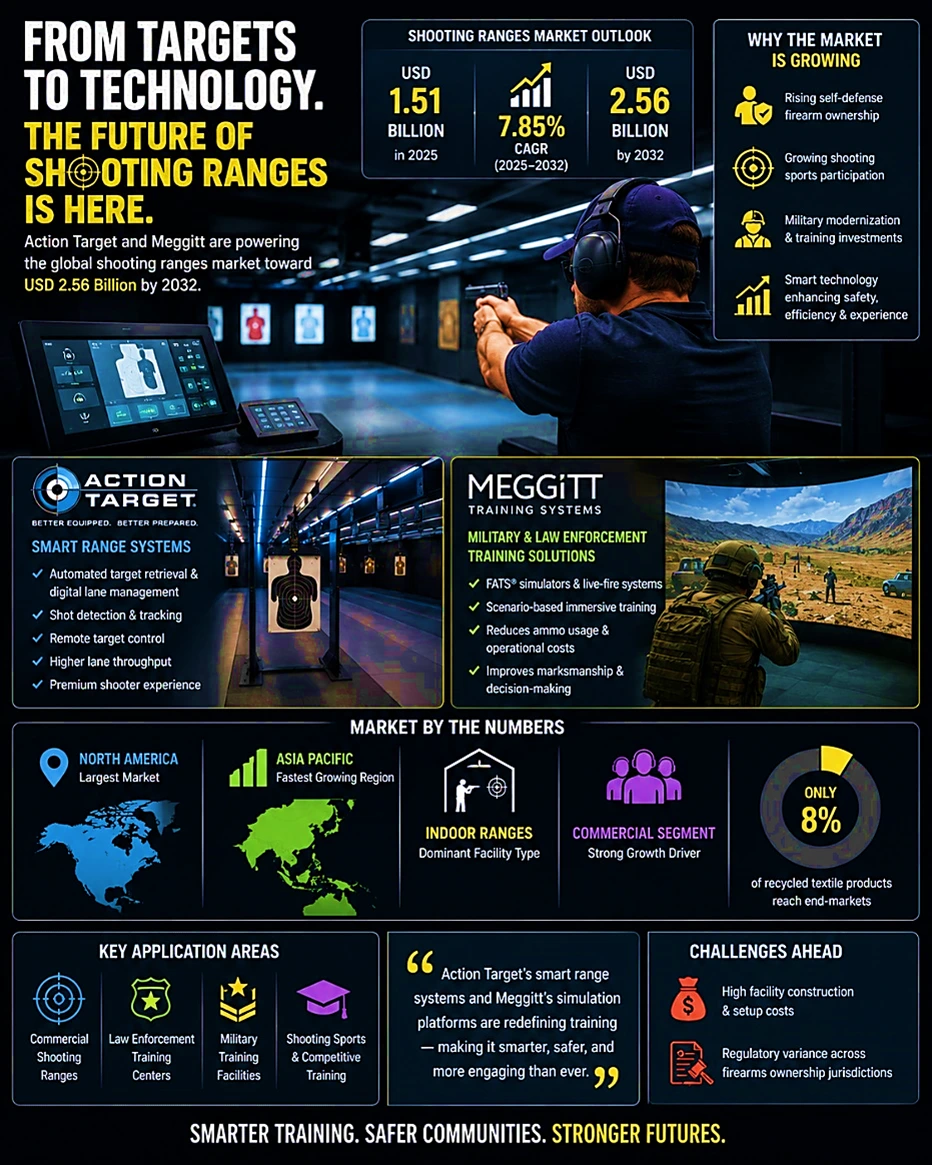
What is driving it?
A combination of:
- Rising civilian firearm ownership
- Military Modernization Budgets
- Law-enforcement Simulation Demand
- and tech-enabled premium shooting experiences.
The “Smart Range” Is Becoming a Premium Experience Business
Action Target is aggressively expanding automated indoor range systems featuring:
- Digital Lane Controls
- Remote Target Systems
- Shot-tracking Analytics
- Automated Retrieval Platforms
The goal is simple: increase visitor throughput while turning shooting facilities into higher-margin membership and entertainment destinations.
MMR Insight: Commercial shooting ranges are increasingly adopting a hospitality-style business model similar to the transformation seen in bowling and esports entertainment venues.
Military and Police Simulation Spending Is Surging
At the same time, Meggitt Training Systems is expanding deployment of its FATS® military simulation systems across NATO-linked training environments.
These systems allow:
- Scenario-based Tactical Simulation
- Judgment-under-pressure drills
- reduced Live Ammunition Usage
- Lower Operational Training Costs
Meanwhile, simulation-focused systems from companies like Laser Shot are helping police academies overcome:
- Ammunition Costs
- Ventilation Limitations
- Indoor Range Restrictions
without reducing training frequency.
North America Dominates — But Asia Is Expanding Fast
North America remains the industry’s largest revenue market due to:
- high civilian firearm ownership
- dense commercial range networks
- recreational shooting participation
But Asia-Pacific is emerging as the fastest-growing region as military modernization programs accelerate across:
- India
- South Korea
- Southeast Asia
Indoor ranges currently dominate facility demand globally because operators can maintain:
- Climate Control
- Higher Safety Compliance
- Year-round Utilization
- Premium Training Environments
Final Take
The shooting range industry is no longer just selling firing lanes.It is increasingly selling:
- simulation technology
- digital training
- immersive tactical experiences
- military readiness infrastructure
And as commercial entertainment, defense modernization, and law-enforcement simulation converge, the industry is quietly transforming into a technology-driven training economy far larger than most investors realize.