
Archer Daniels Midland Is Quietly Turning Corn into Jet Fuel and the $178 Billion Ethanol Industry Will Never Look the Same
ADM controls over 1.6 billion gallons of ethanol capacity across seven plants. Now it is pointing that firepower directly at sustainable aviation fuel and airlines are paying close attention.
Most people think of ethanol as something blended into the gasoline in their car’s tank. ADM is betting it becomes the fuel powering aircraft across the Atlantic.
The Global Ethanol Market, valued at USD 116.47 billion in 2024 and projected to reach nearly USD 178.74 billion by 2032 at a 5.5% CAGR, according to Maximize Market Research, is undergoing a quiet but radical identity shift. And Archer Daniels Midland is sitting at the center of it.
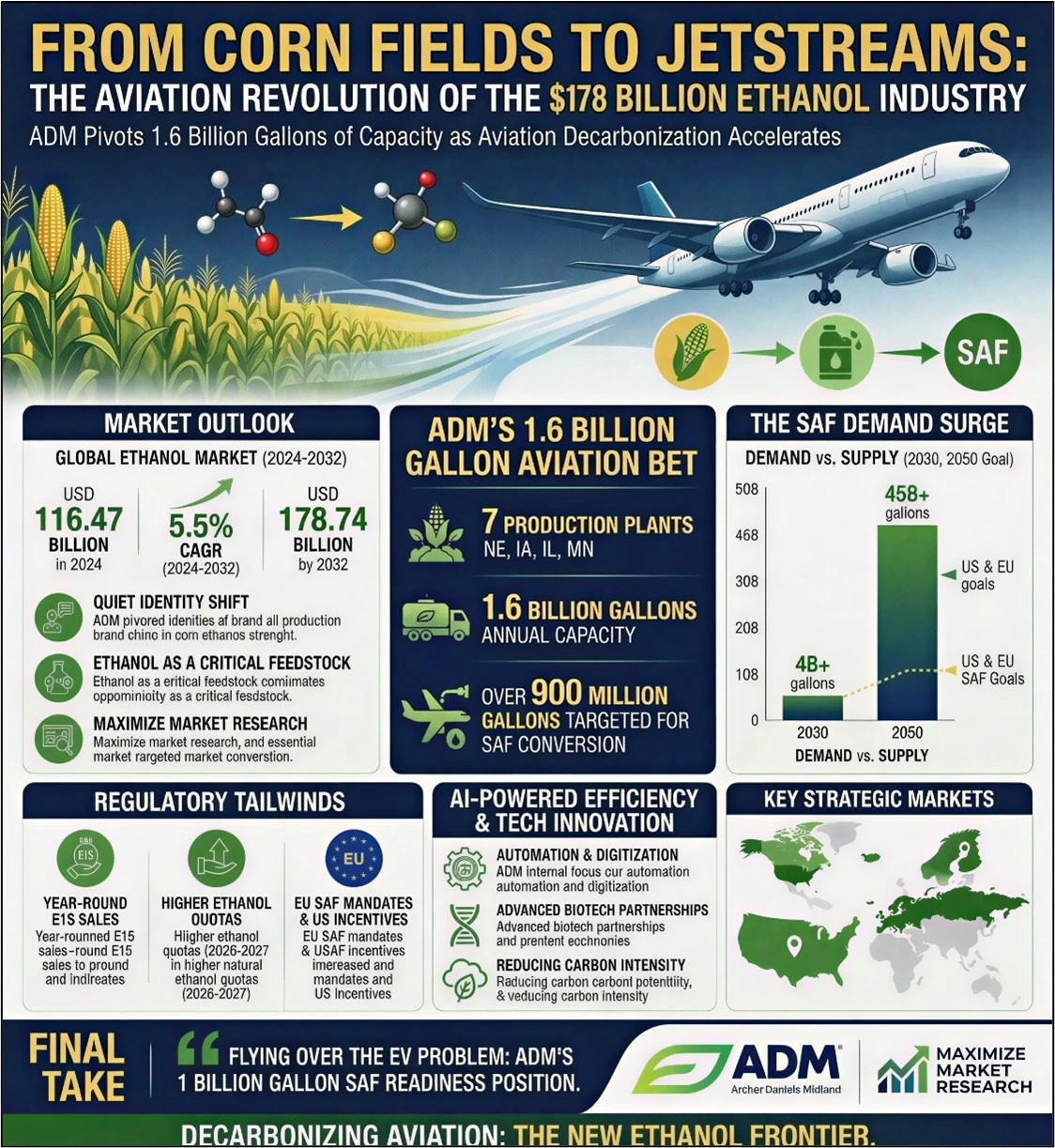
ADM’s 1.6 billion Gallon Bet on Aviation
ADM operates seven ethanol production facilities spread across Nebraska, Iowa, Illinois, and Minnesota representing a combined capacity of approximately 1.6 billion gallons annually. But the company is no longer content to simply blend that volume into gasoline.
ADM has announced plans to convert more than half of its total ethanol production capacity potentially over 900 million gallons into sustainable aviation fuel (SAF). The move targets a market where demand is accelerating far faster than supply can keep pace.
The U.S. and European Union have jointly set SAF goals that would require roughly 4 billion gallons of production by 2030 and more than 45 billion gallons by 2050.
ADM’s corn-derived ethanol is already low enough in carbon intensity to qualify as a SAF feedstock making it one of the most commercially ready pathways available at scale today.
MMR Insight: ADM’s pivot positions ethanol not as a commodity fuel supplement, but as a critical feedstock for aviation decarbonization one of the world’s most difficult sectors to clean up.
AI-Powered Efficiency Meets Agricultural Scale
ADM is not simply converting capacity. It is simultaneously rebuilding the economics of that capacity.
The company has rolled out automation and digitization initiatives across its Carbohydrate Solutions business targeting manufacturing cost reduction and operational efficiency improvements that would make large-scale SAF conversion commercially viable.
It has also deepened strategic partnerships with biotechnology firms to explore advanced fermentation techniques, aiming to improve ethanol yield per bushel of corn while lowering the lifecycle carbon intensity of the fuel produced.
That carbon intensity number matters enormously because SAF credits and regulatory incentives are priced directly against it.
Blending Mandates Are Creating the Floor ADM Needed
The regulatory environment is shifting decisively in ADM’s favor:
- Year-round E15 sales were unlocked by legislation, expanding retail demand for higher-blend ethanol
- The U.S. government has proposed higher ethanol quotas for 2026 and 2027 compared to 2025
- SAF mandates in the EU and incentive frameworks in the U.S. are creating long-term offtake visibility
Together, these policy tailwinds are giving ADM the market clarity it needed to commit capital at scale.
Final Take
The ethanol industry has spent decades fighting for relevance against the rise of electric vehicles. ADM has found a more interesting answer fly over the problem entirely.
As aviation decarbonization becomes one of the most commercially urgent challenges of the next decade, the company controlling nearly 1 billion gallons of SAF-ready production capacity may quietly become one of the most strategically important energy players on the planet.