
Global Hydrogen Race Is Quietly Creating a $491.83 Billion Syngas Economy: Energy Giants Are Expanding Fast
As countries race toward cleaner energy systems and industrial decarbonization, one critical technology is quietly moving to the center of the global energy transition: Syngas. Produced from coal, natural gas, biomass, and waste feedstocks, syngas serves as the foundation for manufacturing:
- Hydrogen
- Methanol
- Ammonia
- Synthetic Fuels
- Fertilizers
- Industrial Chemicals
And demand is accelerating rapidly across energy and industrial sectors worldwide.
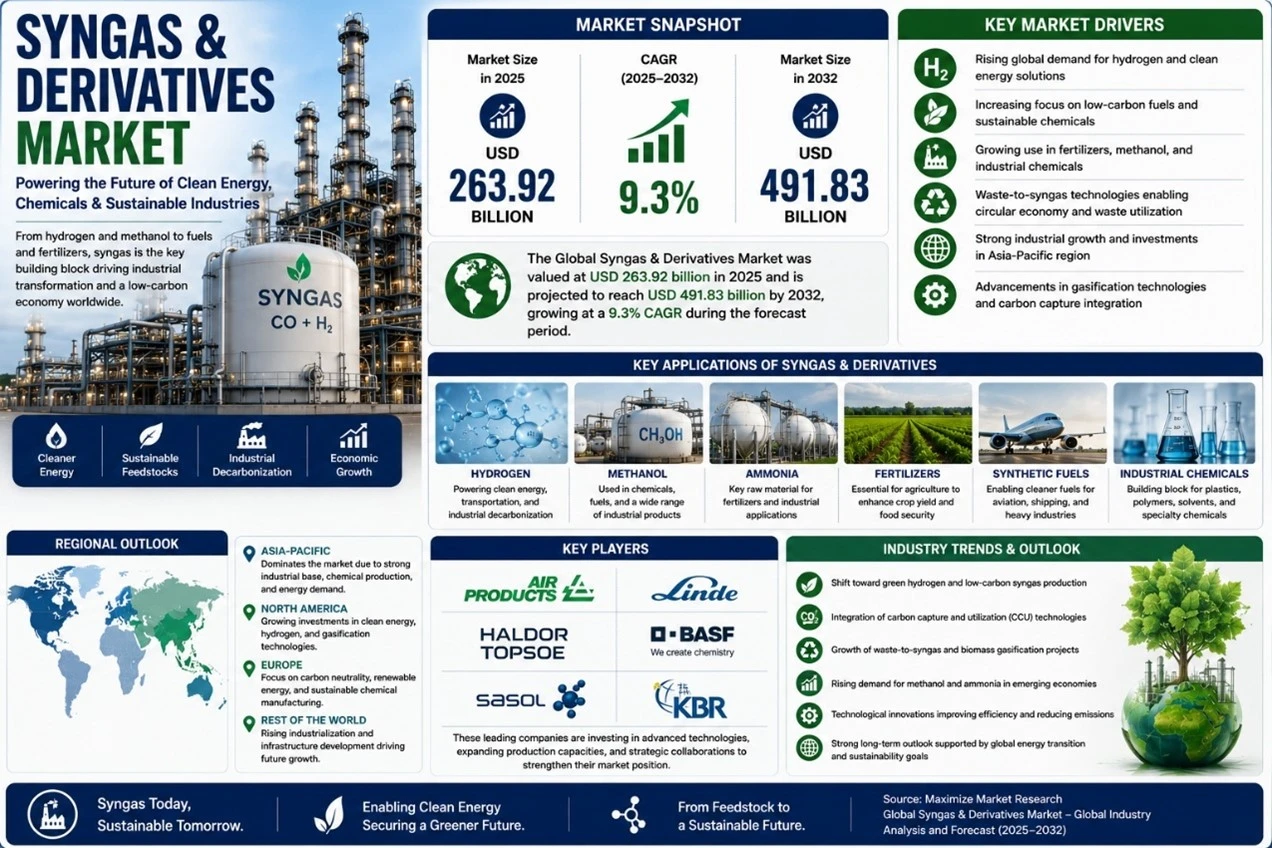
The Global Syngas and Derivatives Market was valued at USD 263.92 billion in 2025 and is projected to reach nearly USD 491.83 billion by 2032, growing at a 9.3% CAGR during the forecast period, according to Maximize Market Research.
And increasingly, the companies controlling syngas production technologies may become some of the most important players in the future low-carbon economy.
Hydrogen Production Is Becoming the Industry’s Biggest Opportunity
One of the strongest growth drivers behind the market is the global push toward hydrogen energy. Governments worldwide are investing billions into:
- Green Hydrogen Projects
- Hydrogen Mobility Infrastructure
- Industrial Decarbonization Programs
- Low-Carbon Fuel Production
because hydrogen is expected to play a crucial role in reducing emissions across heavy industries.
Air Products is aggressively expanding hydrogen and gasification infrastructure projects designed to support large-scale clean-energy production.
Meanwhile, Linde is strengthening advanced syngas-processing technologies focused on industrial hydrogen manufacturing and energy-transition applications.
MMR Insight: Syngas is increasingly evolving from an industrial intermediate into critical infrastructure supporting the global hydrogen economy.
Chemical Manufacturing Continues to Dominate Global Demand
Despite growing interest in clean energy, chemicals remain the largest application segment for syngas derivatives. Syngas is heavily used in the production of:
- Ammonia
- Methanol
- Fertilizers
- Petrochemicals
- Specialty Industrial Chemicals
as manufacturers seek efficient and scalable feedstock solutions.
Haldor Topsoe is investing heavily in advanced syngas-conversion technologies that improve production efficiency across ammonia and methanol value chains.
At the same time, BASF is strengthening sustainable chemical manufacturing initiatives focused on reducing industrial carbon intensity while maintaining production competitiveness.
The growing need for fertilizers and industrial chemicals across emerging economies continues supporting long-term market expansion.
Waste-to-Energy Projects Are Creating New Growth Frontiers
Another major trend reshaping the industry is the rise of waste-to-syngas technologies.
Governments increasingly view municipal waste as a potential energy resource rather than a disposal problem. Modern gasification systems can convert:
- Municipal Solid Waste
- Biomass Residues
- Agricultural Waste
- Industrial By-Products
into usable syngas for power generation and chemical production. This approach helps address:
- Landfill Reduction Goals
- Energy Security Concerns
- Carbon-Emission Targets
- Circular-Economy Initiatives
while creating additional feedstock sources for industrial production.
Asia-Pacific Is Becoming the Global Powerhouse
Asia-Pacific currently dominates the Syngas & Derivatives Market due to:
- Massive Chemical Manufacturing Capacity
- Growing Fertilizer Demand
- Expanding Energy Consumption
- Large-Scale Industrialization
Countries including:
- China
- India
- Japan
- South Korea
continue investing aggressively in syngas infrastructure to support energy security and industrial growth. Meanwhile, rising demand for fertilizers, fuels, and industrial chemicals is accelerating capacity expansions throughout the region.
Carbon Reduction Is Reshaping Investment Decisions
Industrial companies face growing pressure to reduce emissions while maintaining profitability. As a result, investments are increasingly flowing into:
- Carbon-Capture Integration
- Advanced Gasification Technologies
- Cleaner Feedstock Utilization
- Low-Emission Chemical Production Systems
The combination of carbon management and syngas production is emerging as one of the industry’s most promising long-term opportunities.
Companies capable of producing cleaner syngas at scale may gain a significant competitive advantage as environmental regulations tighten globally.
Final Take Syngas is no longer simply a chemical feedstock. It is increasingly becoming critical infrastructure supporting:
- Hydrogen Economies
- Sustainable Fertilizers
- Synthetic Fuels
- Industrial Decarbonization
- Future Energy Security
And as governments and industries accelerate the transition toward cleaner production systems, the companies controlling advanced gasification and syngas-conversion technologies may quietly become some of the most influential players in the next generation of global energy and chemical markets.