
The Electric Vehicle Boom Is Quietly Reshaping the Titanium Industry: Industrial Manufacturers Are Expanding Beyond Aerospace
For decades, titanium demand was dominated by aerospace and military manufacturing. Now, a new industrial transition is emerging.
Electric vehicles, hydrogen infrastructure, desalination systems, and next-generation chemical processing are rapidly creating fresh demand for lightweight, corrosion-resistant titanium materials across global industries.
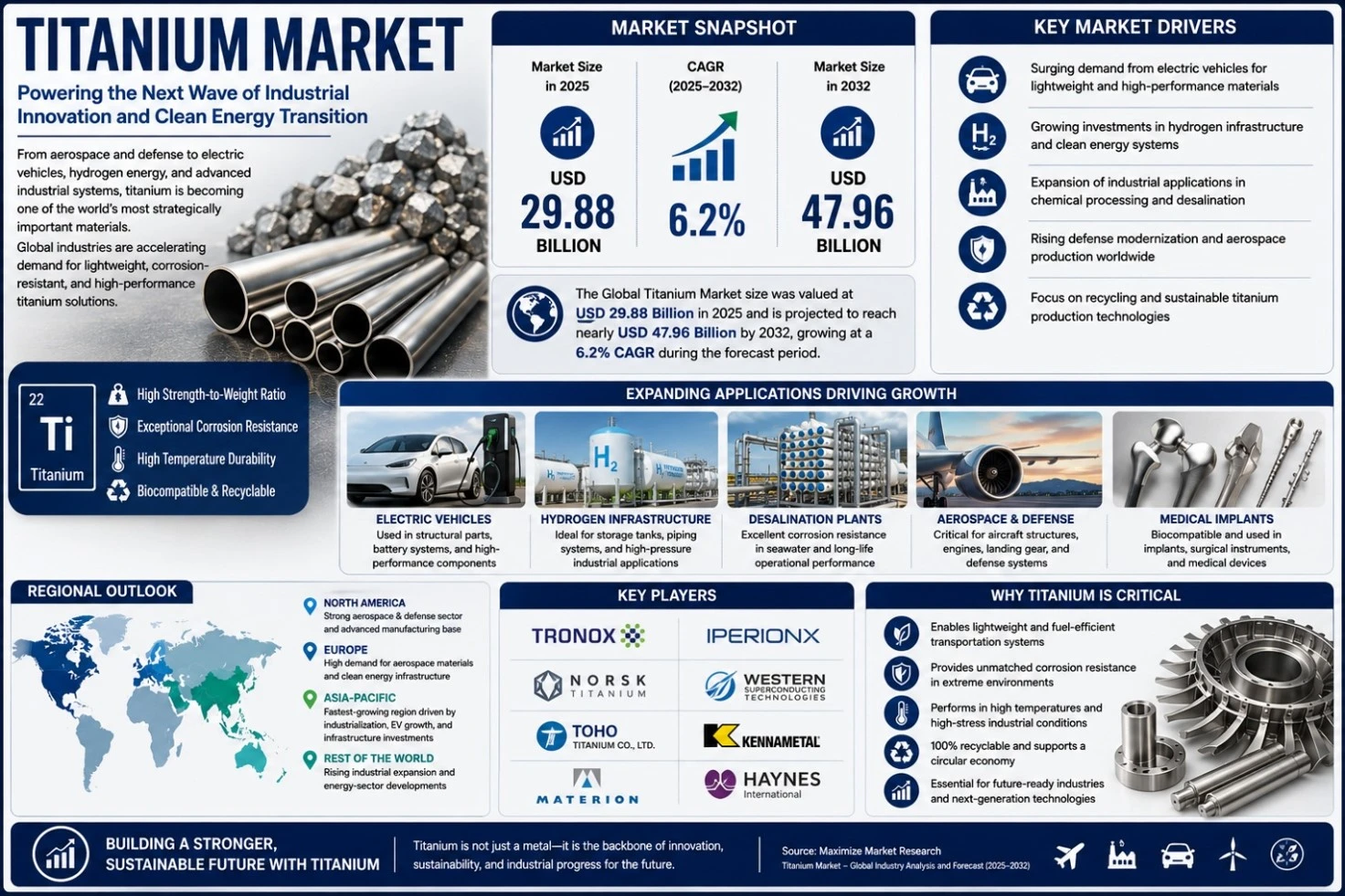
The Global Titanium Market size was valued at USD 29.88 billion in 2025 and is projected to reach nearly USD 47.96 billion by 2032, growing at a 6.2% CAGR during the forecast period, according to Maximize Market Research.
And increasingly, the industry’s biggest growth opportunities are expanding far beyond aircraft manufacturing.
Hydrogen and Clean Energy Systems Are Becoming Major Titanium Consumers
One of titanium’s biggest industrial advantages is its ability to withstand:
- Saltwater Corrosion
- Chemical Exposure
- Extreme Temperatures
- High-Pressure Industrial Environments
That makes titanium critically important for:
- Hydrogen-Production Systems
- Offshore Wind Infrastructure
- Desalination Plants
- Nuclear Facilities
- Advanced Energy-Processing Equipment
Tronox Holdings is strengthening titanium feedstock production capabilities to support rising industrial-material demand tied to global clean-energy infrastructure investments. Meanwhile, IperionX is aggressively expanding low-carbon titanium production technologies focused on sustainable manufacturing and domestic supply-chain security.
MMR Insight: Titanium is increasingly evolving into a strategic clean-energy infrastructure material rather than simply an aerospace alloy.
Electric Vehicles Are Creating New Lightweight-Materials Demand
Automotive manufacturers are aggressively seeking:
- Lightweight Components
- Stronger Structural Materials
- Heat-Resistant Systems
- Long-Life Performance Metals
to improve:
- Battery Efficiency
- Vehicle Range
- Durability
- Energy Performance
Titanium is increasingly being explored for:
- EV Structural Components
- Battery Systems
- Exhaust Technologies
- High-Performance Electric Mobility Applications
Norsk Titanium is expanding additive-manufacturing titanium solutions designed for lightweight industrial and transportation applications. At the same time, Western Superconducting Technologies is strengthening advanced titanium-alloy development for high-performance industrial engineering systems.
Supply-Chain Localization Is Becoming a Strategic Priority
Global titanium supply chains remain highly concentrated across limited production regions. That has triggered rising concerns around:
- Geopolitical Dependency
- Aerospace Supply Security
- Defense-Material Availability
- Industrial Raw-Material Access
Governments across:
- United States
- Europe
- Japan
- India
are increasingly supporting domestic titanium-processing ecosystems to strengthen industrial independence and critical-material security.
Meanwhile, recycling and sustainable titanium-processing technologies are becoming major investment areas as manufacturers attempt to reduce production costs and environmental impact.
Asia-Pacific Is Emerging as the Industry’s Fastest-Growing Hub
North America continues dominating aerospace titanium demand. However, Asia-Pacific is rapidly becoming the industry’s fastest-growing industrial market due to:
- Manufacturing Expansion
- Electric Vehicle Growth
- Industrial Infrastructure Investment
- Rising Energy-System Development
- Defense Modernization
China and India are aggressively scaling advanced metals manufacturing to support future industrial competitiveness and strategic supply-chain resilience.
Final Take:- Titanium is no longer simply tied to aircraft manufacturing. It is increasingly becoming foundational infrastructure supporting:
- Electric Mobility
- Hydrogen Energy
- Industrial Sustainability
- Advanced Manufacturing
- and Global Energy-Transition Systems
And as industries worldwide demand lighter, stronger, and more sustainable engineering materials, the companies controlling next-generation titanium-processing technologies may quietly become some of the most strategically important industrial players of the next decade.