
The World Is Quietly Running Out of Helium — and the Semiconductor Industry Is Starting to Panic
Air Products, Linde, and Qatar are racing to secure one of the planet’s most irreplaceable industrial gases as the Helium Market heads toward $9.47 billion.
Most people think helium belongs in balloons.
In reality, it sits inside some of the world’s most critical technologies:
- Semiconductor manufacturing
- MRI systems
- Fiber optics
- Aerospace systems
- Quantum computing
And now, after years of supply shortages and the decline of the US Federal Helium Reserve, the global helium industry is entering a high-stakes restructuring phase.
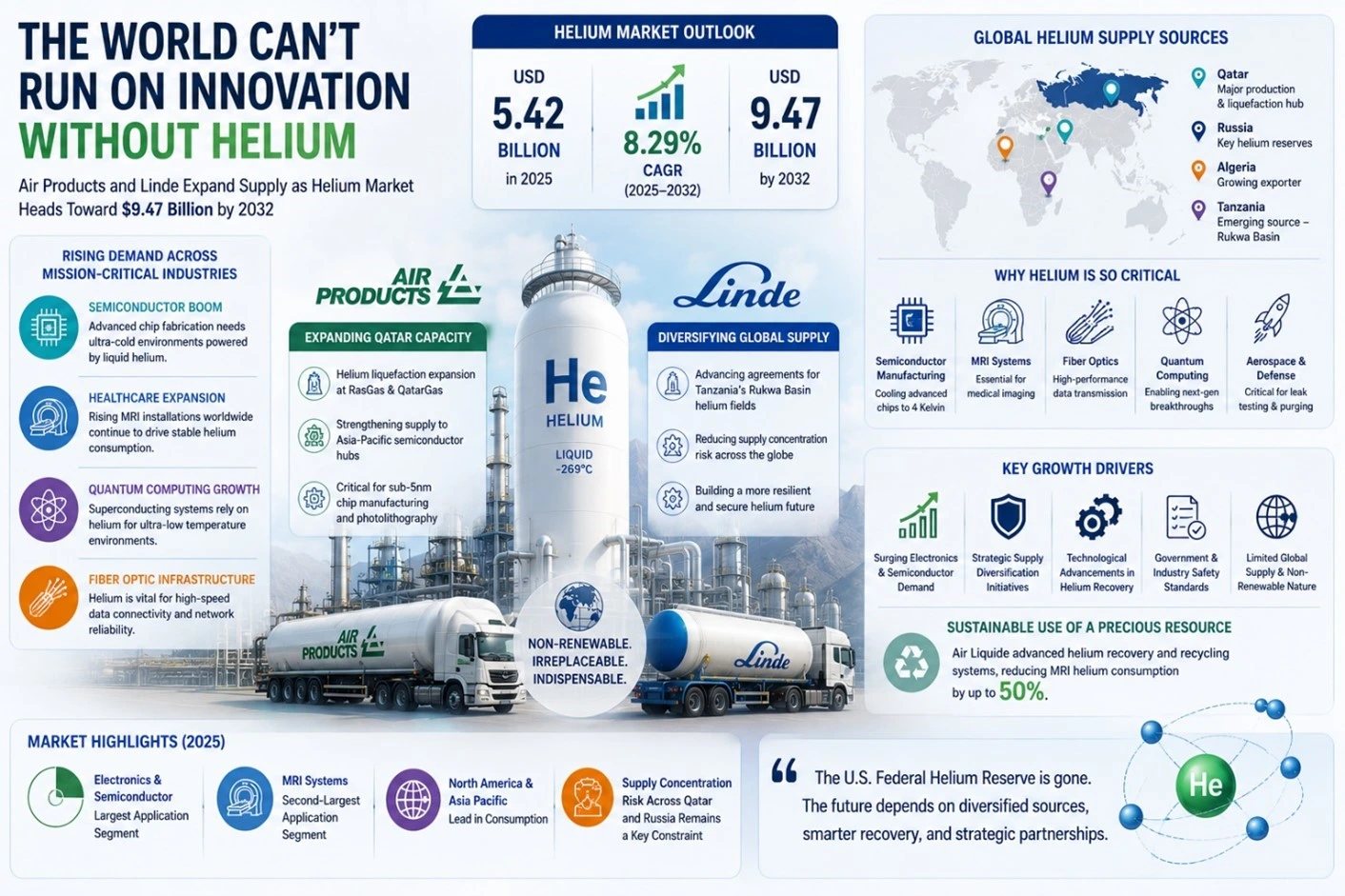
The Global Helium Market, valued at USD 5.42 billion in 2025, is projected to reach USD 9.47 billion by 2032, growing at an 8.29% CAGR, according to Maximize Market Research.
The Semiconductor Industry Is Driving a New Helium Race
The biggest pressure point inside the market is semiconductor manufacturing.
Advanced chip fabrication requires liquid helium cooled to nearly 4 Kelvin for superconducting systems used in next-generation photolithography. That makes helium strategically critical for:
- Sub-5nm Semiconductor Production
- AI chips
- Advanced Processors
- Quantum Systems
To respond, Air Products and Chemicals expanded helium liquefaction capacity in Qatar during 2025 to strengthen supply for semiconductor hubs across:
- Taiwan
- South Korea
- Japan
MMR Insight: Helium is increasingly becoming a strategic semiconductor infrastructure material rather than a commodity industrial gas.
The US Helium Reserve Is Gone — and the Global Supply Chain Is Being Rewritten
For decades, the US Federal Helium Reserve in Texas stabilized global supply.
That era is ending. As reserve depletion accelerates, the market is shifting toward new sourcing regions including:
- Qatar
- Russia
- Algeria
- Tanzania
Linde is now advancing supply agreements tied to Tanzania’s Rukwa Basin helium fields to reduce concentration risk inside the global market.
MMR Insight: The helium industry is entering a geographic diversification phase as buyers attempt to reduce exposure to concentrated geopolitical supply chains.
MRI and Quantum Computing Are Becoming Major Demand Drivers
Beyond semiconductors, helium demand is surging across:
- MRI systems
- Superconducting Magnets
- Scientific Research
- Quantum Computing Infrastructure
Medical imaging remains the second-largest application segment globally.
Meanwhile, companies like Air Liquide are aggressively investing in helium recovery systems capable of reducing MRI helium consumption by nearly 50%. That matters because helium is:
- Non-renewable
- Difficult to Substitute
- Increasingly Expensive to Extract
Electronics Dominates the Market as Asia-Pacific Expands Fastest
Electronics and semiconductor manufacturing currently command the largest application share inside the helium market. North America and Asia-Pacific remain the dominant consumption regions due to:
- Semiconductor Fabrication
- Healthcare Infrastructure
- Electronics Production
At the same time, supply concentration across Qatar and Russia continues creating major long-term market risk.
Final Take
Helium is no longer just an industrial gas. It is becoming a strategic technology resource sitting at the center of:
- Semiconductors
- AI Infrastructure
- Quantum Computing
- Medical Imaging
- Advanced Manufacturing
And as global chip demand accelerates and supply remains structurally constrained, the companies controlling helium production and liquefaction infrastructure may quietly become some of the most strategically important players inside the future technology economy.