
US Cocoa Butter Market: Market Size, Share, Emerging Trends, Competitive Landscape and Forecast (2025–2032)
Overview
The US Cocoa Butter Market was valued at USD 2.12 billion in 2025 and is projected to reach USD 2.81 billion by 2032, expanding at a CAGR of 4.1% during the forecast period (2026–2032).
The United States accounts for approximately 84.0% of the North American Cocoa Butter Market, making it the largest country-level market in the region through the top-down estimation approach.
Food & Beverage remains the largest application segment, driven by strong demand for premium chocolate, confectionery, bakery products, and functional foods.
Rising consumer preference for clean-label, organic, and sustainably sourced cocoa butter is encouraging manufacturers to adopt certified cocoa ingredients and transparent supply chains.
The cosmetics and personal care industry is witnessing increasing utilization of cocoa butter in moisturizers, body lotions, lip balms, skincare creams, soaps, and haircare products due to its natural emollient and antioxidant properties.
Continuous innovation in plant-based foods, premium confectionery, nutraceuticals, and pharmaceutical formulations is creating new growth opportunities for cocoa butter manufacturers.
Digital retail expansion, premium product positioning, and increasing consumer awareness regarding natural ingredients continue to strengthen market demand across the United States.
Leading companies are investing in sustainable cocoa sourcing, advanced processing technologies, product innovation, strategic partnerships, and capacity expansion to enhance competitiveness and address evolving consumer preferences.
US Cocoa Butter Market Overview
The US Cocoa Butter Market was worth about USD 2.12 billion in 2025. It is expected to be worth about USD 2.81 billion by 2032. This means the US Cocoa Butter Market will grow at a rate of 4.1 % from 2026 to 2032.
The United States has the share of the North American cocoa butter market. This is because the United States has a food processing industry. People in the United States also like to buy premium chocolate products. Cocoa butter is very important for making chocolate. It is smooth and melts well. It also tastes good. People like to use cocoa butter in skincare and personal care products because it helps keep skin healthy.
People are starting to prefer products that're clean and good for them. They want products that're organic and sustainably sourced. This is why companies are using cocoa. The US Cocoa Butter Market is also growing because people like to buy premium and dark chocolate.
Cocoa butter is not just used in food. It is also used in body lotions. Lip balms. It is even used in products.
Companies are investing in ways to process cocoa. They are also making products with cocoa butter. This is making the US Cocoa Butter Market more competitive.
More people are shopping online. They care about their health. They like products that're natural and plant-based. This is creating opportunities for the US Cocoa Butter Market.
All these things will help the US Cocoa Butter Market grow steadily from 2026, to 2032. The US Cocoa Butter Market will keep growing because of these factors. The US Cocoa Butter Market is expected to do throughout the forecast period.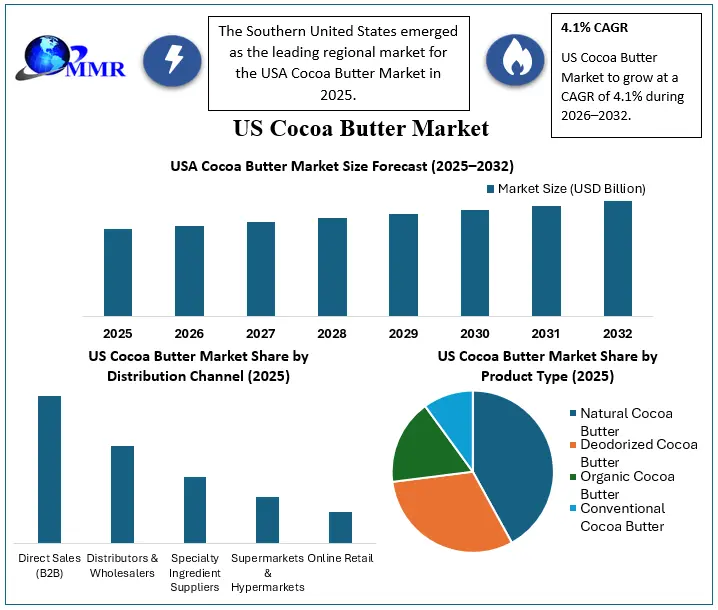
To know about the Research Methodology :- Request Free Sample Report
Market Trends: Sustainable Cocoa Sourcing and Premium Product Innovation are Transforming the US Cocoa Butter Market
The US Cocoa Butter Market is witnessing steady transformation as consumers increasingly prioritize premium-quality, sustainably sourced, and clean-label ingredients across food, cosmetics, and pharmaceutical applications. Demand for premium chocolate, artisanal confectionery, and plant-based products continues to rise, encouraging manufacturers to invest in high-quality cocoa butter with improved functionality and traceable sourcing. Sustainability has become a major industry trend, with companies expanding the use of Rainforest Alliance, Fairtrade, and responsibly sourced cocoa to meet evolving consumer expectations and corporate ESG commitments.
Another significant trend is the growing application of cocoa butter in natural skincare, organic cosmetics, nutraceuticals, and pharmaceutical formulations. Manufacturers are introducing innovative cocoa butter-based products featuring organic certification, reduced processing, and enhanced nutritional value. Digital retail platforms, direct-to-consumer brands, and premium personal care products are further strengthening market demand. Additionally, investments in advanced cocoa processing technologies, supply chain transparency, and product diversification are enabling manufacturers to improve quality while addressing the growing demand for sustainable and functional ingredients.
US Cocoa Butter Market Dynamics
Rising Demand for Premium Chocolate and Natural Personal Care Products
The growing consumption of premium chocolate and functional confectionery products remains the primary driver of the US Cocoa Butter Market. Consumers are increasingly willing to pay premium prices for chocolates made with high-quality cocoa ingredients, while the expanding cosmetics industry continues to utilize cocoa butter in moisturizers, body lotions, lip balms, soaps, and anti-aging skincare products. Rising awareness of cocoa butter's moisturizing, antioxidant, and skin-protective properties, combined with increasing demand for natural ingredients, is accelerating market growth across multiple industries.
Volatility in Cocoa Bean Prices and Supply Chain Uncertainty
The market faces challenges from fluctuating cocoa bean prices caused by climate change, unpredictable weather patterns, crop diseases, and geopolitical factors affecting major cocoa-producing countries. Supply chain disruptions, increasing transportation costs, and higher production expenses can impact manufacturers' profit margins. Additionally, dependence on imported cocoa beans exposes companies to global trade uncertainties and raw material price fluctuations.
Expansion of Sustainable Cocoa Programs and Functional Ingredient Applications
Growing consumer preference for ethically sourced products presents significant opportunities for market participants. Increasing adoption of certified sustainable cocoa, organic product formulations, and environmentally responsible manufacturing practices is strengthening brand value. Furthermore, expanding applications of cocoa butter in nutraceuticals, pharmaceutical formulations, vegan confectionery, and premium cosmetics are creating new revenue streams. Investments in product innovation, advanced processing technologies, and value-added cocoa ingredients are expected to support long-term market expansion.
Meeting Sustainability Expectations While Managing Rising Production Costs
One of the key challenges facing the US Cocoa Butter Market is balancing sustainability goals with cost competitiveness. Consumers increasingly expect companies to ensure full traceability, ethical sourcing, and environmentally friendly production processes. However, implementing sustainable sourcing programs, certification requirements, and advanced quality control measures increases operational costs. At the same time, intense competition from alternative vegetable fats, evolving food regulations, and changing consumer preferences require manufacturers to continuously innovate while maintaining product quality and pricing competitiveness. These factors make supply chain resilience, sustainable procurement, and technological innovation critical for long-term market success.
US Cocoa Butter Market Regional Insights
The Southern United States emerged as the leading regional market for the US Cocoa Butter Market in 2025, supported by its strong food processing industry, advanced manufacturing infrastructure, and the presence of major confectionery, bakery, and personal care product manufacturers.
States such as Texas, Georgia, Florida, and North Carolina serve as key production and distribution hubs due to their well-established logistics networks, access to major ports, and large consumer base. The region also benefits from increasing investments in premium chocolate manufacturing and natural skincare product development.
The Midwest represents another significant market, driven by the concentration of large food processing companies and chocolate manufacturers in states including Illinois, Ohio, and Michigan. The Northeast, led by New York, Pennsylvania, and Massachusetts, continues to witness steady demand owing to rising consumption of premium confectionery, luxury chocolate, and organic personal care products.
Meanwhile, the Western United States, particularly California, Washington, and Oregon, is experiencing rapid growth due to increasing consumer preference for clean-label, organic, vegan, and sustainably sourced products.
Rising investments in premium cosmetics, plant-based food products, and nutraceutical formulations are expected to support balanced regional growth across the United States throughout the forecast period.
US Cocoa Butter Market Competitive Insights
The US Cocoa Butter Market is characterized by the presence of global cocoa processors, ingredient manufacturers, and specialty food companies competing on product quality, sustainable sourcing, innovation, and supply chain efficiency.
Leading companies are focusing on expanding production capacity, improving cocoa processing technologies, and strengthening relationships with certified cocoa suppliers to ensure a consistent supply of high-quality cocoa butter.
Manufacturers are increasingly investing in Rainforest Alliance and Fairtrade-certified cocoa, carbon reduction initiatives, traceable sourcing systems, and environmentally responsible manufacturing practices to meet growing consumer demand for sustainable products. Strategic initiatives such as capacity expansion, mergers and acquisitions, long-term sourcing partnerships, new product launches, and investments in premium and organic cocoa butter continue to shape the competitive landscape.
Additionally, companies are leveraging advanced refining technologies, digital supply chain management, and research and development to enhance product functionality for applications in confectionery, bakery, cosmetics, pharmaceuticals, and nutraceuticals. Continuous innovation, sustainability, and value-added ingredient development are expected to remain the primary competitive differentiators in the US Cocoa Butter Market over the forecast period.
US Cocoa Butter Market Scope: Inquire before buying
| US Cocoa Butter Market | |||
|---|---|---|---|
| Report Coverage | Details | ||
| Base Year: | 2025 | Forecast Period: | 2026-2032 |
| Historical Data: | 2020 to 2025 | Market Size in 2025: | USD 2.12 Bn. |
| Forecast Period 2026 to 2032 CAGR: | 4.1% | Market Size in 2032: | USD 2.81 Bn. |
| Segments Covered: | by Product Type | Natural Cocoa Butter Deodorized Cocoa Butter Organic Cocoa Butter Conventional Cocoa Butter |
|
| by Source | Cocoa Beans Cocoa Liquor |
||
| by Form | Solid Liquid |
||
| by Application | Chocolate & Confectionery Bakery Products Dairy & Frozen Desserts Cosmetics & Personal Care Pharmaceuticals Nutraceuticals Food Service Others |
||
| by Distribution Channel | Direct Sales Distributors & Wholesalers Supermarkets & Hypermarkets Specialty Ingredient Suppliers Online Retail |
||
| by End User | Food & Beverages Manufacturers Cosmetic & Personal Care Manufacturers Pharmaceutical Companies Nutraceutical Manufacturers Household Consumers Food Service Industry |
||
| by Region | South: Texas, Florida, Georgia, North Carolina, Tennessee Midwest: Illinois, Ohio, Michigan, Indiana, Wisconsin Northeast: New York, Pennsylvania, Massachusetts, New Jersey, Connecticut West: California, Washington, Oregon, Arizona, Nevada |
||
US Cocoa Butter Market Key Players
| Company Name | Headquarters | Core Competencies |
| Cargill, Incorporated | Minnesota, USA | Cocoa processing, cocoa butter production, sustainable sourcing |
| Blommer Chocolate Company | Illinois, USA | Cocoa ingredients, chocolate manufacturing, cocoa butter processing |
| The Hershey Company | Pennsylvania, USA | Chocolate manufacturing, premium confectionery, cocoa ingredient utilization |
| Barry Callebaut USA LLC | Illinois, USA | Premium cocoa ingredients, cocoa butter, chocolate solutions |
| Olam Food Ingredients (ofi) USA | California, USA | Sustainable cocoa sourcing, cocoa processing, ingredient solutions |
| ADM (Archer Daniels Midland Company) | Illinois, USA | Food ingredients, cocoa processing, supply chain management |
| Bunge Limited (USA Operations) | Missouri, USA | Food ingredients, edible oils, ingredient distribution |
| Cémoi USA | New Jersey, USA | Cocoa processing, premium chocolate ingredients |
| Guittard Chocolate Company | California, USA | Artisan chocolate, premium cocoa butter, specialty cocoa ingredients |
| Ghirardelli Chocolate Company | California, USA | Premium chocolate manufacturing, cocoa butter applications |
| Mars Wrigley | New Jersey, USA | Chocolate manufacturing, confectionery innovation |
| Mondelez International | Illinois, USA | Global confectionery, cocoa ingredient sourcing |
| Ferrero North America | New Jersey, USA | Premium confectionery, cocoa ingredient utilization |
| Lindt & Sprüngli (USA) | New Hampshire, USA | Premium chocolates, cocoa butter applications |
| Nestlé USA | Virginia, USA | Food & beverage manufacturing, chocolate products |
| Puratos USA | Pennsylvania, USA | Bakery ingredients, cocoa-based solutions |
| AAK USA Inc. | New Jersey, USA | Specialty fats, cocoa butter alternatives, food ingredients |
| Fuji Vegetable Oil Inc. | Georgia, USA | Specialty oils and confectionery fats |
| Ciranda Inc. | Wisconsin, USA | Organic cocoa ingredients, sustainable sourcing |
| SunOpta Inc. (USA Operations) | Minnesota, USA | Natural and organic food ingredients |
| Jedwards International, Inc. | Massachusetts, USA | Natural oils, cosmetic-grade cocoa butter |
| Jedwards International Bulk Ingredients | Massachusetts, USA | Bulk cocoa butter, natural ingredient distribution |
| Essential Depot | Florida, USA | Cosmetic-grade cocoa butter, personal care ingredients |
| Bulk Apothecary | Ohio, USA | Natural cosmetic ingredients, cocoa butter distribution |
| Jedwards Natural Ingredients | Massachusetts, USA | Organic cocoa butter, specialty oils |
| Lotioncrafter LLC | Washington, USA | Cosmetic ingredients, skincare raw materials |
| MakingCosmetics Inc. | Washington, USA | Cosmetic formulations, cocoa butter ingredients |
| Cocoa Supply | Texas, USA | Chocolate-making ingredients, cocoa butter supply |
| OliveNation LLC | Massachusetts, USA | Baking ingredients, cocoa butter products |
| Savannah Foods & Industries | Georgia, USA | Food ingredients, specialty ingredient distribution |
Frequently Asked Questions
Q1. What was the market size of the US Cocoa Butter Market in 2025?
The US Cocoa Butter Market was valued at USD 2.12 billion in 2025 and is projected to reach USD 2.81 billion by 2032.
Q2. What is the expected CAGR of the US Cocoa Butter Market during the forecast period?
The market is expected to grow at a CAGR of 4.1% during the forecast period 2026–2032, driven by increasing demand from the food & beverage, cosmetics, pharmaceutical, and nutraceutical industries.
Q3. Which application segment dominates the US Cocoa Butter Market?
The Chocolate & Confectionery segment holds the largest market share, supported by strong consumer demand for premium chocolates, bakery products, and cocoa-based confectionery across the United States.
Q4. Which region dominated the US Cocoa Butter Market in 2025?
The Southern United States emerged as the leading regional market in 2025, driven by its well-established food processing industry, major confectionery manufacturers, advanced logistics infrastructure, and growing personal care product manufacturing.
Q5. What are the key factors driving the growth of the US Cocoa Butter Market?
Key growth drivers include rising demand for premium chocolate, increasing adoption of natural and organic skincare products, growing preference for clean-label and sustainably sourced cocoa ingredients, expansion of plant-based and functional foods, and continuous investments in advanced cocoa processing technologies and sustainable supply chains.