
Lip Balm Market by Product, by Type, by Usage, by Application, By Distribution Channel and Regional Insights 2034
Overview
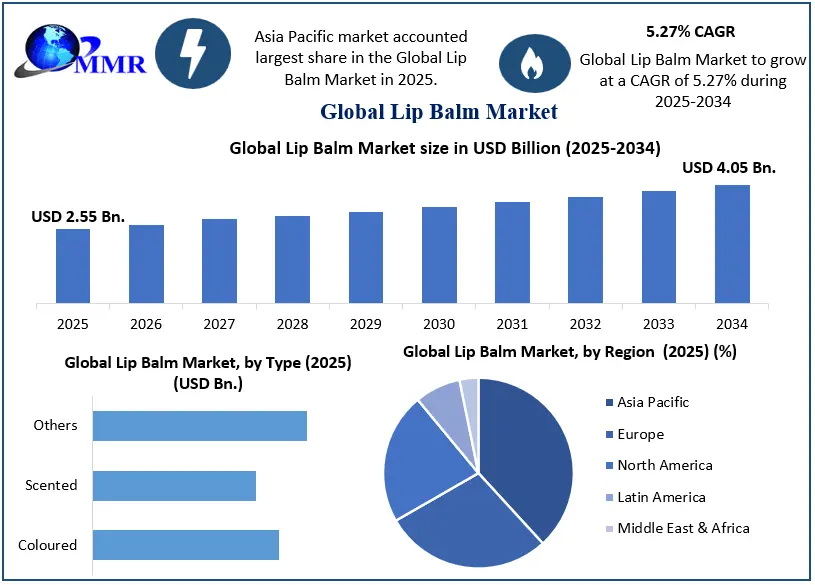
The Lip Balm Market size was valued at USD 2.55 billion in 2025 and the tal Lip Balm revenue is expected to grow at a CAGR of 5.27% from 2026 to 2034, reaching nearly USD 4.05 Billion.
Lip Balm Market Overview:
Lip balms are one of the most popular lip care products specially used in the winter. A Lip balm is a soft wax-like substance that users apply to their lips to saturate lips and relieve pain caused by dry or chapped lips. As the lips have thin skin, they are more sensitive to dryness than other parts of the body. This wax-like substance protects lips from dry air, wind, and cold weather. Using a lip balm on a daily basis helps restore the lip's natural moisture and nourishes it naturally which keeps lips supple and soft. Growing awareness regarding personal care and grooming is fuelling the lip balm market across the globe.The market is also benefiting from the expansion of e-commerce, social media marketing, influencer-led product discovery, and direct-to-consumer beauty brands. These channels improve product accessibility and allow brands to introduce new lip balm formats to a broader consumer base.
In this report, the Lip Balm market's growth reasons, as well as the market's many segments (Product, Type, Usage, Application, and Region), are discussed. Data has been given by market players, regions, and specific requirements. This market report includes a comprehensive overview of all the significant improvements that are presently prevailing in all market segments. Key data analysis is presented in the form of statistics, infographics, and presentations. The study discusses the Lip Balm market's Drivers, Restraints, Opportunities, and Challenges. The report helps to assess the market growth drivers and determines how to use these drivers as a tool. The report also helps to rectify and resolve issues related to the global Lip Balm market situation.
The report includes an analysis of the Middle East conflict's impact on the revenue of market leaders, followers, and disruptors. As geopolitical instability and supply chain disruptions vary across regions and trade corridors, the impact is observed differently by segments. This report covers the current short-term and long-term market effects, specifically regarding energy price volatility and logistics, helping decision-makers prepare strategic outlines for companies by region to navigate this evolving landscape effectively.
Lip Balm Market Highlights:
• Market Size: The global lip balm market is valued at USD 2.55 billion in 2025 and reaches nearly USD 4.05 billion by 2034.
• Growth Rate: The market grows at a CAGR of 5.27% during 2025–2034.
• Asia Pacific Leadership: Asia Pacific holds the largest regional revenue share at more than 38.2% in 2025, supported by rising personal-care awareness, sun exposure concerns, and expanding online beauty sales.
• Dominant Application: Dry Skin remains the leading application segment because lip balms provide moisturization and protection against dryness, wind, cold, and sun exposure.
• Leading Usage Segment: Women dominate the usage segment in 2025, supported by increasing adoption of lip care as part of personal grooming routines. Pasted text
• Product Innovation: Multifunctional lip balms gain importance by combining moisturization, SPF, tint, repair, and skincare benefits.
• Natural & Clean-Label Demand: Consumers increasingly prefer natural, organic, vegan, and clean-label formulations, encouraging brands to use botanical ingredients and natural oils.
• Skincare Integration: Peptides, ceramides, hyaluronic acid, antioxidants, and nourishing oils increasingly appear in lip balm formulations, strengthening the skincare-inspired lip care trend.
Lip Balm Market Growth and Share Analysis
To know about the Research Methodology :- Request Free Sample Report
Lip Balm Market Dynamics:
The Lip Balm market is growing due to its various Benefits
Lips are exposed to extreme temperatures both hot and cold which can affect the lips. Applying a layer of lip balm protects the lips from many elements that may cause long-term harm to the lips. One of the advantages of applying lip balm is that it forms a protective layer on your lips, protecting them from harmful UV rays. Constant exposure to UV radiation can cause hyperpigmentation on and around the lips, as well as dryness. Lip balm gives essential protection while also nourishing your pout. Lip balms come in a variety of flavors and aromas. Manufacturers have increased their attention on product innovation, the development of long-lasting and fast-acting formulas, and attractive product offerings for teenagers, which has helped in the development of a wide range of customers. For example, they have produced flavored balms such as vanilla, mango, and strawberry that add shimmer or gloss to the lips while also providing moisturization. Furthermore, the growth of the online platform, rising awareness about lip care, and customers' changing lifestyles are driving the growth of the lip balm market during the forecast period.
Rising awareness for using natural/ Organic lip balms
The rising demand for cosmetics and lip care products is propelling the global lip balm market. People are becoming more interested in using natural products as they become more aware of the ecological and environmental implications of the excessive use of chemicals in everyday products. Natural lip balms are an all-natural way to keep encouraging and nourish healthy lips. Lip balms are often eaten by the user, hence it is imperative that the contents are not harmful to people when consumed.
A Lip balms for men are trending nowadays
Lip balms are also available for men. Previously, only women were likely to use lip balm and other lip care products. According to a February article published by the US PIRG, over 81 % of women and 39 % of men use lip balms. Male consumers who are motivated by celebrities are more likely to use lip care products and it is the latest trend. Furthermore, with the adoption of men's cosmetics and advertising on different online platforms, male customers have increased fast, supporting the significant expansion of the lip balm market over the next years.
Restraint for the Lip balms market
Lip balms are available in a variety of flavors and aromas on the market. However, many of them are nowadays packed with chemicals that might damage your lips. There are also many that come in colors or smell that user may not like. These factors are restraints to the growth of the market over the forecast period.
Opportunity for the Lip balms market
The growing launch of new and improved products with comprehensive performance may drive market demand: The
global lip balm market is projected to see multiple growth opportunities due to the increasing launch of lip balms with superior performance. Manufacturers are developing lip balms with comprehensive performance. They are experimenting with creating a combination of lip oil and lip balm to deliver better results. Additionally, certain companies provide lip balms with a sun protection factor (SPF) for prevention against sun damage. On the other hand, there is a growing market for tinted lip palms as they offer color-induced lip products with moisturizing capabilities.
In August 2025, Rhode, a US-based skincare brand, announced the launch of Strawberry Glaze, a limited edition flavored lip balm range. The latest offerings are a part of Rhode’s Peptide Lip Treatment inspired by Krispy Kreme donuts. In recent times, there has been a high influx of celebrity-owned skincare brands. These companies generally start with daily essentials including lip care products.
Growing demand for lip balms for medical lip concerns may fuel the market growth rate: During the projection period, the global lip balm industry players can expect higher demand for lip palms suggested by dermatologists, especially for people requiring special lip care treatment. For instance, consumers with sensitive skin may be unable to use regular commercially available lip balms thus requiring products prescribed by medical professionals.
Additionally, the organic lip balms segment is expected to reach new heights during the forecast period. Consumers prefer personal care product manufacturers that promote sustainability. Organic lip palms do not contain any form of chemicals. They are free of animal-based ingredients and hence cater to the needs of consumers using natural products.
Challenges for the Lip balms market
Health hazards associated with the consumption of lip palms could challenge the market expansion: The global lip balms market is projected to be challenged due to the health risks associated with the consumption of lip balms. They are formulated to be used for external applications only. Since they contain waxes and petroleum jelly, accidental consumption may lead to health risks. Additionally, the lip balms industry is highly regulated adding to the market challenges.
Trends for the Lip balms market
• Increasing Demand for Multifunctional Lip Balms: Consumers increasingly prefer lip balms that provide multiple benefits such as moisturization, SPF protection, tint, repair, and anti-aging properties. Multifunctional products offer convenience and support their use as part of daily skincare and beauty routines.
• Growing Preference for SPF-Infused Lip Balms: Awareness of UV-related lip damage drives demand for lip balms with SPF protection. Consumers increasingly choose products that combine hydration with protection against sun exposure, particularly in regions with high levels of UV radiation.
• Rising Demand for Natural and Clean-Label Products: Consumers show increasing interest in natural, organic, vegan, and clean-label lip balms. Brands focus on plant-based oils, natural waxes, botanical extracts, and transparent ingredient formulations to meet these preferences.
• Growing Adoption of Skincare-Infused Lip Care: Lip balm formulations increasingly include skincare ingredients such as peptides, ceramides, hyaluronic acid, antioxidants, and nourishing oils. This trend positions lip balm as a treatment-oriented skincare product rather than only a basic moisturizing product.
Lip Balm Market Segment Analysis:
By Product, the Solid Cream Lip Balm segment is used by all age groups of people. These types of lip balms give a nourishing and luminous effect. They often come in various colors and flavors, therefore the users can pick anyone as per their choice and can get the benefits. These lip balms contain SPF 20 which gives protection against UVA & UVB rays. It is made from Avocado Butter, Vitamin E, Shea Butter, Jojoba & Moringa Oil, etc. that offers smooth, soft, and even-toned lips.
By Type, the Coloured lip balms segment is expected to grow during the forecast period. Women have used tinted lip balms that give color to the lips, nourish and moisturize them, and sometimes even contain useful skincare elements like sunscreen or antioxidants. The best feature is that they are versatile.
By Usage, the Women segment dominate the lip balm market in 2025. This is owing to the rise in working women and their use to protect lips from winter and summer.
By Application, the Dry Skin segment has dominated the market in 2025 and it is expected to dominate the market during the forecast period. Lip balm is a thick substance that moisturizes the dry tissues of the lips when applied to lips. It also protects lips when they are exposed to excessive wind, cold, or sun rays. Lip balms also aid in the relieve the pain caused by dryness and the fast healing of lip tissues.
By Distribution Channel, the market is segmented into hypermarkets and supermarkets, pharmacies and drugstores, specialty beauty stores, online and e-commerce, and other retail channels. Online channels are gaining traction due to convenience and product variety, while pharmacies support medicated lip balms and organized retail offers strong product visibility and accessibility.
Lip Balm Market Regional Insights:
In North America, Lip Balm Market is expected to grow owing to the increasing emphasis on personal looks with a large range of product options. Furthermore, the growing preference for organic lip care products has pushed manufacturers to invest heavily in R&D activities to develop natural and longer-lasting products. Growing demand for sun protection lip care products, rising population, urbanization, changing lifestyles, and men's preference for lip care products are also fuelling the growth of the lip balm market in this region.
The Asia Pacific accounted for the largest revenue share of more than 38.2% in 2025. As a result of sun exposure, a rising number of individuals are suffering from issues like lip pigmentation and darkening, which is boosting demand for these products, particularly in India. India, China, and South Korea are the world’s most dominant countries in terms of personal care products. Many brands including L'Oreal S.A are launching and promoting their products through online platforms in this region and are expected to grow the demand for premium lip balm products in this region.
The Europe lip balm market demonstrates strong demand for high-quality, ingredient-focused and premium lip care products. Consumers increasingly include lip balm in daily skincare routines, with demand for moisturizing, protective, repair-focused, natural, and clean-label formulations. Pharmacies, specialty beauty stores, and premium retail outlets provide strong product accessibility and support the growth of both mass-market and premium lip balm products.
France represents an important European market, supported by consumer preference for premium formulations, refined textures, effective ingredients, and attractive packaging. Pharmacy-based and premium lip care products remain popular, while consumers increasingly seek products that combine hydration, comfort, and subtle cosmetic benefits.
The Middle East & Africa lip balm market benefits from strong demand for hydration and protection due to high temperatures, dry air, and intense sun exposure. Consumers increasingly seek SPF lip balms, intensive moisturizing formulations, and long-lasting lip protection. Expanding pharmacies, shopping malls, beauty retailers, and travel retail channels are improving product availability and supporting market growth across the region.
Lip Balm Market Competitive Landscape:
The global lip balm market remains highly competitive, with companies focusing on product innovation, brand differentiation, ingredient positioning, and expanded distribution. Established personal care and beauty companies compete with emerging skincare brands and direct-to-consumer players.
Competition increasingly centers on multifunctional lip balm products that combine hydration, sun protection, color, treatment, and cosmetic benefits. Natural and organic formulations, sustainable packaging, premium ingredients, and gender-neutral positioning are also becoming important competitive strategies.
Leading companies operating in the broader lip care and lip balm space include L'Oréal, Unilever, Beiersdorf, Procter & Gamble, Burt's Bees, EOS, Clinique, Nivea, ChapStick, Blistex, Vaseline, Maybelline, Neutrogena, and other regional and emerging brands.
| Company / Startup | Location | Key Focus | Competitive Strategy / Differentiation |
| Marin Skincare | Portland, USA | Sustainable and eco-conscious lip care | Uses chitosan derived from lobster shells in its Lobster Lip Balm, combining deep hydration with sustainable use of marine by-products. |
| Space Camp Wellness | USA | Gen Z-focused organic lip care | Founded by influencer Nick Sturniolo; uses nostalgic flavors such as Rocket Pop and Cotton Candy with USDA-certified organic ingredients to combine functionality, flavor, and pop-culture appeal. |
| Innovative Lip Balm Startups | Global | Natural, organic, and sustainable products | Compete through unique formulations, eco-friendly packaging, multifunctional benefits, flavored products, and targeted digital marketing. |
| Established Lip Balm Brands | Global | Mass-market and premium lip care | Compete through product innovation, brand recognition, wider distribution, multifunctional formulations, and consumer-focused marketing. |
Lip Balm Market Recent Industry Developments :
| Date | Company | Recent Development | Market Significance |
| September 2026 | COSRX | Launched its 5 Peptide Lip Collection, combining peptide-based skincare ingredients with color-infused lip care. | Strengthens the skincare-inspired and treatment-focused lip balm trend. |
| August 2026 | KAYALI | Entered lip care with the Yum Lip & Body Collection, including Cashmere Kiss Lip Balm inspired by its fragrance range. | Shows category expansion and fragrance-infused lip care as brands extend into multifunctional beauty. |
| June 2026 | r.e.m. beauty | Introduced Blur Butter Lip Balm in six shades, combining hydration, buildable color, and a soft-matte finish. | Highlights growing demand for lip balm–makeup hybrid products. |
| May 2026 | Oteria | Launched a Tinted Lip Balm range containing shea butter, encapsulated peptides, and cocoa butter. | Reflects the growth of active-ingredient, tinted, and treatment-oriented lip balms. |
| February 2026 | cocokind × OLIPOP | Introduced Ceramide Lip Blur Balms in Strawberry Vanilla, Cherry Cola, and Cream Soda. | Combines ceramides, peptides, hydration, flavor, and color, reinforcing multifunctional lip care innovation. |
| January 2026 | Moroccanoil | Entered lip care with its first Moroccanoil Lip Balm, featuring argan oil, nourishing oils, butters, peptides, and hydrating ingredients. | Demonstrates the expansion of established skincare/beauty brands into ingredient-led lip care. |
Report Objective :
The objective of the report is to present a comprehensive analysis of the Lip Balm market to the stakeholders in the industry. The past and current status of the industry with the forecasted market size and trends are presented in the report with the analysis of complicated data in simple language. The report covers all the aspects of the industry with a dedicated study of key players that include market leaders, followers, and new entrants.
PORTER, PESTEL analysis with the potential impact of micro-economic factors of the market have been presented in the report. External as well as internal factors that are supposed to affect the business positively or negatively have been analyzed, which will give a clear futuristic view of the industry to the decision-makers.
The report also helps in understanding the Lip Balm market dynamics, and structure by analyzing the market segments and projecting the Lip Balm market size. Clear representation of competitive analysis of key players by product, price, financial position, product portfolio, growth strategies, and regional presence in the Lip Balm market make the report investor’s guide.
Lip Balm Market Scope: Inquiry Before Buying
| Lip Balm Market | |||
|---|---|---|---|
| Report Coverage | Details | ||
| Base Year: | 2025 | Forecast Period: | 2026-2034 |
| Historical Data: | 2020 to 2025 | Market Size in 2025: | 2.55 USD Billion |
| Forecast Period 2026-2034 CAGR: | 5.27% | Market Size in 2034: | 4.05 USD Billion |
| Segments Covered: | by Product | Solid Cream Lip Balm Liquid Gel Lip Balm |
|
| by Type | Coloured Scented Others |
||
| by Usage | Women Men Baby |
||
| by Application | Dry Skin Sensitive Skin Others |
||
| by Distribution Channel | Hypermarkets and Supermarkets Pharmacies and Drugstores Specialty Beauty Stores Online and E-commerce Other Retail Channels |
||
Lip Balm Market, by Region:
North America (United States, Canada and Mexico)
Europe (UK, France, Germany, Italy, Spain, Sweden, Austria and Rest of Europe)
Asia Pacific (China, South Korea, Japan, India, Australia, Indonesia, Malaysia, Vietnam, Taiwan, Bangladesh, Pakistan and Rest of APAC)
Middle East and Africa (South Africa, GCC, Egypt, Nigeria and Rest)
Lip Balm Market Key Players
1. CHANEL
2. Yuesai
3. Max Factor
4. Elizabeth Arden
5. Clinique
6. MARY KAY
7. Mentholatum
8. May belline
9. Nivea
10. Kiehl's
11. MAC
12. DHC
13. SHISEIDO
14. Lancôme
15. Neutrogena
16. L'Oréal
17. NUXE
18. Revlon
19. Burt's Bees
20. Blistex
21. Vaseline
22. EOS
23. Carmex
24. Labello
25. ChapStick
26. The Estée Lauder Companies Inc.
27. The Procter & Gamble Company
28. Unilever PLC
29. Beiersdorf AG
30. Johnson & Johnson
31. Avène (Pierre Fabre Group)
32. La Roche-Posay (L'Oréal)
33. Aquaphor (Beiersdorf)
34. Jack Black
35. Smith's Rosebud Salve
36. Badger Balm
37. Himalaya Wellness
38. Laneige (Amorepacific)
39. Tatcha
40. Kosas
Frequently Asked Questions
1] What is the projected Lip Balm Market Size & Forecast?
Ans. The market valuation was USD 2.55 Bn in 2025. With a 5.27% CAGR, the industry growth drivers will reach USD 4.05 Bn by 2034.
2] Which regions lead in Lip Balm production and consumption?
Ans. North America leads production due to advanced manufacturing hubs, while Asia Pacific dominates consumption with a 38.2% Lip Balm Market Share Analysis in 2025.
3] What are the key Lip Balm Market Trends 2026 regarding sustainability?
Ans. Eco-conscious consumers are driving demand for climate-neutral products, featuring biodegradable packaging and vegan formulations, as seen in recent 2026 sustainable personal care product launches.
4] How is the rising demand for men’s lip care affecting growth?
Ans. Male consumer segments are expanding rapidly due to celebrity influence and gender-neutral branding, significantly contributing to the overall Lip Balm Market Share Analysis and expansion.
5] What is the impact of AI on the lip care industry?
Ans. Strategic AI partnerships, like L'Oréal’s collaboration with IBM, optimize sustainable ingredient combinations, accelerating R&D for high-performance formulas to meet evolving Lip Balm Market Trends 2026.
6] Which product segments are driving the Lip Balm Industry Growth?
Ans. The solid cream and colored segments lead, utilizing SPF-rated ingredients and natural butters to target dry skin applications, which remains the market's dominant application category.
7] How are supply chain investments meeting sun-protection demand?
Ans. Major players like Blistex are investing millions in automated manufacturing to increase SPF-rated production, ensuring global supply chains meet the rising 5.27% annual growth rate.