
Transportation Battery Market– Industry Structure Evaluation, Demand Drivers Analysis, Regional Growth Analysis and Identification, Competitive Positioning Review & Global Market Size Forecast to 2034
Overview
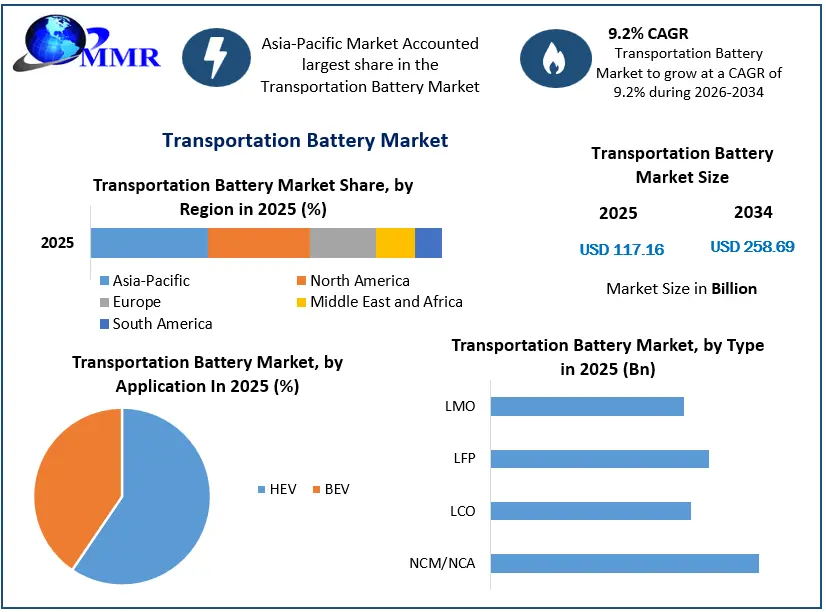
Transportation Battery Market was valued at USD 117.16 Bn. in 2025. The Global Transportation Battery Market size is estimated to grow at a CAGR of 9.2% over the forecast period.
Transportation Battery Market Overview:
The report explores the Transportation Battery market's segments (Type, Interferometer Type, Application, End-User, and Region). Data has been provided by market participants, and regions (North America, Asia Pacific, Europe, Middle East & Africa, and South America). This market report provides a thorough analysis of the rapid advances that are currently taking place across all industry sectors. Facts and figures, illustrations, and presentations are used to provide key data analysis for the historical period from 2020 to 2025. The report investigates the Transportation Battery market's drivers, limitations, prospects, and barriers. This MMR report includes investor recommendations based on a thorough examination of the Transportation Battery market's contemporary competitive scenario.
Transportation Battery Market Growth Outlook
To know about the Research Methodology:-Request Free Sample Report
Transportation Battery Market Dynamics:
Transportation batteries are the batteries that are used in the e-vehicles like hybrid cars, plug-in hybrids, scooters, etc. It is available in different sizes and shapes to fit the many transportation modes. It is consisting of positive and negative electrodes with an electrolyte solution that allows for the flow of ions. When the electrical current is generated, the chemical energy is converted into electrical energy. The increasing demand for e-vehicle and government regulations for ejection of conventional vehicles. It also provides power to automobile sectors like music systems, air conditioners, wipers, etc.
The rapidly increasing urbanization of developing countries and advancement of economies will drive the market in the forecasted period. also, the growing demand for e-vehicle, fuel-saving, and government incentives for cleaner transport are the factors that drive the market in the forecasted period. In the U.S. and China, the government is promoting e-vehicle to protect human life from harmful effects of air pollution and also protect the environment. It has a positive impact on the market. This will develop the urban infrastructure by providing fuel stations and as an outcome, it will raise the demand for the transportation battery market.
The factors which will block the growth of the market are skilled labor shortage, lack of technicians, and the absence of rules and standards. The battery safety problem is one of the major issues which will hamper the growth of the market. High- costs of fuel, limited range and rapidly changing oil prices will restrain the growth of the transportation market. The advanced technologies in e-vehicles and hybrid batteries will create an opportunity in the market.
Transportation Battery Market Trends:
In March 2020, BYD introduced a new blade battery for e-vehicles which increase the battery structure by 50% compared to lithium iron phosphates battery and also better in battery safety.
In 2019, LG Chem merge with General Motors to increase the manufacturing capacity of e-vehicles in the new plant in Ohio.
In February 2020, LG Chem again merge with another company that is Lucid motors, a luxury e-vehicles company to increase the supply of cylindrical batteries for e-vehicles.
Transportation Battery Market Segment Analysis:
Based on Type, the Transportation Battery Market is segmented into LFP, LCO, NCM/NCA, and LMO.
In this segment, LFP (lithium iron phosphate) is dominating the transportation battery market. Because it is known as the heart of e-vehicles with high capacity, long life, and stability. Without these features of LFP, it is impossible to make e-vehicles in the market. The two types of lithium-ion batteries are NCM/NCA (Nickel-Cobalt-Manganese/Nickel-Cobalt-Aluminium) they have a higher energy density and are used for various applications like grid storage, consumer electronics, etc. LMO (Lithium-Manganese-oxide) battery, has the lowest energy density and it is used in lightweight transport like a wheelchair, e-bikes =, etc.
Based on Application, the Transportation Battery Market is segmented into HEV and BEV.
In this segment, HEV is dominating the market for transportation batteries because it provides short-term bursts for acceleration also useful for long-term storage for steady power needs. It also provides power to high-load systems like air conditioners and heaters. The transportation battery is used BEV to store electrical energy which is converted into motion. This battery helps control the speed and power of the electric motors. Some of the advantages of using BEV in transportation batteries are power storage on the go and stopping traffic jams. It also stores the extra energy for the sudden acceleration of the electrical car.
Transportation Battery Market Regional Insights:
The APAC region held the largest market share accounting for 48% in 2025.
The APAC region is expected to witness significant growth at a CAGR of 10% through the forecast period.
The APAC region is dominating the market of transportation batteries because of the highest number of market players and advanced technologies, developed infrastructure, and finances. India and China have the largest population in the world, which generate more profit in the automotive and two-wheeler markets. The demand for commercial aircraft and automobiles is increasing, it has become an integral part of the overall supplier for the transportation market. Government initiatives are also driving the market for transportation batteries.
The objective of the report is to present a comprehensive analysis of the global Market to the stakeholders in the industry. The past and current status of the industry with the forecasted market size and trends are presented in the report with the analysis of complicated data in simple language. The report covers all the aspects of the industry with a dedicated study of key players that include market leaders, followers, and new entrants.
PORTER, PESTEL analysis with the potential impact of micro-economic factors of the market have been presented in the report. External as well as internal factors that are supposed to affect the business positively or negatively have been analyzed, which will give a clear futuristic view of the industry to the decision-makers.
The reports also help in understanding the Market dynamic, and structure by analyzing the market segments and projecting the Market size. Clear representation of competitive analysis of key players by Design, price, financial position, product portfolio, growth strategies, and regional presence in the Market make the report investor’s guide.
Transportation Battery Market Recent Industry Developments
| Date | Company | Development | Impact |
|---|---|---|---|
| 21 April 2025 | CATL | CATL officially launched three EV battery innovations, including the Naxtra mass-produced sodium-ion battery and the second-generation Shenxing superfast charging battery. | The release sets a global peak charging benchmark of 12C with a peak power output of 1.3 MW, accelerating ultra-fast charging capabilities across electric vehicles. |
| 14 November 2025 | LG Energy Solution | LG Energy Solution introduced B.once, a high-speed battery evaluation service designed to assess electric vehicle battery health in five minutes. | The diagnostic technology expands the company’s Battery-as-a-Service (BaaS) footprint and enhances evaluation transparency for the global pre-owned electric vehicle market. |
| 09 March 2026 | Samsung SDI | Samsung SDI publicly unveiled its pouch-type all-solid-state battery sample designed specifically for physical artificial intelligence and robotic application platforms. | The milestone diversifies the company’s battery footprint beyond electric automobiles ahead of its planned mass-production window in H2 2027. |
| 03 April 2026 | LG Energy Solution | LG Energy Solution became the inaugural battery cell manufacturer to join SDVerse, the digital B2B marketplace for automotive software. | The strategic move integrates five proprietary Battery Management System (BMS) software tools into software-defined transportation architectures. |
| 09 May 2026 | EVE Energy | EVE Energy introduced its Open-Source Battery 4.0: AI Battery portfolio tailored specifically for commercial electric transportation during its technology day event. | The integration of AI sensing chips allows real-time health diagnostics, dynamic range optimization, and thermal efficiency improvements across heavy-duty transport fleets. |
Transportation Battery Market Scope: Inquire before buying
| Transportation Battery Market | |||
|---|---|---|---|
| Report Coverage | Details | ||
| Base Year: | 2025 | Forecast Period: | 2026-2034 |
| Historical Data: | 2020 to 2025 | Market Size in 2025: | USD 117.16 Bn. |
| Forecast Period 2026 to 2034 CAGR: | 9.2% | Market Size in 2034: | USD 258.69 Bn. |
| Segments Covered: | by Application | HEV BEV |
|
| by Type | NCM/NCA LCO LFP LMO |
||
Transportation Battery Market, by Region
North America (United States, Canada and Mexico)
Europe (UK, France, Germany, Italy, Spain, Sweden, Austria, Turkey, Russia and Rest of Europe)
Asia Pacific (China, India, Japan, South Korea, Australia, ASEAN and Rest of APAC)
Middle East and Africa (South Africa, GCC, Egypt, Nigeria and Rest of ME&A)
South America (Brazil, Argentina, Columbia and Rest of South America)
Transportation Battery Market, Key Players:
1. Lithium Energy Japan
2. BYD Co., Ltd.
3. Panasonic Holdings Corporation
4. CATL (Contemporary Amperex Technology Co., Limited)
5. OptimumNano Energy Co., Ltd.
6. LG Chem
7. Wanxiang Group
8. Guoxuan High-Tech Co., Ltd. (Gotion High-Tech)
9. China Aviation Lithium Battery (CALB / Lishen)
10. Primearth EV Energy (PEVE)
11. Automotive Energy Supply Corporation (AESC / Envision AESC)
12. Samsung SDI Co., Ltd.
13. Beijing Pride Power System Technology Co., Ltd.
14. BAK Power Battery Co., Ltd.
15. Hitachi Astemo, Ltd.
16. Deutsche ACCUmotive GmbH & Co. KG
17. Boston-Power, Inc.
18. SK Innovation Co., Ltd. (SK On)
19. Northvolt AB
20. EVE Energy Co., Ltd.
21. Sunwoda Electronic Co., Ltd.
22. Farasis Energy (Ganzhou) Co., Ltd.
23. Toshiba Corporation
24. A123 Systems LLC
25. Microvast Holdings, Inc.
26. SVOLT Energy Technology Co., Ltd.
27. GS Yuasa Corporation
28. EnerSys
29. Clarios LLC
30. QuantumScape Corporation
Frequently Asked Questions:
1)What is the CAGR of the Transportation Battery market in the forecasted period?
Ans. The CAGR of the Transportation Battery market in the forecasted period is 9.3%.
2)What is the market size of the Transportation Battery market in 2025?
Ans. The market size of the Transportation Battery market in 2025 was worth USD 117.16 Bn.
3)What is the market size of the Transportation Battery market in 2034?
Ans. The market size of the Transportation Battery market is expected to grow by USD 258.69 Bn. in 2034.
4)Which segment is expected to hold the largest market share in the Transportation Battery market?
Ans. LFP holds the largest market share in Transportation Battery in 2025.
5)Which region is expected to hold the largest market share in the Transportation Battery market?
Ans. The APAC region has the largest market share in Transportation batteries.