
Submarine Power Cables Market Size by Type, Conductor Material, Core Type, Voltage, End User, Region – Segment-Level Market Assessment, Growth Opportunity Analysis, Competitive Mapping & Forecast to 2034
Overview
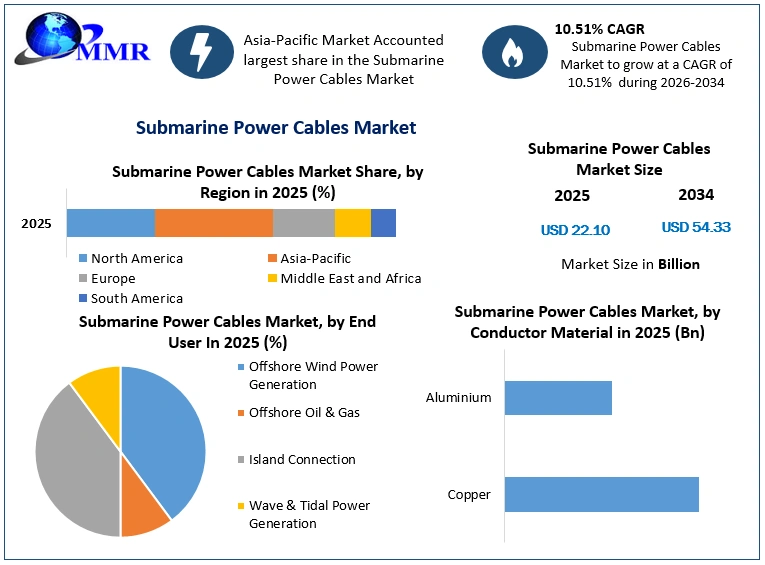
The global Submarine Power Cables Market size was valued at 22.10 billion in 2025, and the total Submarine Power Cables Market revenue is expected to grow by 10.51% from 2026 to 2034, reaching nearly USD 54.33 billion.
Submarine Power Cables Market Overview
A submarine power cable is an electrical cable that transmits electrical power under bodies of water. This cable has multiple sophisticated materials, insulation, and protection systems to help it to operate dependably in a challenging subsea environment. Submarine power cable is crucial for the connections between power grids and electricity trading between nations, and for the interconnection of renewable energy generated from offshore locations.
Submarine Power Cables Market Growth and Share Analysis
To know about the Research Methodology :- Request Free Sample Report
In submarine power cable market report, we have witnessed a significant growth in the Submarine Power Cables Market due to a global shift to renewable energy, including making investments in offshore wind farms, increased interconnections to the electrical grid connections to help with decarbonization and enhance energy security due to raising energy prices and reducing energy per capita. With international hostilities prompting uncertainty in fossil fuel supply and dependence, various governments and energy companies are investing in subsea cable projects, looking to decarbonize energy systems, improve energy supply efficiency, and provide a reliable electricity supply between regions.
The submarine cable technology has evolved from single-core designs to high-voltage direct current (HVDC) design and alternatives current (AC) systems that have a longer life expectancy, deeper embedding and developed smart monitoring systems. Suppliers have introduced new materials, including cross-linked polyethylene (XLPE) insulation and improved installation systems that enhance the transmission capacity and life expectancy.
There is a solid pipeline in Europe and North America with demand for offshore wind energy growing rapidly, with grid modernization efforts gaining momentum as well. In the Asia-Pacific region, particularly in China, Japan, and Taiwan, demand will be driven by key renewable energy targets, more interregional energy (including trade), and government-led infrastructure funding support.
Across the influence of demand, key market players are Prysmian Group, Nexans, NKT A/S, Sumitomo Electric and Tesmec. They have been advancing through R&D in high-capacity cables, installation and maintenance systems with robotics and lighter designs. Opportunities are also expanding for connections along interconnectors between countries, putting offshore energy hubs together, and further offshore projects with deep-water deployment capabilities.
Rising Global Renewable Energy Investments to Drive the Growth of the Submarine Power Cables Market
The increasing push towards renewable energy, specifically offshore wind generation and intercontinental grid connections, is driving demand for submarine power cables. Government agencies and energy companies are committed to creating transmission infrastructure to move power generated from renewable sources hundreds of miles away from consumption, and are investing heavily in underwater transmission. As a result of the increased innovation, investment, and expansion of renewable energy availability, high-capacity submarine cables have clearly seen considerable growth.
Grid Modernisation and Cross-Border Interconnections to Drive Market Growth
An increasing desire for energy security and grid reliability is stimulating huge investment in subsea interconnectors between countries and regions. Subsea cables improve energy diversity, allow for electricity trading, and can provide backup supply when there are ultimately disruptions on the grid. Also, initiatives for regional and transnational smart grids will continue to create large demands for reliable submarine cable systems.
Technical Complexities and High Installation Costs to Restrain Market Growth
The high initial cost of submarine cables, which includes the cost of specialized installation vessels, monitoring devices, and marine surveys, requires considerable capital, and remains the key hurdle to growth into the market. Technical difficulties, such as problems with installation in deep water, environmental challenges, and limitations on maintenance, may also restrict growth - particularly for developing economies with limited funds.
Advancements in Cable Technology and Materials to Create Growth Opportunities
Current research and development with high-voltage direct current (HVDC) technology, new insulation materials, and improved performing protective coatings will all increase the overall efficiency and longevity and reduce the cost of the cable itself. The increasing use of technology, and development of technology, is leading to new applications and potential new market opportunities in very challenging underwater conditions.
Emerging Markets and Offshore Wind Expansion to Create Lucrative Opportunities
The fast-tracked growth of offshore wind farms in the Asia-Pacific and North America, alongside investments in interregional power links in developing economies, creates a significant opportunity. Government support for renewable energy infrastructure, as well as international agreements on power sharing, is also helping to expand markets in areas that were previously underserved.
Environmental Regulations and Permitting Challenges to Restrain Market Growth
Some market participants still face challenges due to strict environmental regulations covering marine installations, lengthy permit approval processes, and ecological concerns. Complying with differing international standards and environmental conservation requirements remains a legitimate concern, often delaying projects and increasing project costs.
Submarine Power Cables Market Segment Analysis
The Submarine Power Cables Market is segmented based on Core Type: Single Core and Multi-Core
The single core segment is anticipated to dominate the market and grow at the highest CAGR throughout the forecast period, as they are the go-to design for higher voltage applications such as interconnectors, offshore wind farms, and cross-border/high voltage transmission applications. Single-core cables are ideal for long-distance HVDC and HVAC submarine deployments since they provide much better electrical performance and because only a single core cable must be laid in deep water, which has a smaller risk of failure than cables that have to work in high-stress marine environments.
Whereas the multi-core segment is only implemented for shorter transmission distances in offshore oil and gas platforms and inter-platform cabling. Although the multi-core product structure serves specialized applications, it will have a lower share of the overall market due to limited implementation for large-scale power transmission projects.
Submarine Power Cables Market Regional Insights
With regard to the Submarine Power Cables Market share over the forecast period, we expect the Asia-Pacific to dominate the market, followed by Europe and North America. The developing markets in Asia-Pacific are expected to have a significant demonstrable commitment to develop additional offshore wind farms, principally in China, Taiwan, Japan, and South Korea. The area is positioned to make these connections go because the governments are credentialing renewables and create energy security. The area has high economic growth rates, high demand growth for electricity, and significant goals for renewable energy usage. These factors diverge with the need for marine power cable capabilities with intercountry and island connections.
Within Europe, the development of submarine power cable installations is relatively mature. It is continuing through advanced development, particularly in the renewable energy market, as well as cross-border cooperation in the energy sector. The North Sea is the centre for wind farm activity and all the related interconnectors linking countries such as the UK, Germany, Norway, and the Netherlands. Again, the restrictiveness of EU policies on decarbonization and energy independence is the main driver of market conditions, making Europe a viable region where technology and projects can be demonstrated.
North America is a significant and fast-growing market that is being driven primarily by new offshore wind projects on the northeastern and mid-Atlantic coasts of the U.S. There is both government support and federal targets to increase offshore wind capacity, which is establishing a substantial and growing pipeline of demand for submarine cables, and new projects electrifying islands and improving grid reliability in both Canada and the U.S.
In the Middle East and Africa, the adoption of emerging markets is being developed slowly, with focus areas including the delivery of intercountry grid connections to strengthen energy trading and stability for countries that share similar energy demand patterns, as well as island electrification projects and the connection of offshore oil & gas infrastructure. Diminutive in size today, increasing investment in energy infrastructure and renewable projects leads to future opportunities for submarine cable projects.
Advances in technology that enhance the performance of High-Voltage Direct Current (HVDC) transmission, increase cable capacity, and develop improved installation techniques are expected to fuel growth in all these markets. The global imperative to transition energy systems and grid interconnections will ensure that reliance on submarine power cables will only grow as they solidify their importance in the world's future energy infrastructure.
Submarine Power Cables Market Competitive Landscape:
Asian cable manufacturers, particularly Sumitomo Electric (Japan), LS Cable & System (South Korea), and Zhongtian Technology (China), are aggressively expanding into the European and global markets by offering cost-competitive solutions and forming strategic joint ventures with offshore wind developers. Unlike European incumbents that emphasize turnkey solutions and in-house installation fleets, Asian challengers often partner with specialized marine contractors for project execution. Their competitive edge lies in lower manufacturing costs, strong government backing, and rapid scaling capacity, which makes them increasingly attractive for emerging offshore wind markets in Asia-Pacific (Taiwan, Japan, South Korea) and new interconnector projects in the Middle East and Africa.
Additionally, Chinese companies such as ZTT and Orient Cable are gaining market share by targeting price-sensitive contracts and leveraging domestic offshore wind expansion to strengthen their expertise before moving into Western markets.
Submarine Power Cables Market Key Trends:
• Significant Investment in Offshore Wind Energy Infrastructure
The biggest trend in our industry is the unprecedented global movement towards offshore wind farms, bringing billions of Euros in contracts for cable manufacturers. Large energy developers and transmission system operators, including TenneT, Ørsted, and National Grid, are heavily investing in large-scale projects mainly in Europe. The €1.8+ billion contract awarded by TenneT to Prysmian for grid connections in Germany and Nexans' contract to connect the Hornsea 3 farm in the UK are a testament to this trend. This trend has resulted in a pipeline of work for many years to come. The offshore wind sector is also creating opportunities for new manufacturing capacity for companies like Prysmian, which are building new specialized manufacturing facilities, given the amount of new work in North America and the Asia-Pacific region as well and Europe.
• Policy Determining Focus on Interconnectors for Energy Security and Grid Stability
In addition to developing offshore wind farms, much of the strategic focus is on deploying High-Voltage Direct Current (HVDC) submarine cables for international interconnectors. While these may seem like simply connecting to wind farms to share power, projects like this allow the national grids of separate countries to connect, share power, balance with renewables, and generate energy security. The successful early commissioning of the Sea Link interconnector between Great Britain and Ireland by Nexans is a great example, or ZTT's project in about a year connecting Chile to Brownsville, Texas.
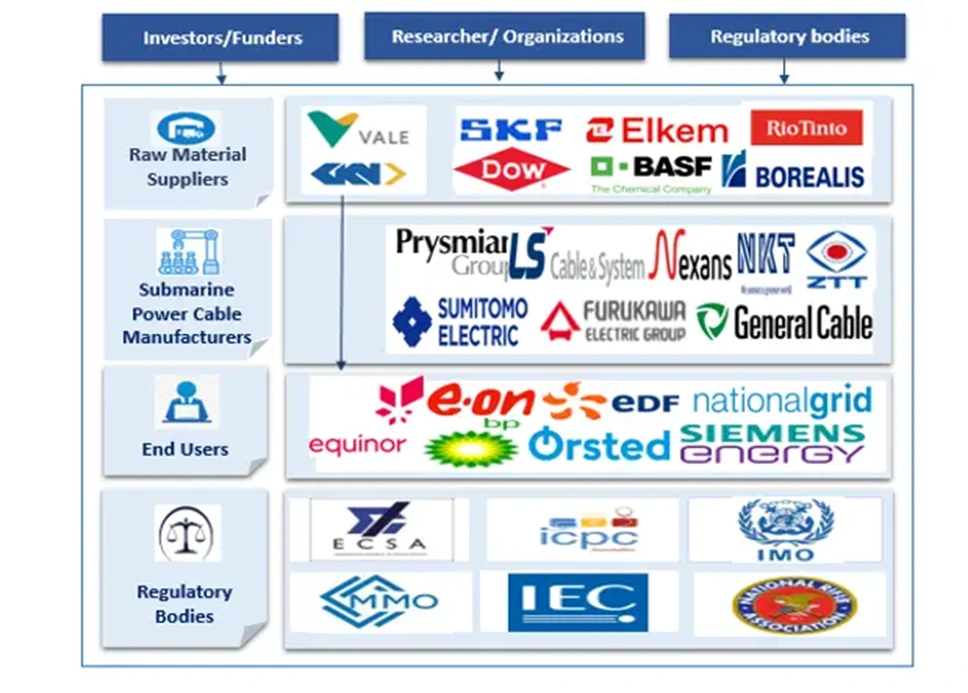
Submarine Power Cable Industry Ecosystem
Submarine Power Cables Market Recent Industry Developments
| Date | Company | Development | Impact |
|---|---|---|---|
| 04 March 2026 | NKT | NKT signed a record-breaking firm contract worth more than EUR 2.2 billion with National Grid and SSEN Transmission to supply the HVDC power cable system for the Eastern Green Link 3 (EGL3) project. | The ~680 km transmission link will deliver up to 2 GW of capacity, significantly reinforcing the UK power grid and supporting massive offshore renewable energy integration. |
| 02 February 2026 | Prysmian | Prysmian signed a over €2.3 billion contract with SP Energy Networks and National Grid to deliver the Eastern Green Link 4 (EGL4) high-voltage direct current interconnector. | The link connects Scotland and England with 2 GW of clean energy transmission capacity, enough to power approximately 2 million homes. |
| 19 January 2026 | NKT | NKT finalized contracts with SSEN Transmission to deliver 525 kV HVDC power cable systems for two major Scottish transmission links, Western Isles and Spittal to Peterhead. | The projects add 1.8 GW of transmission capacity across a combined 380 km route length, targeted for commissioning in 2030 to strengthen British grid stability. |
| 07 January 2026 | Nexans | Nexans completed the high-voltage subsea cable installation for the Tyrrhenian Link Project in Italy for Terna, successfully finalizing its deep-water pull-in operations. | The project achieved a world-record installation depth of 2,150 meters for a 500 kV HVDC subsea cable, showcasing advanced deep-water engineering capabilities. |
| 26 March 2025 | Prysmian | Prysmian announced a 7-year framework agreement with N-Sea to provide rapid response maintenance and repair services for submarine cables. | The partnership creates the first market-led rapid response solution to enhance critical infrastructure safety and minimize downtime for offshore energy operators. |
Scope of the Submarine Power Cables Market report: Inquire before buying
| Global Submarine Power Cables Market | |||
|---|---|---|---|
| Report Coverage | Details | ||
| Base Year: | 2025 | Forecast Period: | 2026-2034 |
| Historical Data: | 2020 to 2025 | Market Size in 2025: | USD 22.10 Bn. |
| Forecast Period 2026 to 2034 CAGR: | 10.51% | Market Size in 2034: | USD 54.33 Bn. |
| Segments Covered: | by Type | AC DC |
|
| by Conductor Material | Copper Aluminium |
||
| by Core Type | Single Core Multi-Core |
||
| by Voltage | Up to 66 KV 66 KV-220 KV Above 220 KV |
||
| by End User | Offshore Wind Power Generation Offshore Oil & Gas Island Connection Wave & Tidal Power Generation |
||
Submarine Power Cable Market, by Region:
North America (United States, Canada, and Mexico)
Europe (UK, France, Germany, Italy, Spain, Sweden, Russia, and the Rest of Europe)
Asia Pacific (China, South Korea, Japan, India, Australia, ASEAN, and the Rest of APAC)
Middle East and Africa (South Africa, GCC, Egypt, Nigeria, and the Rest of ME&A)
South America (Brazil, Argentina Rest of South America)
Submarine Power Cable Market, Key Players:
North America
1. General Cable (North America)
2. Southwire Company, LLC (North America)
Europe
1. Prysmian Group (Europe)
2. Nexans SA (Europe)
3. NKT A/S (Europe)
4. Hellenic Cables S.A. (Europe)
5. TF Kable (Europe)
6. Alcatel Submarine Networks (Europe)
7. ABB Ltd. (Europe)
Asia-Pacific
1. Sumitomo Electric Industries, Ltd. (Asia-Pacific)
2. LS Cable & System Ltd. (Asia-Pacific)
3. Hengtong Group Co., Ltd. (Asia-Pacific)
4. ZTT Group (Asia-Pacific)
5. Ningbo Orient Wires & Cables Co., Ltd. (Asia-Pacific)
6. Furukawa Electric Co., Ltd. (Asia-Pacific)
7. VISCAS Corporation (Asia-Pacific)
8. KEI Industries Limited (Asia-Pacific)
9. Fujikura Ltd. (Asia-Pacific)
10. NEC Corporation (Asia-Pacific)
11. Taihan Electric Wire Co., Ltd. (Asia-Pacific)
Frequently Asked Questions
1. What are the growth drivers for the Submarine Power Cables Market?
Ans. The increasing deployment of offshore renewable energy sources, such as wind, wave, and tidal installations, drives the demand for submarine power cables. These cables are essential for transmitting electricity generated offshore to mainland grids, supporting the growth of renewable energy projects.
2. What are the major restraints for the Submarine Power Cables Market growth?
Ans. Price sensitivity among consumers may limit the market penetration of Submarine Power cables due to their higher cost.
3. Which region is expected to lead the global Submarine Power Cables Market during the forecast period?
Ans. Asia Pacific is expected to lead the global Submarine Power Cables Market during the forecast period.
4. What is the projected market size and growth rate of the Submarine Power Cables Market?
Ans. The Submarine Power Cables Market size was valued at USD 22.10 billion in 2025, and the total revenue is expected to grow at a CAGR of 10.51% from 2026 to 2034, reaching nearly USD 54.33 billion by 2034.
5. What segments are covered in the Submarine Power Cables Market report?
Ans. The Submarine Power Cable report covers Type, Core Type, Voltage, Conductor Material, End-Use, and Region.